Why in the News
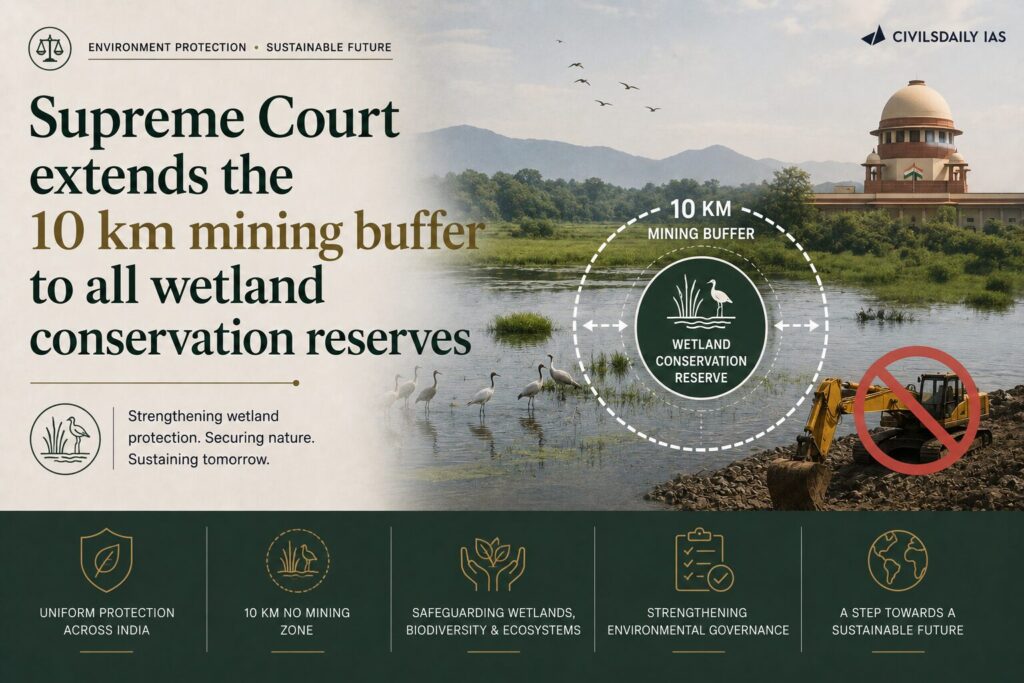
The Supreme Court clarified that its ban on mining within a 10 km radius of the Asan Conservation Reserve (a Ramsar Site) applies to all Wetland Conservation Reserves across India unless approved by the Standing Committee of the National Board for Wildlife (NBWL) and the Ministry of Environment, Forest and Climate Change (MoEFCC).
What is a Conservation Reserve?
- A protected area category created under the Wildlife (Protection) Act, 1972 (through the 2002 Amendment).
- Covers government-owned land adjacent to National Parks and Wildlife Sanctuaries.
- Protects habitats and wildlife corridors with community participation.
What is an Eco-Sensitive Zone (ESZ)?
- A buffer area notified under the Environment (Protection) Act, 1986 around National Parks and Wildlife Sanctuaries.
- Restricts activities such as mining, industries, and large-scale construction to reduce ecological impacts.
Supreme Court Ruling
- Extended the 10 km mining restriction to all Wetland Conservation Reserves.
- Recognized wetlands as a distinct ecologically sensitive category.
- Mining within the buffer requires approval from the NBWL Standing Committee and MoEFCC.
Why is the Ruling Significant?
- Protects wetlands from mining and habitat degradation.
- Recognizes the importance of catchment areas for wetland health.
- Ensures uniform protection for wetland conservation reserves across India.
Challenges
- Incomplete mapping and notification of wetlands.
- Encroachment and land-use change.
- Pollution and eutrophication.
- Weak enforcement by State Wetland Authorities.
- Development pressures from mining and infrastructure projects.
Value Addition
Ramsar Convention
- International treaty for the conservation and wise use of wetlands.
- Adopted in 1971 at Ramsar, Iran.
- India became a Contracting Party in 1982.
Wetlands (Conservation and Management) Rules, 2017
- Regulate conservation and management of notified wetlands.
- Implemented through State Wetland Authorities.
Back2Basics
National Board for Wildlife (NBWL)
- Statutory body under the Wildlife (Protection) Act, 1972.
- Chairperson: Prime Minister.
- Standing Committee examines projects affecting protected areas.
Asan Conservation Reserve
- Location: Dehradun, Uttarakhand.
- Ramsar Site: Since 2020 (Uttarakhand’s first Ramsar Site).
- Formed by the Asan Barrage at the confluence of the Asan and Yamuna rivers.
- Important wintering habitat for migratory birds.
“[2019] Consider the following statements:
1. Under Ramsar Convention, it is mandatory on the part of the Government of India to protect and conserve all the wetlands in the territory of India.
2. The Wetlands (Conservation and Management) Rules, 2010 were framed by the Government of India based on the recommendations of Ramsar Convention.
3. The Wetlands (Conservation and Management) Rules, 2010 also encompass the drainage area or catchment regions of the wetlands as determined by the authority.
(a) 1 and 2 only
(b) 2 and 3 only
(c) 3 only
(d) 1, 2 and 3