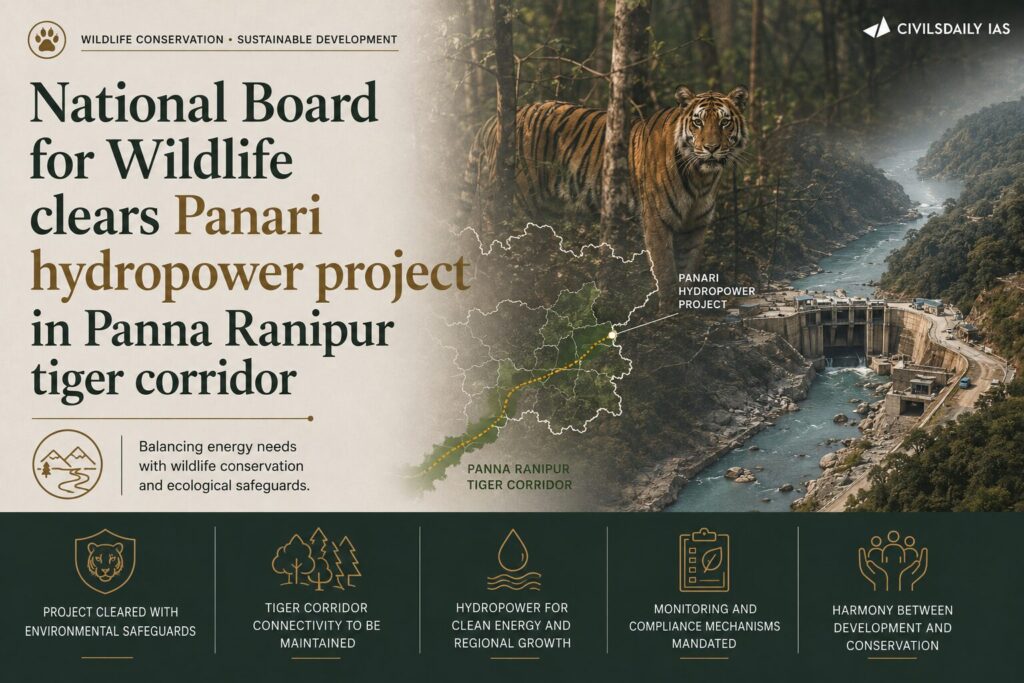
Why in the News
The Standing Committee of the National Board for Wildlife (NBWL) recommended wildlife clearance for the 1,800 MW Panari Pumped Storage Hydropower Project in the Panna-Ranipur Tiger Corridor, despite concerns that it could fragment a critical wildlife corridor.
How does a Pumped Storage Hydropower Project (PSH) work?
- Uses two reservoirs at different elevations.
- During low electricity demand, water is pumped to the upper reservoir.
- During peak demand, water is released to generate electricity.
- Acts as a grid-scale energy storage system for renewable energy.
What is the Panna-Ranipur Tiger Corridor?
- Connects Panna Tiger Reserve (Madhya Pradesh) with Ranipur Tiger Reserve (Uttar Pradesh).
- Facilitates movement of tigers, leopards, and sloth bears.
- Ensures genetic exchange and healthy wildlife populations.
- A wildlife corridor is a natural passage connecting fragmented habitats, enabling movement, migration, breeding, and genetic exchange among wildlife populations.
Why was the Project Cleared?
- NBWL Standing Committee approved it based on recommendations of:
- National Tiger Conservation Authority (NTCA)
- Wildlife Institute of India (WII)
- Clearance is subject to mitigation measures.
Concerns
- Corridor fragmentation affecting wildlife movement.
- Increased human-wildlife conflict.
- Loss of habitat connectivity and genetic diversity.
- Cumulative impacts of multiple infrastructure projects.
Mitigation Measures
- Construction of three 30-metre-wide wildlife overpasses.
- Relocation of muck dumping and project facilities outside the corridor.
- Realignment of project infrastructure to reduce habitat disturbance.
Back2Basics: Panna Tiger Reserve
- Designation: Tiger reserve and UNESCO Biosphere Reserve, in Madhya Pradesh.
- Location: Panna and Chhatarpur districts, on the Vindhyan ranges along the Ken River.
- Distinction: Site of a successful tiger reintroduction after its tiger population was lost around 2009.
- Linked project: Adjoins the Ken Betwa river linking project, India’s first interlinking of rivers.
“[2020] Among the following Tiger Reserves, which one has the largest area under ‘Critical Tiger Habitat’?
(a) Corbett
(b) Ranthambore
(c) Nagarjunsagar-Srisailam
(d) Sunderbans
