Why in the News
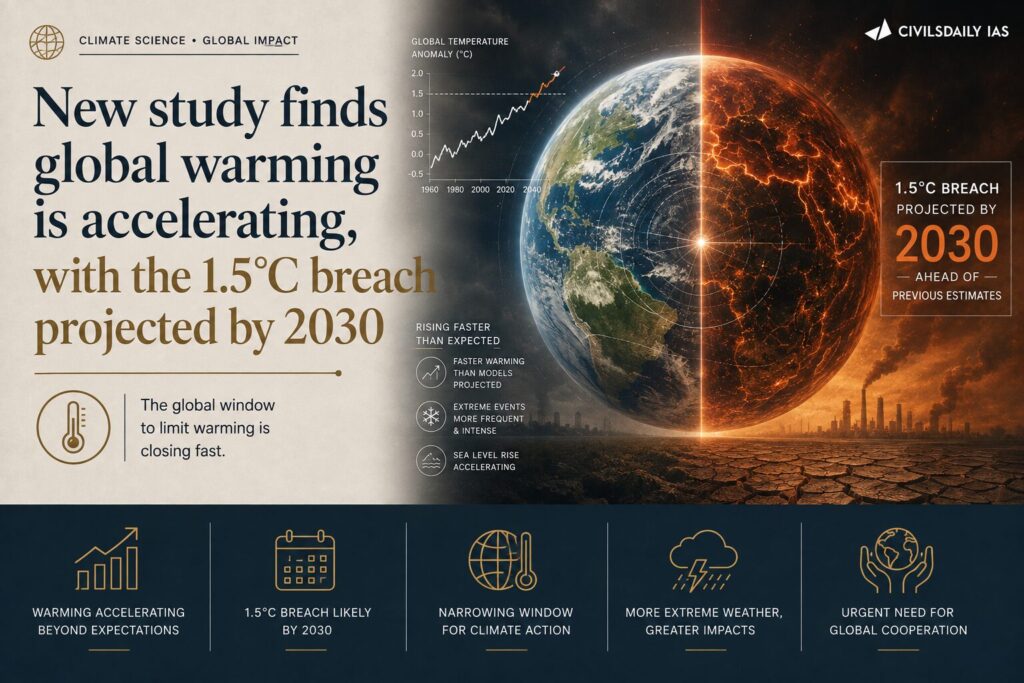
A study in the journal Geophysical Research Letters reports evidence that global warming is accelerating, not merely continuing. After removing natural noise from five temperature datasets, the authors find the last decade warmed faster than any previous decade on record, and project the 1.5 degree Celsius threshold being breached by 2030.
What is the 1.5 degree Celsius threshold?
- Paris target: Under the Paris Agreement, 2015, countries agreed to hold warming well below 2 degrees Celsius above pre industrial levels and to pursue efforts to limit it to 1.5 degrees Celsius.
- Why 1.5 matters: Beyond 1.5 degrees Celsius, risks of extreme heat, sea level rise, and ecosystem collapse rise sharply, making it the central guardrail of climate policy.
What are aerosols and the masking effect?
- Aerosols: Aerosols are tiny particles from sources such as burning fossil fuels that reflect sunlight and exert a cooling effect on the atmosphere.
- How cooling works: Light-colored particles bounce sunlight back into space and help make clouds brighter, which lowers temperatures.
- The cooling mask: This pollution has acted like an invisible shield, hiding a portion of the total heat trapped by greenhouse gases
- Unmasking: As pollution controls cut aerosols, their cooling effect fades and the full warming from greenhouse gases is felt, an effect the study describes as a disappearing cooling mask.
Why is measuring acceleration difficult?
- Noisy temperatures: Global temperatures fluctuate year to year because of natural factors like volcanic eruptions and changes in solar activity. (Volcano noise includes the seismic vibrations, audible sounds, and infrasound produced by subsurface magma movement, degassing, and eruptions. Solar noise refers to intense bursts of radio waves and energetic emissions naturally broadcast by the Sun.)
- Masked trend: These events can temporarily hide the underlying human caused warming, making it hard to prove the rate itself is rising.
How did the study establish acceleration?
- Multiple datasets: The authors analysed five major global temperature datasets to avoid relying on any single record.
- Statistical subtraction: They used statistical methods to remove the influence of volcanic and solar noise, isolating the human driven trend.
- High confidence: After removing the noise, they were more than 98% certain the jump in warming rate was real rather than a short lived fluctuation, dating the change to around 2015.
- Timing: This change or acceleration in the rate of warming was identified to have begun around
2015 .
Why does the faster pace matter?
- Shrinking timeline: Under the earlier, slower rate, the world expected more time before breaching 1.5 degrees Celsius, and the accelerated pace brings the breach forward to 2030.
- Twin drivers: Greenhouse gas emissions remain the primary cause, while falling aerosol pollution adds to the acceleration.
What are the challenges to limiting warming to 1.5 degrees Celsius?
- Continued emissions growth: Global carbon dioxide emissions remain near record highs, driven by fossil fuel use in power, industry, and transport.
- Aerosol paradox: Cutting air pollution saves lives but removes a cooling effect, accelerating near term warming.
- Shrinking carbon budget: The remaining budget consistent with 1.5 degrees Celsius is small and shrinks with every year of high emissions.
- Slow energy transition: Renewable growth has not yet displaced fossil fuels fast enough to cut absolute emissions.
- Feedback loops: Melting ice, thawing permafrost, and forest loss release additional carbon and reduce reflectivity, reinforcing warming.
- Finance and equity gaps: Developing countries lack the finance and technology transfer needed to decarbonise while meeting development needs.
Conclusion
The study reframes the problem from steady warming to an accelerating one, advancing the likely 1.5 degree Celsius breach to 2030. The central unresolved issue is that cleaning the air removes a cooling shield, so only deep and sustained cuts in greenhouse gases can slow the pace.
Back2Basics:
Paris Agreement
- Adopted: 2015 at the 21st Conference of the Parties (COP21), entering into force in 2016.
- Convening body: United Nations Framework Convention on Climate Change (UNFCCC).
- Core goal: Limit warming well below 2 degrees Celsius, pursuing 1.5 degrees Celsius above pre industrial levels.
- Mechanism: Nationally Determined Contributions, updated every five years, with a global stocktake to assess collective progress.
PYQ Relevance
[UPSC 2022] Discuss global warming and mention its effects on the global climate. Explain the control measures to bring down the level of greenhouse gases which cause global warming, in the light of the Kyoto Protocol, 1997.
Linkage: The question examines the causes, impacts and mitigation of global warming through international climate frameworks. The article adds recent evidence that global warming is accelerating, highlighting the need for faster emission cuts to achieve Paris Agreement goals.