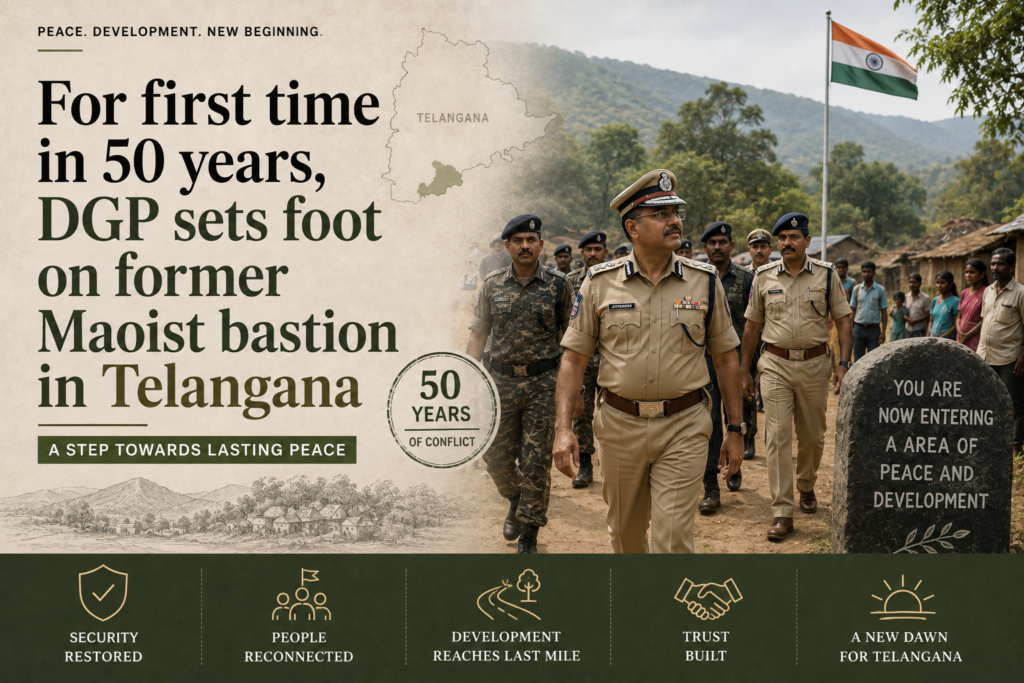
Why in the News
For the first time in 50 years, a Director General of Police set foot on the Telangana side of Karregutta, a hill once used to house Central Committee members of the banned Communist Party of India (Maoist). The visit marks the decline of Left Wing Extremism under Operation Kagar, with around 700 surrenders in Telangana and the top leadership largely killed, arrested, or surrendered.
What is Operation Kagar?
- Definition: Operation Kagar is a coordinated anti-Maoist offensive launched by security forces in pursuit of the central government’s deadline for a Naxal-free India.
- Scope: It combines intensified security operations with surrender-and-rehabilitation measures across the Maoist-affected belt.
Who are the CPI (Maoist)?
- Definition: The Communist Party of India (Maoist), or CPI (Maoist), is a banned Left Wing Extremist organisation that seeks to overthrow the state through armed struggle.
- Leadership: Its former General Secretary Muppala Lakshmana Rao, alias Ganapati, was the longest-serving general secretary of the outfit.
What happened at Karregutta?
- The DGP’s visit: The Telangana Director General of Police entered the Telangana side of Karregutta accompanied by a large contingent of police and revenue personnel.
- The message: The delegation’s size was meant to signal that it is now safe to visit the area, where earlier only specialised forces such as Greyhounds and COBRA units operated briefly during operations.
- Tricolour hoisted: The contingent hoisted the national flag at the spot.
- Tourism plan: The DGP announced the kaccha road into the forest would be tarred and the area developed into a tourist spot.
- Surrender support: Surrendered Maoists are given a lump-sum grant, including the bounty announced on their heads, to start a new life.
What is the current status of the Maoist decline?
- Surrenders: Around 700 Maoists surrendered in Telangana alone during the operation.
- Leadership losses: By March 31, several Central Committee members of the CPI (Maoist) were killed, arrested, or had surrendered.
- Top commander killed: Former General Secretary Nambala Keshava Rao, alias Basavaraju, was killed in a police encounter in May 2025.
- Factional split: After Basavaraju’s death the party split into two factions, one led by Mallojula Venugopal Rao, alias Sonu, and another by Thippiri Tirupathi, alias Devuji, who later surrendered.
- Few absconding: Only two to three top Maoists remain absconding, chief among them Ganapati.
Conclusion
A DGP entering Karregutta after five decades, followed by the hoisting of the Tricolour, signals the sharp decline of the Maoist movement in Telangana under Operation Kagar. With around 700 surrenders, the top leadership neutralised, and only a handful absconding, the insurgency’s organisational base has collapsed. The next milestone is the government’s deadline for a Naxal-free India and the rehabilitation of surrendered cadres into mainstream society.
Back2Basics:
Left Wing Extremism in India (Foundational Context)
- About: Left Wing Extremism (LWE), also called Naxalism, is an armed insurgency by Maoist groups aiming to capture state power through violence.
- Geography: It has historically concentrated in a forested tribal belt across Chhattisgarh, Jharkhand, Odisha, Telangana, and neighbouring States.
- Nodal ministry: The Ministry of Home Affairs coordinates the national response through security and development measures.
Communist Party of India (Maoist)
- Formation: Formed in 2004 through the merger of the People’s War Group and the Maoist Communist Centre of India.
- Status: Designated a terrorist organisation under the Unlawful Activities (Prevention) Act, 1967.
- Objective: Seeks to overthrow the Indian state through protracted armed struggle.
- Armed wing: Operates the People’s Liberation Guerrilla Army.
Government Initiatives against LWE
- SAMADHAN doctrine: An overarching strategy covering smart leadership, aggressive strategy, motivation, actionable intelligence, and technology.
- Security Related Expenditure Scheme: Reimburses States for security operations, training, and rehabilitation of surrendered cadres.
- Aspirational Districts Programme: Targets development in the most backward districts, many of them LWE-affected.
- Road connectivity projects: The Road Requirement Plan and RCPLWE scheme build roads to open up affected areas.
- Surrender and Rehabilitation Policy: Provides grants, vocational training, and support to those who lay down arms.
Key Facts about LWE
- Shrinking footprint: The number of LWE-affected districts has fallen sharply over the past decade.
- Declining violence: Incidents and casualties have dropped substantially with intensified operations.
- Elite forces: Greyhounds of Telangana and Andhra Pradesh and the CoBRA units of the CRPF are specialised anti-Maoist forces.
Challenges in Countering LWE
- Development deficit: Persistent gaps in roads, health, and education sustain grievances in affected areas.
- Difficult terrain: Dense forests and hilly terrain aid guerrilla movement and hamper operations.
- Tribal alienation: Displacement and land alienation feed recruitment among tribal populations.
- Rehabilitation gaps: Surrendered cadres struggle to find a foothold in mainstream society.
- Cross-border and inter-State movement: Cadres exploit State boundaries to evade coordinated action.
Way Forward
- Sustained development: Extend roads, connectivity, and public services into cleared areas.
- Robust rehabilitation: Ensure surrendered cadres receive grants, skills, and livelihoods.
- Protect tribal rights: Implement the Forest Rights Act and Fifth Schedule protections effectively.
- Consolidate security gains: Hold cleared areas and prevent the movement’s revival across State borders.
UPSC Relevance
[UPSC 2018] Left Wing Extremism (LWE) is showing a downward trend, but still affects many parts of the country. Briefly explain the Government of India’s approach to counter the challenges posed by LWE.
Linkage: The PYQ examines the Government’s approach to tackling Left Wing Extremism. Operation Kagar demonstrates the security and surrender components of this approach. The article also highlights the need for rehabilitation and development after security gains.
