Why in the News?
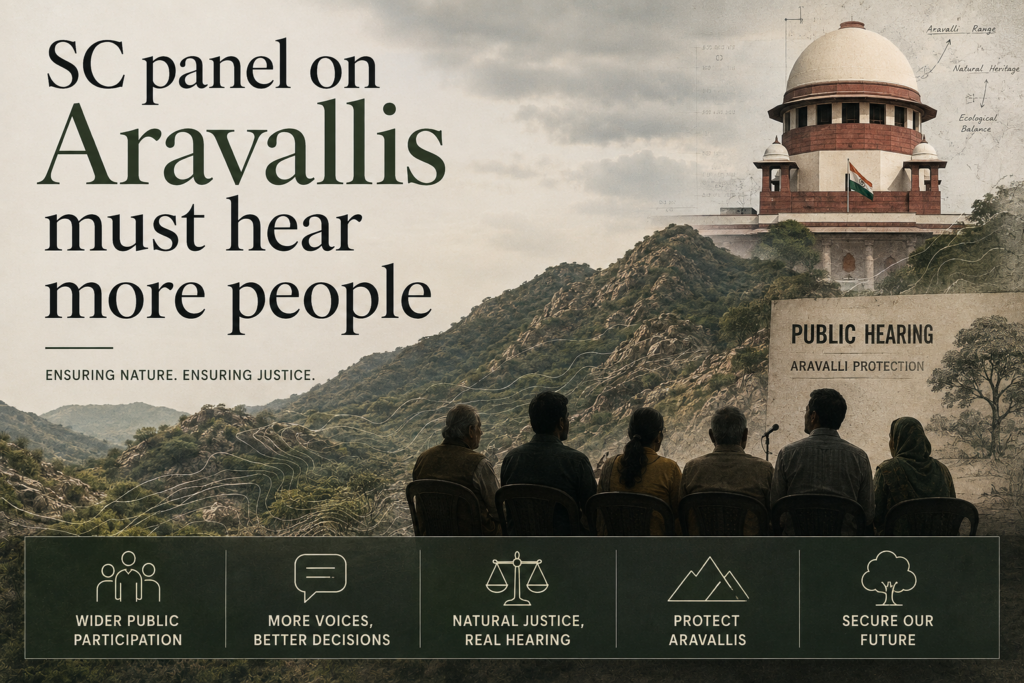
Civil society groups and mining affected communities have alleged that the Supreme Court appointed High Powered Committee (HPC) on the Aravallis left out several districts and did not adequately hear local people during its consultations. The dispute exposes the tension between expert led regulation of mining and genuine participation of the communities whose lands and livelihoods the decision will affect.
What is the High Powered Committee on the Aravallis?
- Origin: The Supreme Court of India constituted a high-powered expert committee headed by Kanchan Devi to review the definition and delineation of the Aravalli hill range, guide mining regulations, and protect the fragile ecosystem from continuous environmental degradation.
- Mandate: It is to submit a report that will shape decisions on mining and conservation across the range, with an August 31 deadline.
- Consultation window: The panel held a 21 day period for stakeholders to submit comments, which has now ended.
- Field visits: It conducted field visits in Gurgaon, Alwar, Ajmer and Udaipur between 6 and 10 August.
Why are activists challenging the consultation process?
- Villages left out: The Aravalli Virasat Jan Abhiyan claims the HPC did not visit any mining affected villages to understand ground realities.
- Urban centric hearings: Public hearings were held at urban centres that affected villagers could not reach, and information was not publicised in local newspapers, on radio, or at panchayat offices.
- Lobby dominance: Around 80 percent of representations in Ajmer were pro mining, with a similar pattern elsewhere, and those speaking against mining were allegedly threatened.
- Access failures: A scheduled Udaipur meeting for 10 August was moved to the evening of 9 August, making it hard for many to attend, and requested visits to villages hit by limestone mines and stone crushers did not happen.
- Central demand: The group wants the HPC to seek an extension of the August 31 deadline and hold meaningful consultations across all 64 districts in Delhi, Haryana, Rajasthan, Uttar Pradesh and Gujarat.
What is an Eco Sensitive Zone?
- Definition: An Eco Sensitive Zone is an area notified around protected areas or ecologically fragile landscapes where activities such as mining are regulated or prohibited to act as a shock absorber.
- The National Wildlife Action Plan (2002-2016) recommended that State governments identify areas within 10 km of national parks and wildlife sanctuaries for declaration as Eco-Sensitive Zones (ESZs).
- The recommendation was to be implemented under the Environment (Protection) Act, 1986, under the framework of the Ministry of Environment, Forest and Climate Change (MoEFCC).
- Relevance: Regulation of mining in the Aravallis turns on how such protective boundaries and restrictions are drawn and enforced.
Why does the Aravalli range matter for mining regulation?
- Ecological role: The Aravallis are India’s oldest mountain range and act as a barrier against desertification spreading eastward from the Thar.
- Mining pressure: Limestone mines, stone crushers and other extraction have degraded stretches of the range.
- Legal history: Courts have repeatedly intervened to restrict illegal and unregulated mining in the range.
- Livelihood stakes: Rural and Adivasi communities depend on the hills, so decisions affect both ecology and livelihoods.
Why does the mining lobby versus affected communities tension shape the outcome?
- Capture risk: Hearings dominated by pro mining representations risk producing a report that understates ground level harm.
- Precedent invoked: Activists demand a systematic outreach approach similar to the one adopted a decade ago by the Western Ghats Ecology Expert Panel, which held direct public hearings.
- Intimidation: Alleged threats to those opposing mining undermine the credibility of the consultation.
- Deadline pressure: A fixed August 31 deadline discourages the fuller consultation the communities are demanding.
Conclusion
The current status is a contested consultation process, with affected communities demanding a deadline extension and direct village level hearings before the HPC finalises its report to the Supreme Court. The dispute turns on whether expert regulation of Aravalli mining can be legitimate without hearing the people most affected by it. The next milestone is whether the committee seeks an extension or submits its report by August 31 as scheduled.
Back2Basics:
Foundational Context: Mining in India
- About: Mining is the extraction of minerals from the earth and is regulated as a hazard prone activity with significant environmental impact.
- Scale: India produces a range of major and minor minerals, with states such as Rajasthan, Odisha and Jharkhand holding large reserves.
- Environmental impact: Mining causes deforestation, dust and air pollution, groundwater depletion, and land degradation.
- Governance: Mineral development is regulated under central law with clearances layered across environment, forest and pollution statutes.
Statutory Framework Governing Mining and the Aravallis
- Mines and Minerals (Development and Regulation) Act, 1957: The principal law regulating the mining sector and grant of mineral concessions.
- Environment (Protection) Act, 1986: Enables environmental clearances and the notification of Eco Sensitive Zones.
- Forest (Conservation) Act, 1980: Requires clearance before diverting forest land for mining.
- Air (Prevention and Control of Pollution) Act, 1981: Regulates dust and emissions from mining and crushing.
- National Green Tribunal Act, 2010: Provides the forum for adjudicating mining and environmental disputes.
The Aravalli Range
- Designation: India’s oldest fold mountain range, running across Delhi, Haryana, Rajasthan and Gujarat.
- Location and extent: Stretches roughly 690 kilometres from Delhi to Gujarat, with Guru Shikhar as its highest peak.
- Ecological function: Acts as a natural barrier checking the eastward spread of the Thar desert and supports groundwater recharge.
- Distinguishing feature: Hosts unique biodiversity and forms the watershed for several rivers.
- Current concern: Threatened by illegal mining, stone crushing and encroachment.
Government Initiatives for Aravalli and Land Restoration
- Aravalli Green Wall Project: Initiative to create a green belt along the range to combat land degradation and desertification.
- Compensatory Afforestation Fund: Funds afforestation to offset forest land diverted for mining and other uses.
- National Afforestation Programme: Supports regeneration of degraded forest land.
- Desertification action: India’s commitments under the United Nations Convention to Combat Desertification guide land restoration.
Key Facts about the Aravallis and Mining
- Districts covered: The HPC’s mandate spans 64 districts across five states.
- Oldest range: The Aravallis are among the oldest mountain systems in the world.
- Deadline: The committee faces an August 31 report deadline.
- Precedent: The Western Ghats Ecology Expert Panel is cited as a model of participatory consultation.
Challenges in Aravalli Conservation
- Illegal mining: Unregulated extraction continues despite court orders.
- Weak consultation: Affected rural and Adivasi communities are inadequately heard.
- Enforcement gaps: Overlapping jurisdictions weaken monitoring of mining bans.
- Encroachment: Construction and settlement erode the range.
- Desertification risk: Degradation of the range threatens its role as a desert barrier.
- Intimidation of activists: Reported threats deter local opposition to mining.
Way Forward
- Direct village outreach: Hold public hearings in affected villages, not only urban centres.
- Extend timelines: Allow adequate consultation before finalising a decision of this scale.
- Strengthen enforcement: Deploy satellite monitoring and strict penalties against illegal mining.
- Protect participants: Ensure safety for community members opposing mining.
- Restore degraded land: Scale up afforestation and green wall efforts across the range.
PYQ Relevance
[UPSC 2025] Mineral resources are fundamental to the country economy and these are exploited by mining. Why is mining considered an environmental hazard? Explain the remedial measures required to reduce the environmental hazard due to mining.
Linkage: The PYQ directly connects with the environmental hazards of mining and remedial measures for sustainable mineral extraction. The Aravalli case highlights illegal mining, ecological degradation, weak enforcement and the need for participatory conservation.
