Why in the news?
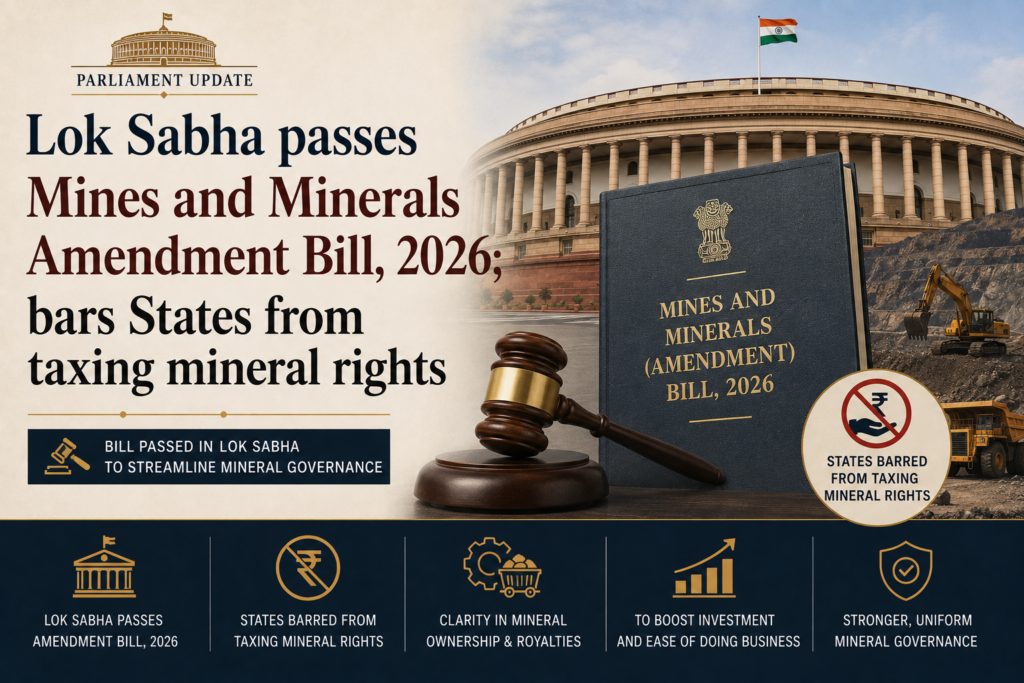
The Lok Sabha passed the Mines and Minerals (Development and Regulation) Amendment Bill, 2026 without debate, barring State governments from imposing additional taxes, cesses or levies on mineral rights and giving the Centre greater control over regulating mineral-laden lands. The move exposes a fiscal federalism clash, since it curtails a State taxation power the Supreme Court had upheld in 2024 and shifts fiscal authority over a Concurrent-domain resource toward the Union.
What does the Mines and Minerals (Development and Regulation) Amendment Bill, 2026 do?
- Bars State levies: It prevents State governments from imposing additional taxes, cesses or levies on mineral rights.
- Central control: It gives the Centre greater control over regulating mineral-laden lands.
- Stated rationale: The Coal and Mines Minister argued that divergent fiscal levies by States had created uncertainty in the mineral sector.
- Feared effects cited: The government said such divergence could raise costs, encourage imports and undermine domestic supply chains.
What is the Mines and Minerals (Development and Regulation) Act, 1957?
- Purpose: The MMDR Act, 1957 is the principal law regulating the mining sector, governing the grant of mineral concessions, leases and the development and regulation of mines.
- Federal scheme: It empowers the Centre to frame rules for major minerals, while States frame rules for minor minerals and grant concessions for minerals in their territory.
Current Status of State taxation power over minerals in India
- State entitlement: States levy royalty on extracted minerals and, since a 2024 Supreme Court ruling, hold constitutional competence to tax mineral rights and mineral-bearing lands.
- The 2024 judgment: A nine-judge Bench held that royalty is not a tax and that States have legislative power to tax mineral rights, a power the present Bill now seeks to restrict.
- Revenue stakes: Mineral-rich States such as Jharkhand, Odisha and Chhattisgarh rely on mining royalties and cesses as a significant own-revenue source.
Constitutional Provisions related to mineral regulation and fiscal federalism
- Entry 54, Union List: Regulation of mines and mineral development to the extent Parliament declares expedient in the public interest.
- Entry 23, State List: Regulation of mines and mineral development subject to the Union List entry.
- Entry 50, State List: Taxes on mineral rights subject to any limitations imposed by Parliament relating to mineral development.
- Entry 49, State List: Taxes on lands and buildings, the basis on which States tax mineral-bearing land.
- Article 246 and Seventh Schedule: Distribute legislative competence between the Union and the States across the three Lists.
- Article 265: No tax shall be levied or collected except by authority of law.
Why does the Centre want to bar State levies?
- Uniformity: A single fiscal regime is intended to remove the uncertainty created by State-by-State levies.
- Cost competitiveness: The government links divergent levies to higher input costs for downstream industry and greater import dependence.
- Supply chain security: Uniform charges are framed as protection for domestic mineral supply chains, including critical minerals.
Why do States and the Opposition see this as an assault on federalism?
- Overriding the Court: The Bill legislatively narrows a taxation power the Supreme Court affirmed for States in 2024.
- Erosion of own-revenue: Barring cesses and levies removes a fiscal lever that mineral-rich States use to fund local development.
- Centralising trend: Critics place it within a wider pattern of the Union tightening control over resources located in State territories.
- Process objection: The Bill was passed without debate amid protests, which the Opposition cited as a denial of scrutiny on a federalism-sensitive measure.
Major debates surrounding mineral taxation federalism
- Royalty versus tax: Whether royalty is a tax and where the line lies between Union regulation of mineral development and State taxation of mineral rights.
- Parliamentary limitation: How far Parliament’s power under Entry 50 to limit State mineral taxation can extend before it hollows out the State entry.
- Distributive justice: Whether mineral-bearing States should retain fiscal upside from resources extracted within their borders.
- Investment climate: Whether uniform central levies genuinely lower costs or merely redistribute fiscal space from States to industry.
Challenges to a centralised mineral fiscal regime
- Vertical fiscal imbalance: Reduced own-revenue deepens State dependence on central transfers.
- Litigation risk: A statutory override of a constitutional ruling invites fresh challenges before the Supreme Court.
- Regional equity: Resource-rich but income-poor States lose a development financing tool.
- Cooperative federalism strain: Bypassing State consent on a shared-domain subject weakens negotiated federalism.
- Compliance uncertainty: Transition from varied State levies to a single regime creates short-term ambiguity for operators.
Conclusion
The Lok Sabha has cleared a Bill that removes the States’ power to levy additional taxes on mineral rights and centralises regulatory control over mineral lands. The current status is passage in the Lower House amid Opposition protest; the next milestone is its consideration in the Rajya Sabha and likely constitutional scrutiny given its tension with the 2024 Supreme Court ruling on State taxation of minerals.
What is Fiscal Federalism? (Foundational Context)
- About: Fiscal federalism is the division of taxation powers, expenditure responsibilities and transfers between the Union and the States.
- Rationale: It exists to match revenue-raising capacity with spending needs across tiers of government.
- Named typology: It addresses vertical imbalance between the Union and States, horizontal imbalance across States, and weak third-tier finances at the local level.
Key Concerns Regarding Fiscal Federalism
- Shrinking divisible pool: Rising cesses and surcharges reduce the shareable tax pool with States.
- Eroded State autonomy: GST and central levies have narrowed independent State taxation.
- Resource control: Central assertion over minerals and land in State territories limits State fiscal levers.
- Weak local finances: Third-tier bodies remain underfunded and dependent.
Constitutional Framework Governing Mineral Regulation
- Entry 54 (List I): Union regulation of mines and mineral development in the public interest.
- Entry 23 (List II): State regulation of mines subject to the Union entry.
- Entry 50 (List II): State taxes on mineral rights subject to parliamentary limitation.
- Article 246: Allocation of legislative competence across the three Lists.
- Article 265: Taxation only by authority of law.
Way Forward
- Consultative design: Frame mineral fiscal policy through the GST Council model of negotiated federalism.
- Revenue neutrality: Compensate mineral-rich States for lost cesses through predictable transfers.
- Legal clarity: Reconcile the amendment with the 2024 ruling to avoid protracted litigation.
- District mineral funds: Strengthen use of mining revenues for affected local communities.
“[2025] Consider the following statements:
Statement I: In India, State Governments have no power for making rules for grant of concessions in respect of extraction of minor minerals even though such minerals are located in their territories.
Statement II: In India, the Central Government has the power to notify minor minerals under the relevant law.
Which one of the following is correct in respect of the above statements?
(a) Both Statement I and Statement II are correct and Statement II explains Statement I
(b) Both Statement I and Statement II are correct but Statement II does not explain Statement I
(c) Statement I is correct but Statement II is incorrect
(d) Statement I is incorrect but Statement II is correct
