Why in the news?
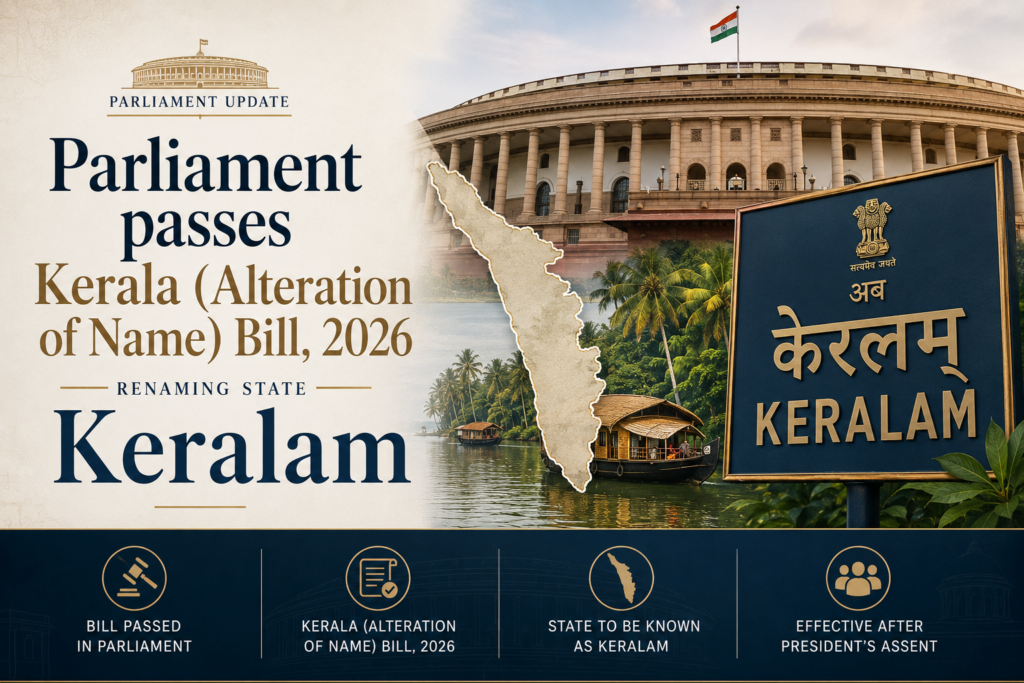
Parliament passed the Kerala (Alteration of Name) Bill, 2026, renaming the State Keralam and amending the First Schedule of the Constitution. The Rajya Sabha cleared the Bill by voice vote, over two years after the State Assembly unanimously resolved for the change. The measure has surfaced pending name change proposals from other States, including West Bengal’s request to become Bangla.
How is a State renamed under the Constitution?
- Article 3 power: Parliament may by law alter the name of a State, and such a bill can be introduced only on the recommendation of the President.
- State legislature reference: The President must refer the bill to the concerned State legislature for its views within a specified period, though those views are not binding.
- First Schedule amendment: Renaming requires an amendment to the First Schedule, which lists the States and Union Territories, effected under Article 4 as an ordinary law.
What is the Kerala (Alteration of Name) Bill, 2026?
- Core change: The Bill changes the name of the State from Kerala to Keralam and makes the consequential amendment to the First Schedule.
- Origin: It continues the Kerala Assembly’s 2024 resolution urging the Union government to rename the State Keralam.
- Passage: The Lok Sabha passed it on Tuesday and the Rajya Sabha by voice vote on Wednesday, with all MPs supporting the rename.
What is the current status of State name changes in India?
- Precedents: Madras became Tamil Nadu, and several States and cities have been renamed over the decades.
- Pending proposals: West Bengal’s proposal to become Bangla has been pending for eight years, and members sought renaming of other States, cities and railway stations.
- Ordinary majority: A First Schedule amendment for renaming is passed as an ordinary law, not requiring the special majority reserved for other constitutional amendments.
- Linguistic basis: Keralam is the Malayalam name of the State, and the change reflects respect for regional language identity.
Constitutional provisions related to State renaming:
- Article 3: Empowers Parliament to form new States and to alter areas, boundaries or names of existing States.
- Article 4: Provides that laws under Articles 2 and 3, including consequential First Schedule and Fourth Schedule amendments, are not deemed constitutional amendments under Article 368.
- First Schedule: Lists the States and Union Territories and their territories, amended to record the new name.
- Article 3 proviso: Requires presidential recommendation and reference to the State legislature before introduction.
What does the Bill do procedurally?
- Amends the First Schedule: Substitutes Keralam for Kerala in the constitutional list of States.
- Consequential amendments: Makes the necessary changes so that references in law read as Keralam.
- Voice vote clearance: Passed in the Upper House by voice vote with cross party support during the Monsoon Session.
How does renaming differ from creating or altering a State?
- Name only: Renaming changes only the label, leaving territory, boundaries and administrative structure intact.
- Same Article, different effect: Article 3 covers both renaming and territorial reorganisation, but renaming carries no boundary or population change.
- No special majority: Both are enacted by simple majority under Article 4, unlike amendments under Article 368.
What are the major debates surrounding State renaming?
- Federal courtesy: Members urged that the Union work closely with States and respect regional languages, framing the change within cooperative federalism.
- Pending parity: The eight year delay on West Bengal’s Bangla proposal raised the question of consistent and timely treatment of State requests.
- Symbolic versus substantive: One member argued the Centre should change its behaviour on disaster funding, not just the name, contrasting symbolic recognition with substantive support.
Conclusion: Parliament has passed the Kerala (Alteration of Name) Bill, 2026, renaming the State Keralam and amending the First Schedule under Article 3. The change gives effect to the Kerala Assembly’s 2024 resolution and reflects the State’s Malayalam identity. The next step is presidential assent, after which the First Schedule stands amended.
Back2Basics: First Schedule and States reorganisation
- First Schedule: Lists the 28 States and 8 Union Territories with their territorial extents.
- States Reorganisation Act, 1956: Reorganised State boundaries largely on linguistic lines, the framework within which Kerala was formed.
- Renaming precedents: Madras to Tamil Nadu (1969), Mysore to Karnataka (1973), Uttaranchal to Uttarakhand (2007), and Orissa to Odisha (2011).
- Process anchor: Article 3 read with Article 4 governs formation, alteration and renaming of States.
