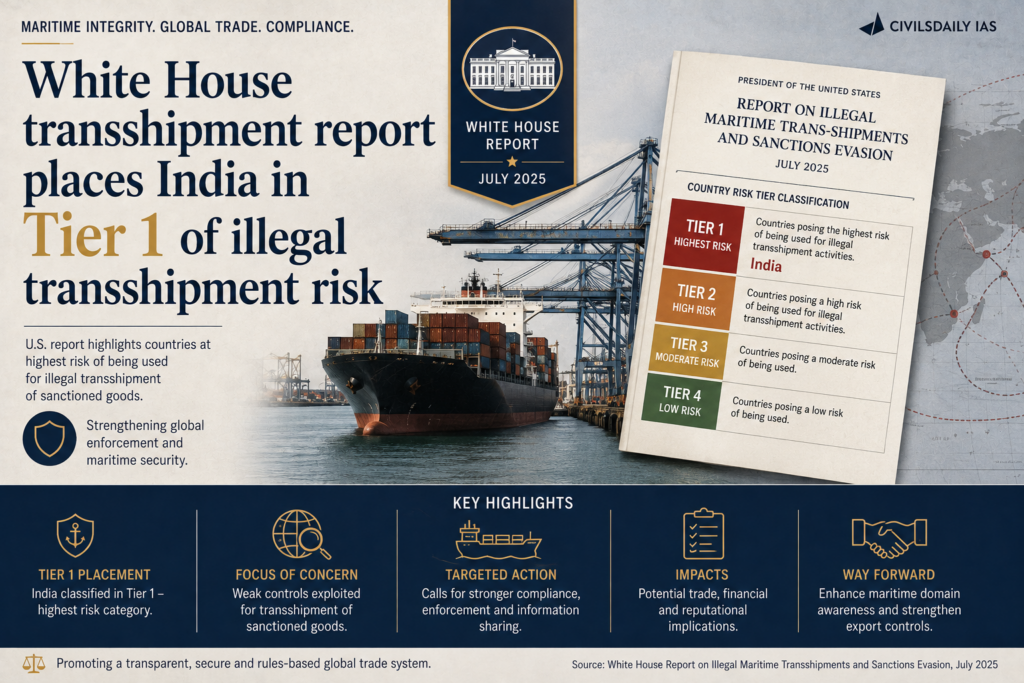
Why in the News
A White House report, The Great Transshipment Scam, places India in Tier 1 for elevated illegal transshipment risk, alleging that some Chinese goods are routed through India to evade US tariffs.
Key Definitions
- Illegal Transshipment: Routing goods through a third country and making minimal changes to disguise their actual country of origin and avoid tariffs.
- Tariff Arbitrage: Earning a profit by routing goods through a country with a lower tariff.
- Rules of Origin: Rules used to determine the country of origin of a product, generally based on where substantial transformation occurs.
- Substantial Transformation: A manufacturing process that changes a product sufficiently to give it a new identity, character or use.
- Screwdriver Factory: A facility that mainly assembles imported components with minimal domestic value addition.
- Section 301: US law allowing action against foreign trade practices considered unfair or discriminatory.
- Trade Diversion: Shifting trade flows from one country or route to another due to tariffs, restrictions or other trade barriers.
What does the US report allege?
- India is placed in Tier 1.
- The Pune, Gujarat and Chennai production belt is specifically mentioned.
- Pumps and compressors are cited as examples.
- India, Mexico and Vietnam together accounted for an estimated $67 billion of transshipped goods in 2025.
- No punitive action has yet been announced.
Why does it matter for India?
- Greater scrutiny of Indian exports.
- China Plus One manufacturing could face stricter origin verification.
- Dependence on Chinese components may complicate origin claims.
- Tariff action could affect India’s access to the US market.
[2025, GS3, 10 marks] What are the challenges before the Indian economy when the world is moving away from free trade and multilateralism to protectionism and bilateralism? How can these challenges be met?”
[2017] Consider the following statements:
1. India has ratified the Trade Facilitation Agreement (TFA) of WTO.
2. TFA is a part of WTO’s Bali Ministerial Package of 2013.
3. TFA came into force in January 2016.
Which of the statements given above is/are correct?
(a) 1 and 2 only
(b) 1 and 3 only
(c) 2 and 3 only
(d) 1, 2 and 3
