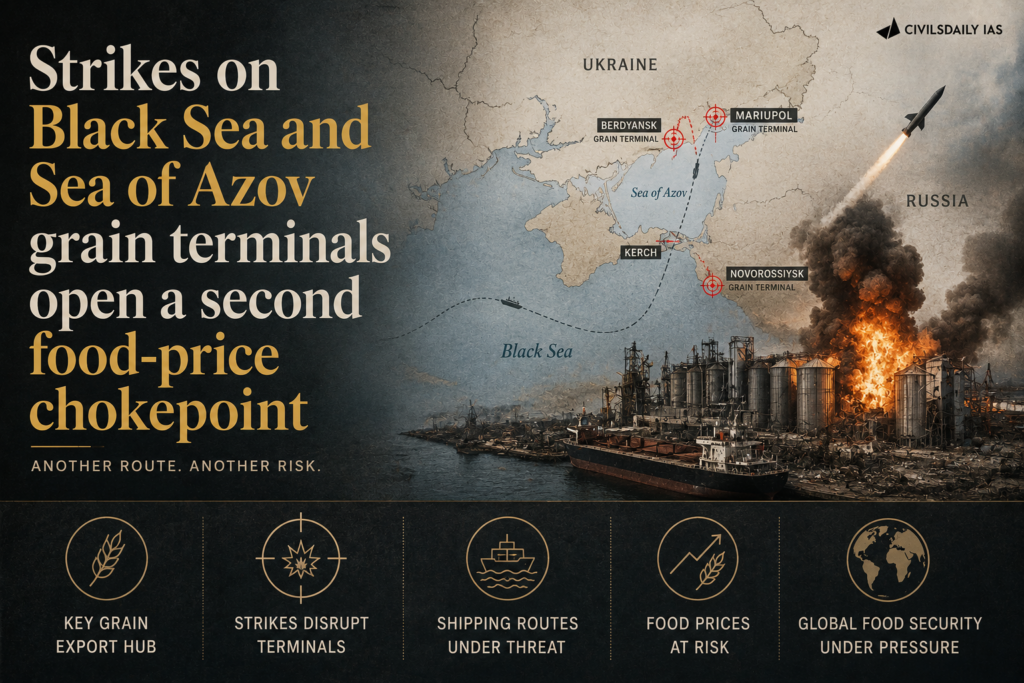
Why in the News?
A Ukrainian drone strike on 11 August destroyed two major grain export terminals at Russia’s Novorossiysk port, removing 15.6 million tonnes (mt) of annual export capacity. This opens a second global trade chokepoint alongside the Strait of Hormuz, shifting the food security crisis from a production problem to a shipping/transit blockade.
Key Geography & Infrastructure
- Black Sea & Sea of Azov Grain Corridor: Primary maritime route for Russian and Ukrainian agricultural exports via the Kerch Strait and Turkish Straits.
- Novorossiysk: Major Russian Black Sea port handling bulk grain shipments.
- Kerch Strait: The sole, narrow maritime outlet connecting the Sea of Azov to the Black Sea (a classic single point of failure).
- Greater Odesa Port Complex: Ukraine’s main shipping hub (Odesa, Chornomorsk, Pivdennyi), handling ~90% of its agricultural exports.
- Izmail: Ukraine’s primary Danube River port, serving as an alternative inland waterway route.
Regional Dependence & Export Weight
- Russian Routing: Over 80% of Russian grain exports move through Sea of Azov and Black Sea ports.
- Ukrainian Routing: The Greater Odesa complex handles about 90% of Ukraine’s agricultural exports.
- Global Wheat Share: Russia and Ukraine combined account for 27.4% of global wheat exports.
- Global Sunflower Oil Share: Russia and Ukraine combined supply 61.5% of global sunflower oil shipments, the highest concentration of any commodity.
- Other Staples: Together they control 15.8% of global barley and 12.5% of global corn shipments.
Causes of the Global Price Shock
- Shipping Bottleneck, Not Output Deficit: Granaries are full in Russia and Ukraine, but cross-border strikes have created severe risk, stopping safe physical transport.
- Soaring Insurance Premiums: War risk cover on hulls and cargo acts as a hidden tariff, driving up freight costs and pricing out smaller buyers.
- Compounding EU Crop Yield Reductions (USDA Data):
- Wheat: Projected to drop 7.5% (down to 134.2 mt).
- Corn: Expected to drop to 50.2 mt (a nearly two-decade low).
- Cause: Record summer heatwaves and prolonged drought cut yields across Europe.
- Global Repricing: CBOT wheat and corn futures rose 4–5% following the strikes. Major alternative exporters (US, Canada, Australia) saw prices surge simultaneously.
Impact on India & Domestic Policy Measures
Key Exposures
- Edible Oil Risk: India is the world’s largest vegetable oil importer and heavily relies on Black Sea sunflower oil.
- Dual Chokepoint Strain: Simultaneous disruptions in the Strait of Hormuz (energy/fertilizers) and Black Sea/Kerch Strait (food/edible oils).
Statutory & Policy Framework
- Essential Commodities Act, 1955: Regulates production, stock limits, and distribution of foodstuffs and edible oils.
- National Food Security Act (NFSA), 2013: Guarantees subsidized foodgrains to ~two-thirds of India’s population.
- Foreign Trade (D&R) Act, 1992: Legal framework for export bans, quotas, and Minimum Export Prices (MEP).
- Customs Tariff Act, 1975: Regulates import duty structures on crude and refined edible oils.
- Key Interventions: Open Market Sale Scheme (OMSS), Price Stabilisation Fund (PSF), Pradhan Mantri Garib Kalyan Anna Yojana (PMGKAY), and the National Mission on Edible Oils – Oil Palm (NMEO-OP).
Key Institutional Concepts
- FAO Food Price Index: A monthly index tracking international market prices of five commodity groups (Cereals, Vegetable Oils, Dairy, Meat, Sugar), weighted by export shares. Hosted by the Food and Agriculture Organization (HQ: Rome, established 1945).
- Chicago Board of Trade (CBOT): Premier futures exchange establishing global benchmark prices for wheat, corn, and soybeans.
- USDA WASDE Report: World Agricultural Supply and Demand Estimates; the primary global benchmark for crop yields and trade shares.
- Maritime Chokepoint: A narrow, strategic passage (e.g., Turkish Straits, Kerch Strait, Strait of Hormuz, Bab el-Mandeb) where high volumes of global trade pass, creating high geographical vulnerability.
“[2024, GS3, 15 marks] Elucidate the importance of buffer stocks for stabilizing agricultural prices in India. What are the challenges associated with the storage of buffer stock? Discuss.”
[2014] Turkey is located between
[A] Black Sea and Caspian Sea
[B] Black Sea and Mediterranean Sea
[C] Gulf of Suez and Mediterranean Sea
[D] Gulf of Aqaba and Dead Sea
