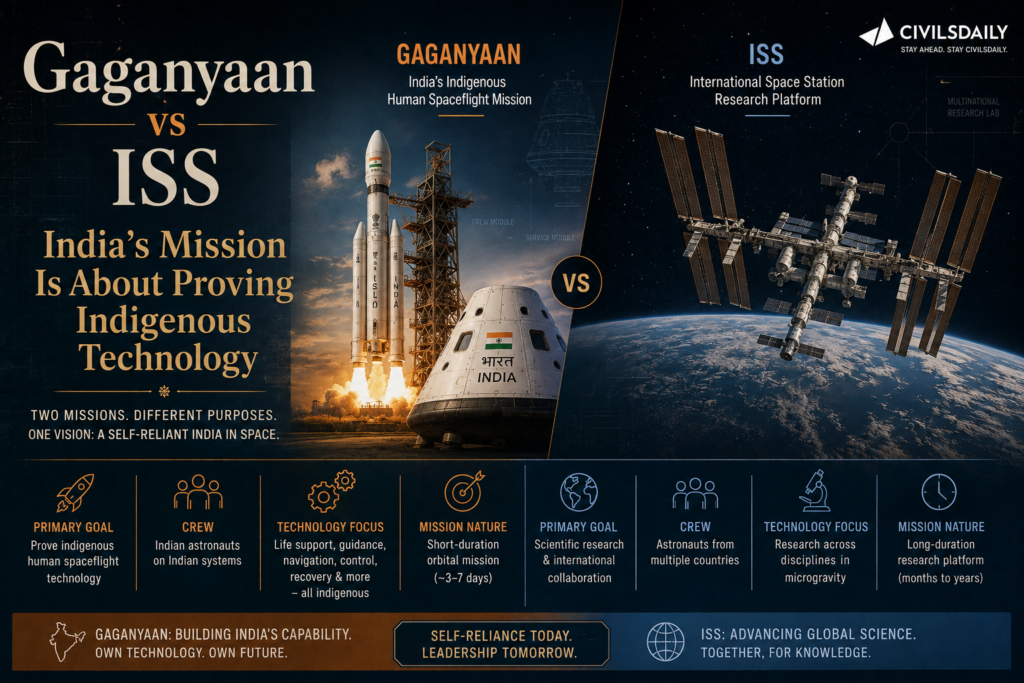
Why in the News
The Indian astronaut who flew on Axiom Mission 4 has described Gaganyaan as a prototype mission built to prove technology, test systems and communicate with the ground, unlike the International Space Station flight, which was an established mission of experiments and return. The distinction separates having flown from owning the capability to fly. Axiom Space owned no hardware, while the Indian Space Research Organisation (ISRO) is building the capsule and the spacecraft in house.
What is the Gaganyaan mission?
- About: It is India’s first human spaceflight programme, designed to carry a crew to low Earth orbit in an indigenously built crew module and return them safely.
- Nature of the mission: It is a prototype mission, focused on proving the technology, testing out systems and communicating with the ground, not on a defined experiment schedule.
- In house hardware: ISRO is building the capsule and the spacecraft in which the astronauts will travel, and launching Indian astronauts on an Indian vehicle.
- Engineering intensity: The work is described as heavy engineering, with robust processes and review mechanisms being set up around it.
- Status: The programme is scheduled over the next year or two, and preparation is currently ground based.
What was Axiom Mission 4?
- About: It was a commercial crewed mission to the International Space Station, on which an Indian became only the second Indian in space and the first in over four decades.
- Duration: The Indian crew member spent 20 days at the International Space Station after a launch on 25 June.
What is microgravity?
- About: It is the condition of near weightlessness experienced in orbit, where objects and fluids behave differently from how they behave on the ground.
- Why it matters for training: Microgravity cannot be simulated on the ground, so the environment is encountered fully only in flight.
Why is the Axiom model not comparable to the Gaganyaan model?
- Axiom owned no hardware: Axiom Space is a private company coordinating missions to space and did not own any of the hardware used.
- Station ownership: The International Space Station is owned by NASA and its international partners, not by the mission coordinator.
- Vehicle ownership: The crew flew in SpaceX’s Crew Dragon vehicle, launched by the Falcon 9 rocket, both owned by SpaceX.
- ISRO’s position: India is attempting to make the hardware in house and launch its own astronauts in its own capsule, which is a different nature of work.
- Consequence: The two programmes cannot be compared, because one buys access to space and the other builds the means of access.
What did India actually gain from the Axiom flight?
- Stated objective: The primary objective of the mission was to learn as much as possible and use that experience to enable India’s own mission.
- Observation team: An ISRO team was present alongside the astronaut to observe how operations were run.
- End to end exposure: The team witnessed the end to end execution of an entire crewed mission, from preparation to recovery.
- Ecosystem lesson: ISRO has launched many successful missions, but human spaceflight requires a different ecosystem, and the scale of operations was the biggest learning.
- Disciplines identified: The flight showed the range of disciplines India must address before sending people to space and bringing them back.
What does an astronaut’s training and career actually involve?
- Breadth of training: An astronaut must train across a sharply increased number of disciplines, since in orbit there is no one else available.
- Roles carried by one person: The same person must act as pilot, commander, doctor, researcher, plumber and mechanic, with microbiology and medical procedures part of the training.
- Waiting time: In established programmes such as those of the United States and Russia, the average wait before an astronaut first flies is around five to six years.
- No certainty of flight: Some astronauts are selected and never fly, so there is no guarantee attached to selection.
- Career arithmetic: An astronaut typically flies two to three times, at six months each from the United States, which is about 1.5 years of a 40 year career, leaving 38.5 years on the ground.
What space technology carries back to terrestrial use?
- Water reclamation: The water reclamation system on the International Space Station recycles about 98 percent of the water, which removes the need to carry large quantities into orbit.
- Scaling potential: Scaling that system for use on Earth would deliver a direct benefit in water conservation and resource efficient use.
- Established spinoffs: Space programmes have already produced carbon water filters and satellite based positioning systems for everyday use.
Challenges to Gaganyaan
- Human rating of the launch vehicle: Every subsystem must be requalified for crew safety, which extends timelines. e.g. the Test Vehicle Abort Mission TV D1 flown in October 2023 to validate the crew escape system.
- Schedule slippage: Crewed flight targets have moved repeatedly since approval. e.g. the original 2022 target announced in 2018 has shifted by several years.
- Launch reliability: A single stage anomaly can ground an entire programme. e.g. the failure of the PSLV C61 mission in May 2025 due to a third stage anomaly.
- Absence of domestic astronaut training infrastructure: India lacked a full crew training facility when selection was completed. e.g. the four astronaut designates trained at the Gagarin Cosmonaut Training Centre in Russia before the Bengaluru facility was built out.
- Budget scale: India’s civil space budget is a fraction of the leading spacefaring nations. e.g. the Department of Space received about Rs 13,416 crore in the 2025 to 2026 Union Budget.
- Crew recovery and medical support: Splashdown recovery requires naval assets, trained divers and medical evacuation chains. e.g. recovery trials conducted with the Indian Navy off the Visakhapatnam coast.
- Space debris risk in low Earth orbit: Crewed vehicles must plan collision avoidance in an increasingly congested orbit. e.g. ISRO’s Project NETRA set up for space situational awareness and debris tracking.
Conclusion
Flying an Indian on foreign hardware demonstrated access to space, while Gaganyaan is an attempt to build the capability itself, which is why the two missions are not comparable. The value extracted from the commercial flight was learning transfer, particularly the recognition that human spaceflight demands an ecosystem rather than a launch. The next milestone is the uncrewed test flight sequence, followed by the first crewed flight and then the Bharatiya Antariksh Station.
India’s Human Spaceflight Programme
- About: Human spaceflight covers the design of a crew module, a service module, a crew escape system, a human rated launch vehicle, life support, astronaut training and recovery operations.
- Gaganyaan design: A three member crew is to be placed in a low Earth orbit of about 400 km for a mission of up to three days, with a sea splashdown recovery.
- Launch vehicle: The Human Rated LVM3 (HLVM3) is the designated launcher, derived from India’s heaviest operational rocket.
- Precursor tests: The programme runs uncrewed test flights, pad abort and in flight abort tests, and a robotic flight carrying the humanoid Vyommitra before crewed flight.
- Long term roadmap: India has announced the Bharatiya Antariksh Station by 2035 and an Indian crewed landing on the Moon by 2040.
- Standing: India would become the fourth country to launch humans into orbit on its own vehicle, after the Soviet Union and Russia, the United States and China.
Back2Basics: International Space Station
- What it is: The largest crewed structure in low Earth orbit, operated as a multinational research laboratory.
- First module: The Zarya module was launched in 1998, with continuous human occupation since November 2000.
- Partners: Five participating space agencies, NASA, Roscosmos, the European Space Agency, the Japan Aerospace Exploration Agency and the Canadian Space Agency.
- Orbit: It orbits at roughly 400 km altitude, completing an orbit in about 90 minutes and around 16 orbits a day.
- Function: It hosts microgravity research in biology, human physiology, materials science and Earth observation.
- Retirement: The station is planned for controlled deorbit around 2030 to 2031, which is driving commercial station projects.
Government Initiatives
- Indian Space Policy, 2023: Opens the space sector to non government entities across the value chain and redefines the roles of ISRO, IN-SPACe and NSIL.
- IN-SPACe: The Indian National Space Promotion and Authorisation Centre, a single window autonomous body that authorises and promotes private space activity.
- NewSpace India Limited (NSIL): The commercial arm of the Department of Space, handling technology transfer and demand driven satellite and launch missions.
- Gaganyaan Programme: Sanctioned in 2018 and later expanded in scope and outlay to include the first module of the Bharatiya Antariksh Station.
- Foreign Direct Investment reform, 2024: Liberalised FDI limits for satellite manufacturing, launch vehicles and ground segment components.
- SpaDeX: The Space Docking Experiment, which demonstrated autonomous docking of two Indian satellites, a prerequisite technology for a space station and crewed missions.
Key Facts about India in Space
- First Indian in space: Flew aboard the Soviet Soyuz T-11 mission in 1984, spending about eight days aboard the Salyut 7 station.
- Second Indian in space: Flew on Axiom Mission 4 in 2025, over four decades after the first flight, spending 20 days at the International Space Station.
- ISRO: Established in 1969, headquartered in Bengaluru, functioning under the Department of Space.
- Chandrayaan 3: Made India the first country to soft land near the lunar south pole, in August 2023, with National Space Day observed on 23 August.
- Aditya L1: India’s first solar observatory, placed in a halo orbit around the Sun Earth Lagrange point L1.
- Private launch: India’s first privately built rocket flew a suborbital mission in November 2022, marking the entry of startups into launch services.
Challenges in India’s Space Sector
- Launch cadence: India’s annual number of launches remains low relative to demand from satellite operators. e.g. the backlog of commercial launch orders routed to NSIL after the 2020 opening of the sector.
- Heavy lift capacity: Payload capacity to geostationary transfer orbit constrains large commercial contracts. e.g. Indian communication satellites above four tonnes were launched on the European Ariane 5 before LVM3 was available.
- Semiconductor and component import dependence: Space grade electronics and detectors are largely imported. e.g. radiation hardened processors sourced abroad for satellite avionics.
- Private sector financing: Space startups face long gestation and limited domestic risk capital. e.g. a decade of development preceded India’s first private suborbital launch in 2022.
- Regulatory gap: India has no comprehensive space activities statute defining liability, licensing and third party damage. e.g. the Space Activities Bill introduced for consultation in 2017 has not been enacted.
- Space debris and congestion: Collision avoidance manoeuvres are rising as orbital traffic grows. e.g. ISRO’s annual space situational assessment reports record multiple avoidance manoeuvres each year.
- Human resource retention: Trained engineers are drawn to higher paying private and foreign employers. e.g. attrition from public sector space units after the sector opened to startups.
Way Forward
- Enact a space activities law: Provide statutory clarity on licensing, liability and insurance for private operators.
- Raise launch cadence: Expand launch pad and integration capacity so vehicle assembly is not the bottleneck.
- Build domestic astronaut training and recovery infrastructure: Complete a full spectrum training facility and standing naval recovery capability.
- Deepen the supply chain: Fund space grade electronics and materials manufacturing under existing electronics and component schemes.
- Institutionalise learning transfer: Convert lessons from the commercial crewed flight into documented mission assurance protocols for Gaganyaan.
- Expand space situational awareness: Scale radar and optical tracking under Project NETRA to protect crewed and uncrewed assets.
- Sustain public engagement: Use National Space Day and school outreach to build the long term talent pipeline that a crewed programme needs.
Matching Previous Year Question
“[2025] Consider the following space missions:
I. Axiom-4
II. SpaDeX
III. Gaganyaan
How many of the space missions given above encourage and support microgravity research?
(a) Only one
(b) Only two
(c) All the three
(d) None

Answer: (b)”