Why in the News
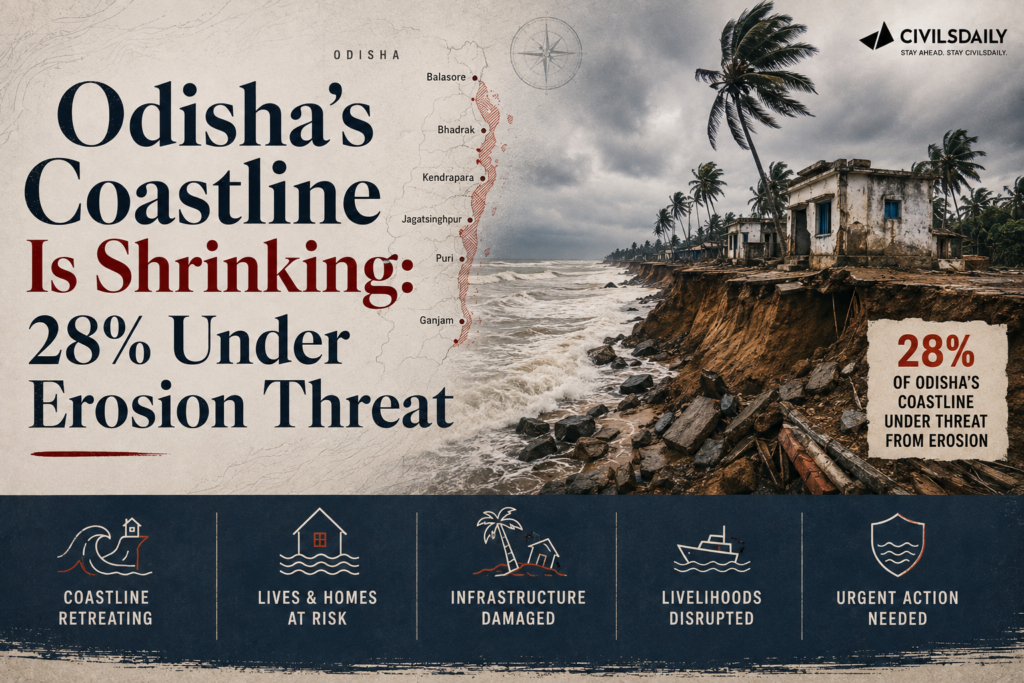
A reply tabled in the Rajya Sabha by the Union Minister for Ports, Shipping and Waterways stated that about 28.3 percent of Odisha’s 564 km coastline is undergoing erosion. The figure sits alongside a second one that complicates it, since 54.1 percent of the same coastline is gaining land, which means the state faces not a uniformly retreating coast but a redistribution of sand that destroys some villages while building others.
What is a geotextile tube embankment?
- About: A geotextile tube is a large cylindrical container fabricated from high strength, porous synthetic fabric and filled with a sand slurry to form an artificial coastal structure.
- Material: The fabric is a woven synthetic such as polypropylene, which retains the sand fill while allowing water to drain out through the pores.
- Function: Rows of such tubes are laid to form a sea wall that absorbs the impact of incoming waves at the shoreline. The energy loss at the structure reduces the scouring of the beach behind it.
- Deployment in Odisha: One such embankment is being developed at Pentha village in Kendrapara district, one of the worst affected stretches of the Odisha coast.
- Why it is preferred: The tubes are filled with locally dredged sand rather than imported rock armour, which lowers cost and allows the structure to settle with the seabed.
What is shoreline change?
- About: Shoreline change is the dynamic process in which the boundary between land and water shifts over time.
- Drivers: The shift is produced by natural forces such as waves, tides and storms, and by human activity such as port construction and sand mining.
What is coastal accretion?
- About: Accretion is the seaward growth of the shoreline when sediment carried by waves and currents is deposited faster than it is removed.
- Why it matters: A coastline can record accretion in aggregate while individual stretches erode, because the same longshore current that starves one beach feeds another.
What is the National Centre for Coastal Research?
- About: The National Centre for Coastal Research (NCCR) is the national institution that monitors long term shoreline change across the Indian coastline.
- The Odisha study: It carried out a comprehensive assessment and mapping of shoreline change analysis along the Odisha coast from 1990 to 2022, and identified several stretches in the affected districts as vulnerable stretches.
How does erosion vary across Odisha’s six coastal districts?
- The state level split: Of the 564 km coastline, 28.3 percent is eroding, 17.6 percent is stable with no significant shoreline change, and 54.1 percent is undergoing accretion.
- Jagatsinghpur: The most erosion prone district, with 47.6 percent of its 55.8 km coastline facing erosion.
- Ganjam: Erosion affects 45.7 percent of its 60.18 km shoreline.
- Kendrapara: Erosion affects 45 percent of its 149.36 km shoreline, the longest coastline among the six districts.
- Balasore: Erosion affects 23.8 percent of its 88 km coastline.
- Puri: Erosion affects 10.2 percent of its 138 km coastline.
- Bhadrak: Erosion affects 4.6 percent of its 72 km coastline, the lowest share among the six.
What drives shoreline change along the Odisha coast?
- Natural marine forces: Waves, tides and storms continuously redistribute sediment along the coast.
- Coastal structures: A 2021 study on shoreline change along the Odisha coast, published in the Journal of Earth System Science, records that sea walls, breakwaters and jetties modify both the shoreline and the beach morphology.
- Ports and harbours: The effect is more significant where hard structures are raised for port and harbour development, which interrupts the longshore movement of sand.
- Extreme events: Tsunamis and cyclonic storms produce drastic shoreline changes, and Odisha is the most cyclone prone state along the Indian coast.
- Human extraction and construction: Sand mining and unplanned infrastructure development along the coast remove or block sediment supply.
- Sea level rise: Global sea level rise driven by climate change adds a permanent upward baseline to every storm surge and tidal cycle.
What has coastal erosion already cost Odisha’s communities?
- Villages lost in Kendrapara: Rising sea level and coastal erosion have already submerged 16 villages in Kendrapara district, displacing several hundred people.
- Loss beyond land: The affected villagers lost not only their land but also their livelihoods, since fishing and cultivation both depend on proximity to the lost shoreline.
- Podampeta in Ganjam: A village of nearly 500 households has been deserted as the sea swept inland.
- Ramayapatna and other settlements: Several other coastal villages in Ganjam are witnessing the sea advance towards the landmass, rendering residents homeless.
What measures has Odisha taken to protect its coast?
- Geotextile tube embankment: A geotextile tube sea wall is being developed at Pentha in Kendrapara to absorb wave impact on one of the most exposed stretches.
- Sea wall cum service roads: These are being developed across parts of Balasore district and at Ramayapatna beach in Ganjam.
- How the dual structure works: The outer tier acts as a defensive barrier against strong tidal waves and erosion. The inner tier operates as a service road for local transport and public access.
- Planned relocation: The state has developed a resettlement colony, described as India’s first climate resettlement colony, to accommodate people displaced by coastal erosion.
- Vulnerability mapping: The NCCR has identified specific vulnerable stretches within the six districts on the basis of long term shoreline analysis, which allows protection works to be prioritised.
“[2022, GS3, 15 marks] Explain the causes and effects of coastal erosion in India. What are the available coastal management techniques for combating the hazard?”
