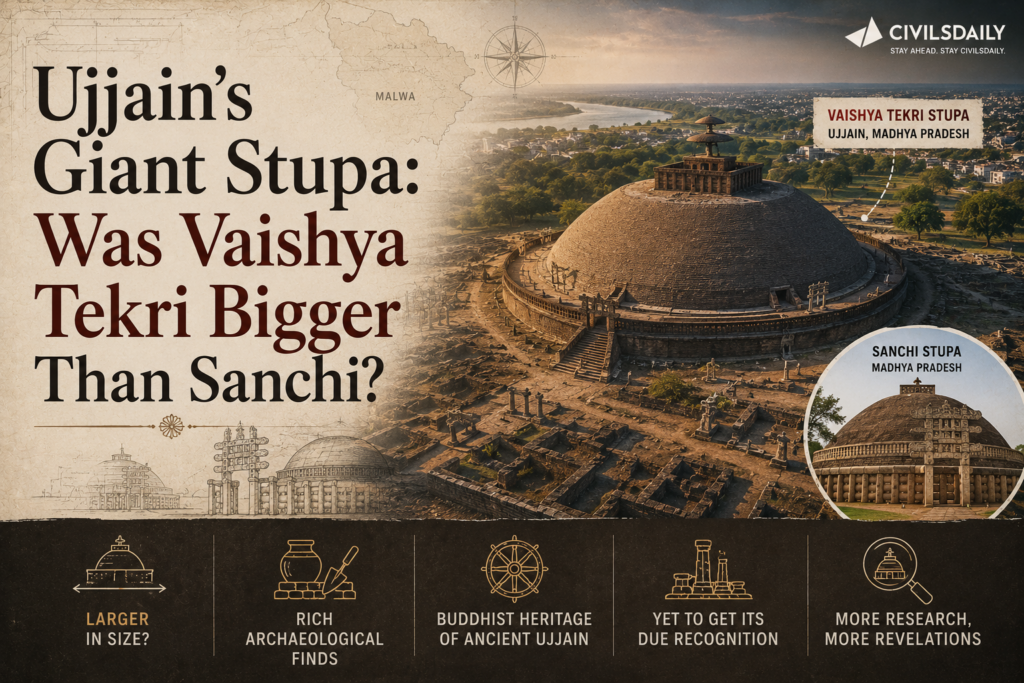
Why in the News
Madhya Pradesh plans to excavate and restore Vaishya Tekri in Ujjain, a major mound believed to contain a Mauryan-era stupa. ASI suggests it may have been larger than the Sanchi Stupa, but its association with Ashoka remains unproven.
What is Vaishya Tekri?
- Located in Ujjain, an important Mauryan-era centre.
- Excavated first in 1938-39 by the erstwhile Gwalior State.
- Identified as a major stupa, not a natural mound.
- 1938 report estimated its base at about 350 ft diameter and height at 100+ ft.
- Dating to the 3rd century BCE was suggested from brick dimensions and coins.
Key Archaeological Evidence
- Core made of rammed blackish murum.
- Exterior faced with brick masonry and mud mortar.
- Finds included:
- Punch-marked coin
- Cast Avanti coin
- A moat surrounded the stupa, with a western passage for worshippers.
- An unusual bowl-shaped masonry base helped resist lateral thrust.
Ashoka Connection
- Tradition associates Ujjain with Ashoka’s viceroyalty.
- However, the 1938 excavation did not establish an Ashokan connection.
- The report only stated that the stupa could possibly be one of the stupas attributed to Ashoka.
- Brick size and coins establish a period, not the identity of the patron.
Prelims Quick Facts
- Vaishya Tekri: Ujjain, Madhya Pradesh
- Period: Mauryan, 3rd century BCE
- Monument: Buddhist stupa
- First excavation: 1938-39
- Estimated diameter: ~350 ft
- Sanchi Stupa height: ~54 ft
- Key coin: Punch-marked coin
- Agency: Archaeological Survey of India
“[2026] Which of the following statements on the Amaravati Stupa and its relief sculpture is/are correct?
1. It was located in the lower Krishna valley.
2. In India, it was next only to the Sanchi Stupa in size.
3. The Amaravati school of sculpture made a lasting impact on the later South Indian sculpture, and its products were carried to Sri Lanka and South-east Asia.
(a) 1 only
(b) 1 and 3 only
(c) 2 and 3 only
(d) 1, 2 and 3
