Why in the News
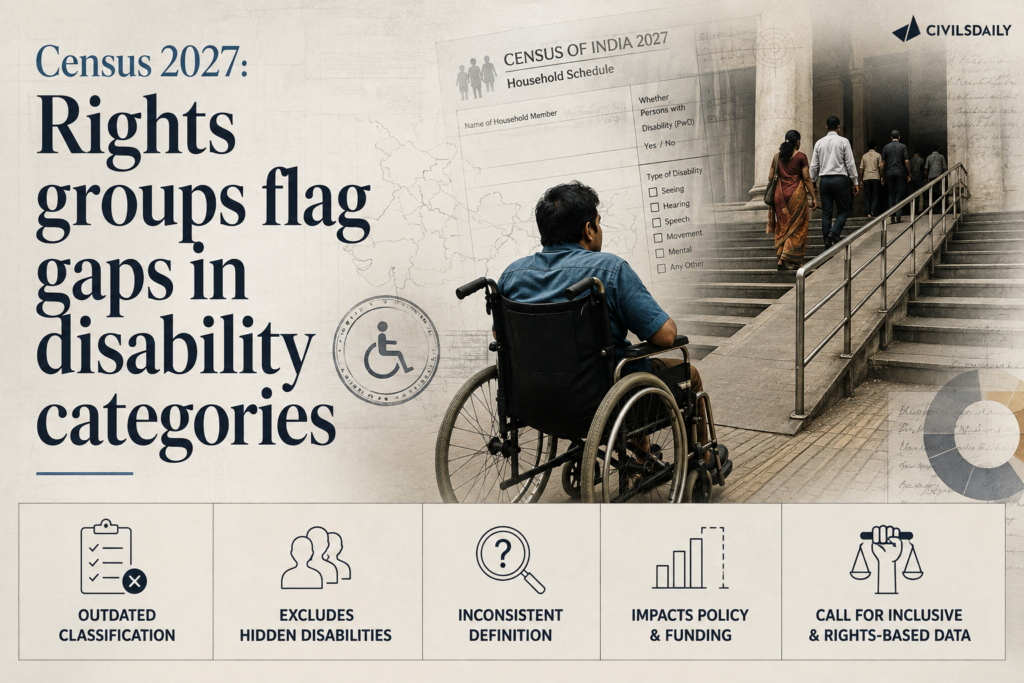
Disability rights organisations have objected to the nine category disability question proposed for Census 2027, against the 21 specified disabilities recognised in law. The objection turns on a design choice, since the categories printed on the schedule decide which conditions can be counted at all, and a condition without its own box is recorded inside a broader one or not at all.
What does Census 2027 propose to record on disability?
- The nine proposed categories: Seeing, hearing, speech, mobility, intellectual disability, mental illness, disability due to acid attack, disability due to chronic neurological disease, and blood disorder.
- What carries over from 2011: Six of the nine, namely seeing, hearing, speech, mobility, intellectual disability and mental illness, are the 2011 Census categories, with “mental retardation” renamed “intellectual disability”.
- What is new: Acid attack, chronic neurological disease and blood disorder are the three additions over the 2011 schedule.
- Multiple disability recording: The questionnaire allows up to three disabilities to be recorded for one person, entered in the order of severity.
What are “specified disabilities” under the Rights of Persons with Disabilities Act, 2016?
- The statutory list: The Rights of Persons with Disabilities (RPwD) Act, 2016 recognises 21 specified disabilities in its Schedule, covering physical, intellectual, mental, blood related and multiple disabilities.
- The expansion it made: The Act replaced the Persons with Disabilities Act, 1995 and raised the recognised types from seven to 21, treating disability as a dynamic and evolving concept.
Why do rights groups say the nine categories fall short?
- The assurance on record: The Union Minister of State for Social Justice and Empowerment stated in March 2026 that Census 2027 would capture data on all 21 disabilities.
- Conditions without a distinct box: Autism spectrum disorder, specific learning disabilities, dwarfism, leprosy cured persons and multiple disabilities including deafblindness are not distinctly placed under any proposed category.
- Distinct conditions collapsed into one: Thalassemia, haemophilia and sickle cell disease are reduced to the single category “blood disorder”, which erases the difference between three separate conditions with different prevalence and support needs.
- Other statutory conditions absent: Cerebral palsy, muscular dystrophy and multiple sclerosis are recognised in the Act but not separately represented in the proposed schedule.
- Scale of the objection: The statement of the National Platform for the Rights of the Disabled (NPRD), citing information from the Politics and Disability Forum, was endorsed by more than 400 signatories.
What is the Registrar General’s defence of the design?
- Broad categories by design: The nine are described as broader categories that include other detailed specific disabilities within them.
- Severity ordering retained: The option to record up to three disabilities in order of severity is offered as the mechanism for capturing multiple disability.
- Consultation claimed: Categories were finalised after consultation with the Department of Empowerment of Persons with Disabilities, the Ministry of Social Justice and Empowerment, and other stakeholders.
- Enumerator competence: Field functionaries are not technically qualified to assess or confirm a specific disability, which is the stated reason for keeping categories broad.
- Training provided: A three day training covering all aspects of the questionnaire is held for enumerators and supervisors.
- Comparison with 2011: The 2027 schedule enumerates a larger number of disabilities than the 2011 schedule did.
Why does the classification itself decide the count?
- The instrument sets the ceiling: An enumerator can only record what the schedule offers, so a condition without a category is absorbed into a broader one and disappears from the published table.
- Untrained recognition: Broad categories without a notified training module on which specific disability sits under which head leave the classification to the enumerator’s judgement.
- The respondent’s own knowledge: A person who neither communicates nor understands the correct name of their disability cannot correct a wrong entry, which compounds the error.
- Self declaration and stigma: Census disability data is self reported, and households under reported disability in earlier rounds because of stigma, which a broad category does nothing to correct.
- Downstream consequence: Undercounting a specific group weakens the evidence base for scheme design, budget allocation and reservation entitlements tied to that disability.
What did the 2011 Census record on disability?
- Total count: The 2011 Census counted 2.68 crore persons with disabilities, which was 2.21 percent of the country’s population.
- Categories used: The 2011 schedule carried six of the nine categories now proposed.
- Concentration of the count: Movement or locomotor, hearing and vision related disabilities together accounted for over half of the country’s population with disabilities.
- What the 2011 base implies: A count already limited to six categories in 2011 sets the comparison base against which any 2027 increase will be read.
Challenges to accurate disability enumeration
- Self reporting and stigma: Households conceal disability, particularly mental illness and intellectual disability, to avoid social consequences for marriage and employment. e.g. the 2011 Census figure of 2.21 percent sits well below global disability prevalence estimates of around 15 percent of population.
- Untrained enumerators on clinical categories: A three day training cannot equip a field functionary to distinguish autism spectrum disorder from intellectual disability. e.g. specific learning disabilities are invisible without assessment and were absent from the 2011 count entirely.
- Severity capping at three: Persons with more than three conditions lose the rest of their profile, which particularly affects multiple disability. e.g. deafblindness combines two sensory disabilities and has no distinct category in the proposed schedule.
- No linkage to certification data: Census figures are not reconciled with the Unique Disability ID database, so the two official counts diverge. e.g. UDID certification is issued against the 21 statutory categories while the Census will record nine.
- Question placement and time: The disability question sits late in a long household schedule, where fatigue produces default negative answers. e.g. the 2027 self enumeration form is completed by the respondent without any enumerator prompt at all.
- Definitional change across rounds: Renaming and regrouping categories between censuses breaks comparability of the time series. e.g. “mental retardation” in 2011 becomes “intellectual disability” in 2027, and three blood conditions are merged into one new head.
Conclusion
The dispute is not about whether Census 2027 counts persons with disabilities but about whether its nine category schedule can carry the 21 categories the law recognises. The Registrar General’s position is that the nine are containers holding the specific conditions, and the rights groups’ position is that a container without a notified mapping and enumerator training will not produce disaggregated data. The self enumeration window for snowbound areas is open until 31 August 2026, with the second phase of population enumeration in those areas from 1 to 30 September 2026 and a revisional round from 1 to 5 October 2026. Any change to the disability question must therefore be made before the main enumeration schedule is frozen.
“[2026] Which of the following statements with regard to the persons with disabilities in India is/are correct?
1. The Rights of Persons with Disabilities Act, an Act passed by the Parliament of India in 2018, mandates reservation in education and employment, places a legal duty on Governments to ensure accessibility and non-discrimination.
2. The Sugamya Bharat Abhiyan focuses on achieving universal accessibility for Persons with Disabilities across three key domains, built infrastructure, transport systems and information and communication technology.
3. The National Divyangjan Finance and Development Corporation (NDFDC) is a public sector organisation set up by the Ministry of Corporate Affairs as a not-for-profit company to promote entrepreneurship among Persons with Disabilities (PwDs).
(a) 1 and 2
(b) 2 only
(c) 1 and 3
(d) 1 only
