Why in the News
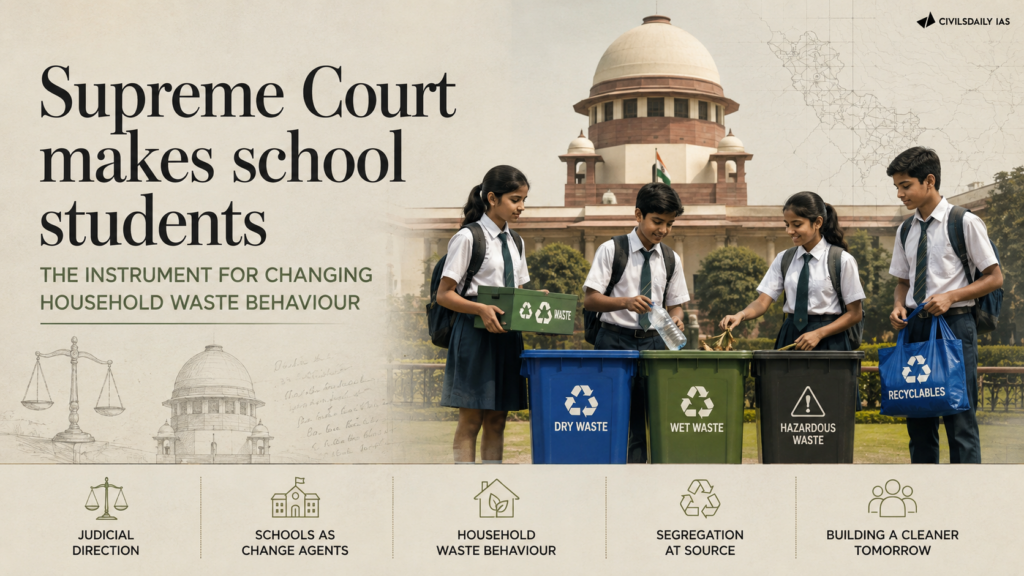
The Supreme Court has directed the Department of School and Higher Education to integrate theoretical and practical instruction on solid waste management so that students train their own family members. The order rejects the assumption that solid waste is a problem for sanitary workers alone, holding that a minuscule number of sanitary workers cannot handle the waste generated by a population of 1.4 billion. The order was passed on 18 August and released on Wednesday.
What are the Solid Waste Management Rules, 2026?
- About: The Solid Waste Management (SWM) Rules, 2026 are the subordinate rules that set the national standards for the segregation, collection, transport, processing and disposal of municipal solid waste.
- Benchmark for audit: The Court treated these Rules as the extant standard against which existing waste infrastructure must be completely audited and upgraded.
- Where implementation power sits: The Court agreed with the Additional Solicitor General that the true power to implement the Rules lies with householders, local body officers and every direct and indirect contributor of waste, not with the municipal machinery alone.
What are the five categories of waste the Court identified?
- Biodegradable waste: Organic waste from kitchens, markets and gardens that decomposes and is treatable by composting or biomethanation.
- Non biodegradable waste: Plastics, metals, glass and packaging that persist and require material recovery or recycling.
- Hazardous waste: Waste with toxic, corrosive, reactive or infectious properties requiring specialised handling and treatment.
- Electronic waste: Discarded electrical and electronic equipment carrying both recoverable metals and toxic components.
- Construction waste: Debris from building, renovation and demolition, which is the heaviest stream by volume in a growing city.
- The Court’s conclusion from the set: The volume and complexity of these five streams have outgrown what any single class of workers can be expected to handle.
Why did the Court call the sanitary worker assumption constitutionally unethical?
- The prevailing assumption: The Bench held that the assumption that solid waste is a problem for sanitary workers alone, while the rest of the population remains passive generators, is neither legally correct nor practically sustainable, and is constitutionally unethical.
- The general feeling in society: The Court described the regrettable attitude as one where a person is entitled to generate but not to cooperate and control the impact of solid waste management at the threshold.
- Arithmetic of the mismatch: Every human being and their activities result in pollution, yet all contributors expect a minuscule percentage of sanitary workers to handle it.
- The responsibility it fixed: The Court held that this perception shall be eradicated and that waste management shall be the responsibility of all contributors.
- The public health warning: Continued complacency would lead to pandemic and endemic situations.
What monitoring machinery has the Court already put in place?
- Trigger for the committee: The imbalance between the volume of waste generated and the infrastructure to collect it alarmed the Court on 25 May, when it constituted a monitoring committee.
- Five Union Secretaries: The committee comprises the Secretaries of the Ministries of Housing and Urban Affairs; Environment, Forest and Climate Change; Jal Shakti; and Panchayati Raj and Rural Development; and the Department of Drinking Water and Sanitation.
- Pollution regulator: The Member Secretary of the Central Pollution Control Board (CPCB) is the sixth member.
- Design logic of the composition: Urban services, environmental standards, water and sanitation, and rural local government are placed in a single body because waste crosses all four jurisdictions.
Why did the Court fall back on education rather than penalty?
- The limit of law: The Bench accepted the reality that law alone could not induce good civic behaviour, and that the change had to come from within.
- The instrument chosen: The Court held that an educated child is the most effective and least coercive instrument for educating a parent or a relative.
- The tension this creates: Rules, standards and a five Secretary committee are enforceable instruments with fixed accountability, while behavioural change through schoolchildren has no compliance date and no defaulter.
- The reversal of the usual direction: Compliance is being routed through the household rather than through the municipal contractor, which shifts the burden to the very generators the Rules had earlier treated as passive.
What directions did the Court issue?
- Curriculum integration: The Department of School and Higher Education must integrate, with immediate effect, both theoretical and practical knowledge on solid waste management.
- Students as trainers: Students are to be equipped to train their own family members in waste handling at the household stage.
- Teachers as trainers of trainers: Teachers are to be trained so that they can deliver the practical component.
- District level engagement: District Collectors must engage with households and educational institutions.
- Infrastructure audit: The waste infrastructure needs a complete audit and upgradation to meet the extant standards of the Solid Waste Management Rules, 2026.
Conclusion
The Court has reclassified solid waste from a service delivery failure of municipal sanitation into a generation side behavioural failure of 1.4 billion contributors, and has held the passive generator assumption to be constitutionally unethical. Its enforceable directions are the curriculum mandate on the Department of School and Higher Education, the engagement duty on District Collectors and the infrastructure audit against the Solid Waste Management Rules, 2026. The five Secretary committee constituted on 25 May continues to monitor the volume and infrastructure mismatch. The next stage will turn on whether the Department reports a dated curriculum integration plan, since the order carries an immediate effect direction but no separate compliance schedule.
“[2018, GS3, 10 marks] What are the impediments in disposing the huge quantities of discarded solid wastes which are continuously being generated? How do we remove safely the toxic wastes that have been accumulating in our habitable environment?”
