Why in the News
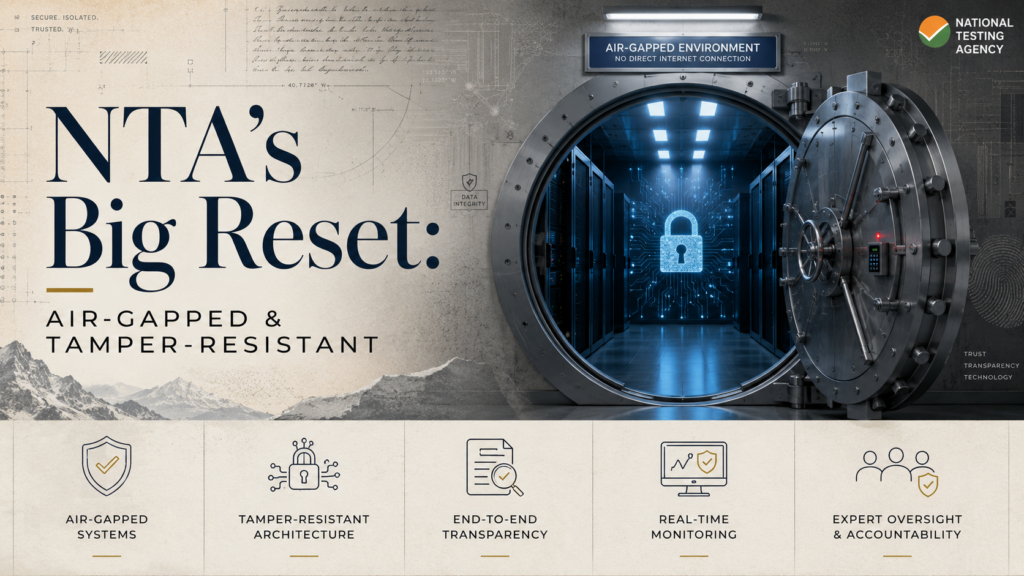
A day after the Education Ministry announced an overhaul of the examination system at the National Testing Agency (NTA), a senior agency official set out its operating design: shorter engagement periods for subject experts, information withheld even inside official circles, and question paper work confined to air gapped systems. The design treats paper leakage as an insider access problem rather than a detection problem.
What does the four tier examination security system involve?
- Two distinct levels: The four tier system is operationalised at two levels, the first at the stage of setting question papers and the second at the stage of physical security during the process.
- Level one, separation of paper setting functions: Separate sets of people are involved with each key function, namely item writers and those moderating, translating and vetting the items, so no single group sees the paper end to end.
- Level two, layered physical screening: Persons coming to the centres are physically frisked, their credentials are established, their electronic devices are verified, and they work only on air gapped systems.
- Already field tested: The new system was tested in the recent Council of Scientific and Industrial Research examination and the National Eligibility cum Entrance Test (NEET) re examination, and is being institutionalised now.
What is an air gapped system?
- Definition: An air gapped system is a computer or system completely isolated from unsecured external networks, including the public internet, so data cannot move in or out over a network connection. Isolation means any transfer requires physical access, which is what the frisking and device verification layers are designed to control.
Why is the National Testing Agency shortening the engagement of subject experts?
- The stated reason: A senior agency official said engagement time is being curtailed because the mafia tries to make these people compromised if they are there for a longer duration.
- The threat characterised: The official described what the agency faces as a big mafia, framing leakage as organised rather than opportunistic.
- Scale of the churn: The Director General had announced the removal of 600 experts and the onboarding of new ones.
- The logic of rotation: A shorter tenure limits the window in which an expert can be identified, approached and cultivated by an organised network.
Why is information being staggered even inside official circles?
- Partial disclosure by design: The agency and the Education Ministry are leaning towards a system where full information is not divulged even within official circles.
- The operating rule: Plans are confidential and divulged to people only in parts, on a need to know basis, so that no individual holds the complete process map.
- The stated intent: The official said the agency is not disclosing everything and is not opening all its cards, including to people within the system.
How is physical security being tightened around the examination process?
- Frisking at entry: Persons coming to the centres are physically frisked before entry.
- Credential verification: Credentials of those entering are established rather than assumed from a pass or list.
- Device control: Electronic devices carried by such persons are verified.
- Isolated computing: Work is confined to air gapped systems, cutting the network route out of the secure area.
- Dedicated security force: Premises are being secured by the Central Industrial Security Force (CISF), which specialises in frisking.
What did the Parliamentary Standing Committee find about the agency’s record?
- The report: The Parliamentary Standing Committee on Education, Women, Children, Youth and Sports flagged the agency’s problems in its 371st Report, 2025, submitted to Parliament.
- The 2024 record: Of the 14 competitive examinations conducted by the NTA in 2024, at least five faced major issues.
- Postponements: Three examinations, namely the University Grants Commission National Eligibility Test (UGC-NET), the Council of Scientific and Industrial Research National Eligibility Test (CSIR-NET) and the National Eligibility cum Entrance Test Postgraduate (NEET-PG), had to be postponed.
- Leak and result failure: One examination, the National Eligibility cum Entrance Test Undergraduate (NEET-UG), saw instances of paper leaks, and one, the Common University Entrance Test for undergraduate and postgraduate admission, saw its results postponed.
- Question setting errors: In the Joint Entrance Examination (JEE) Main held in January 2025, at least 12 questions had to be withdrawn due to errors noted in the final answer key.
- The Committee’s conclusion: Such instances do not inspire the confidence of examinees in the system, and the NTA needs to quickly get its act together so that they do not recur.
Challenges to the four tier security overhaul
- Expert churn trades security for quality: Replacing subject experts frequently reduces the accumulated experience of the item writing pool, which is itself a source of error. e.g. 12 questions withdrawn from JEE Main January 2025 over answer key errors, a failure of question quality rather than of security.
- Air gapping does not cover the human carrier: Network isolation stops remote exfiltration but not a person who memorises or physically removes content. e.g. the government’s own submission before the Supreme Court that the system is foolproof but that at some point there is human intervention.
- Need to know secrecy weakens internal audit: Compartmentalised plans that even officials do not see in full make independent internal verification of the process harder. e.g. no single officer being able to certify end to end compliance when each holds only a fragment of the plan.
- Outsourced links remain the weak node: Printing, transport and centre operations run through contractors outside the agency’s direct control. e.g. arrests following the NEET-UG leak extended beyond the agency’s own staff.
- Frisking capacity does not scale to all centres: Deploying a specialised central force is feasible at paper setting and storage nodes but not at thousands of examination centres. e.g. NEET-UG is conducted for over 23 lakh candidates across the country on a single day.
- Tested at small scale, deployed at large scale: The system was validated on the CSIR examination and a re examination, both far smaller than a full national cycle. e.g. a re examination involves a fraction of the centres, invigilators and logistics of a first attempt NEET-UG.
Conclusion
The overhaul reorganises examination security around compartmentalisation: shorter expert tenures, split paper setting functions, partial information even internally, and isolated computing behind physical screening. It has been tested on the CSIR examination and the NEET re examination and is now being institutionalised across the agency’s calendar. The Parliamentary Standing Committee’s finding that five of 14 examinations in 2024 failed sets the benchmark this design has to beat. The unresolved element is the human intervention the government itself concedes remains in the chain.
About the National Testing Agency
- Mandate: The NTA is an autonomous testing organisation set up in 2017 under the Ministry of Education to conduct entrance examinations for higher education institutions, and it became operational in 2018.
- Legal form: It is registered under the Societies Registration Act, 1860 and is headed by a Director General.
- Examination portfolio: It conducts NEET-UG, JEE Main, UGC-NET, CSIR-NET, the Common University Entrance Test, the Common Management Admission Test and the Graduate Pharmacy Aptitude Test, among others.
- Delivery mode: Its examinations run in both pen and paper and computer based modes, across thousands of centres and multiple sessions.
- Scale: Its examinations together cover crores of candidates a year, with NEET-UG alone drawing over 23 lakh candidates in 2026.
Laws and Rules Governing Examination Security
- Public Examinations (Prevention of Unfair Means) Act, 2024: Criminalises leakage of question papers and answer keys, unauthorised access, tampering with computer networks and the conduct of fake examinations, with imprisonment of three to five years and a fine up to ten lakh rupees for individuals.
- Service provider liability: A fine up to one crore rupees and debarment from conducting public examinations for four years.
- Organised crime: Imprisonment of five to ten years and a fine of not less than one crore rupees, with all offences cognizable, non bailable and non compoundable.
- Bharatiya Nyaya Sanhita, 2023: Supplies the general offences of cheating, criminal conspiracy and forgery used alongside the special law.
- Central Industrial Security Force Act, 1968: The statute under which the force securing examination premises is constituted and deployed.
- State anti cheating laws: State statutes such as the Rajasthan Public Examination (Prevention of Unfair Means) Act, 2022 govern state recruitment and board examinations, which the central Act does not automatically cover.
“[2024, GS2, 15 marks] What are the aims and objects of the recently passed and enforced, The Public Examination (Prevention of Unfair Means) Act, 2024? Whether University/State Education Board examinations, too, are covered under the Act?”
