Why in the News
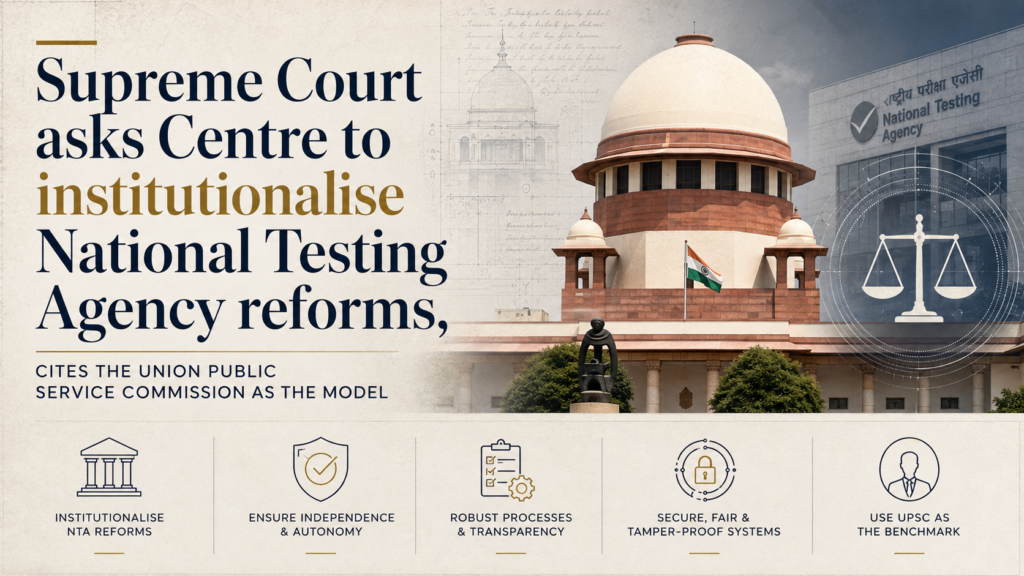
The Supreme Court has directed the Union government to file an affidavit within three weeks setting out what it has done to implement the recommendations of the expert committee headed by a former Chairperson of the Indian Space Research Organisation (ISRO) on the National Testing Agency (NTA). The Bench held that reforms must be institutionalised and carried forward by successive officers rather than restarted with each new committee after each failure.
What is the National Testing Agency (NTA)?
- Status: The National Testing Agency (NTA) is an autonomous testing organisation set up in 2017 under the Ministry of Education and registered under the Societies Registration Act, 1860, to conduct entrance examinations for higher education institutions.
- Examinations conducted: It conducts the National Eligibility cum Entrance Test Undergraduate (NEET-UG), the Joint Entrance Examination Main, the University Grants Commission National Eligibility Test, and the Common University Entrance Test, among others.
- Why it is before the Court: The agency has been under the Supreme Court’s scanner since the NEET-UG 2026 paper leaks, with petitioners describing the failure as recurring and systemic rather than isolated.
What is a sovereign database?
- Meaning: A sovereign database is one whose servers, storage and control remain within the jurisdiction and ownership of the sovereign authority, rather than on infrastructure owned or operated by a third party or located abroad. The Bench asked whether the NTA has one and where question papers are stored.
Why did the National Testing Agency come under the Supreme Court’s scrutiny?
- The trigger event: The 2026 NEET-UG question paper leaks led to cancellation of the examination and left over 23 lakh medical college aspirants stranded.
- Criminal process: A Central Bureau of Investigation (CBI) probe was ordered into the leaks and arrests were made.
- Political consequence: The leaks led to nationwide protests and a police crackdown on students, and ultimately to the resignation of the then Union Education Minister.
- The petitioners’ framing: The Court was hearing petitions by the Federation of All India Medical Association and the United Doctors Front, which characterised the 2026 leak as part of a recurring, systemic and catastrophic failure of the NTA in conducting NEET-UG.
Why does the Court treat committee hopping as the problem rather than the solution?
- The Bench’s central objection: The Court held that it should not be that a committee gives recommendations and a new committee is then formed which removes the old one lock, stock and barrel.
- The specific sequence at issue: A seven member committee formed in 2024 under a former ISRO Chairperson recommended structural reforms in the NEET system, and the Centre has since constituted a task force under an Infosys co founder for new technological reforms.
- The Court’s fix, not replacement but review: The new task force must review the earlier committee’s recommendations and improve on them where necessary, and the earlier committee’s chairperson could be made part of the new body.
- The pattern is older than these two: The Bench pointed out that there were two more committees before the 2024 committee, and that recommendations must not remain on paper but must translate into action.
- The Solicitor General’s position: The Union government agreed on the need for a permanent mechanism to introduce reforms and maintain their continuity, and stated that it had already accepted the 2024 committee’s recommendations.
What does the Court mean by institutional memory in an examination body?
- The failure mode named: A set of reforms implemented for one examination is undone in the next when senior NTA officers are shifted out, so continuity depends on individuals rather than on the institution.
- The standard set: Reforms must be vibrant, institutionalised and carried on within the NTA by successive officers, and must flow down from one generation of officers to the next.
- The comparator used: The Court cited the Union Public Service Commission (UPSC), which has conducted examination after examination without a hitch because it holds institutional memory and institutional expertise.
- What the earlier committee already said: The 2024 committee had itself focused on ways to build institutional memory and had identified the problem as systemic rather than logistical.
What specific institutional gaps did the Bench probe?
- Technology capability: The Bench asked how the agency was facing new technological challenges, and whether the necessary infrastructure and software systems were in place.
- Data security and storage: It asked about cybersecurity and storage, whether the NTA has a sovereign database, and where question papers are stored.
- Physical premises: It asked where the agency’s office is situated and pressed on the need to secure office premises and operational infrastructure.
- Manpower: It asked how many officers the body has, how much staff is available, whether the various director and joint director positions had been filled, and how many had taken charge.
- Candidate facing systems: It stressed training and preparing personnel for the long term, candidate friendly arrangements and a grievance mechanism, and the strengthening of physical and intellectual capacity.
- The government’s response on hiring: The Solicitor General said hiring for scaling up digital infrastructure was under way and that the chief technology officer and chief financial officer had already been selected.
What has the Centre placed on record?
- Earlier affidavit: The Court referred to an affidavit of 4 August filed by the Union government listing several senior appointments to be made to the NTA.
- Fresh affidavit directed: The Secretary must file an affidavit within three weeks, containing all details and indicative timelines, on steps taken to implement the 2024 committee’s suggestions as reflected and nuanced by the new task force.
- Measures claimed: The Centre’s affidavit described the Public Examinations (Prevention of Unfair Means) Act, 2024 and the constitution of the new task force as landmark measures against future paper leaks.
- Mandate of the new task force: It has been constituted to recommend end to end reforms focused on leveraging advanced technology such as artificial intelligence and blockchain to strengthen examination security and integrity.
- Limits on redesigning NEET-UG: Any structural change in the design of NEET-UG would be undertaken only in consultation with and with the concurrence of the Union Health Ministry and the National Medical Commission.
- Assurance to candidates: The Union government committed to giving candidates adequate advance notice of any change in the mode or design of the examination.
- The residual admission: The Solicitor General submitted that the system in place is foolproof but that at some point there is human intervention.
Challenges to institutionalising reform in the National Testing Agency
- Officer rotation defeats continuity: Reforms owned by a posting rather than a post are reversed on transfer, which is precisely the failure the Court described. e.g. reforms implemented for one examination cycle being undone in the next after senior NTA officers were shifted out.
- No statutory foundation: The NTA is a registered society rather than a body created by statute, so its powers, tenure protections and accountability are weaker than those of a constitutional or statutory examination body. e.g. the UPSC derives its independence from Article 315 of the Constitution, which the NTA has no equivalent of.
- Recommendations without an implementation tracker: Successive committees have produced reports with no published mechanism to show which recommendation was executed and when. e.g. the Court had to direct an affidavit with indicative timelines three weeks out simply to learn the status of the 2024 committee’s recommendations.
- The human link in an otherwise sealed chain: Security design can cover technology and logistics but not the conduct of every person with access. e.g. the Solicitor General’s own submission that the system is foolproof but that at some point there is human intervention.
- Vendor and outsourcing dependence: Question paper printing, transport and centre operations run through private contractors whose staff sit outside the agency’s disciplinary reach. e.g. arrests following the NEET-UG leak extended beyond the agency’s own personnel.
- State level examinations remain outside the frame: The Court’s directions bind the NTA, and state recruitment and board examinations run on separate legal and administrative regimes. e.g. the Jharkhand government’s cancellation of 22 recruitment examinations over alleged irregularities in the same week.
Conclusion
The Court has shifted the remedy from constituting committees to building an institution, holding that reforms must survive the officers who introduced them. The immediate stage is a directed affidavit from the Secretary within three weeks, setting out implementation of the 2024 committee’s recommendations as nuanced by the new task force, with indicative timelines. Whether the NTA acquires a sovereign database, filled senior posts, secured premises and a grievance mechanism is the test the Court has set. Committee count is not the measure of reform; institutional memory is.
[2024, GS2, 15 marks] What are the aims and objects of the recently passed and enforced, The Public Examination (Prevention of Unfair Means) Act, 2024? Whether University/State Education Board examinations, too, are covered under the Act?”
