Why in the News
National Security Adviser Ajit Doval met Chinese Foreign Minister Wang Yi in Beijing on August 25 for the 25th round of Special Representatives (SR) talks on the India-China boundary. India and China first issued separate readouts, then released an identical eight-point joint consensus on August 26, agreeing to push for “Early and Substantial Harvest” on boundary delimitation, two new military meeting points, two new border hotlines, an Expert-Level Mechanism on trans-border rivers, facilitation of the Kailash-Mansarovar Yatra, resumption of border trade, and the next SR round in India in 2027.
What does the joint statement’s careful language reveal about the relationship?
- A delayed but fast-negotiated text: The 24 hour gap between the separate initial statements and the identical joint text suggests consensus took time to build, but once found, the text was agreed within 18 hours, signalling political intent at the highest level ahead of a packed diplomatic fortnight.
- Deliberate avoidance of contentious terms: Both sides avoided the words “Tibet” or “Xizang” in the joint text, referring only to the Kailash-Mansarovar Yatra and border trade through three passes, and used the dual naming, Kailash and Gang Rinpoche, Manasarovar and Mapam Yun Tso, to sidestep sovereignty-loaded terminology.
- New hotlines require internal clearance in Beijing: Until now, the only functional military hotline was in the Western sector, Ladakh; extending hotlines and meeting points to the Eastern sector, Arunachal Pradesh, which China claims as South Tibet, would have required internal Chinese clearance, since it touches a claim China treats as sensitive.
Why is China’s stance on the BRICS summit significant?
- Calibrated ambiguity on Xi Jinping’s participation: China has said it “supports India in hosting a successful BRICS summit” in Delhi on September 12 but has stayed evasive on whether President Xi Jinping will personally attend, a position the writer reads as deliberate tactical ambiguity rather than indecision.
- India’s leverage is constrained by external pressure: India has to accept this ambiguity given its trade-economic vulnerability and the geopolitical turbulence triggered by President Donald Trump’s tariff actions, which narrows India’s room to press Beijing on the BRICS question.
Challenges to sustaining the India-China diplomatic thaw
- The boundary dispute remains structurally unresolved: “Early and Substantial Harvest” language covers delimitation, mapping where the border lies, but explicitly operates without prejudice to the final settlement under the 2005 Agreement on Political Parameters, so no boundary line is actually being fixed. Eg. The Eastern sector hotline extension itself required Beijing’s internal clearance precisely because the underlying territorial claim remains contested. Fix. Use the Expert-Level Mechanism agreed in the joint statement to convert delimitation “harvest” language into a scheduled, verifiable set of mapping milestones rather than an open-ended process.
- Trust deficit persists beneath cooperative language: Both governments continue to issue separate domestic-facing statements before agreeing a joint text, reflecting a persistent gap between what each side is willing to say to its own public and what it is willing to commit to jointly. Eg. India’s initial embassy statement was notably more restrained than Beijing’s warmer framing of “global and strategic significance,” before both converged on the identical joint text a day later.
Conclusion
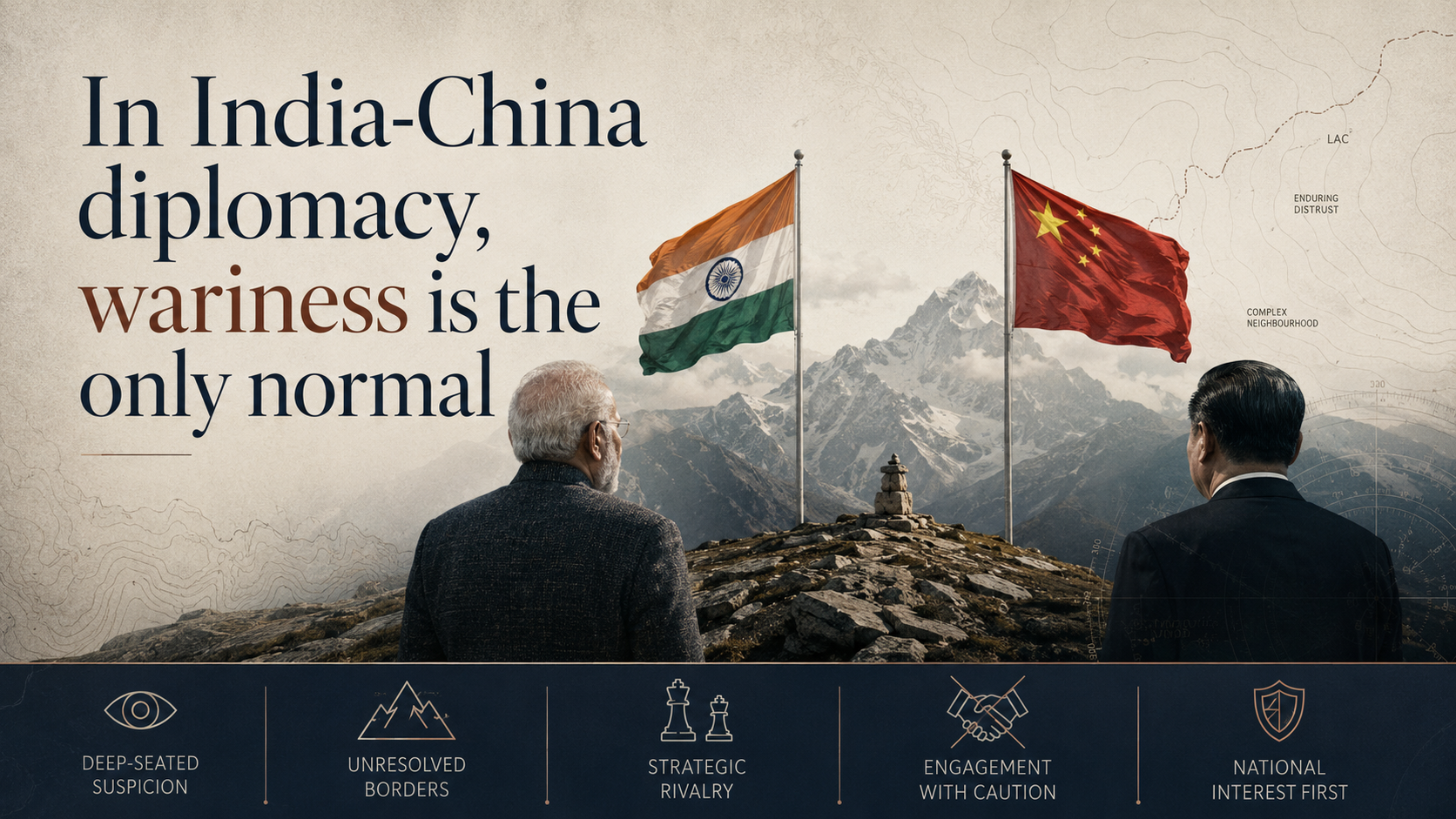
The writer’s central argument is that deeply embedded wariness, not a failure of diplomacy, is the operating method of India-China relations: both sides manage friction through carefully calibrated joint language, incremental confidence-building measures and studied ambiguity on sensitive questions such as Tibet and Xi Jinping’s BRICS attendance. The near-term test of this method will be the SCO summit in Bishkek from August 31 to September 1 and the BRICS summit in Delhi on September 12.
India-China Relations
- A boundary dispute rooted in the 1962 war: India and China share an unresolved boundary along the Line of Actual Control (LAC), the subject of the 1962 Sino-Indian War, and have since built a layered set of confidence-building mechanisms rather than a settled border.
- The Special Representatives mechanism: Established in 2003, the SR talks are the highest-level bilateral channel for discussing a framework settlement of the boundary question, distinct from routine military and diplomatic contacts.
- Galwan reset the relationship’s tenor: The 2020 Galwan Valley clash, the first fatal India-China military confrontation in over four decades, froze high-level engagement for years before talks such as the current SR round resumed.
- Trade imbalance runs alongside the security relationship: India runs a large and persistent trade deficit with China even as both sides pursue diplomatic normalisation, a structural feature of the relationship independent of the boundary talks.
Key Facts about India-China Relations
- Agreement on Political Parameters, 2005: Sets out the guiding political parameters and principles for a boundary settlement, and remains the reference framework the current “Early and Substantial Harvest” language explicitly operates without prejudice to.
- SCO membership since 2017: India and China are both members of the Shanghai Cooperation Organisation, the same platform hosting the Bishkek summit immediately after the current round of SR talks.
Challenges in India-China Relations
- Unresolved boundary despite repeated confidence-building measures: Decades of hotlines, meeting points and expert mechanisms have reduced the risk of miscalculation without resolving the underlying territorial claims. Eg. The Eastern and Middle sector hotlines agreed in the current round only supplement, rather than replace, the unresolved 2005 political parameters framework. Fix. Anchor future confidence-building measures to specific, dated delimitation milestones rather than open-ended review mechanisms.
- Structural trade dependence on China: India’s electronics, pharmaceutical and solar manufacturing sectors remain dependent on Chinese intermediate goods and active pharmaceutical ingredients, a vulnerability that persists regardless of the state of boundary diplomacy. Eg. India’s trade deficit with China has stayed among its largest with any single country for over a decade. Fix. Accelerate production-linked incentive schemes targeting the specific intermediate goods categories where import dependence is highest, rather than broad-based manufacturing incentives.
Back2Basics: What is the Line of Actual Control (LAC)?
- A de facto, not a demarcated, boundary: The Line of Actual Control is the notional line separating Indian-controlled and Chinese-controlled territory, distinct from an internationally recognised or mutually demarcated border, and both sides hold differing perceptions of exactly where it runs in several sectors.
