Why in the News
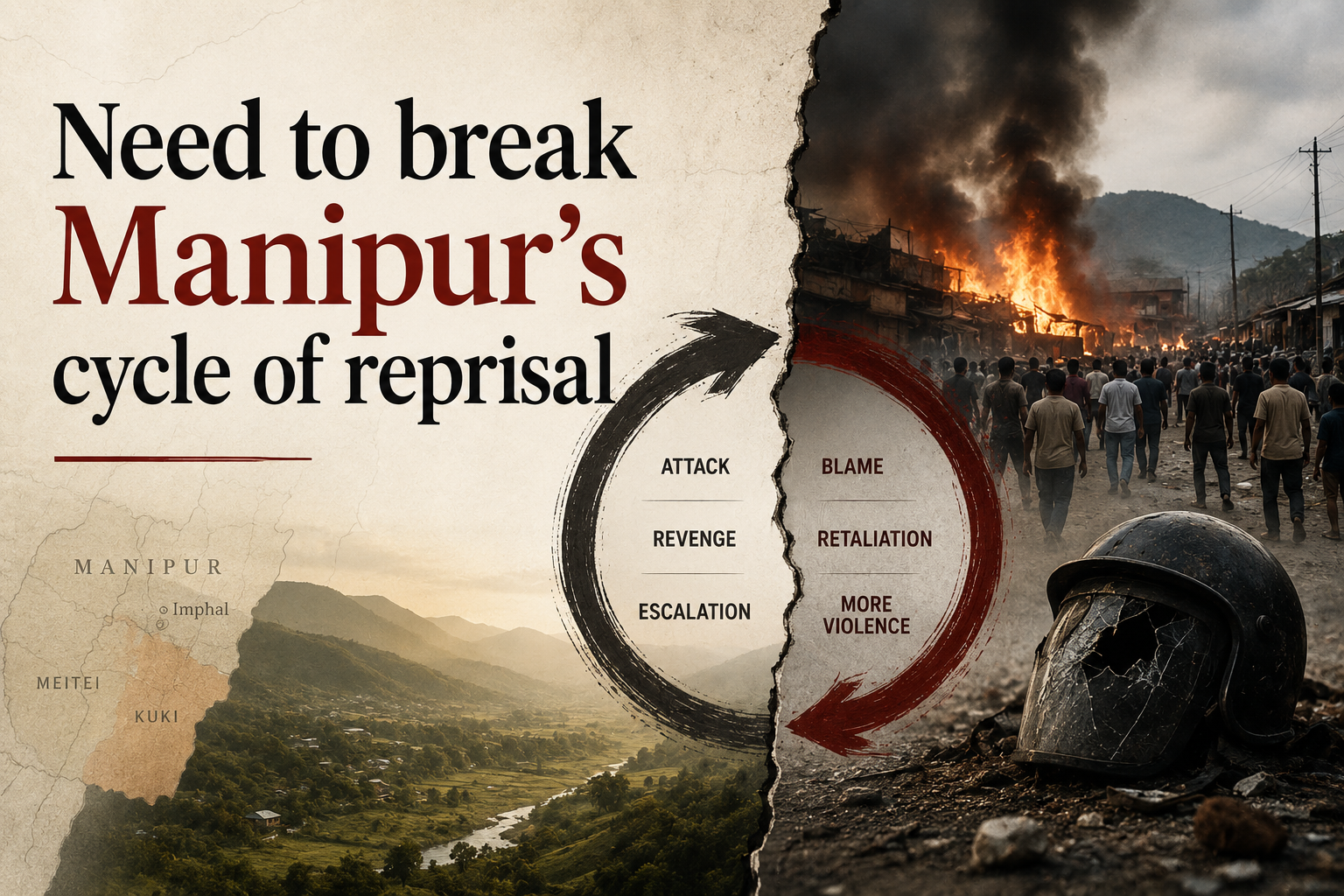
More than three years after the Meitei-Kuki clashes began, Manipur now faces a deepening Kuki-Naga fault line. Four Naga civilians were killed this week in Kuki-dominated Kangpokpi district, an episode that follows the killing of Kuki-Thadou church pastors in May, retaliatory abductions on both sides, and the recovery a month later of the bodies of six Naga men.
How has the conflict widened beyond the original Meitei-Kuki fault line?
- A second, distinct fault line has opened: What began as Meitei-Kuki violence in 2023 has produced a separate Kuki-Naga confrontation, evident in this week’s killing of four Naga civilians in Kangpokpi, a district that sits between Naga-dominated Senapati to the north and Meitei-dominated valley districts to the south.
- A traceable chain of retaliation: The killing of Kuki-Thadou pastors in May was followed by retaliatory abductions from both communities, and the subsequent recovery of six Naga men’s bodies a month later, establishing a pattern of reprisal rather than an isolated incident.
- Blockades have turned roads into contested territory: Meitei, Kuki and Naga groups have separately imposed blockades that disrupt supplies, raise the cost of food and fuel, and restrict access to healthcare, with Kangpokpi the worst affected due to its position between rival-dominated districts.
Why has the return of an elected government failed to restore order?
- A power-sharing arrangement has not translated into reconciliation: The state government led by Yumnam Khemchand Singh, a Meitei chief minister with deputy chief ministers from the Kuki and Naga communities, returned in February after almost a year of President’s Rule, but has found little success pulling the state back from the brink.
- Social segregation has outpaced political representation: The communities remain socially segregated, so political representation across the three groups in government has not by itself addressed the everyday separation that sustains distrust and enables further violence.
- Displacement has produced a significant, undercounted toll: Right to Information data has revealed that more than 700 internally displaced people have died in relief camps, a toll separate from and additional to deaths from direct violence.
Challenges to a political settlement in Manipur
- Security forces have struggled to secure supply routes: Security forces have had very little success ensuring the safe movement of convoys carrying essential supplies through blockaded areas. Eg. Blockades imposed by Meitei, Kuki and Naga groups have repeatedly disrupted the movement of food, fuel and medical supplies into Kangpokpi and surrounding districts. Fix. Establish dedicated, jointly monitored humanitarian corridors for essential supplies, with monitoring involving representatives from all three communities rather than security forces alone.
- Armed groups remain undisbanded: Militant groups from multiple communities continue to operate, and a crackdown on extremist elements has not kept pace with the scale of continuing violence. Eg. The killing of four Naga civilians in Kangpokpi this week, alongside the earlier killing of Kuki-Thadou pastors, shows armed actors from more than one community remain capable of carrying out attacks. Fix. Pursue simultaneous, verifiable disarmament commitments from armed groups across all three communities rather than sequencing disarmament by community.
- No agreed framework exists for resolving land and identity claims: Every claim over land and identity cannot be resolved overnight, and the absence of an interim framework leaves communities without a safe basis for movement, trade or daily coexistence. Eg. The overlapping blockades by all three communities show there is currently no shared understanding of which areas each community can safely access. Fix. Prioritise an interim framework guaranteeing safe movement, trade and access to essential services, deferring final land and identity settlements to a later, dedicated political process.
Conclusion
The editorial’s position is that political representation alone, through a Meitei chief minister and Kuki and Naga deputy chief ministers, cannot resolve a conflict sustained by social segregation and repeated cycles of reprisal. It calls for sustained dialogue empowering civil society leaders, an interim framework for safe movement and trade, and simultaneous disarmament and action against extremist elements, alongside the immediate arrest of those responsible for this week’s killings.
Back2Basics: What is President’s Rule?
Central takeover of state governance: President’s Rule, imposed under Article 356 of the Constitution, allows the Union government to assume direct control of a state’s administration when its constitutional machinery is deemed to have broken down, as occurred in Manipur for nearly a year before the elected government returned in February.
