Why in the News
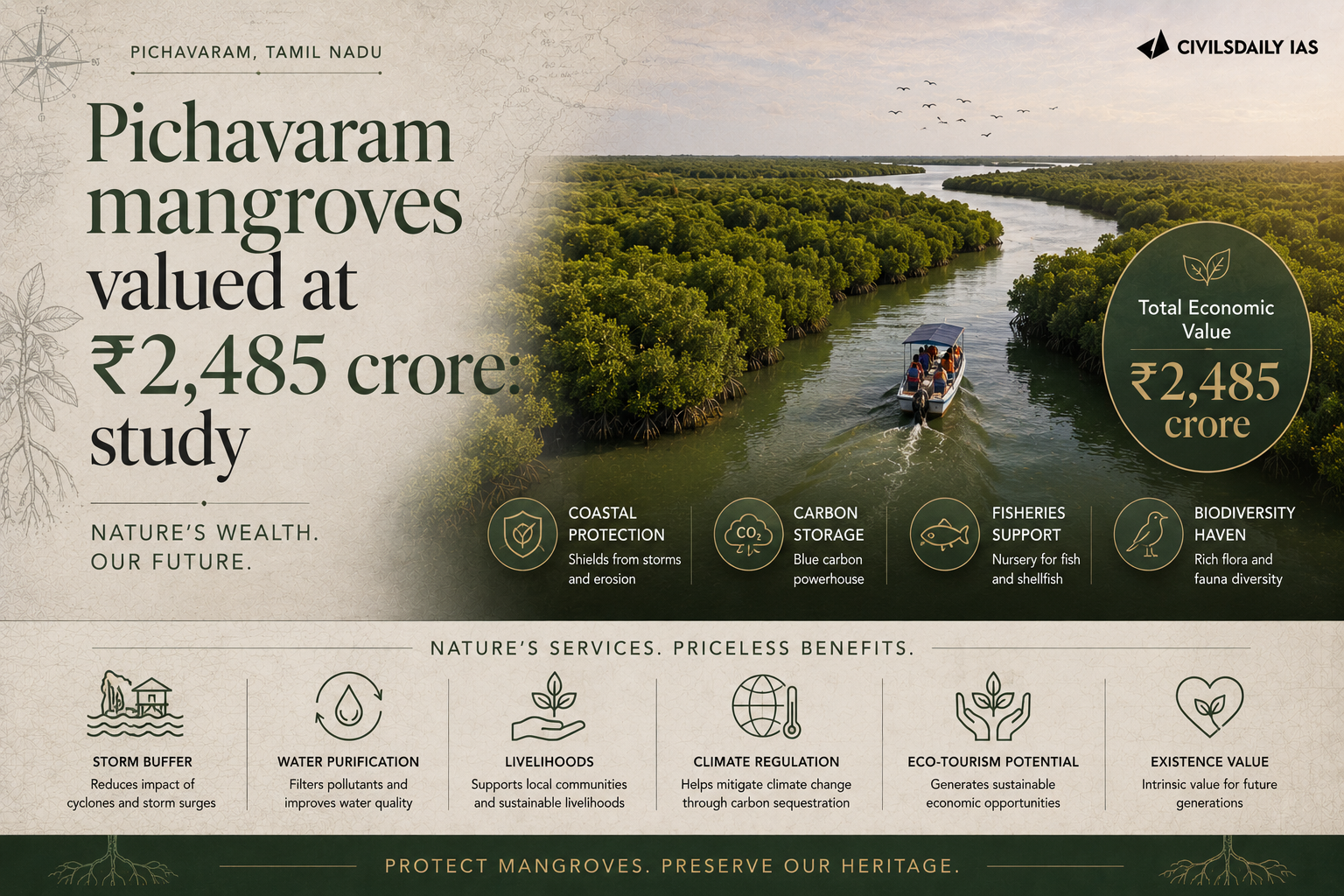
A study of the Pichavaram mangrove ecosystem in Tamil Nadu has put its total economic value (TEV) at ₹2,485.38 crore, with a per hectare value of ₹1.83 crore. The valuation covers ecological, economic and social benefits together, and includes a separate blue carbon assessment of what the forest stores. The study was carried out at the Centre for Ecological Economics and Natural Resources, Institute for Social and Economic Change, Bengaluru, and was funded by the Forest Genetics Division, Coimbatore. The tension it identifies is that most of what a mangrove supplies is non market in nature, so it never enters the accounts that development planning actually uses.
What is ecosystem service valuation?
- About: Ecosystem service valuation attaches a monetary figure to the benefits a natural system supplies, so that those benefits can be compared against the returns from converting the same land to another use.
- The four service categories: Mangrove systems supply provisioning, regulating, supporting and cultural ecosystem services. Provisioning covers physical output such as fish, regulating covers functions such as storm buffering and climate regulation, supporting covers processes such as nutrient cycling, and cultural covers non material benefits.
- Total economic value: TEV is the aggregate of all these service flows expressed in one figure, rather than only the marketed output the system yields.
What did the valuation measure?
- The headline value: The total economic value of the Pichavaram mangrove ecosystem stands at ₹2,485.38 crore, and the per hectare value at ₹1.83 crore.
- Sediment holds more carbon than the trees: The analysis found that mangrove sediments constitute a more substantial carbon reservoir than the vegetation.
- Soil carbon density: Average soil organic carbon stock was estimated at 251.14 tonnes of carbon per hectare, generating an economic value of ₹90.24 lakh per hectare.
- Combined blue carbon asset: With vegetation and soil carbon pools taken together, the total blue carbon asset value of the ecosystem is ₹1,612.40 crore. Blue carbon is the carbon captured and stored by coastal and marine vegetation and the sediment beneath it.
Why do these benefits stay out of development planning?
- The services are non market: Several ecological benefits are non market in nature and are not reflected in market transactions, so they generate no price a planner can read.
- Undervaluation is the consequence: Many ecosystem services remain undervalued in conventional development planning even where their contribution to ecological sustainability and human well being is established.
- Valuation is the bridge: A single expressed figure allows a non market service to be set against a marketed alternative use of the same coastal land.
What makes Pichavaram ecologically significant?
- Status: It is deemed one of the most ecologically significant coastal wetland ecosystems in India.
- Biodiversity and fisheries: It supports biodiversity conservation and fisheries productivity.
- Coastal protection and climate regulation: It provides coastal protection, climate regulation and blue carbon sequestration.
- Livelihood security: It underpins livelihood security for the coastal communities that depend on it.
How was the study built?
- Primary and secondary data: The assessment combined primary field data with secondary sources rather than relying on modelled estimates alone.
- Household survey base: Primary information was collected from 302 households across five mangrove dependent villages.
- The villages covered: The five are MGR Thittu, Kalaignar Nagar, Chinnavaikal, Patriadi and Mudasalodai.
What does the study recommend?
- Valuation inside planning: Ecosystem service valuation should be integrated into coastal development planning and environmental decision making.
- Mangroves as nature based solutions: Mangroves should be recognised as key nature based solutions for climate adaptation and disaster risk reduction.
- Finance instruments: Blue carbon financing mechanisms, carbon credit programmes and Payment for Ecosystem Services schemes should be developed for these systems.
Challenges to using ecosystem service valuation in coastal planning
- A non market service produces no cash flow: A protective service is realised only when the hazard it guards against actually occurs, so it never appears in a project’s financial statement. Eg. Mangrove storm buffering shows up as damage avoided during a cyclone landfall, which no project account records.
The Fix: Require the ecosystem service value of the land to be entered as a stated line item in the cost benefit statement of every coastal infrastructure clearance. - Valuation methods are contested: Survey based techniques such as willingness to pay measure what nearby residents can afford rather than what the service is worth to the wider economy. Eg. Household surveys in poor mangrove dependent villages return low willingness to pay figures for the same service that protects a city downstream.
The Fix: Publish the method, the sample and the confidence range alongside every headline valuation figure so the number can be contested on its assumptions. - Aquaculture and land conversion drive mangrove loss: The land use that competes with mangrove is profitable, immediate and privately captured, while the service lost is diffuse and public. Eg. Shrimp pond expansion along the Tamil Nadu and Andhra Pradesh coast has cleared mangrove and adjoining back swamp.
The Fix: Tie Coastal Regulation Zone enforcement to satellite based mangrove cover monitoring with annual public reporting at the district level. - Blue carbon credits lack a settled soil accounting standard: Sediment carbon is the largest pool and the least standardised, so the same forest yields different credit volumes under different protocols. Eg. Soil carbon is measured to one metre depth in some protocols and deeper in others.
The Fix: Adopt a single national measurement protocol for mangrove soil organic carbon before any credit is issued against Indian mangrove land. - Restoration often replaces hydrology with planting: Plantation drives on sites that were never mangrove habitat produce low survival and no service recovery. Eg. Monoculture planting on open mudflats has repeatedly failed where tidal flushing was never restored.
The Fix: Restore tidal connectivity and creek hydrology first, and allow natural regeneration to determine species composition.
Conclusion
A valuation changes nothing by itself. It changes outcomes only when the figure enters the document that decides land use, and coastal zone plans in India are still written without one. Tamil Nadu’s coastal clearances are the place this will show. The marker to watch is whether an approval order for coastal land begins citing a per hectare service value against the project it is approving.
Back2Basics
- Location: The Pichavaram mangrove forest lies in Cuddalore district on the Tamil Nadu coast.
- Setting: It sits in the estuarine complex formed between the Vellar and Coleroon rivers, adjoining the Killai backwater.
- Scale: It is among the largest mangrove forests in India and is made up of a network of islets separated by tidal creeks.
- Composition: Avicennia and Rhizophora are the dominant mangrove genera across the forest.
[2023, GS3, 15 marks] Comment on the National Wetland Conservation Programme initiated by the Government of India and name a few India’s wetlands of international importance included in the Ramsar Sites.
