Why in the News
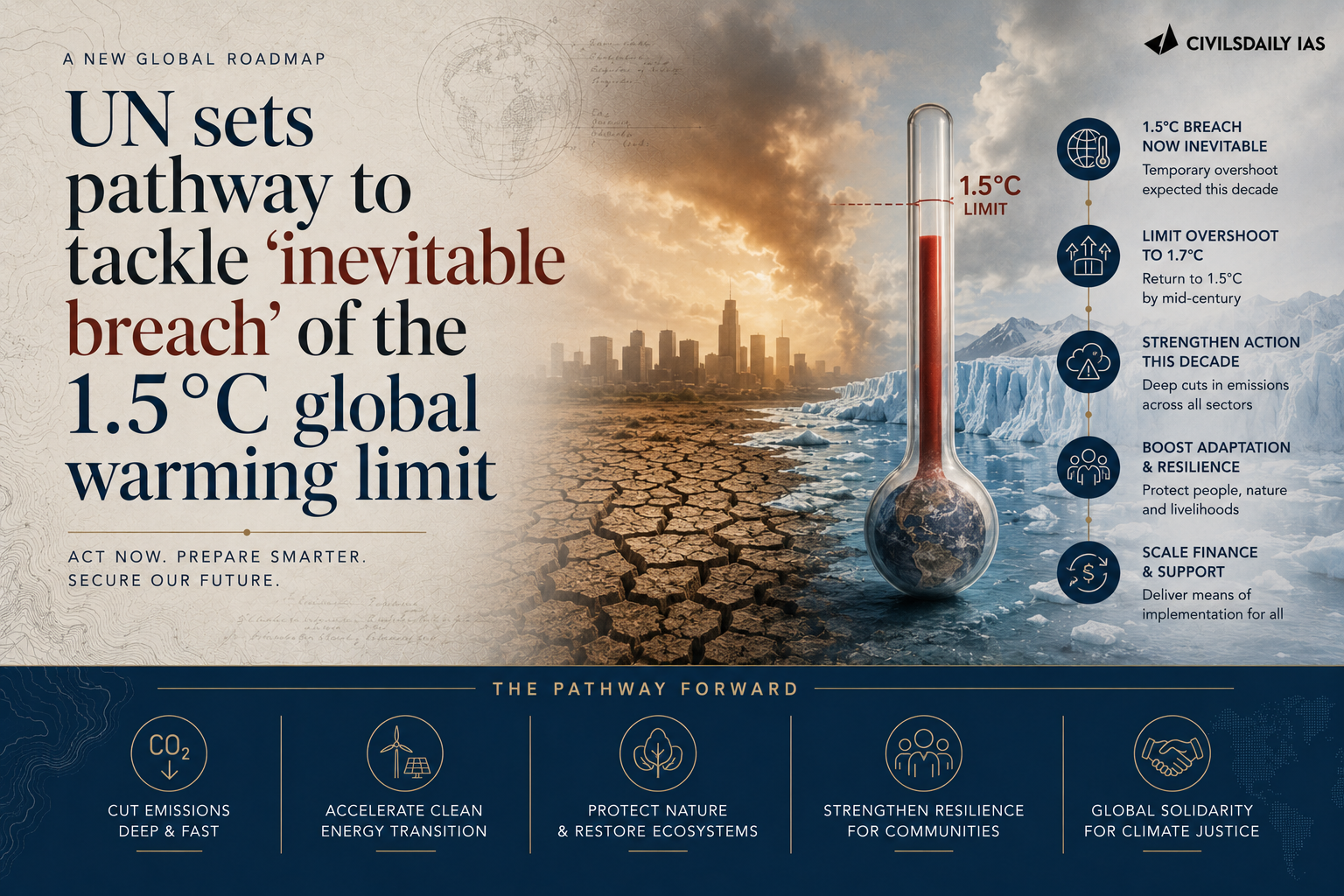
The United Nations Environment Programme (UNEP) has for the first time set out a detailed “overshoot, peak, and decline” pathway for global warming. Its report, Limiting Overshoot, states that a breach of the 1.5 degrees Celsius limit is now unavoidable and will bring irreversible ecological losses that no adaptation initiative can undo. That limit is the central goal of the Paris Agreement, 2015, which committed parties to holding the rise in average global temperatures well below 2 degrees Celsius and to pursuing efforts to limit it to 1.5 degrees Celsius above pre industrial levels. The shift is in the framing rather than in the science: the objective being planned for is no longer the prevention of a breach but the management of one, described in the report itself as by no means an acceptable or preferred pathway and simply the best remaining option.
What is the “overshoot, peak, and decline” pathway?
- The sequence it describes: Average global temperature crosses the 1.5 degrees Celsius limit, rises to a peak, and is then brought back down below the limit by 2100.
- What it tries to control: With the crossing treated as fixed, the two variables left are the height of the peak and the length of time spent above the limit, and the pathway seeks to hold both as low as possible.
- What it requires that mitigation alone does not: Returning below the limit after a peak requires removing carbon dioxide already in the atmosphere, not only stopping additional emissions.
What do the warming projections show?
- The breach is imminent: Global warming will cross 1.5 degrees Celsius in the next few years.
- Full delivery of every pledge still overshoots: A scenario in which every country delivers on its national climate plan and its net zero target puts peak warming at 1.8 degrees Celsius.
- Current policies point far higher: They point to a rise of about 2.6 degrees Celsius by 2100, within a range of 1.9 to 3.6 degrees Celsius.
What are the compounding costs of time spent above 1.5 degrees Celsius?
- Sea level and ocean systems: Sea level rise accelerates, and coral reefs collapse.
- Cryosphere: Glacier loss exceeds a quarter of global glacier mass by 2100.
- Food systems: Global food production declines by up to 14% by 2050 without effective adaptation.
- Tipping points: The odds rise of irreversible transitions in the West Antarctic and Greenland ice sheets, the Atlantic Meridional Overturning Circulation, the ocean current system that redistributes heat across the Atlantic, and the Amazon.
Why is reversing an overshoot harder than avoiding it?
- Delay adds warming at a fixed rate: Every five years of continued high emissions adds roughly 0.1 degrees Celsius to peak warming.
- Removing the same warming costs far more than adding it: Reversing that 0.1 degrees Celsius afterwards means pulling about 220 billion tonnes of carbon dioxide out of the atmosphere, over and above whatever is still being emitted.
- Emission cuts alone no longer close the gap: A steep scaling up of nature based removals, such as large reforestation programmes, is required alongside them.
Why does the report single out methane?
- A first for the United Nations: This is the first time a report of this kind has placed significant stress on methane rather than treating carbon dioxide as the only lever.
- Its share of the problem is large: Methane contributes about 0.5 degrees Celsius of current warming.
- It is the fastest acting lever available: Cutting methane is described as the most effective way to slow warming in the near term, which is precisely what holding down the peak requires.
How was the diplomatic ground for conceding an overshoot laid?
- The concession was made first at a climate conference, not in a science report: The 30th UN Climate Change Conference (COP30), held in 2025 at Belém in Brazil, produced the consensus “Global Mutirão” decision, mutirão being a Portuguese term for collective effort.
- What made it significant: It was the first COP text to concede that a temporary overshoot of the 1.5 degrees Celsius limit was likely, given how fast the remaining carbon budget was being spent.
- The political framing accompanying the report: This summer’s heat, wildfires and floods have been described as a warning of what lies ahead, with the stated objective now to make the overshoot as small and as short as possible.
Challenges to an overshoot, peak and decline pathway
- Carbon removal at the required scale does not exist: The pathway assumes gigatonne scale removal that current technology and land availability cannot deliver. Eg. Operating direct air capture plants worldwide remove a volume measured in thousands of tonnes a year against a requirement measured in billions.
The Fix: Separate emission reduction and removal targets in every nationally determined contribution, so removal cannot be used to discount a country’s reduction obligation. - Overshoot creates a moral hazard in near term policy: Once a temporary breach is accepted as planned for, the incentive to cut now weakens, because the shortfall is deferred to a future removal obligation. Eg. Net zero pledges dated to mid century already rely on unspecified future removals to close the residual gap.
The Fix: Fix binding five year interim carbon budgets, so a country’s compliance is assessed against cumulative emissions rather than against a distant target year. - Tipping points are not reversible when the temperature comes back down: Bringing temperature below the limit later does not restore a system that has already crossed its threshold. Eg. An ice sheet that has begun irreversible retreat continues losing mass even after warming stabilises.
The Fix: Set the peak temperature, rather than the end of century value, as the headline metric against which climate policy is assessed. - Nature based removal competes with food and land rights: Large reforestation programmes need land that is already used for cultivation, grazing or forest dwelling communities. Eg. Plantation drives on land recorded as degraded have displaced pastoral and forest dependent use in several countries.
The Fix: Require free, prior and informed consent and a land tenure audit before any removal project is counted towards a national target. - The cost falls on countries that did not cause the overshoot: Adaptation finance to survive the period above the limit is needed by economies with the least capacity to raise it. Eg. Small island developing states face permanent territorial loss from sea level rise they contributed almost nothing to.
The Fix: Tie disbursement from the loss and damage fund to a published overshoot period schedule, so the finance arrives during the years the harm is being incurred.
Conclusion
The value of this pathway is that it makes the cost of delay arithmetic rather than rhetorical. Warming added by continuing to emit is cheap and automatic; warming removed afterwards is expensive, slow and dependent on technology that has not been built at scale. That asymmetry is what converts a distant target year into an immediate operational question about the next few years of emissions. The reform that follows is to shift the metric climate policy is judged on, from a date by which a country claims to reach balance to the height of the peak its emissions in this decade produce.
[2025, GS3, 15 marks] Write a review on India’s climate commitments under the Paris Agreement (2015) and mention how these have been further strengthened in COP26 (2021). In this direction, how has the first Nationally Determined Contribution (NDC) intended by India been updated in 2022?”
