Why in the News
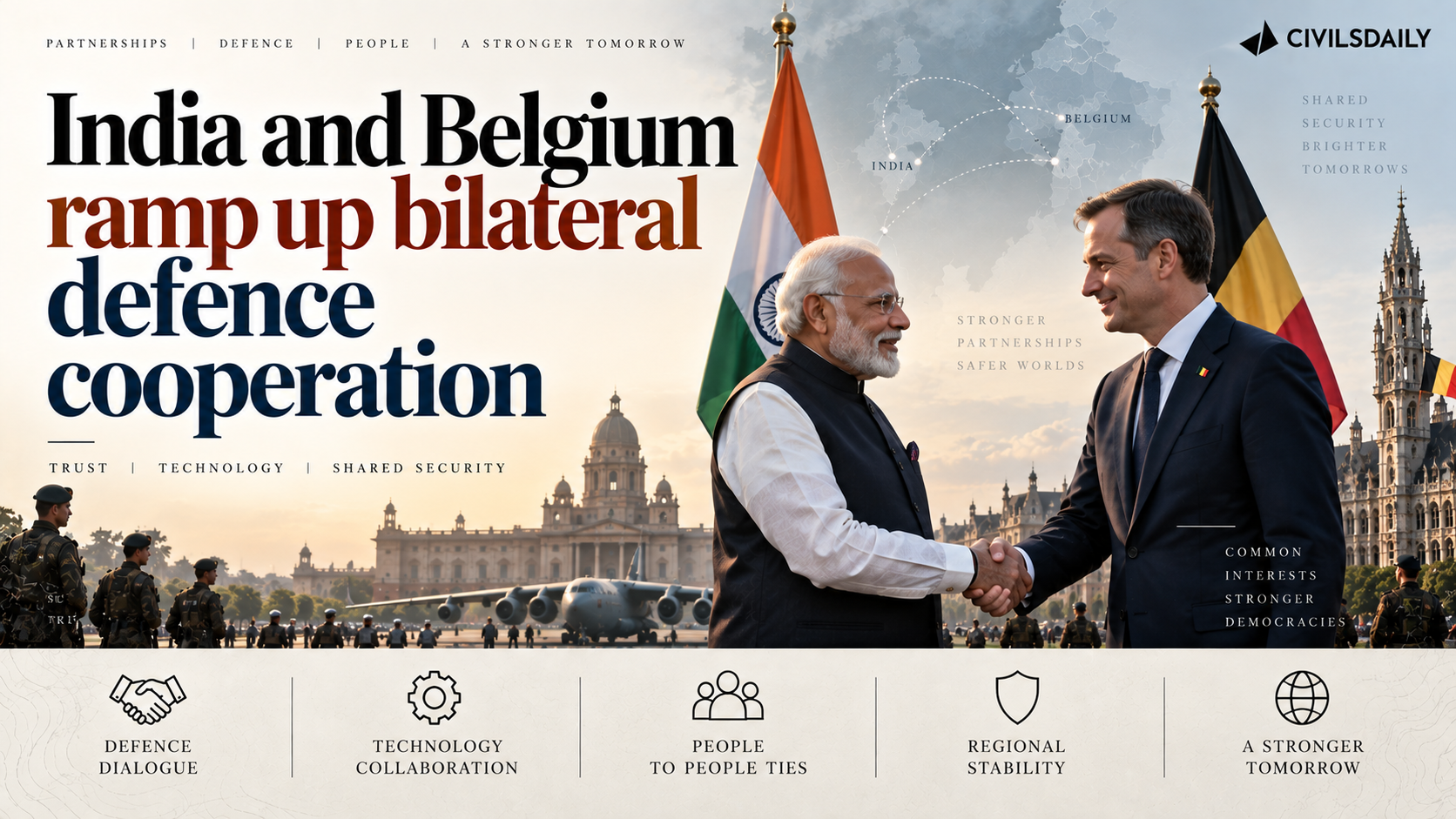
India and Belgium have signed three government level defence agreements, ramping up a defence relationship that had carried no framework instrument.
What was signed at the government level?
- A Letter of Intent on Defence Cooperation: Signed by the two defence ministries, it covers training, officer exchanges, research and development, seminars, joint exercises and maritime security.
- An industry to industry Memorandum of Understanding (MoU): It links the Belgian Security and Defence Industry association with the Society of Indian Defence Manufacturers.
- A law enforcement MoU: The Central Bureau of Investigation (CBI) and the Belgium Federal Police agreed to cooperate on transnational organised crime, cybercrime and related matters.
Which capability areas does the defence cooperation target?
- Maritime and undersea systems: Mine countermeasures, autonomous maritime systems, underwater robotics and sensors are named focus areas.
- Critical infrastructure protection: The list extends to protection of ports, pipelines and subsea data cables.
- Conventional and emerging systems: Ammunition, radar, electro optical sensors, command and control, and counter drone systems are covered.
- The engagement machinery: The two Defence Ministers agreed to expand contact through a defence cooperation dialogue, high level visits, training and capacity building, and acknowledged the need for greater maritime security collaboration in the Indo-Pacific.
What was announced alongside the signed instruments?
- A resident defence presence in Brussels: India announced the appointment of a Defence Attache at its Embassy in Brussels.
- A trade and investment channel: A fast trade mechanism was established to handle trade and investment, alongside a commitment to double bilateral trade over the next five years.
- A Consular Dialogue: A standing consular channel was established between New Delhi and Brussels.
- Private sector agreements: At least ten private defence agreements were sealed during the visit, including production of Belgian military items such as rockets in India.
Where does the economic relationship currently stand?
- Merchandise trade: Bilateral trade stood at $13.01 billion in 2025-26.
- Investment: Belgian foreign direct investment into India was about $4.2 billion between April 2000 and December 2025.
- The Belgian trade position: The Belgian side described the global situation as turbulent and called for free trade and an end to the unilateral imposition of tariffs.
What did the two sides agree on regional and global security?
- The Pakistan assurance: India raised concerns over Belgian defence technology or expertise reaching Pakistan, and received an assurance that there is no question of such cooperation.
- Terrorism: The Belgian side supported India’s campaign against cross border terrorism and condemned the Pahalgam terror attack.
- Maritime routes: The joint statement called for the safety and security of maritime routes and for safe and unimpeded maritime shipping, in the context of the conflicts in West Asia and Ukraine.
- Conflict resolution: Both sides supported efforts aimed at an early end to the conflicts in Ukraine and West Asia, and backed a just peace in Ukraine consistent with the United Nations Charter.
- A shared historical marker: The two leaders paid tribute to the more than 9,000 Indian soldiers who died at Flanders Fields during the First World War.
Challenges to India Belgium defence cooperation
- A Letter of Intent creates no obligation: It records agreed areas of work and binds neither side to a contract, a value or a timeline. Eg. India’s defence industrial roadmaps with European partners have taken years to convert into signed production contracts.
The Fix: Attach a dated work plan with a named nodal agency on each side, reviewed at every defence cooperation dialogue. - Export clearance does not sit with the federal government alone: Belgian arms export licences are issued at regional government level and operate under the European Union common position on arms exports. Eg. Flanders and Wallonia license equipment produced in their own regions separately.
The Fix: Negotiate a programme level licence assurance at the time of contract, instead of clearance obtained shipment by shipment. - Joint production usually stops at final assembly: Technology transfer in Indian defence tie ups has historically covered assembly rather than the propellant, seeker or sensor core. Eg. Several ammunition and rocket partnerships have delivered kits assembled in India from imported subsystems.
The Fix: Write a phased indigenous content schedule into each private agreement, measured at component level rather than by value. - A political assurance is not a contractual clause: An undertaking on third country transfers given in a bilateral meeting is not enforceable in any signed instrument. Eg. The assurance on Pakistan was conveyed through officials rather than recorded as a treaty obligation.
The Fix: Convert the undertaking into an end use and non transfer clause in every follow on agreement signed under the Letter of Intent. - The trade base is narrow: The exchange is dominated by a single commodity group, so a doubling target rests on a thin sectoral spread. Eg. Antwerp’s diamond trade accounts for the bulk of India Belgium merchandise flows.
The Fix: Set named non gem sectoral milestones under the fast trade mechanism, so the target is measured outside the diamond trade.
Conclusion
A relationship built largely on trade has acquired a defence framework in the space of a single visit. What has been signed is intent, an industry linkage and a police cooperation channel, and the substance now depends on what follows them. Two things are worth watching: whether the private production agreements reach contract, and whether the trade target is pursued in sectors outside the commodity group that currently dominates the exchange.
Back2Basics: Society of Indian Defence Manufacturers
- What it is: The apex industry body representing Indian defence manufacturers, which acts as the single interface between the domestic defence industry and the Ministry of Defence.
- Origin: It was set up in 2017, promoted by the Confederation of Indian Industry.
- Membership: It spans defence public sector undertakings, large private manufacturers and micro, small and medium enterprises in the defence supply chain.
- What it does: It signs cooperation agreements with counterpart industry associations abroad, and represents industry positions on procurement policy and indigenisation.
[2023, GS2, 15 marks] ‘The expansion and strengthening of NATO and a stronger US-Europe strategic partnership works well in India.’ What is your opinion about this statement? Give reasons and examples to support your answer.
