| Question (2025, GS3 – 15 Marks): “Write a review on India’s climate commitments under the Paris Agreement (2015) and mention how these have been further strengthened in COP26 (2021). In this direction, how has the first Nationally Determined Contribution (NDC) intended by India been updated in 2022? Linkage: This is the most direct conceptual parallel. To analyze the gap between “climate pledges” and “actual policy trajectory” highlighted by the UNEP, candidates must evaluate India’s specific NDCs under the Paris Agreement, how they were upgraded at COP26, and their final 2022 formalization |
Mentor Comment
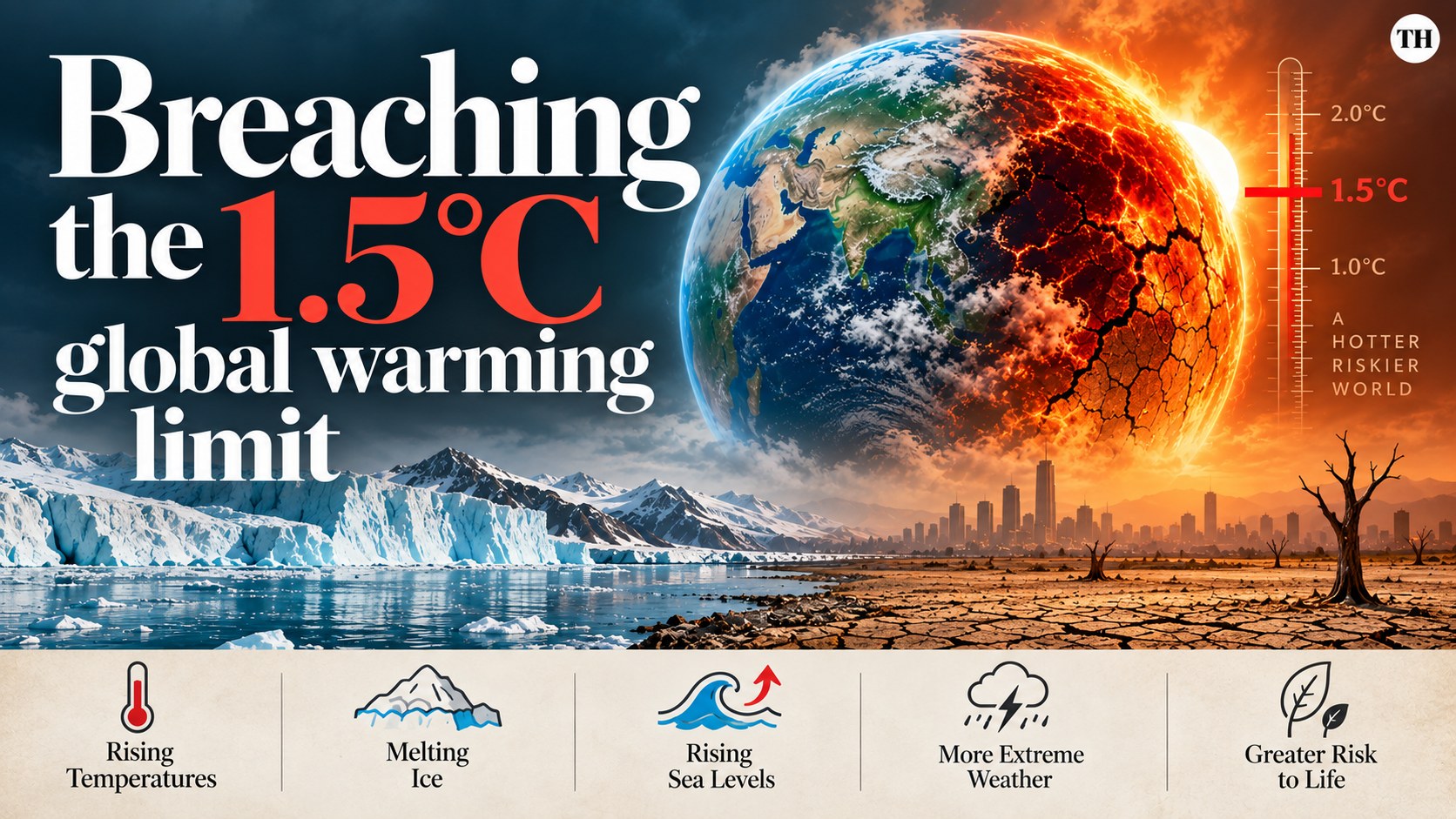
The United Nations Environment Programme (UNEP) has found that breaching the 1.5 degrees Celsius global warming limit brings irreversible losses that adaptation cannot undo. Its report, Limiting Overshoot, accepts that the limit has already been breached. Full delivery of every existing national climate pledge still puts the world on course for 1.8 degrees Celsius, and current policies point to 2.6 degrees Celsius. The report’s new emphasis falls on greenhouse gases other than carbon dioxide, and on methane above all. The disagreement it reopens is between assessments that measure climate progress by mitigation and major developing economies that measure it by the finance and technology they receive. That disagreement now reaches India directly, because a smaller neighbour hit by a glacial disaster has named India among the emitters responsible.
What is the “overshoot, peak and decline” pathway?
- What it describes: Average global temperatures rise above the 1.5 degrees Celsius limit, countries hold that peak as low as they collectively can, and temperatures are brought back below the limit by the end of the century.
- Why the peak is the variable that matters: Neutralising the heating effect of even a tenth of a degree is far harder than preventing that rise in the first place, so every fraction avoided at the peak is a fraction that never has to be reversed.
- What it refuses to concede: The pathway accepts the scientific reality of a 1.5 degrees Celsius world and rejects the conclusion that nothing further can be done once the threshold is crossed.
Why has the report shifted attention to gases other than carbon dioxide?
- Methane carries a large share of present warming: It is responsible for about 0.5 degrees Celsius of current warming, so cutting it changes the temperature curve within years rather than decades.
- It is the fastest available brake: Action on methane is treated as the most effective way to slow warming in the near term, which is precisely the window in which the peak is decided.
- The collective instrument already exists: More than 155 countries have joined the Global Methane Pledge, committing to cut anthropogenic methane at least 30 percent below 2020 levels by 2030.
- India stands outside it: India has not joined the Pledge, so the single fastest near term lever is not one the country has committed to pull.
Why do major developing economies resist a mitigation first framing?
- They claim the transition is already under way: These economies argue that they are moving away from fossil fuels and should not be assessed as though they were not.
- The damage they face comes from someone else’s stock: Their vulnerability arises from historical accumulations of carbon released by richer developed countries, which is the basis of their claim to greater financial support and affordable technology.
- The report is silent where they are loudest: Limiting Overshoot has little to say on adaptation finance, so the question these economies bring to every negotiation goes unanswered in the assessment they are asked to act on.
How does the Bhotekoshi disaster complicate India’s position?
- A vulnerable neighbour has named India: Nepal’s Foreign Affairs Minister has said that major industrial emitters such as China, the United States and India must consider the impact of rising temperatures on small countries such as Nepal.
- The victim framing no longer holds unchallenged: India’s per capita emissions remain below the world average, and a section of the world nonetheless now places India within the group causing the problem rather than the group suffering it.
- The next negotiation is dated: Countries convene in Turkiye in November for COP31, where the familiar disagreements over mitigation and finance are expected to resurface with this new complication attached.
Challenges to the overshoot, peak and decline pathway
- The return leg depends on removal capacity that does not exist at scale: Bringing temperatures back below the limit assumes large volumes of carbon dioxide will be removed from the atmosphere later in the century. Eg. The direct air capture plants operating in Iceland remove tens of thousands of tonnes a year at most, against annual global emissions measured in tens of billions of tonnes.
The Fix: Treat removal as a supplement to be verified and funded now, and set peak temperature targets that assume no removal beyond capacity already demonstrated. - Some losses do not reverse when the temperature does: Ice sheets, coral reefs and glaciers respond to the peak rather than to the eventual average, so returning below 1.5 degrees Celsius does not restore what the overshoot destroyed. Eg. The August 2026 glacial collapse on the Nepal China border destroyed valleys that no later cooling will reconstitute.
The Fix: Attach separate thresholds for irreversible systems to the pathway, so peak height is judged against them rather than against the century end average alone. - The methane lever sits with countries that have not pulled it: The largest sources of anthropogenic methane are concentrated in a handful of economies outside the Pledge. Eg. India’s methane arises chiefly from livestock and paddy cultivation, which are livelihood activities rather than industrial infrastructure that can be shut down.
The Fix: Fund livestock feed and paddy water management programmes that cut methane without cutting output, so the reduction is not paid for by farm incomes. - The pathway offers nothing to those already past adaptation: A framework organised around peak management assumes adaptation absorbs the interim, and for the most exposed countries it does not. Eg. Nepal contributes a negligible share of global emissions and has lost roughly a tenth of its economy to a single event.
The Fix: Pair every overshoot pathway with a stated adaptation finance figure, so the interim period carries a costed obligation rather than an assumption.
Conclusion
The threshold argument is over and the argument about who pays for its consequences is not. India has spent three decades arguing that historical responsibility sits elsewhere, and that argument is now being made about India by a country downstream of the Himalayas. Refusing the mitigation frame no longer settles the question, because the objection is arriving from the Global South rather than from the West. What to watch is whether India carries a methane position and an adaptation finance demand into COP31 as a single package, or continues to press the second while declining the first.
Back2Basics: United Nations Environment Programme
- What it is: The United Nations body responsible for setting the global environmental agenda and coordinating environmental work across the UN system.
- When it was created: It was established in 1972, following the United Nations Conference on the Human Environment held at Stockholm that year.
- Where it sits: Its headquarters are at Nairobi, making it the first UN agency headquartered in a developing country.
- What it publishes: Its recurring assessments include the Emissions Gap Report, the Adaptation Gap Report and the Global Environment Outlook.
