
Why in News?
- WHO has validated Bhutan as the first country in the South-East Asia Region to eliminate dog-transmitted rabies as a public health problem. India aims to eliminate human deaths from dog-mediated rabies by 2030.
What does WHO Validation Mean?
- Not virus eradication: It means elimination of human deaths from dog-mediated rabies.
- The virus may still exist in wildlife reservoirs.
- 2 years: No human deaths from dog-mediated rabies for at least two consecutive years.
- The country must demonstrate capacity to prevent re-emergence through surveillance and response.
How did Bhutan achieve it?
Two-pronged strategy
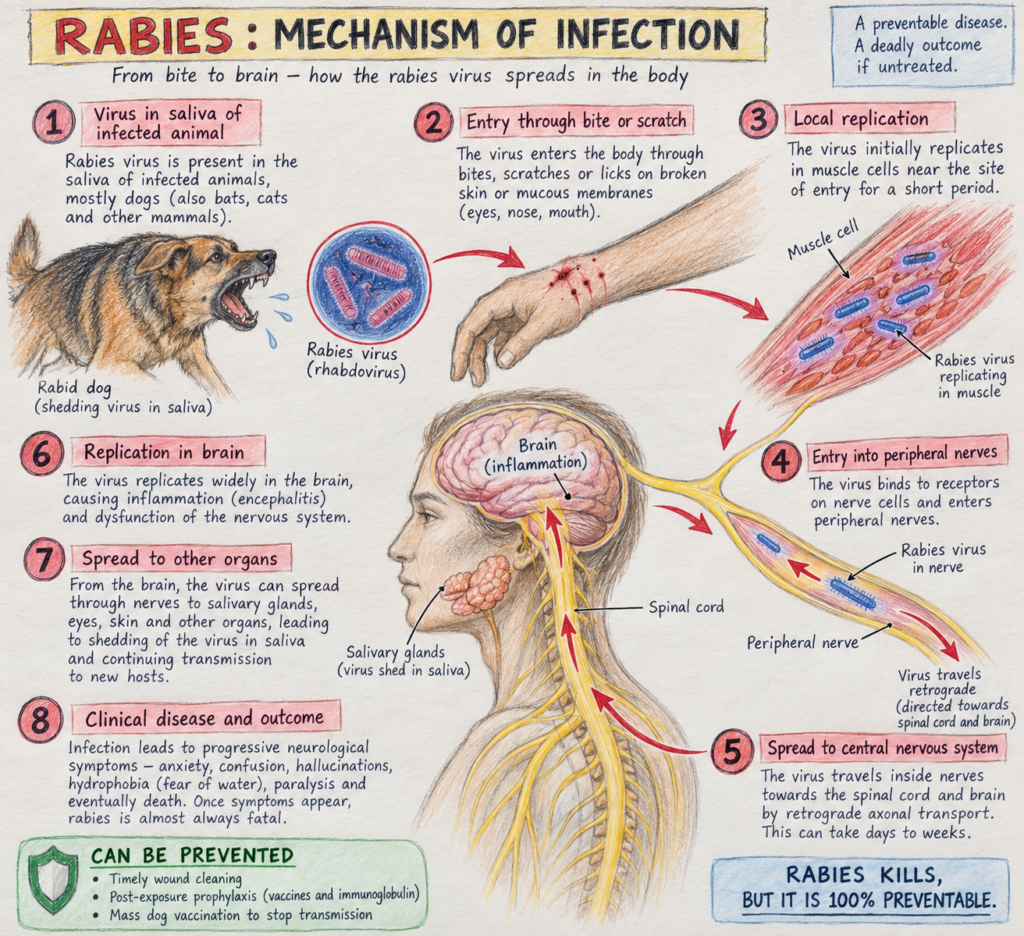
- Mass vaccination of dogs to control infection at source.
- Post-Exposure Prophylaxis (PEP) for exposed humans:
- Wound washing with soap and water
- Rabies vaccine
- Rabies immunoglobulin where required
One Health approach
- Coordination between:
- Ministry of Health
- Ministry of Agriculture and Livestock
- Local governments
- Veterinary workers
- Communities
- De-suung volunteers, called “Guardians of Peace”, supported vaccination and awareness.
Why is Rabies a Major Challenge for India?
- ~59,000: Global rabies deaths annually.
- ~1/3: Share of global deaths occurring in India.
- ~96%: Rabies mortality and morbidity associated with dog bites.
- Rabies is endemic across most of India.
- Exceptions: Andaman & Nicobar Islands and Lakshadweep.
- Once clinical symptoms appear, rabies is almost always fatal.
What does India need for the 2030 Target?
1. Dog vaccination
- Achieve around 70% vaccination coverage.
- Conduct annual mass vaccination campaigns.
- Publish district-level vaccination coverage.
2. Dog population management
- Strengthen municipal sterilisation and vaccination programmes.
- Link funding to verified vaccination coverage, rather than only sterilisation numbers.
3. Better PEP access
- Decentralise rabies immunoglobulin to lower-level health facilities.
- Improve rural access to complete PEP.
4. Strong surveillance
- Make human and animal rabies nationally notifiable.
- Improve case-based reporting and mortality estimation.
5. One Health coordination
- Integrate human health, animal health and environmental health.
- Strengthen coordination among health, animal husbandry and wildlife agencies.
One Health
- Definition: An integrated approach linking human, animal and environmental health.
- Rabies is a classic One Health disease because:
- Reservoir: Mainly animals
- Transmission: Animal to human
- Outcome: Human disease and death
- India has established the National One Health Mission for coordination on zoonotic diseases.
Prelims Quick Revision
- 59,000: Approximate global rabies deaths annually.
- 1/3: Approximate share occurring in India.
- 96%: Mortality and morbidity associated with dog bites.
- 70%: Approximate dog vaccination coverage required to interrupt transmission.
- 2 years: Disease-free period relevant to WHO validation.
- 2030: Target for eliminating human deaths from dog-mediated rabies.
- Rabies elimination ≠ rabies virus eradication
[2014] Consider the following diseases:
1. Diphtheria
2. Chickenpox
3. Smallpox
Which of the above diseases has/have been eradicated in India?
(a) 1 and 2 only
(b) 3 only
(c) 1, 2 and 3 only
(d) None of the above
