Why in the News
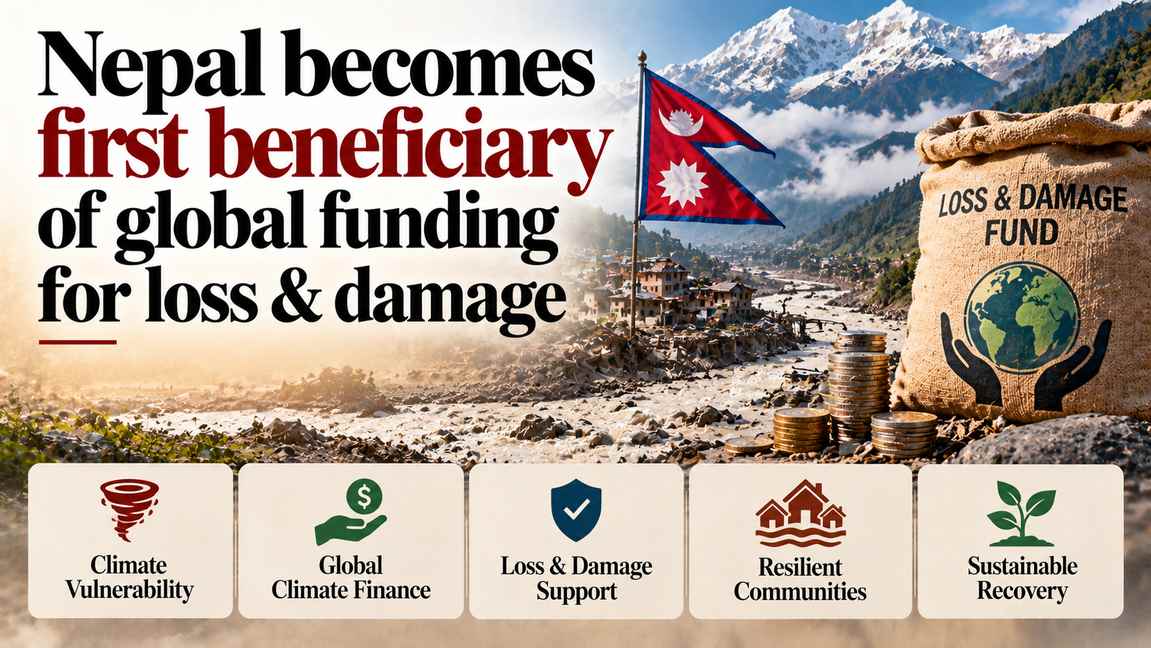
For the first time, a country will receive money from the global fund created to pay for climate damage that has already happened. The Fund for Responding to Loss and Damage (FRLD) has provisionally set aside $20 million for Nepal after the August floods, meeting a long-pending demand of developing countries.
What is the FRLD, and why was it created?
- What it is: The FRLD pays for climate harm that has already happened and cannot be adapted to, unlike funds that cut emissions or build defences. It works like international disaster relief.
- Who demanded it: Developing countries, especially small and least developed ones, pressed for it, because they are most exposed and have the least resources to cope.
- Creation: After over a decade and a half of negotiations, it was created at COP27, the UN climate conference held at Sharm el-Sheikh, Egypt, in 2022.
- Operationalisation: It began work at COP28 in Dubai the next year, with the first round of pledges. The World Bank hosts it on an interim basis.
- The takeaway: Nepal’s grant is the first test of whether the fund can move money to a disaster-hit country.
What has the FRLD decided for Nepal?
- Emergency meeting: The FRLD Board met in emergency session at the request of Nepal and other developing countries. It “provisionally set aside” Nepal’s grant.
- Formal application: Nepal must file a formal request, which the Board will consider at its December meeting.
- Single-event cap: Each request must lie between $5 million and $20 million, so Nepal got the most allowed for one event. Countries may file separate requests for separate incidents.
- The disaster: A rock and ice avalanche on 26 August in the northeastern Rasuwa district set off the floods. They were a glacial lake outburst flood (GLOF), assessed as induced by climate change.
- Human toll: The floods killed more than 1,300 people, and over 5,000 are still missing.
Why is the grant both a milestone and a token?
- Operational step: The approval is a small but significant step in making the loss and damage framework work for vulnerable countries.
- Scale gap: Nepal puts its initial recovery and reconstruction needs at no less than $4.71 billion, so the grant covers under one per cent.
- Release delay: A former Director General of the International Solar Alliance (ISA) warned that money is released only after Nepal’s further project proposals are cleared, so relief may come late.
- Queue of requests: By June, the fund had received 176 requests from 119 countries, all still pending.
Challenges
- Small capital base: The fund’s reserves are a small fraction of the reconstruction bills climate disasters leave.
- Slow approval cycle: Grants wait for formal applications and scheduled Board meetings, delaying relief after a fast disaster.
- Per-event ceiling: The cap on each request cannot match losses that run into billions of dollars.
- Voluntary funding: Contributions are voluntary, so the fund depends on donors’ goodwill. Eg. The United Arab Emirates’ $100 million led the early pledges.
Way Forward
- Fast-track window: The Board should release part of a grant before the full project proposal clears.
- Larger pledges: Developed countries should raise and deliver pledges at the coming climate conference.
- Higher ceiling: The Board should review the per-event cap for disasters of Nepal’s scale.
Conclusion
The loss and damage fund has moved from pledges to its first allocation, but the sum shows how far its resources fall short of the losses it was built to meet. What to watch is whether the Board confirms Nepal’s grant at its next meeting and how fast the money arrives.
Key numbers
- Nepal’s assessed economic loss: At least $2.69 billion (Nepal government estimate).
- Value of pending FRLD requests: $2.8 billion, as of June 2026.
- Share of reconstruction cost: Under 0.5% of an estimated $5 billion (former ISA Director General).
Back2Basics: Glacial Lake Outburst Flood (GLOF)
- What it is: The sudden release of water held in a glacial lake, which sends a large volume downstream in a short time.
- How the lake forms: Meltwater collects behind a moraine ridge or an ice dam left by a retreating glacier, so loose debris or ice holds it back.
- What breaches it: An avalanche or landslide into the lake, seepage that erodes the moraine, or failure of the ice dam.
- Why it is tracked: Glacier retreat is adding to the number and volume of Himalayan glacial lakes, so national inventories monitor them.
Matching Previous Year Question
“[2016] With reference to the Agreement at the UNFCCC Meeting in Paris in 2015, which of the following statements is/are correct? 1. The Agreement was signed by all the member countries of the UN and it will go into effect in 2017. 2. The Agreement aims to limit the greenhouse gas emissions so that the rise in average global temperature by the end of this century does not exceed 2oC or even 1.50C above pre-industrial levels. 3. Developed countries acknowledged their historical responsibility in global warming and committed to donate $ 1000 billion a year from 2020 to help developing countries to cope with climate change. Select the correct answer using the code given below. (a) 1 and 3 only (b) 2 only (c) 2 and 3 only (d) 1, 2 and 3 ANSWER: (b)”
