Why in the News
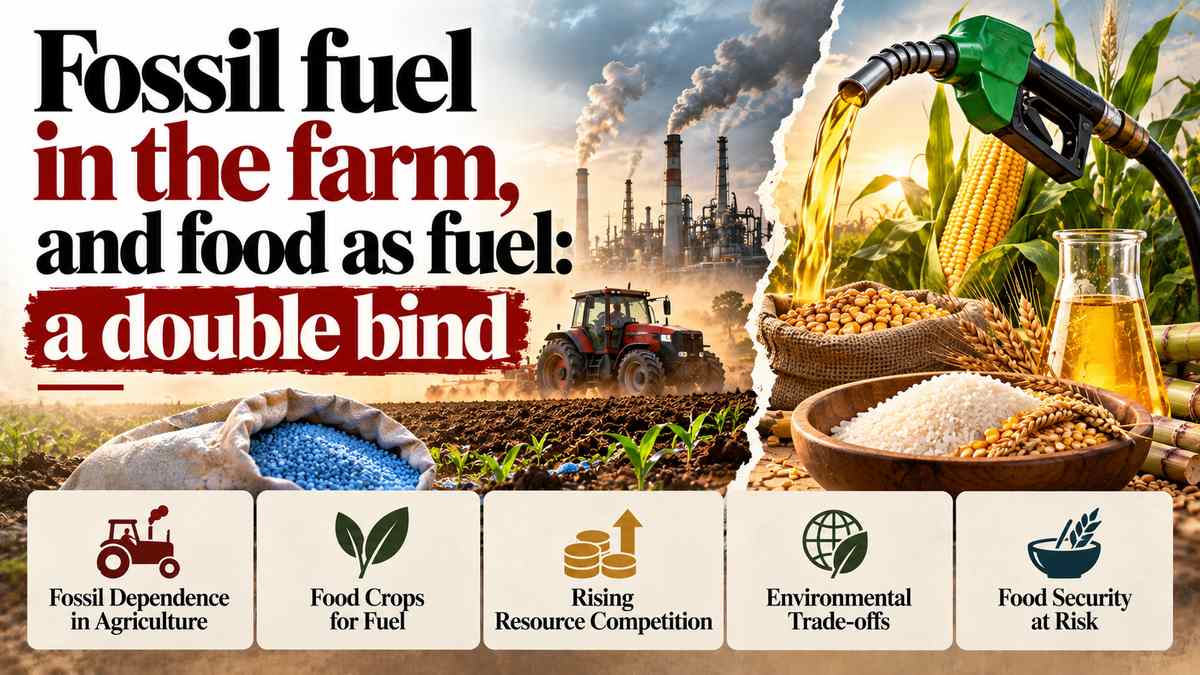
The West Asia and Russia-Ukraine conflicts, together with El Nino (a Pacific warming that weakens India’s monsoon), are testing two trends in Indian farming. One is the “fossilisation” of farming, its reliance on petroleum-based inputs. The other is the “fuelisation” of food, the diversion of crops to make fuel.
What is the “fossilisation” of farming?
- What it is: Farming that ran on bullocks and manure now runs on fossil fuels and their by-products. It is like a home moving from firewood to cooking gas: easier, but exposed to prices.
- Mechanisation: India’s tractor population has crossed 1.2 crore, and combines and motor pumps have replaced bullocks and the Persian wheel.
- Fertilisers: About 67.5% of chemical fertiliser nutrients come from two products, urea and di-ammonium phosphate (DAP).
- Pesticides: Most crop protection chemicals are built from naphtha, a crude oil product, and their solvents are largely petroleum-based.
- The takeaway: Oil and gas price rises now reach the farm through its machines, nutrients and sprays.
How have the wars raised farm input costs?
- Gas for urea: Liquefied natural gas (LNG), the main feedstock for nitrogen fertilisers, rose from about $11 to $30 per million British thermal units over the past year.
- Naphtha: Northwest European naphtha cargoes rose from about $515 to $910 a tonne in the same year.
- Sulphur: This by-product of oil refining and gas processing is essential for every phosphorus fertiliser, including DAP and single super phosphate (SSP). It has soared from below $300 a tonne to over $1,000.
- Why sulphur spiked: Ukraine’s strikes on Russian refineries and gas plants, and Iran’s attacks on Gulf energy infrastructure, squeezed supply.
What is the “fuelisation” of food?
- Reverse fossilisation: With Brent crude above $100 a barrel, turning food crops into biofuel becomes profitable, so farming becomes a fuel source, not only a fuel user.
- Ethanol in India: India blends ethanol from sugarcane, rice, maize and other cereals up to 20% in petrol.
- Biodiesel abroad: Vegetable oils can become fatty acid methyl esters (FAME), a diesel substitute. Since July, Indonesia requires all diesel to contain 50% palm oil FAME.
- Policy response: The government has banned using sugarcane juice and B-heavy molasses for ethanol. Grains may follow as El Nino weakens the monsoon.
Can farming absorb a twin shock this time?
- The last twin shock: In 1979-80, farm output contracted sharply and the oil import bill doubled on the back of Iran’s Islamic Revolution.
- Diversified incomes: More farm income now comes from dairying, poultry, aquaculture and horticulture, not field crops alone.
- Irrigation buffer: About 56% of gross cropped area is now irrigated, nearly double the share then, so sharp output falls of the old kind are unlikely.
Challenges
- Import dependence: India imports oil, gas, ammonia, rock phosphate, sulphur, muriate of potash and pesticide ingredients, so price spikes abroad hit farmers and the subsidy bill.
- Wasted nitrogen: Urea is 46% nitrogen, but crops absorb only a third of it. The rest escapes as ammonia or washes away as nitrate.
- Locked phosphorus: About three fourths of the phosphorus in DAP gets “locked up” in the soil, out of the roots’ reach that season.
Way Forward
- Balanced fertilisers: Gradually replace urea and DAP with ammonium sulphate and complex fertilisers that lose less nitrogen and lock up less phosphorus.
- Biostimulants: Use biostimulants that expand roots and alter plant metabolism to raise nutrient uptake.
- Plant defence: Cut chemical pesticides by triggering plants’ own defence mechanisms, an approach similar to vaccines.
- Solar and drip irrigation: Shift irrigation progressively to solar pumps and drip systems.
Conclusion
Indian agriculture now sits on both sides of the energy market, buying fossil inputs and supplying biofuel crops, so an oil shock hits it twice. What to watch is whether ethanol curbs extend to grains and efficient fertilisers cut import exposure.
Key numbers
- Tractors: Hardly 8,500 in 1950-51; 11.6 lakh sold in 2025-26 alone.
- Fertiliser use (N, P and K): 69,800 tonnes in 1950-51; 33.5 million tonnes in 2025-26.
- Farm output, 1979-80: Contracted 12.8%.
- Irrigated share of gross cropped area: 17.1% in 1950-51; 29% in 1979-80.
Schemes and Initiatives for the Fertiliser Sector
- Neem-coated urea: Coating all urea with neem improves efficiency and curbs diversion of subsidised urea to non-farm use.
- Nutrient Based Subsidy (NBS): Phosphatic and potassic fertilisers are subsidised according to their nutrient content.
- Nano fertilisers: Nano Urea Plus and Nano DAP reduce bulk fertiliser use and import dependence.
Matching Previous Year Question
“[2020] With reference to chemical fertilizers in India, consider the following statements: 1. At present, the retail price of chemical fertilizers is market-driven and not administered by the Government. 2. Ammonia, which is an input of urea, is produced from natural gas. 3. Sulphur, which is a raw material for Phosphoric acid fertilizer, is a by-product of oil refineries. Which of the statements given above is/are correct? (a) 1 only (b) 2 and 3 only (c) 2 only (d) 1, 2 and 3 ANSWER: (b)”
