Why in the News
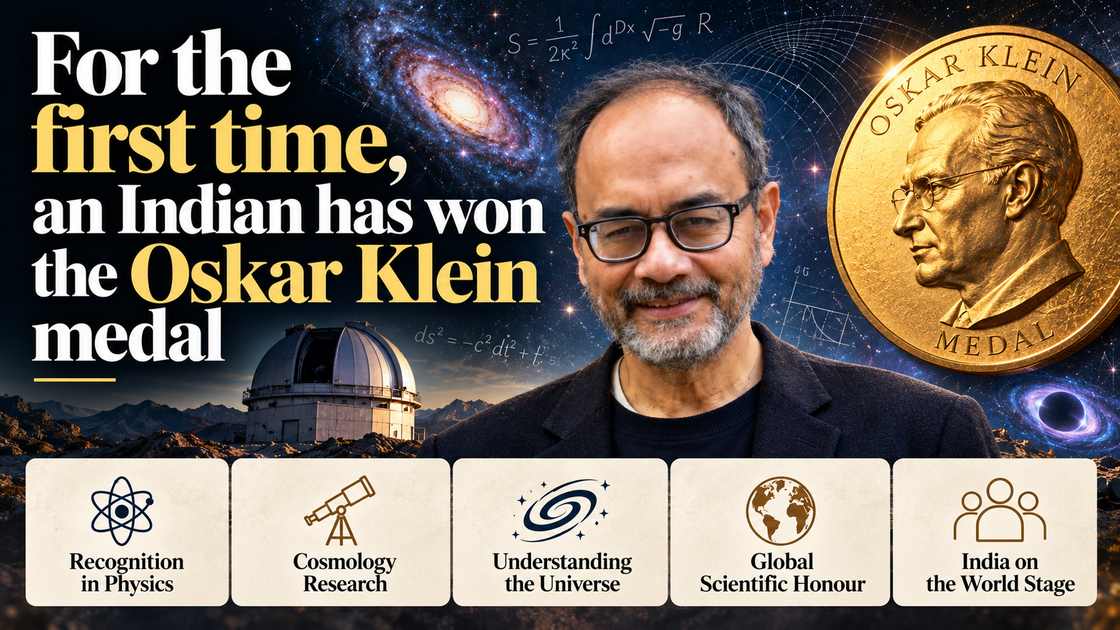
For the first time, an Indian has won the Oskar Klein medal, one of the highest honours in theoretical physics. Ashoke Sen, ICTS-Infosys Madhava Chair Professor at the International Centre for Theoretical Sciences (ICTS), Bengaluru, received the medal for his work on string theory.
What is the Oskar Klein medal?
- What it is: The medal honours leading work in theoretical physics and carries an award lecture by the winner. It has been awarded every year since 1988.
- Who awards it: Stockholm University and the Nobel Committee for Physics of the Royal Swedish Academy of Sciences award it jointly.
- Sen’s lecture: As part of the award, Sen delivered a lecture titled ‘Gravity from Strings and Strings from Gravity’ at Stockholm University.
- The takeaway: An India-based physicist now holds an honour awarded jointly by the Nobel Committee for Physics.
What is Sen’s work in string theory?
- String theory: It pictures the smallest particles as tiny vibrating strings, like one guitar string playing different notes, and tries to reconcile quantum theory (physics of the very small) with gravitation.
- Grand unified theory: String theory seeks a grand unified theory explaining all particles and forces at every scale, from subatomic particles to galaxies.
- S-duality: Sen did pioneering work on this symmetry. It links a theory with strong interactions to one with weak interactions, so hard problems in one can be solved through easier ones in the other.
- Black holes and string fields: Sen made a precision count of black hole entropy (a measure of the hidden internal states of a black hole). His advances in string field theory shaped modern string theory.
- Earlier honours: Sen has earlier won the Dirac medal and the Breakthrough Prize in Fundamental Physics.
How does the medal fit a run of honours for Indian physicists?
- Deepak Dhar: The theoretical physicist was named winner of the Dirac medal earlier this year, the second Indian after Sen to win it.
- Two top medals: Dhar, also awarded the Boltzmann Medal a few years ago, is the only Indian to hold both the Dirac and Boltzmann medals.
- Jainendra Jain: Last year the Indian-origin American physicist, associated with several Indian institutions, was named one of the winners of the Wolf Prize.
- Standing of these prizes: All of them rank among the most prestigious honours in physics, considered just below the Nobel Prize.
Conclusion
Indian theoretical physics has moved from isolated honours to a steady run of the field’s top prizes, with Sen’s medal the latest. Whether that recognition is matched by deeper support for theoretical research in Indian institutions remains open.
Back2Basics: International Centre for Theoretical Sciences (ICTS)
- What it is: A centre of the Tata Institute of Fundamental Research (TIFR), located in Bengaluru.
- Founded: Established in 2007 to promote research in the theoretical sciences.
- Parent funding: TIFR is a national institute funded by the Department of Atomic Energy.
- What it does: It hosts long research programmes, schools and discussion meetings that bring international scientists to India.
Matching Previous Year Question
“[2017] The terms `Event Horizon’, ‘Singularity’, `String Theory’ and `Standard Model’ are sometimes seen in the news in the context of (a) Observation and understanding of the Universe (b) Study of the solar and the lunar eclipses (c) Placing satellites in the orbit of the Earth (d) Origin and evolution of living organisms on the Earth ANSWER: (a)”
