💥Join UPSC 2027,2028 Mentorship (July Batch) + XFactor Notes & Microthemes PDF

Subject: Achievements of Indians in S&T

  • IoT Based Smart Health Tracker for Himalayan Yaks

    Why in News?

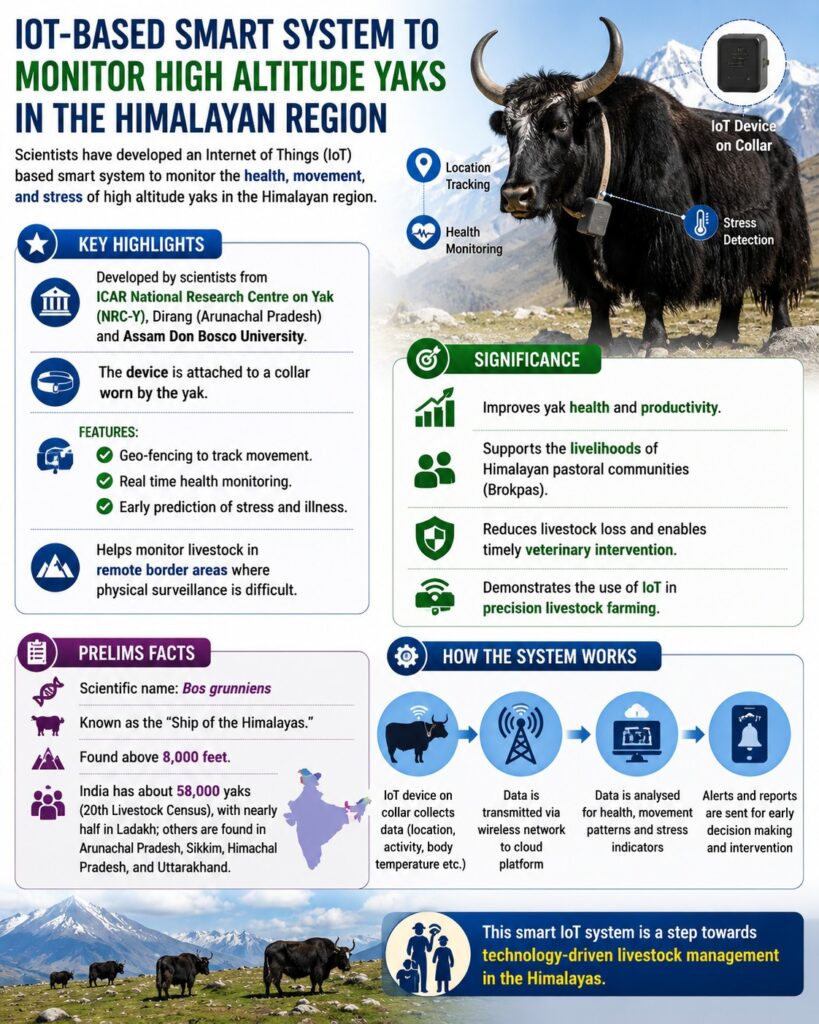
    Scientists have developed an Internet of Things (IoT) based smart system to monitor the health, movement, and stress of high altitude yaks in the Himalayan region.

    Key Highlights

    • Developed by scientists from ICAR National Research Centre on Yak (NRC-Y), Dirang (Arunachal Pradesh) and Assam Don Bosco University.
    • The device is attached to a collar worn by the yak.
    • Features:
      • Geo-fencing to track movement.
      • Real time health monitoring.
      • Early prediction of stress and illness.
    • Helps monitor livestock in remote border areas where physical surveillance is difficult.

    Significance

    • Improves yak health and productivity.
    • Supports the livelihoods of Himalayan pastoral communities (Brokpas).
    • Reduces livestock loss and enables timely veterinary intervention.
    • Demonstrates the use of IoT in precision livestock farming.

    Prelims Facts

    • Scientific name: Bos grunniens
    • Known as the “Ship of the Himalayas.”
    • Found above 8,000 feet.
    • India has about 58,000 yaks (20th Livestock Census), with nearly half in Ladakh; others are found in Arunachal Pradesh, Sikkim, Himachal Pradesh, and Uttarakhand.

    [2018] When the alarm of your smartphone rings in the morning, you wake up and tap it to stop the alarm which causes your geyser to be switched on automatically. The smart mirror in your bathroom shows the day’s weather and also indicates the level of water in your overhead tank. After you take some groceries from your refrigerator for making breakfast, it recognises the shortage of stock in it and places an order for the supply of fresh grocery items. When you step’ out of your house and lock the door, all lights, fans, geysers and AC machines get switched off automatically. On your way to office, your car warns you about traffic congestion ahead and suggests an alternative route, and if you are late for a meeting, it sends a message to your office accordingly. In the context of emerging communication technologies, which one of the following terms best applies to the above scenario?

    [A] Border Gateway Protocol

    [B] Internet of Things

    [C] Internet Protocol

    [D] Virtual Private Network

  • India’s First PinS Instrument Approach Procedure for Helicopter Operations

    Why in News?

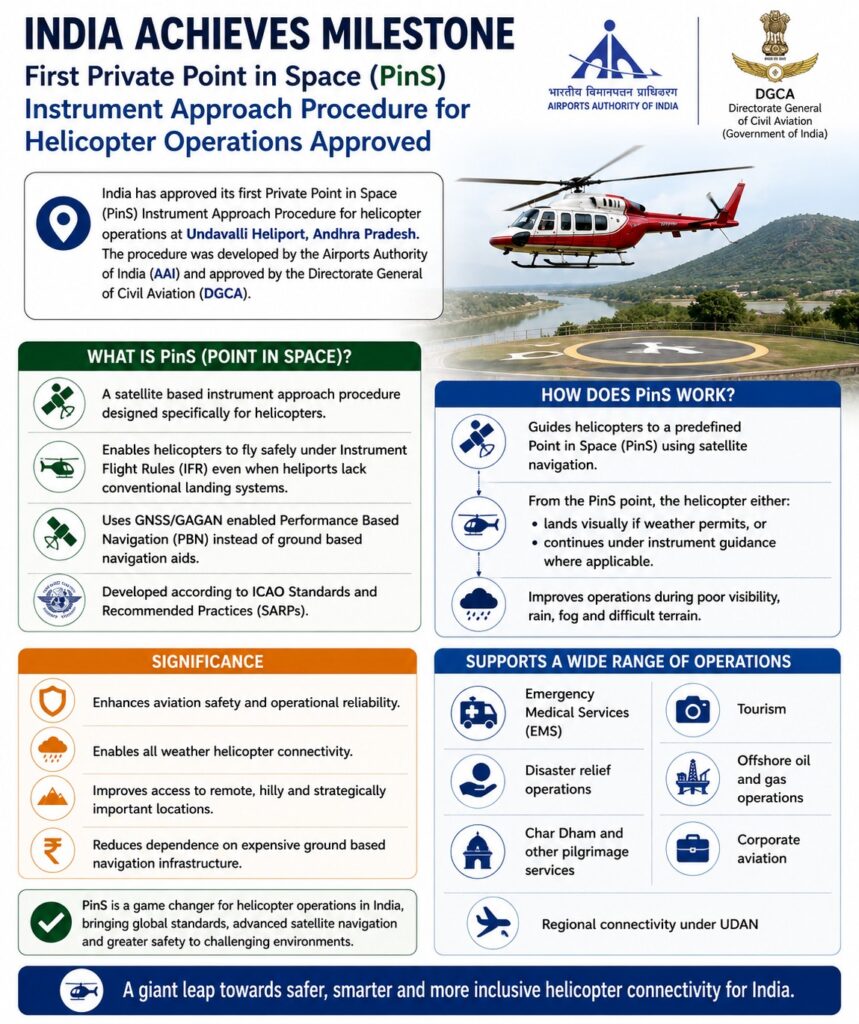
    India has approved its first Private Point in Space (PinS) Instrument Approach Procedure for helicopter operations at Undavalli Heliport (Andhra Pradesh). The procedure was developed by the Airports Authority of India (AAI) and approved by the Directorate General of Civil Aviation (DGCA).

    What is PinS (Point in Space)?

    • A satellite based instrument approach procedure designed specifically for helicopters.
    • Enables helicopters to fly safely under Instrument Flight Rules (IFR) even when heliports lack conventional landing systems.
    • Uses GNSS/GAGAN enabled Performance Based Navigation (PBN) instead of ground based navigation aids.
    • Developed according to ICAO Standards and Recommended Practices (SARPs).

    How does PinS work?

    • Guides helicopters to a predefined Point in Space (PinS) using satellite navigation.
    • From the PinS point, the helicopter either lands visually if weather permits, or continues under instrument guidance where applicable.
    • Improves operations during poor visibility, rain, fog and difficult terrain.

    Significance

    • Enhances aviation safety and operational reliability.
    • Enables all weather helicopter connectivity.
    • Improves access to remote, hilly and strategically important locations.
    • Reduces dependence on expensive ground based navigation infrastructure.
    • Supports: Emergency Medical Services (EMS), Disaster relief operations, Char Dham and other pilgrimage services, Tourism, Offshore oil and gas operations, Corporate aviation, and Regional connectivity under UDAN.

    Instrument Flight Rules (IFR)

    • Flight operations conducted primarily using cockpit instruments rather than visual references.
    • Essential during poor weather and low visibility.

    Performance Based Navigation (PBN)

    • Navigation based on aircraft performance standards using satellite navigation.
    • Improves route efficiency, safety and fuel savings.

    GAGAN (GPS Aided GEO Augmented Navigation)

    • India’s Satellite Based Augmentation System (SBAS).
    • Developed jointly by ISRO and AAI.
    • Enhances the accuracy and integrity of GPS signals for civil aviation.

    [2025] GPS-Aided Geo Augmented Navigation (GAGAN) uses a system of ground stations to provide necessary augmentation. Which of the following statements is/are correct in respect of GAGAN?
    I. It is designed to provide additional accuracy and integrity.
    II. It will allow more uniform and high quality air traffic management.
    III. It will provide benefits only in aviation but not in other modes of transportation.
    Select the correct answer using the code given below.

    [A] I, II and III

    [B] II and III only

    [C] I only

    [D] I and II only

  • India’s Emerging Technology Ecosystem

    Why in the news?

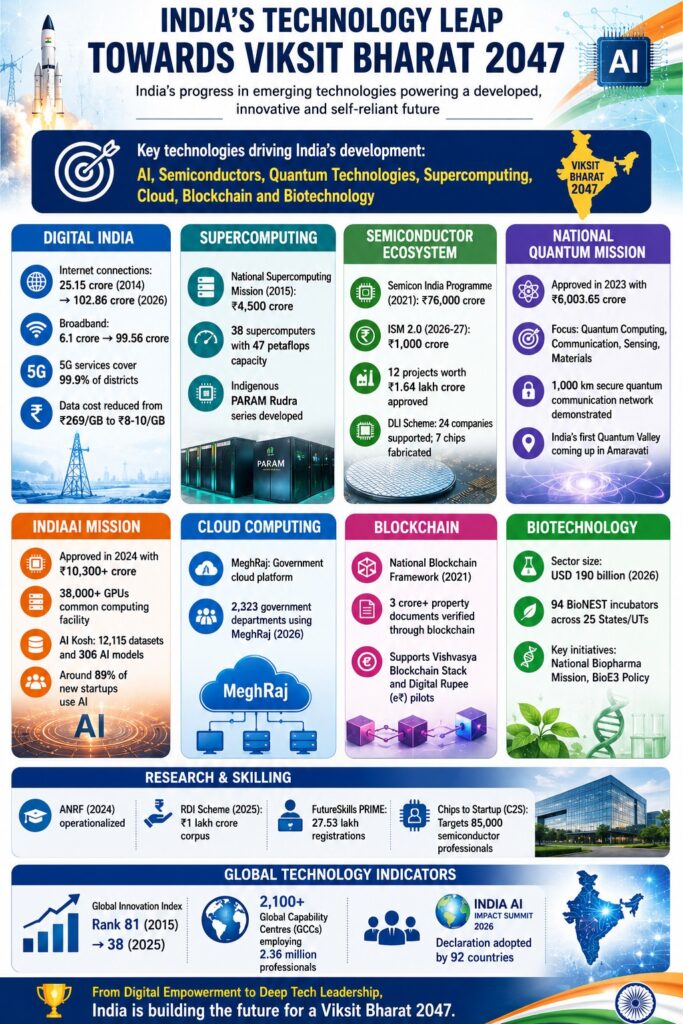
    The Government highlighted India’s progress in AI, semiconductors, quantum technologies, supercomputing, cloud computing, blockchain, and biotechnology as key pillars of Viksit Bharat 2047.

    Digital India

    • Internet connections: 25.15 crore (2014) → 102.86 crore (2026).
    • Broadband: 6.1 crore → 99.56 crore.
    • 5G services cover 99.9% of districts.
    • Data cost reduced from ₹269/GB to ₹8-10/GB.

    Supercomputing

    • National Supercomputing Mission (2015): ₹4,500 crore.
    • 38 supercomputers with 47 petaflops capacity.
    • Indigenous PARAM Rudra series developed.

    Semiconductor Ecosystem

    • Semicon India Programme (2021): ₹76,000 crore.
    • ISM 2.0 (2026-27): ₹1,000 crore.
    • 12 projects worth ₹1.64 lakh crore approved.
    • DLI Scheme: 24 companies supported; 7 chips fabricated.

    National Quantum Mission

    • Approved in 2023 with ₹6,003.65 crore.
    • Focus: Quantum Computing, Communication, Sensing, Materials.
    • 1,000 km secure quantum communication network demonstrated.
    • India’s first Quantum Valley coming up in Amaravati.

    IndiaAI Mission

    • Approved in 2024 with ₹10,300+ crore.
    • 38,000+ GPUs common computing facility.
    • AI Kosh: 12,115 datasets and 306 AI models.
    • Around 89% of new startups use AI.

    Cloud Computing

    • MeghRaj: Government cloud platform.
    • 2,323 government departments using MeghRaj (2026).

    Blockchain

    • National Blockchain Framework (2021).
    • 3 crore+ property documents verified through blockchain.
    • Supports Vishvasya Blockchain Stack and Digital Rupee (e₹) pilots.

    Biotechnology

    • Sector size: USD 190 billion (2026).
    • 94 BioNEST incubators across 25 States/UTs.
    • Key initiatives: National Biopharma Mission, BioE3 Policy.

    Research & Skilling

    • ANRF (2024) operationalized.
    • RDI Scheme (2025): ₹1 lakh crore corpus.
    • FutureSkills PRIME: 27.53 lakh registrations.
    • Chips to Startup (C2S): Targets 85,000 semiconductor professionals.

    Global Technology Indicators

    • Global Innovation Index: Rank 81 (2015) → 38 (2025).
    • 2,100+ Global Capability Centres (GCCs) employing 2.36 million professionals.
    • India AI Impact Summit 2026: Declaration adopted by 92 countries.

    [2022] Which one of the following is the context in which the term “qubit” is mentioned?

    [A] Cloud Services

    [B] Quantum Computing

    [C] Visible Light Communication Technologies

    [D] Wireless Communication Technologies

  • Discuss the work of ‘Bose-Einstein Statistics’ done by Prof. Satyendra Nath Bose and show how it revolutionized the field of Physics.

    In 1924, S.N Bose wrote a groundbreaking paper on quantum theory that solved key problems in radiation physics. Recognizing its importance, Albert Einstein translated and published it, laying the foundation of Bose-Einstein statistics and modern quantum mechanics.

    The Work of ‘Bose-Einstein Statistics’

    Indistinguishability of Particles: Bose proposed that subatomic particles like photons are completely identical and indistinguishable, meaning swapping their positions does not create a new physical state.

    New Counting Method: Instead of using classical probability, Bose developed a unique statistical method to calculate how identical particles distribute themselves across different energy levels.

    Deriving Planck’s Law: Bose successfully derived Max Planck’s blackbody radiation formula purely from quantum concepts, completely removing the traditional reliance on classical physics electromagnetism laws.

    Integer Spin Behavior: The statistics apply to particles with whole-number spins, called Bosons, which naturally tend to cluster together in the exact same quantum state.

    Extension to Matter: Albert Einstein expanded Bose’s mathematical framework from light photons to massive gas atoms, predicting a new state of matter at ultra-low temperatures.

    How It Revolutionized the Field of Physics

    The Concept of Bosons: Particles with integer spins (Eg- photons, gluons, and the Higgs Boson) were named bosons in his honor. Unlike fermions, any number of bosons can occupy the same quantum state.

    Macroscopic Quantum Phenomena: The statistics provided the mathematical basis to understand low-temperature quantum phenomena like superfluidity and superconductivity.

    Experimental Proof: The theoretical prediction of BECs was experimentally proven in 1995 by Eric Cornell and Carl Wieman, which created an entirely new field of ultra-cold atomic physics.

    Technological Applications: It serves as the underlying principle behind lasers (which rely on coherent, indistinguishable photons), semiconductors, and modern quantum computing

    S.N Bose bridged the gap between early quantum theory and modern quantum mechanics by redefining particle identity through revolutionary statistical methods, influencing pioneers like Erwin Schrödinger and Werner Heisenberg.

  • How was India benefited from the contributions of Sir M.Visvesvaraya and Dr. M. S. Swaminathan in the fields of water engineering and agricultural science respectively?

    India’s foodgrains production has surged from 50.8 million tons in 1950-51 to over 357 million tons in 2025. Sir Visvesvaraya and Dr. Swaminathan played a prominent role in this transformation.

    Contribution of Sir M. Visvesvaraya in Water Engineering

    Modernisation of Irrigation Systems – Eg- Invented the automatic weir water floodgates, first installed at KRS Dam

    Major Dams and Multipurpose Projects – Designed the Krishna Raja Sagara (KRS) Dam, which irrigated 1.2 lakh+ hectares in Mandya region

    Developed water supply and drainage systems for Hyderabad, Pune, Nagpur, Belagavi

    Promotion of Scientific Water Management – Pioneered ideas like integrated river valley development

    Advocated planned economic development through irrigation, power generation, and industrialisation. Eg- Mysore Iron & Steel Works.

    International Projects– worked on water supply and drainage systems in the British Colony of Aden (now Yemen)

    His Mysore State Flood Report in 1909 provided crucial insights on flood management

    Contributions of Dr. M. S. Swaminathan in Agricultural Science

    Chaired the National Commission on Farmers and recommended policies like the MSP formula (C2 + 50%).

    Father of the Green Revolution – Introduced high-yielding varieties of wheat and rice. Eg- “Swarna” rice variety

    Achieving Food Self-Sufficiency – foodgrain production rose from ~72 million tonnes (1965) to over 130 million tonnes (1980s), ending “ship-to-mouth” dependence.

    Promotion of Sustainable and Climate-Resilient Agriculture – Advocated genetic conservation, bio-fortification, and evergreen revolution principles

    He played an instrumental role in developing the Protection of Plant Varieties and Farmers’ Rights Act of 2001.

    Institutional Building

    ICAR modernisation – Director-General from 1972 to 1979.

    Setting up MS Swaminathan Research Foundation (MSSRF)

    Promoting biotechnology. Eg- research on cryogenetics in potato crops.

    Together, they shaped India’s progress in water management, agriculture, and national development.

    Agriculture Technology