💥Join UPSC 2027,2028 Mentorship (July Batch) + XFactor Notes & Microthemes PDF

Category: Ranker Webinars

  • UPSC Prelims 2021 || How to Solve the paper during exam || by Santosh Gupta (Link Inside)

    UPSC Prelims 2021 || How to Solve the paper during exam || by Santosh Gupta (Link Inside)

    Connect with our mentors:- https://bit.ly/Free_One_to_One_Mentorship

    To know more about Civilsdaily IAS:- https://www.civilsdaily.com/ias-2021-22-mentorship/

    Hello Aspirants of Prelims 2021, are you fully prepared for prelims? Do you know how to perfectly utilise two hours of paper to qualify prelims? Do you know how many rounds you should go to solve the paper? How to handle pressure and remain confident during exams?

    Santosh Gupta sir discusses here not only exam pressure but also how many rounds you should go and how to best utilise time for a perfect score of 130+ from his own experience of getting 130+ in his all 6 attempts in prelims.

    How to avoid silly mistakes, watch this video of him. It is most important for all of you appear for prelims 2021:https://youtu.be/AfavQ_6ne7Q

    How to utilise remaining day for revision effectively for Prelims:- https://youtu.be/m1LLOStMiF0

    How to utilise Elimination techniques for solving questions by Sajal Sir:- https://youtu.be/nWSptxBC9r0


    About Santosh Gupta sir:-
    Santosh Gupta sir has scored above 140 twice in UPSC prelims and always 130 plus in all 6 attempts. He wrote all 6 mains and appeared for Interviews 3 times. He has qualified UPSC EPFO and BPSC 56-59th also.

    He has been teaching and mentoring UPSC aspirants for the last 5 years with tremendous interest in environment and ecology and Polity.

  • Jagrati Awasthi (AIR 2) recommends the rich quality of Civilsdaily content for UPSC | Watch the interview | Speak directly with our mentor now

    Jagrati Awasthi (AIR 2) recommends the rich quality of Civilsdaily content for UPSC | Watch the interview | Speak directly with our mentor now

    We, at Civilsdaily, dedicate our work to our students, and we work hard every day to make sure our students get the best guidance and study material possible. Our efforts feel magical when our students succeed and share their views.

    Jagrati Awasthi, AIR 2, had an interview with a television channel about her success. And in that interview, she recommended Civilsdaily for preparation. She said that the content on Civilsdaily is rich and high quality. It helped her prepare better for Mains and succeed!

    You can watch the video here:

    If you wish to speak directly with a personal mentor on Civilsdaily, just fill this form and the mentor will get back to you for a personalized discussion.

  • Important Schemes related to depressed classes/SC/ST and Women

    04th Oct 2021


    UPSC 2022 countdown has begun! Get your personal guidance plan now! (Click here)


    Nai Manzil Scheme

    OBJECTIVES –

    • To address the educational and livelihood needs of minority communities lagging behind in terms of educational attainments.
    • It aims to provide educational intervention by giving the bridge courses to the trainees and getting them Certificates for Class XII and X from distance medium educational system.
    • It seeks to provide trade basis skill training in four courses at the same time of formal education, in field of (i) Manufacturing (ii) Engineering (iii) Services (iv) Soft skills. It intends to cover people in between 17 to 35 age group from all minority communities as well as Madrasa students.
    • Nodal Ministry –The Union Ministry of Minority Affairs

    Nai Roshni

    OBJECTIVES –

    • Empower and install confidence in women of minority communities by equipping them with knowledge, tools and techniques to interact with government systems, banks and intermediaries
    • Nodal Ministry –The Union Ministry of Minority Affairs

    USTAAD Scheme

    OBJECTIVES –

    • The scheme aims at preserving and promoting the rich heritage of the traditional arts & crafts of the Minority communities. 2.In the light of globalisation & competitive market, these crafts have gradually lost their employability. 3.It also envisages at boosting the skill of craftsmen, weavers and artisans who are already engaged in the traditional ancestral work.
    • Nodal Ministry –The Union Ministry of Minority Affairs

    Hunar Haat

    OBJECTIVES –

    • It is aimed at promoting and supporting artisans from Minority communities and providing them domestic as well as international market for display and sell their products.
    • The Hunar Haat exhibition has been organised by the National Minorities Development & Finance Corporation (NMDFC) under “USTTAD” scheme In it about 184 master artisans from across the country are showcasing their traditional art and skills at about 100 stalls at the international platform.
    • It seeks to provide an excellent platform to artisans belonging to Minority communities from across nation to display their art and skills before domestic and international visitors.
    • Nodal Ministry –The Union Ministry of Minority Affairs

    Stanapan Suraksha Scheme

    OBJECTIVES –

    • To promote breastfeeding and keep a tab on “inappropriate” promotion of baby food items. Stanpan Suraksha is first-of-its-kind app deveopled for promoting breastfeeding and baby food promotion reporting mechanism.
    • Using it any person can click a photograph of inappropriate baby food promotion around them and related equipment and send it to BPNI.
    • The app also has a city-wise database of trained breastfeeding counsellor to educate and provide assistance to mothers during antenatal and postnatal period. It has sign up option for mothers who wish to become a breastfeeding counsellor, pledging for petition and donation.
    • Nodal Ministry –Ministry of Tribal Affairs

    Eklavya Model Residential Schools

    • Eklavya Model Residential School Scheme was started in 1998
    • First school was started in the year 2000 in Maharashtra.
    • EMRSs have been functioning as institutions of excellence for tribal students.
    • In order to further educational opportunities for more ST children, Government has sought to extend the facility of EMRSs in all the 672 Blocks where ST population is more than 50% of the total population in a span of next five years.
    • Funds for establishing the school are arranged by both Centre and State government together.
    • Nodal Ministry –Ministry of Tribal Affairs

    Pre-Matric Scholarship Scheme

    OBJECTIVES –

    • To decrease the dropout rate in the transition from elementary to the secondary stage. Given for Class 9th and 10th.
    • Nodal Ministry –Ministry of Social Justice & Empowerment

    Babu Jagjivan Ram Chhatrawas Yojana

    OBJECTIVES –

    • Educational empowerment of Scheduled castes.
    • Central assistance is provided to the implementing agencies viz. State Governments/UT Administrations/ Central and State Universities/ Non-Governmental Organisations/Deemed Universities in the private sector, for construction of fresh hostels/expansion of existing hostel facilities for Scheduled Castes students.
    • Nodal Ministry –Ministry of Social Justice & Empowerment

    National Overseas Scholarship Scheme.

    OBJECTIVES –

    • Financial support to SC and ST students pursuing Master’s level courses and PhD/Post-Doctoral courses abroad.
    • Nodal Ministry –Ministry of Social Justice & Empowerment

    Scheme for up-gradation of merit of SC students.

    OBJECTIVES –

    • Upgrade the merit of SC students by providing them remedial and special coaching in classes IX to XII.
    • Income Ceiling: Rs. 3.00 Lakh per annum .
    • Nodal Ministry –Ministry of Social Justice & Empowerment

    Self Employment Scheme for Rehabilitation of Manual Scavengers (SRMS)

    OBJECTIVES –

    • To rehabilitate all the remaining manual scavengers and their dependents in alternative occupations.The main features of the Scheme include one-time cash assistance, training with stipend and concessional loans with subsidy for taking up alternative occupations.
    • Nodal Ministry –Ministry of Social Justice & Empowerment

    Sugmay Bharat Abhiyaan

    OBJECTIVES –

    • The target of this scheme is to make at least fifty government buildings disabled-friendly under the campaign in each of the state till the end of 2016 and make 25 per cent of the public transport vehicles under the government as disabled-friendly till mid-2017.
    • A remarkable feature of the scheme is that a website will also be made where the people can put their views on the accessibility of any building.
    • The international airports in the country and railway stations which come under A1, A and B categories will be made fully disabled-friendly.
    • Special set-top boxes will be made available to make watching TV more convenient for the visually impaired. In the next 5 years, almost 200 persons will be trained to speak in sign languages on government TV channels. Government websites will also be made friendlier by using text to speech option.
    • Under the scheme, the Ministry of Social Justice and Empowerment will give free motorized tricycles to persons with 70-90% disability.
    • A Sugamya Bharat mobile app which can provide information on disabled-friendly public facilities in a city, will be launched under the scheme.
    • For awareness, a team of experts will conduct workshops for sensitizing the main parties including builders and activists.
    • Nodal Ministry – Ministry of Social Justice & Empowerment

    Disha

    OBJECTIVES –

    • Early Intervention and School Readiness Scheme.
    • This is an early intervention and school readiness scheme for children upto 10 years with the disabilities covered under the National Trust Act.
    • Nodal Ministry –Ministry of Social Justice & Empowerment

    VIKAASDay Care

    OBJECTIVES –

    • A day care scheme for persons with autism, cerebral palsy, mental retardation and multiple disabilities, above 10 years for enhancing interpersonal and vocational skills.
    • Nodal Ministry –Ministry of Social Justice & Empowerment

    SAMARTH Respite Care

    OBJECTIVES –

    • A scheme to provide respite home for orphans, families in crisis, Persons with Disabilities (PwD) from BPL, LIG families with at least one of the four disabilities covered under the National Trust Act.
    • Nodal Ministry –Ministry of Social Justice & Empowerment

    GHARAUNDA

    OBJECTIVES –

    • Group Home for Adults.
    • This scheme provides housing and care services throughout the life of the person with Autism, Cerebral Palsy, Mental Retardation and Multiple Disabilities.
    • Nodal Ministry –Ministry of Social Justice & Empowerment

    NIRMAYA Health Insurance Scheme.

    OBJECTIVES –

    • This scheme is to provide affordable Health Insurance to persons with Autism, Cerebral Palsy, Mental Retardation and Multiple Disabilities.
    • Nodal Ministry –Ministry of Social Justice & Empowerment

    SAHYOGI Caregiver training scheme

    OBJECTIVES –

    • A scheme to set up Caregiver Cells (CGCs) for training and creating skilled workforce of caregivers to care for Person with Disabilities (PwD) and their families.
    • Nodal Ministry –Ministry of Social Justice & Empowerment

    GYAN PRABHA Educational support

    OBJECTIVES –

    • Scheme to encourage people with Autism, Cerebral Palsy, Mental Retardation and Multiple Disabilities for pursuing educational/ vocational courses.
    • Nodal Ministry –Ministry of Social Justice & Empowerment.

    PRERNA Marketing Assistance.

    OBJECTIVES –

    • A marketing scheme to create viable & widespread channels for the sale of products and services produced by persons with autism, cerebral palsy, mental retardation and multiple disabilities
    • Nodal Ministry – Ministry of Social Justice & Empowerment

    Schemes and Policies for Women

           SCHEME      OBJECTIVES             SALIENT                                   FEATURESMINISTRY
    Nirbhaya Fund -Nirbhaya Fund is an Indian rupee 10 billion corpus announced by the Government of India in its 2013 Union Budget.
    -According to the then Finance Minister P. Chidambaram, this fund is expected to support initiatives by the government and NGOs working towards protecting the dignity and ensuring the safety of women in India.
    -Nirbhaya (fearless) was the pseudonym given to the 2012 Delhi gang-rape victim to hide her actual identity.
    Earlier Ministry of Home Ministry, Now Ministry of Women & Child
    ICDS-To prevent and reduce young child under-nutrition
    (% underweight children 0- 3 years) by 10 percentage
    points,
    -Enhance early development and learning outcomes in
    all children 0-6 years of age,
    -improve the care and nutrition of girls and women and
    reduce anaemia prevalence in young children, girls and
    women by one fifth by the end of the 12th five-year plan.
    -It is a centrally sponsored scheme
    -The engagement of the Anganwadi worker and helper from the same village
    -It is a universal and self-selecting scheme i.e. anyone can visit the Aanganwadi centre and
    enrol these services.
    -Package of six services i.e.
    o SNP – supplementary nutrition programme
    o Pre-school education
    o Health and nutrition education,
    o Immunization,
    o Health check-up and
    o Referral services to the beneficiaries
    AEC-cum-crèche, AWC-cum counsellor.
    Ministry of Women & Child
    Mahila Police Volunteer It envisages the creation of a link between the police authorities and the local communities in villages through police volunteers who will be women specially trained for this purpose. Under this scheme, it is expected to have at least one such volunteer in every village whose primary job will be to keep an eye on situations where women in the village are harassed or their rights and entitlements are denied or their development is prevented. Joint initiative b/w Min. of WCD and Home Min.Ministry of Women & Child and Home Ministry
    UJJAWALA Yojana A comprehensive scheme for prevention of trafficking and rescue, rehabilitation and reintegration of victims of trafficking and commercial sexual exploitationMinistry of Women & Child
    One-Stop centre scheme1. To provide integrated support and assistance to women affected by violence, both in private and public spaces under one roof.
    2. To facilitate immediate, emergency and non-emergency access to a range of … support under one roof to fight against any forms of violence against women
    1. These centres will provide immediate access to a range of services including medical, legal, psychological and counselling support to the victims.
    2. The OSC will support all women including girls below 18 years of age affected by violence, also for girls below 18 years of age, institutions and authorities established under Juvenile Justice (Care and Protection of Children) Act, 2000 and the Protection of Children from Sexual Offences Act, 2012 will be linked with the OSC.
    3. In addition to this, a single uniform number –181 will provide 24-hour emergency response to all women affected by violence, through referral (linking with appropriate authorities such as Police, OSC or hospital); funding thru’ Nirbhaya fund
    Ministry of Women & Child
    Swadhar Grehs Homes for relief and rehabilitation of women in difficult circumstances including survivors of rape/assault etc.
    Provision for food clothing, counselling. training, clinical and legal aid; long term
    Ministry of Women & Child
    She-Box Online complaint Management System for women working in both public and private organizations to ensure effective implementation of the Sexual Harassment of Women at Workplace ActMinistry of Women & Child
    Universalization of Women Helpline  Ministry of Women & Child
    The mission for Protection and Empowerment for Women: To achieve holistic empowerment of women through
    the convergence of schemes/programmes of different Ministries/
    Department of Government of India as well as State
    Governments
    -It aimed at improving the declining Child Sex Ratio; ensuring survival. & protection
    of the girl child; ensuring her education, and empowering her to fulfil her potentials social sector welfare schemes for care, protection and development of
    women.
    -It will provide an interface for rural women to approach the government for availing their entitlements and for empowering them through training and capacity building.
    Ministry of Women & Child
    Mahila Shakti Kendra -Mahila Shakti Kendras will converge all Govt. Schemes for women at National, State, District and Block level
    Skill Development, Employment, Digital Literacy, Health and Nutrition.
    -Through this scheme, the government plans to reach 115 most backward districts in the country with 920 Mahila Shakti Kendra…
    Ministry of Women & Child
    PRIYADARSHINI SCHEME(discontinued in 2016) Women’s Empowerment and Livelihoods Programme in the Mid Gangetic PlainsMinistry of Women & Child
    Sabla-Enable the adolescent girls for self-development and
    empowerment
    -Improve their nutrition and health status.
    -Promote awareness about health, hygiene, nutrition, adolescent
    reproductive and sexual health (ARSH) and family and child care.
    -To educate, skill and make them ready for life’s challenges
    Nutrition provision
    – Iron and folic acid (IFA) supplementation
    – Health check-up and referral services
    – Nutrition & health education (NHE)
    -Counselling/guidance on family welfare, ARSH, child
    care practices and home management.
    -Upgrade home-based skills, life skills and integrate
    with the national skill development program (NSDP)
    for vocational skills.
    -Mainstream out of school adolescent girls into
    formal/non-formal education.
    -Provide information/guidance about existing public
    services such as PHC, CHC, post office, bank, police
    the station, etc.
    Ministry of Women & Child
    Saksham  Ministry of Women & Child
    Mahila Kisan Sashaktikaran Pariyojana-Empower women in agriculture by making systematic investments to enhance their participation and productivity,
    -Create and sustain agriculture-based livelihoods of rural women.
    -a sub-component of the Deendayal Antodaya Yojana-NRLM (DAY-NRLM)
    – Under the Pariyojana, projects are conceived in such a manner that the skill base of the women in agriculture is enhanced to enable them to pursue their livelihoods on a sustainable basis.
    -Under MKSP sustainable agriculture, 58 projects from 14 States have been sanctioned which will benefit 24.5 lakhs Mahila Kisans during the period.
    Ministry of Rural Development
    Beti Bachao Beti Padhao 1.Prevent Female infanticide
    2.Ensure Every Girl Child is Protected
    3.Ensure every Girl Child is educated
    Enforcement of PC & PNDT Act, nation-wide awareness and advocacy campaign and multi-sectoral action in select 100 districts (low on Child Sex Ratio) in the first phase.
    -Under this scheme, there is a strong emphasis on mindset change through training, sensitization, awareness-raising and community mobilization on ground.
    It is a tri-ministerial effort of Ministries of Women and Child Development, Health & Family Welfare and Human Resource Development.
    Sukanya samriddhi yojana 1.(Minor) bank account for girl child below the age of 10.
    2.She can withdraw 50% of the money after reaching the age of 18 e.g. for higher education. 18 years deadline will also help to prevent child-marriages.
    For initial account opening, minimum deposit Rs.1000 required.
    Later, any amount in multiples of 100 can be deposited, but maximum Rs. 1.5 lakh per year.
    Interest rate: 9.1% compounded annually.
    Ministry of Women & Child
    Pocso-e Box 1, POCSO e-box is a unique endeavour by NCPCR for receiving an online complaint of Child Sexual Abuse directly from the victim.
    2. Through a well-defined procedure, complaints are directly followed up by a team which counsels the victim, providing further guidance for required legal action. Through a short animation film embedded in the e-box, it assures the victim not to feel bad, helpless or confused as it’s not her fault. With the e-box, it is easy to register a complaint through a step-by-step guided process.
    The Ministry of Women & Child
    It is an initiative of the National Commission for Protection of Child Rights (NCPCR), for Direct online Reporting of Child Sexual Abuse.
    NARI Due to scattered information on various women-centric schemes/legislations, there is a lack of awareness
    among people regarding the same. To address this problem the government launched NARI portal as a single
    window access to information and services
    Ministry of Electronics & Information Technology
    e-samvaad Portal It is a platform for NGOs and civil society to interact with the Ministry of Women and Child Development
    (MWCD) by providing their feedback, suggestions, put up grievances, share best practices etc.
    • This will help in the formulation of effective policies and measures for the welfare of women and children.
    Ministry of Women & Child
    Stree Swabhiman -It aims to create a sustainable model for providing adolescent girls and women access to affordable sanitary products in rural areas.
    -Under this project, sanitary napkin micro manufacturing units (semi-automatic and manual process
    production unit) are being set up at CSCs across India, particularly those operated by women entrepreneurs.
    -The product will be sold under the local brand name and marketed by village-level entrepreneurs.
    -Each facility will employ 8-10 women and educate women of their society to overcome this social taboo.
    -It also has a menstrual hygiene related awareness generation component and is also expected to reduce
    drop-out rates in girls on reaching puberty.
    Ministry of
    Electronics and Information
    technology (MeITY)
    PROGRAM TO TRAIN ELECTED WOMEN REPRESENTATIVES OF
    PANCHAYATI RAJ INSTITUTIONS
     -The program aimed at capacity building of EWRs is being organized by the National Institute of Public Cooperation and
    Child Development (NIPCCD) of the MoWCD.
    -It is the first-ever initiative which will train approximately twenty thousand EWRs covering nearly 50 EWRs
    from each district (by March 2018) who will go out and administer the villages professionally.
    – It will help in creating model villages, ensure their effective participation in the governance process and help
    preparing women as political leaders of the future.
    Ministry of women and Child
    Support to Training and Employment
    Programme for Women (STEP)
     -To provide competencies and skill that enable women to become self-employed/entrepreneurs.
    -The scheme is intended to benefit women who are in the age group of 16 years and above across the country.
    Ministry of women and Child
    Rashtriya Mahila Kosh -RMK is a national credit fund for women under the aegis of the Ministry of Women and Child Development.
    -It was established in 1993 for socio-economic empowerment of women.
    -It aims to provide financial services with backward and forward linkages for women in the unorganized sector through Intermediary Micro Finance Organizations (IMOs) and Women Self Help Groups (SHGs) and to augment their capacities through multi-pronged efforts.
    -RMK also extends micro-credit to the women in the informal sector through a client-friendly, without collateral and in a hassle-free manner for income generation activities
    Ministry of women and child

    Samanvaya: Free 1-to-1 mentorship for UPSC IAS

    Fill up this form to schedule a free on-call discussion with senior mentor from Civilsdaily. Once submitted we will call you within 24 hours.

    Civilsdaily Samanvaya 1-On-1 Mentorship Form

    Field will not be visible to web visitor

  • Jagrati Awasthi (AIR 2) recommends the rich quality of Civildaily content for UPSC | Watch the interview | Speak directly with our mentor now

    Jagrati Awasthi (AIR 2) recommends the rich quality of Civildaily content for UPSC | Watch the interview | Speak directly with our mentor now

    We, at Civilsdaily, dedicate our work to our students, and we work hard every day to make sure our students get the best guidance and study material possible. Our efforts feel magical when our students succeed and share their views.

    Jagrati Awasthi, AIR 2, had an interview with a television channel about her success. And in that interview, she recommended Civilsdaily for preparation. She said that the content on Civilsdaily is rich and high quality. It helped her prepare better for Mains and succeed!

    You can watch the video here:

    If you wish to speak directly with one of our mentors on Civilsdaily, just fill this form and the mentor will get back to you for a personalized discussion.

  • Over 80 Civilsdaily students became RANKERS in UPSC civil services 2020(30 in top 100)| YOU can be NEXT| New batch of Foundation 2022 Starting  Oct 16th| Schedule your free mentorship call

    Over 80 Civilsdaily students became RANKERS in UPSC civil services 2020(30 in top 100)| YOU can be NEXT| New batch of Foundation 2022 Starting Oct 16th| Schedule your free mentorship call

    Civilsdaily helped over 80 aspirants become Rankers in the UPSC exam 2020!

    30 Civilsdaily students secured ranks in the top 100 (more than any other institute)!

    Our results improved by 80% in just one year!

    Our top rankers from UPSC 2020

    Now, we are launching another batch of Foundation 2022 using the same strategy and plan that got us this incredible result.

    80 Students realized their dream of cracking the exam. YOU could be next!

    So, what is Foundation 2022, and how will it help you?

    1. It is a complete program for IAS 2022 which includes:
    2. Master Classes -to ensure comprehensive coverage of all the portions of static syllabus along with an in-depth analysis.
    3. Ultimate Assessment Program – to evaluate your level of preparation through various tests- Prelims, Mains, Essay, Samachar Manthan, Decimate Prelims.
    4. A dedicated mentor to guide you through the maze of the UPSC exam.
    5. Exclusive membership to Civilsdaily Community on Habitat.

    What is Ultimate Assessment Program 2022

    A mentor-guided assessment program to keep you on track at all times and bring in strategic interventions when and where required.

    How are we going to approach UPSC IAS 2022?

    Broadly, six factors determine your success in cracking this prestigious IAS exam.

    The most important being understanding the expectations of UPSC. According to that planning and strategizing. Then Learning – Knowledge and information. Then Analyzing – making linkages, connections, etc. After that, Executing and utilizing information, and Constant course correction – because mistakes are inevitable, need to rectify them asap.

    How will it help you?

    Through our mentorship-driven and personalized approach, we’re hell-bent on simplifying things for you. Hence, we have come up with a plan that you will instantly connect with you and give you a vibe that yes you can do it!

    1. Integrated Approach

    Preparation for Prelims and Mains is harmonized. You study a subject, attempt prelims tests, and then attempt mains tests for the same. This leads to solid preparation.

    Many institutes out there will not able to present an integrated approach. They offer separate timetables for prelims and mains confusing the students further. That’s not the case with us!

    2. Priority-wise Coverage of subjects

    We are starting with the most important subjects from the exam perspective first. These are very predictable + have a very high return on investment. They need to be mastered if one has to have a shot at the exam. Polity, Modern History, and Economics. The lower priority ones follow afterward.

    3. Logical Division of Topics

    Subjects have been divided into topics that logically fit together. Eg. for Polity we ask you to prepare in 2 parts – first, till Central Government and second, from State Government and beyond. This division is not ad-hoc and does not break the flow of your studies.

    4. Base and Advanced Sources

    We have divided the sources into 2 parts, Base Sources, and Advanced Sources. Base sources are those which you have to master. You should come to advanced sources only when you are thorough with the Base Sources.

    All this is under the guidance of a dedicated mentor who will oversee your progress, help you strategize your preparation, plan it and make it measurable, help you analyze and evaluate your preparation; and introduce strategic interventions wherever and whenever required.

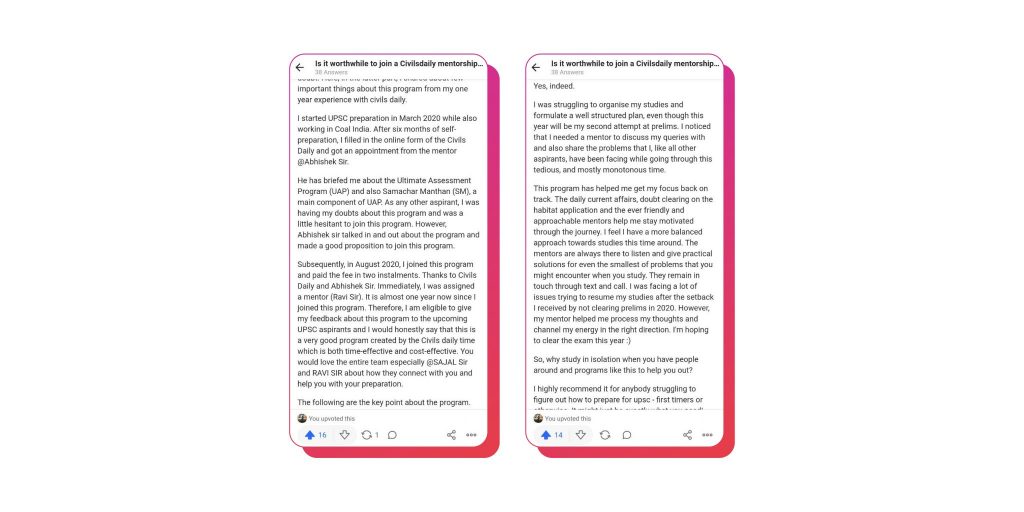
    Here’s what students have to say about the program:

    Do not wait, start on the right track. Civilsdaily has helped 80 aspirants become rankers. You can be next!

  • Join us on Live Webinar |  Zoom Link Inside | How does an aspirant become a Topper? Sajal sir after mentoring 80+ rankers will reveal the secret

    Join us on Live Webinar | Zoom Link Inside | How does an aspirant become a Topper? Sajal sir after mentoring 80+ rankers will reveal the secret

    UPSC Results are out and I am very proud of working closely with more than 80 Rankers this year. 

    One thing I can surely say is that Every Topper is different. There cannot be any 1 single perfect strategy for cracking this exam. Every Topper followed a unique strategy to crack the exam. But all of them had something in common. They avoided certain fundamental mistakes which made their journey smoother and easier.

    Every Topper will tell their own Story and Strategy but that particular strategy might work for someone and may not work for someone else. Having closely worked with more than 200 rankers in the last 4 years, I have identified certain common qualities which are shown by almost every ranker I have worked with. These Qualities are not guaranteeing success but certainly, they would improve your chances of cracking the UPSC exam.

    I will be conducting a webinar on Saturday 2nd October. Here are the things that you will learn after attending this webinar:

    1. Mistakes that have been avoided by the toppers

    2. Case Study of various toppers (How did they improve over time )

    3. Thorough analysis of Toppers copy 

    4. How to utilize the last 240 remaining for the 2022 exam effectively

    5. When to begin your prelims preparation?

    6. How much time needs to be spent on Optionals and Answer writing

    7. Importance of Structure and Presentation in getting high marks in UPSC GS mains

    8. Open Q&A session with Participants

    Date – 2/10/2021 (Saturday)

    Time – 7 p.m.

    About Sajal Sir

    He is the founder and Core Faculty at CD. An economics Post-Graduate, He had scored the highest marks in GS Mains in the 2017 UPSC exam, and under his guidance, more than 80 students cracked the UPSC exam in 2020.

  • Global Space Missions and Telescopes in News

    02th Oct 2021


    UPSC 2022 countdown has begun! Get your personal guidance plan now! (Click here)


    NASA’s ICESat-2 maps Antarctic ice sheet melting

    ICESat-2 

    • NASA’s ICESat-2 launched less than three months ago has mapped melting ice sheets in Antarctica and the resulting sea level rise across the globe, which could help improve climate forecasts.
    • The ICESat-2 stands for Ice, Cloud and land Elevation Satellite-2 .
    • It is measuring the height of sea ice to within an inch, tracing the terrain of previously unmapped Antarctic valleys, surveying remote ice sheets, and peering through forest canopies and shallow coastal waters.
    • With each pass of the ICESat-2 satellite, the mission is adding to datasets tracking Earth’s rapidly changing ice.
    • As ICESat-2 orbits over the Antarctic Ice Sheet, the photon returns reflect from the surface and show high ice plateaus, crevasses in the ice 20 metres deep, and the sharp edges of ice shelves dropping into the ocean.

    Unified Geologic Map of the Moon

    • The first-ever digital, unified, global, geological map of the moon was released virtually by the  United States Geological Survey (USGS), NASA and the Lunar Planetary Institute.
    • The UGM will serve as a blueprint for future human missions and a source of research and analysis for the educators and the general public interested in lunar geology.
    • The map is a ‘seamless, globally consistent, 1:5,000,000-scale geologic map’.
    • The mapped surface features of the moon included crater rim crests, buried crater rim crests, fissures, grabens, scarps, mare wrinkle ridges, faults, troughs, rilles, and lineaments.

    Its’ significance

    • The moon’s South Pole is especially interesting because the area is much larger than the North Pole and there could be a possibility of the presence of water in these permanently shadowed areas.
    • Further, the South Pole region also contains the fossil record of the early Solar System.
    • These present and future moon missions’ success can be further helped by the digital map of the moon.
    • The Chandrayaan 2, an active mission also targets the Lunar South Pole for exploration

    GRACE-FO Mission

    • The Gravity Recovery and Climate Experiment Follow-On (GRACE-FO) mission is a partnership between NASA and the German Research Centre for Geosciences (GFZ).
    • GRACE-FO is a successor to the original GRACE mission, which orbited Earth from 2002-2017.
    • It carries on the extremely successful work of its predecessor while testing a new technology designed to dramatically improve the already remarkable precision of its measurement system.

    Fast Radio Bursts (FRBs)

    • FRBs are super intense, millisecond-long bursts of radio waves produced by unidentified sources in the space.
    • Their discovery in 2007 by American astronomer Duncan Lorimer led to the term ‘Lorimer Bursts’.
    • Since then, just a few dozen similar events have been observed in data collected by radio telescopes around the world, building evidence that points to a variety of potential causes.
    • Only a handful of emissions have been traced to specific areas of the sky, indicating sources in other galaxies.
    • The flash of radio waves is incredibly bright if distant, comparable to the power released by hundreds of millions of suns in just a few milliseconds.
    • This intensity suggests powerful objects like black holes and neutron stars could be involved.
    • The events were once considered to be largely transient – they seemed to happen once, without obvious signs of a repeat emission. However, a number of such bursts have been identified since then.

    Why are they significant?

    • First noticed in 2018 by the Canadian observatory the waves have created ripples across the globe for one reason — they arrive in a pattern.
    • This gave birth to theories that they could be from an alien civilization.
    • Initially, it was believed that the collision of black holes or neutron stars triggers them.
    • But the discovery of repeating FRBs debunked the theory of colliding objects.

    NASA’s new Mars rover: Perseverance

    • The Perseverance rover weighs less than 2,300 pounds and is managed by NASA’s Jet Propulsion Lab.
    • The rover’s mission will be to search for signs of past microbial life. It will also collect samples of Martian rocks and dust, according to the release.
    • The rover will also be tasked with studying the red planet’s geology and climate.
    • All of NASA’s previous Mars rovers — including the Sojourner (1997), Spirit and Opportunity (2004) and Curiosity (exploring Mars since 2012) — were named in this way.

    2020 CD3

    • The mini-moon was discovered by some astronomers at NASA-funded Catalina Sky Survey (CSS) in Arizona.
    • It is actually an asteroid, about the size of a car; its diameter is about 1.9-3.5 m.
    • And unlike our permanent Moon, the mini-moon is temporary; it will eventually break free of Earth’s orbit and go off on its own way.
    • Orbit integrations indicate that this object is temporarily bound to the Earth.
    • 2020 CD3 was captured into Earth’s orbit over three years ago.
    • For CSS, it is only the second such discovery. It previously discovered 2006 RH120, which orbited Earth for some time that year, before it escaped in 2007.

    NASA’s InSight Mission

    • The Interior Exploration using Seismic Investigations, Geodesy and Heat Transport mission is a robotic lander designed to study the deep interior of the planet Mars.
    • It is the first mission dedicated to looking deep beneath the Martian surface.
    • Among its science tools are a seismometer for detecting quakes, sensors for gauging wind and air pressure, a magnetometer, and a heat flow probe designed to take the planet’s temperature.
    • The InSight mission is part of NASA’s Discovery Program.
    • It is being supported by a number of European partners, which include France’s Centre National d’Études Spatiales (CNES), the German Aerospace Center (DLR) and the United Kingdom Space Agency (UKSA).

    Habitable-zone Planet Finder

    • NASA’s Kepler mission observed a dip in the host star’s light, suggesting that the planet was crossing in front of the star during its orbit.
    • To confirm, researchers turned to an instrument called Habitable-zone Planet Finder (HPF). It has confirmed that there is indeed an exoplanet.
    • HPF is an astronomical spectrograph, built by Penn State University scientists, and recently installed on the 10m Hobby-Eberly Telescope at McDonald Observatory in Texas.
    • The instrument is designed to detect and characterize planets in the habitable zone — the region around the star where a planet could sustain liquid water on its surface — around nearby low-mass stars.
    • The newly confirmed planet, called G 9-40b, is the first one validated by HPF. It is about twice the size of Earth and orbits its star once every six Earth-days.

     Betelgeuse

    • Using the European Space Organization’s (ESO) Very Large Telescope (VLT), astronomers have noticed the unprecedented dimming of Betelgeuse.
    • It is a red supergiant star (over 20 times bigger than the Sun) in the constellation Orion.
    • Along with the dimming, the star’s shape has been changing as well, as per recent photographs of the star taken using the VISIR instrument on the VLT.
    • Instead of appearing round, the star now appears to be “squashed into an ova”.

    NASA announced it has selected four Discovery Program investigations to develop concept studies for possible new missions.

    What are the new missions?

    • Two proposals are for trips to Venus, and one each is for Jupiter’s moon Io and Neptune’s moon Triton.
    • After the concept studies are completed in nine months, some missions ultimately may not be chosen to move forward.

    DAVINCI+

    • DAVINCI+ stands for Deep Atmosphere Venus Investigation of Noble gases, Chemistry, and Imaging Plus.
    • This will analyse Venus’s atmosphere to understand how it was formed and evolved, and if it ever had an ocean.
    • This will advance understanding of the formation of terrestrial planets.

    IVO

    • Io Volcano Observer is a proposal to explore Jupiter’s moon Io, which is extremely volcanically active.
    • This will try to find out how tidal forces shape planetary bodies.
    • The findings could further knowledge about the formation and evolution of rocky, terrestrial bodies and icy ocean worlds in the Solar System.

    TRIDENT

    This aims to explore Neptune’s icy moon, Triton, so that scientists can understand the development of habitable worlds in the Solar System.

    VERITAS

    Venus Emissivity, Radio Science, InSAR, Topography, and Spectroscopy will aim to map Venus’s surface to find out why Venus developed so differently from Earth.

    Pale Blue Dot

    • The ‘Pale Blue Dot’ is one of the most iconic images in the history of astronomy.
    • It shows Earth as a single bright blue pixel in empty space within a strand of sun rays, some of which are scattering from and enlightening the planet.
    • The original image was taken by the Voyager 1 mission spacecraft on February 14, 1990 when it was just beyond Saturn.
    • At the behest of astronomer Carl Sagan, the cameras were turned towards Earth one final time to capture the image.
    • After this, the cameras and other instruments on the craft were turned off to ensure its longevity.

    About Voyager 1

    • Voyager 1 is a space probe launched by NASA on September 5, 1977.
    • Having operated for more than 42 years, the spacecraft still communicates with the Deep Space Network to receive routine commands and to transmit data to Earth.
    • At a distance of 148.67 AU (22.2 billion km) from Earth as of January 19, 2020 it is the most distant man-made object from Earth.
    • The probe’s objectives included flybys of Jupiter, Saturn, and Saturn’s largest moon, Titan.

    The Family Portrait of the Solar System

    • The Pale blue dot image was a part of a series of 60 images designed to produce what the mission called the ‘Family Portrait of the Solar System’.
    • This sequence of camera-pointing commands returned images of six of the solar system’s planets, as well as the Sun.

    Solar Orbiter (SolO) Probe

    • The Solar Orbiter, a collaborative mission between the European Space Agency and NASA to study the Sun, took off from Cape Canaveral in Florida.
    • Carrying four in situ instruments and six remote-sensing imagers, the Solar Orbiter (called SolO) will face the sun at approximately 42 million kilometres from its surface.
    • Before SolO, all solar imaging instruments have been within the ecliptic plane, in which all planets orbit and which is aligned with the sun’s equator.
    • The new spacecraft will use the gravity of Venus and Earth to swing itself out of the ecliptic plane, passing inside the orbit of Mercury, and will be able to get a bird’s eye view of the sun’s poles for the first time.

    Spitzer Space Telescope

    • The Spitzer Space Telescope is a space-borne observatory, one of the elements of NASA’s Great Observatories that include the Hubble Space Telescope and the Chandra X-Ray.
    • Using different infrared wavelengths, Spitzer was able to see and reveal features of the universe including objects that were too cold to emit visible light.
    • Apart from enabling researchers to see distant cold objects, Spitzer could also see through large amounts of gas using infrared wavelengths to find objects that may otherwise have been invisible to human beings.
    • These included exoplanets, brown dwarfs and cold matter found in the space between stars.
    • Spitzer was originally built to last for a minimum of 2.5 years, but it lasted in the “cold” phase for over 5.5 years. On May 15, 2009 the coolant was finally depleted and the “warm mission” began.

    Thirty Metre Telescope

    • The TMT is a proposed astronomical observatory with an extremely large telescope (ELT) that has become the source of controversy over its planned location on Mauna Kea on the island of Hawaii in the US state of Hawaii.
    • It is being built by an international collaboration of government organisations and educational institutions, at a cost of $1.4 billion.
    • “Thirty Metre” refers to the 30-metre diameter of the mirror, with 492 segments of glass pieced together, which makes it three times as wide as the world’s largest existing visible-light telescope.
    • The larger the mirror, the more light a telescope can collect, which means, in turn, that it can “see” farther, fainter objects.
    • It would be more than 200 times more sensitive than current telescopes and would be able to resolve objects 12 times better than the Hubble Space Telescope.

    Artemis Mission

    • In 2011, NASA began the ARTEMIS (Acceleration, Reconnection, Turbulence, and Electrodynamics of the Moon’s Interaction with the Sun) mission using a pair of repurposed spacecraft and in 2012 the Gravity Recovery and Interior Laboratory (GRAIL) spacecraft studied the Moon’s gravity.
    • For the program, NASA’s new rocket called the Space Launch System (SLS) will send astronauts aboard the Orion spacecraft a quarter of a million miles away from Earth to the lunar orbit.
    • The astronauts going for the Artemis program will wear newly designed spacesuits, called Exploration Extravehicular Mobility Unit, or xEMU.
    • These spacesuits feature advanced mobility and communications and interchangeable parts that can be configured for spacewalks in microgravity or on a planetary surface.

    Bhibha Constellation and Santamasa Planet

    Bhibha

    • The star has been named in honour of a pioneering Indian woman scientist Bibha Choudhury, who discovered subatomic particle, pi-meson.
    • ‘Bhibha’ also means “a bright beam of light” in Bengali.
    • It is located in the constellation of Sextans. It is as hot as the sun, with a surface temperature of about 6,000 degrees Kelvin. It is 1.55 times bigger, 1.21 times massive, and 1.75 times brighter.
    • It is so far away that light from it takes 310.93 years to reach Earth and hence it is visible only with a telescope.

    Santamasa

    • The planet has been named S’antamasa’ to reflect the cloudy nature of its atmosphere. ‘Santamasa’ is the Sanskrit term for ‘clouded’.
    • ‘Santamasa’, which is its only planet, is estimated to have a mass of 1.5 times that of Jupiter, going around the central star in a nearly circular orbit just in 2.1375 days.
    • Revolving so near the host star, the planet is expected to be very hot.

    Arrokoth

    • The International Astronomical Union and Minor Planets Center, the global body for naming Kuiper Belt objects have given this name.
    • It was discovered in 2014 with the Hubble Space Telescope, which is operated by the Space Telescope Science Institute in Baltimore.
    • Nasa’s New Horizons spacecraft flew by the snowman figured ice mass in December 2018, some 1.6 billion kilometres beyond Pluto.
    • The New Horizons team of NASA proposed the name to the International Astronomical Union and Minor Planets Center.
    • For the New Horizons team it took some months to finalise this name. In the language of the Powhatan tribe, Arrokoth means “sky”.
    • The team got the approval from the elders of the Powhatan tribe to assign it to their newfound “baby”.

    About New Horizons mission

    • NASA launched the New Horizons mission in January 2006.
    • After crossing by Pluto in 2015, in 2019 it flew by Arrokoth. This remains the “farthest flyby ever conducted.”

    Maxwell

    • The Maxwell is the latest in a line of experimental aircraft the NASA.
    • It has been developed over many decades for many purposes, including the bullet-shaped Bell X-1 that first broke the sound barrier and the X-15 rocket plane flown by Neil Armstrong before he joined the Apollo moon team.
    • The two largest of 14 electric motors that will ultimately propel the plane are powered by specially designed lithium ion batteries.
    • The Maxwell will be the agency’s first crewed X-plane to be developed in two decades.
    • The lift propellers will be activated for take-off and landings, but retract during the flight’s cruise phase.

    Voyager 2

    • Voyager 2 was launched in 1977, 16 days before Voyager 1, and both have travelled well beyond their original destinations.
    • The spacecraft were built to last five years and conduct close-up studies of Jupiter and Saturn.
    • As the spacecraft flew across the solar system, remote-control reprogramming was used to endow the Voyagers with greater capabilities than they possessed when they left Earth.
    • It carries a working instrument that will provide first-of-its-kind observations of the nature of this gateway into interstellar space.
    • It is slightly more than 18 billion kilometres from Earth. Its twin, Voyager 1, crossed this boundary in 2012.
    • Their five-year lifespans have stretched to 41 years, making Voyager 2 NASA’s longest-running mission.

    Ionospheric Connection Explorer

    • NASA has launched a satellite to explore the mysterious, dynamic region where air meets space.
    • The satellite — called ICON, short for Ionospheric Connection Explorer — rocketed into orbit following a two-year delay.
    • The refrigerator-size ICON satellite will study the airglow formed from gases in the ionosphere and also measure the charged environment right around the spacecraft which is at a level of 580 kilometres above the Earth’s surface.
    • The ionosphere is the charged part of the upper atmosphere extending several hundred miles (kilometres) up.
    • It’s in constant flux as space weather bombards it from above and Earth weather from below, sometimes disrupting radio communications.

    Lunar Reconnaissance Orbiter (LRO)

    • The Lunar Reconnaissance Orbiter and Lunar Crater Observation and Sensing Satellite missions began on June 18, 2009.
    • It is a robotic spacecraft currently orbiting the Moon.
    • It studies the Moon’s surface, clicks pictures, and collects data that help in figuring out the presence and possibility of water ice and other resources on the Moon, as well as plan future missions to it.
    • The primary mission of the LRO, managed by NASA’s Goddard Space Flight Center, located in Greenbelt, Maryland, was to measure the entire lunar surface to create a high-resolution 3-D map of the Moon.
    • The map with ~50-centimeter resolution images would aid in the planning of future robotic and crewed missions.
    • In addition, LRO would map the Polar Regions and search for the presence of water ice

    K2-18b

    • About 110 light years from Earth, an exoplanet eight times the mass of Earth orbits a star. Called K2-18b, it was discovered in 2015 by NASA’s Kepler spacecraft.
    • The researchers used 2016-17 data from the Hubble Space Telescope and developed algorithms to analyse the starlight filtered through K2-18b’s atmosphere.
    • The results revealed the molecular signature of water vapour, also indicating the presence of hydrogen and helium in the planet’s atmosphere.
    • It resides in a habitable zone — the region around a star in which liquid water could potentially pool on the surface of a rocky planet.
    • Scientists have found signatures of water vapour in the atmosphere of K2-18b. The discovery of water vapour is not the final word on the possibility of life.
    • That makes it the only planet orbiting a star outside the Solar System that is known to have both water and temperatures that could support life.

    Asteroid Impact Deflection Assessment (AIDA)

    • It is an ambitious double-spacecraft mission to deflect an asteroid in space, to prove the technique as a viable method of planetary defence.
    • The mission, which includes NASA and the European Space Agency (ESA), is known as the Asteroid Impact Deflection Assessment (AIDA).
    • The target is the smaller of two bodies in the “double Didymos asteroids” that are in orbit between Earth and Mars.
    • Didymos is a near-Earth asteroid system. Its main body measures about 780 m across; the smaller body is a “moonlet” about 160 m in diameter.
    • The project aims to deflect the orbit of the smaller body through an impact by one spacecraft.
    • Then a second spacecraft will survey the crash site and gather the maximum possible data on the effect of this collision.

    Parker Solar Probe

    • It is part of NASA’s “Living with a Star” programme that explores different aspects of the Sun-Earth system.
    • The probe seeks to gather information about the Sun’s atmosphere and NASA says that it “will revolutionise our understanding of the Sun”.
    • It is also the closest a human-made object has ever gone to the Sun.
    • During the spacecraft’s first two solar encounters, the instruments were turned on when Parker was about 0.25 AU from the Sun and powered off again at the same distance on the outbound side of the orbit.
    • For this third solar encounter, the mission team turned on the instruments when the spacecraft was around 0.45 AU from the Sun on the inbound side of its orbit.
    • It will turn them off when the spacecraft is about 0.5 AU from the Sun on the outbound side.

    TOI 270

    • It is the name of the dwarf star and the planetary system recently discovered by NASA’s Transiting Exoplanet Survey Satellite (TESS).
    • TOI 270 is about 73 light years away from Earth, and is located in the constellation Pictor.
    • Its members include the dwarf star, which is 40 per cent smaller than the Sun in size and mass, and the three planets or exoplanets (planets outside the solar system) that have been named TOI 270 b, TOI 270 c, and TOI 270 d.
    • These three planets orbit the star every 3.4 days, 5.7 days, and 11.4 days respectively. In this system, TOI 270 b is the innermost planet.

    About Transiting Exoplanet Survey Satellite (TESS)

    • TESS is NASA’s latest satellite to search for planets outside our solar system, known as exoplanets.
    • The mission will spend the next two years monitoring the nearest and brightest stars for periodic dips in their light.
    • TESS is expected to transmit its first series of science data back to Earth in August, and thereafter periodically every 13.5 days, once per orbit, as the spacecraft makes it closest approach to Earth.
    • These events, called transits, suggest that a planet may be passing in front of its star.
    • TESS is expected to find thousands of planets using this method, some of which could potentially support life.

    Tiangong-2

    • Tiangong means “Heavenly Palace”. It was 10.4 metres long and 3.35 metres wide at its widest point, and weighed 8.6 metric tonnes.
    • It was launched on September 15, 2016 and, in late 2016, hosted two Chinese astronauts for 30 days in what was China’s longest manned space mission so far.
    • The recently decommissioned space lab followed the Tiangong-1, China’s first space station, which crashed into the southern Pacific Ocean on April 1, 2018 after Chinese scientists lost control of the spacecraft.
    • China had launched Tiangong-1 in 2011 as proof-of-concept of technologies for future stations. The lab was visited by two teams of Chinese astronauts for 11 days and 13 days respectively.

    About Hayabusa2

    • Japan’s Hayabusa2 spacecraft, which successfully made its second touchdown on asteroid Ryugu has become the first ever space probe to gather material from beneath the surface of an asteroid.
    • Launched in December 2014, the probe is a follow-up of Hayabusa, which explored the asteroid Itokawa in 2005.
    • Hayabusa was the first mission to return an asteroid sample to Earth.
    • The asteroid mission first reached Ryugu — a kilometre-wide asteroid, with a relatively dark surface and almost zero gravity — in June 2018 and made its first touchdown on the surface in February 2019.
    • A month later the spacecraft hit the surface of Ryugu with a pellet and created a 10-metre-wide crater.
    • It also exposed the materials under the asteroid’s surface that were so far protected from the harsh effects of cosmic rays and charged particles of solar wind blasting through space.

    About PUNCH Mission

    • NASA has selected an US-based Indian researcher to lead its PUNCH mission which will image the Sun.
    • PUNCH stands for “Polarimeter to Unify the Corona and Heliosphere,” is focused on understanding the transition of particles from the Sun’s outer corona to the solar wind that fills interplanetary space.
    • It will consist of a constellation of four microsatellites that through continuous 3D deep-field imaging, will observe the corona and heliosphere as elements of a single, connected system.
    • This is a landmark mission will image regions beyond the Sun’s outer corona.
    • The Sun and the solar wind are one interconnected system, but these have until recently been studied using entirely different technologies and scientific approaches.

    Spectrum-Roentgen-Gamma (SRG) Telescope

    • The telescope will be launched into space on a Russian-built Proton-M rocket from the Baikonur Cosmodrome in Kazakhstan in June 2019.
    • The four-year mission will survey the entire sky eight times and track the evolution of the universe and dark energy, a mysterious repulsive force that is accelerating its expansion.
    • Besides, it also aims to detect up to three million supermassive black holes — many of which are unknown — and X-rays from as many as 700,000 stars in the Milky Way.
    • The telescope is the first to be sensitive to high-energy ‘hard’ X-rays and map the entire sky.
    • The SRG will also find how dark matter — the main engine of galaxy formation — is spread in the universe.
    • X-ray sky surveys have also been conducted by previous missions, but they were not able to map the entire sky, the report said.

    MeerLICTH Optical Telescope

    • Scientists in South Africa have launched the world’s first optical telescope linked to a radio telescope, combining “eyes and ears” to try to unravel the secrets of the universe.
    • The latest move combines the new optical telescope MeerLITCH — Dutch for ‘more light’ — with the recently-completed 64-dish MeerKAT radio telescope, located 200 kilometres away.
    • This is the eye, with the MeerKAT being the ears as a radio telescope.
    • The MeerLITCH uses a main mirror just 65 cm in diameter and a single 100 megapixel detector measuring 10 cm x 10 cm.
    • Astronomers have previously had to wait for a cosmic incident to be picked up by a radio telescope and then carry out optic observations afterwards.
    • The project has been six years in the making by a joint-team of South African, Dutch and British scientists.

    Ultima Thule

    • NASA has found evidence for a unique mixture of methanol, water ice, and organic molecules on Ultima Thule’s surface — the farthest world ever explored by mankind.
    • Ultima Thule is a contact binary, with two distinctly differently shaped lobes.
    • At about 36 kilometres long, it consists of a large, strangely flat lobe — nicknamed “Ultima” — connected to a smaller, somewhat rounder lobe — dubbed “Thule” — at a juncture.
    • Officially named (486958) 2014 MU69, it earned the nickname Ultima Thule following a public contest in 2018.
    • It is located in the Kuiper Belt, a disc in the outer Solar System (beyond Neptune) that consists of small bodies including Pluto.
    • 2014 MU69 was discovered in June 2014 by astronomers using the Hubble Space Telescope but is so distant that many of its characteristics remain to be understood.

    About the mission

    • New Horizons, a space probe that was launched in 2006, became the first mission to visit Pluto in 2015.
    • Travelling farther into the Kuiper Belt, the nuclear-powered space probe has come within 3,500 km of Ultima Thule.
    • Images taken revealed that the object may have a shape similar to a bowling pin, or a “snowman”, or a peanut spinning end over end, or could be two objects orbiting each other.
    • Flyby data showed that Ultima Thule is spinning like a propeller with the axis pointing approximately toward New Horizons.
    • NASA released a composite of two images taken by New Horizons’ high-resolution Long-Range Reconnaissance Imager.

    Chang’e-4

    • In January, the Chinese spacecraft Chang’e-4 — named after the moon goddess in Chinese mythology — became the first ever craft to touch down on the far side of the lunar surface.
    • The team landed its probe in the Von Karmen Crater in the Aitken Basin at the Moon’s south pole — home to one of the largest impact craters known in the solar system.
    • Scientists have said they could be a step closer to solving the riddle behind the Moon’s formation, unveiling the most detailed survey yet of the far side of Earth’s satellite.

    Cassini Mission

    • Launched in 1997, the Cassini mission is a cooperation between NASA, the European Space Agency and the Italian Space Agency.
    • It has sent back thousands of stunning images and made numerous discoveries about the ringed planet and its moons.
    • Cassini–Huygens is an unmanned spacecraft sent to the planet Saturn.
    • Cassini is the fourth space probe to visit Saturn and the first to enter orbit. Its design includes a Saturn orbiter and a lander for the moon Titan.
    • The lander, called Huygens, landed on Titan in 2005.

    China’s BeiDou navigation satellite, a rival to US GPS, starts global services

    • China’s BeiDou Navigation Satellite System (BDS), touted as a rival to the widely-used American GPS, has started providing global services.

    BeiDou Navigation Satellite System (BDS)

    • Named after the Chinese term for the ‘Big Dipper’, the BeiDou system started serving China in 2000 and the Asia-Pacific region in 2012.
    • It will be the fourth global satellite navigation system after the US GPS, Russia’s GLONASS and the European Union’s Galileo.
    • The positioning accuracy of the system has reached 10 metres globally and five metres in the Asia-Pacific region.
    • Its velocity accuracy is 0.2 metres per second, while its timing accuracy stands at 20 nanoseconds, he said.
    • Pakistan has become the first country to use the BeiDou system ending its reliance on the Global Positioning System (GPS).

    GRAPES-3 Experiment

    • For the first time in the world, researchers at the GRAPES-3 muon telescope facility in Ooty have measured the electrical potential, size and height of a thundercloud that passed overhead on December 1, 2014.
    • GRAPES-3 (Gamma Ray Astronomy PeV EnergieS phase-3) is designed to study cosmic rays with an array of air shower detectors and a large area muon detector.
    • It aims to probe acceleration of cosmic rays in the following four astrophysical settings.
    • It is located at Ooty in India and started as a collaboration of the Tata Institute of Fundamental Research, Mumbai, India and the Osaka City University, Osaka, Japan.

    Asteroid ‘99942 Apophis’

    • On April 13, 2019, a near-Earth asteroid will cruise by Earth, about 31,000 km above the surface.
    • The asteroid, called 99942 Apophis, is 340 m wide.
    • At one point, it will travel more than the width of the full Moon within a minute and it will get as bright as the stars in the Little Dipper, according to NASA’s Jet Propulsion Laboratory.
    • It is rare for an asteroid this size to pass by Earth so close.
    • Although scientists have spotted small asteroids, on the order of 5-10 metres, flying by Earth at a similar distance, asteroids the size of Apophis are far fewer in number and so do not pass this close to Earth as often.
    • Among potential lessons from Apophis, scientists are hoping they can use its flyby to learn about an asteroid’s interior.
    • Apophis is one of about 2,000 currently known Potentially Hazardous Asteroids, and scientists also hope their observations might help gain important scientific knowledge that could one day be used for planetary defence.

    Samanvaya: Free 1-to-1 mentorship for UPSC IAS

    Fill up this form to schedule a free on-call discussion with senior mentor from Civilsdaily. Once submitted we will call you within 24 hours.

    Civilsdaily Samanvaya 1-On-1 Mentorship Form

    Field will not be visible to web visitor

  • Final Call | Registrations to Close in 2 Hrs | Journey from an Aspirant to a Topper | Sajal sir sharing secret after mentoring 80+ rankers | Join the Webinar Today at 7 PM

    Final Call | Registrations to Close in 2 Hrs | Journey from an Aspirant to a Topper | Sajal sir sharing secret after mentoring 80+ rankers | Join the Webinar Today at 7 PM

    UPSC Results are out and I am very proud of working closely with more than 80 Rankers this year. 

    One thing I can surely say is that Every Topper is different. There cannot be any 1 single perfect strategy for cracking this exam. Every Topper followed a unique strategy to crack the exam. But all of them had something in common. They avoided certain fundamental mistakes which made their journey smoother and easier.

    Every Topper will tell their own Story and Strategy but that particular strategy might work for someone and may not work for someone else. Having closely worked with more than 200 rankers in the last 4 years, I have identified certain common qualities which are shown by almost every ranker I have worked with. These Qualities are not guaranteeing success but certainly, they would improve your chances of cracking the UPSC exam.

    I will be conducting a webinar on Saturday 2nd October. Here are the things that you will learn after attending this webinar:

    1. Mistakes that have been avoided by the toppers

    2. Case Study of various toppers (How did they improve over time )

    3. Thorough analysis of Toppers copy 

    4. How to utilize the last 240 remaining for the 2022 exam effectively

    5. When to begin your prelims preparation?

    6. How much time needs to be spent on Optionals and Answer writing

    7. Importance of Structure and Presentation in getting high marks in UPSC GS mains

    8. Open Q&A session with Participants

    Date – 2/10/2021 (Saturday)

    Time – 7 p.m.

    About Sajal Sir

    He is the Core Faculty at CD. An economics Post-Graduate, He had scored the highest marks in GS Mains in the 2017 UPSC exam, and under his guidance, more than 80 students cracked the UPSC exam in 2020.

  • How does an aspirant become a Topper? Sajal sir after mentoring 80+ rankers will reveal the secret in a free webinar.|Tomorrow at 7 PM|Registration link inside

    How does an aspirant become a Topper? Sajal sir after mentoring 80+ rankers will reveal the secret in a free webinar.|Tomorrow at 7 PM|Registration link inside

    UPSC Results are out and I am very proud of working closely with more than 80 Rankers this year. 

    One thing I can surely say is that Every Topper is different. There cannot be any 1 single perfect strategy for cracking this exam. Every Topper followed a unique strategy to crack the exam. But all of them had something in common. They avoided certain fundamental mistakes which made their journey smoother and easier.

    Every Topper will tell their own Story and Strategy but that particular strategy might work for someone and may not work for someone else. Having closely worked with more than 200 rankers in the last 4 years, I have identified certain common qualities which are shown by almost every ranker I have worked with. These Qualities are not guaranteeing success but certainly, they would improve your chances of cracking the UPSC exam.

    I will be conducting a webinar on Saturday 2nd October. Here are the things that you will learn after attending this webinar:

    1. Mistakes that have been avoided by the toppers

    2. Case Study of various toppers (How did they improve over time )

    3. Thorough analysis of Toppers copy 

    4. How to utilize the last 240 remaining for the 2022 exam effectively

    5. When to begin your prelims preparation?

    6. How much time needs to be spent on Optionals and Answer writing

    7. Importance of Structure and Presentation in getting high marks in UPSC GS mains

    8. Open Q&A session with Participants

    Date – 2/10/2021 (Saturday)

    Time – 7 p.m.

    About Sajal Sir

    He is the founder and Core Faculty at CD. An economics Post-Graduate, He had scored the highest marks in GS Mains in the 2017 UPSC exam, and under his guidance, more than 80 students cracked the UPSC exam in 2020.

  • ISRO and its Missions/Important Submarines in News

    01st Oct 2021


    UPSC 2022 countdown has begun! Get your personal guidance plan now! (Click here)


    1. RISAT-2B: An all-seeing radar imaging satellite

    • The PSLV-C46 is set to launch RISAT-2B from Satish Dhawan Space Centre in Sriharikota.

    RISAT Constellation

    • RISAT-2B, short for “Radar Imaging Satellite-2B”, is the second in a series of satellites used to observe weather conditions on Earth using radar imagery.
    • RISAT-2 was the first satellite in the series, launched for the purpose of surveillance. RISAT-1 was launched later, to become India’s first all-weather radar imaging satellite.
    • RISAT-2B is to be followed by RISAT-2BR1, 2BR2, RISAT-1A, 1B, 2A and so on.
    • ISRO orbited its first two radar satellites in 2009 & 2012 and it plans to deploy four or five of them in 2019 alone.
    • A constellation of such space-based radars means a comprehensive vigil over the country.
    • Once operational, the satellite will be capable of monitoring weather day and night, in all weather conditions.

    2.Phase 4 of Geosynchronous Satellite Launch Vehicle (GSLV)

    • The Union Cabinet has approved ongoing GSLV continuation programme Phase-4 consisting of five GSLV flights during the period 2021-2024.
    • The will enable the launch of 2 tonne class of satellites for Geo-imaging, Navigation, Data Relay Communication and Space Sciences.
    • It will meet the demand for the launch of satellites at a frequency up to two launches per year, with maximal participation by the Indian industry.

    About GSLV

    • GSLV Continuation Programme was initially sanctioned in 2003, and two phases have been completed and the third phase is in progress and expected to be completed by Q4 of 2020-21.
    • GSLV has enabled independent access to space for 2 tonne class of satellites to Geosynchronous Transfer Orbit (GTO).
    • One of the significant outcomes of the GSLV Continuation Programme is the mastering of the highly complex cryogenic propulsion technology, which is an essential technological capability to launch communication satellites to GTO.
    • This has also paved the way for the development of a high thrust Cryogenic engine & stage for the next-generation launch vehicle i.e. GSLV Mk-lll.
    • With the recent successful launch of GSLV-F11 on 19th December 2018, GSLV has successfully orbited 10 national satellites.
    • GSLV with the indigenous Cryogenic Upper Stage has established itself as a reliable launch vehicle for communication, navigation and meteorological satellites and also to undertake future interplanetary missions.

    3.Mission Shakti (Anti-Satellite Missile Test)

    • In an incremental advance, India has successfully conducted an Anti-Satellite (ASAT) missile test, named Mission Shakti.
    • India becomes the fourth country in the world to demonstrate the capability to shoot down satellites in orbit.
    • So far, only the United States, Russia and China have this prowess.

    Mission Shakti

    • While Mission Shakti may have targeted an object in outer space, India has long developed the ability to intercept incoming missiles.
    • In 2011, a modified Prithvi missile mimicked the trajectory of a ballistic missile with a 600-km range.
    • The DRDO-developed Ballistic Missile Defence (BMD) Interceptor Missile successfully engaged an Indian orbiting target satellite in Low Earth Orbit (LEO) in a ‘Hit to Kill’ mode.
    • The interceptor missile was a three-stage missile with two solid rocket boosters.

    4.Young Scientist Programme (YUVIKA)

    Young Scientist Programme

    • ISRO has launched a special programme for School Children called “Young Scientist Programme” “YUva VIgyani KAryakram from this year.
    • The Program is primarily aimed at imparting basic knowledge on Space Technology, Space Science and Space Applications to the younger ones with the intent of arousing their interest in the emerging areas of Space activities.
    • The residential training programme will be of around two weeks duration during summer holidays and it is proposed to select 3 students each from each State/ UTs to participate in this programme covering state, CBSE, and ICSE syllabus.
    • Those who have just finished 9th standard (in the academic year 2018-19) and waiting to join 10th standard (or those who have started 10th Std just now) will be eligible for the programme.
    • The selection will be based on the 8th Std marks.
    • Students belonging to the rural area have been given special weightage in the selection criteria.

    5.PSLV-C45/ Emisat Mission

    • For the sheer number of ‘firsts’ to its credit, the scheduled PSLV-C45/Emisat mission scheduled will be a memorable one for the ISRO.

    PSLV-C45/Emisat

    • C-45, which is set for lift-off from the second launchpad at Sriharikota, will mark the 47th flight of the PSLV.
    • It is meant for electromagnetic spectrum measurements, according to the ISRO.
    • It will be released into an orbit at 749 km.
    • EMISAT is primarily based on on the famous Israeli spy satellite called SARAL or (Satellite with ARgos and ALtika), and inherits its SSB-2 bus protocol for conducting sharp electronic surveillance across the length and breadth of India.
    • The satellite would serve as the country’s roving device for detecting and gathering electronic intelligence from enemy radars across the borders as it circles the globe roughly pole to pole every 90 minutes or so.
    • For the third successive PSLV mission, the ISRO plans to reuse the rocket’s spent fourth stage or PS4 to host short experiments.

    6.ISRO, French agency to set up a maritime surveillance system

    • ISRO and its French counterpart CNES has sealed an agreement to set up a joint maritime surveillance system in the country.
    • The two nations will explore putting up a constellation of low-Earth orbiting satellites.

    Oceansat-3-Argos Mission

    • The system will be augmented with the launch of Oceansat-3-Argos mission in 2020 along with a joint infrared Earth-observation satellite.
    • These will identify and track the movement of ships globally – and in particular, those moving in the Indian Ocean region where France has its Reunion Islands.
    • Before that, they will initially share data from their present space systems and develop new algorithms to analyse them, according to the Paris based National Centre for Space Studies.
    • They work together for the design and development of joint products and techniques, including those involving Automatic Identification System (AIS), to monitor and protect the assets in land and sea.

    7. Use of Space Technology in Agriculture Sector

    • The Ministry of Agriculture and Farmers Welfare has been pro-active in using the space technology in the agricultural sector. Take a look of various initiative in the aid of farmers:

    Various institutional measures

    1. The Department of Agriculture, Cooperation and Farmers Welfare established a Centre, called Mahalanobis National Crop Forecast Centre, in 2012.
    2. It works for operationalization of the space technology developed in the Indian Space Research Organization, for crop production forecasting.
    3. The Soil and Land Use Survey of India uses satellite data for soil resources mapping.

    8. India’s communication satellite GSAT-31 launched successfully

    GSAT-31

    1. It was launched in an elliptical Geosynchronous Transfer Orbit with a perigee (nearest point to Earth) of 250 km and an apogee (farthest point to Earth) of 35,850 km, inclined at an angle of 3.0 degree to the equator.
    2. With a lift-off mass of 2536 kg, GSAT-31 will augment the Ku-band transponder capacity in Geostationary Orbit.
    3. The satellite will provide continuity to operational services on some of the in-orbit satellites.
    4. GSAT-31 will provide DTH Television Services, connectivity to VSATs for ATM, Stock-exchange, Digital Satellite News Gathering (DSNG) and e-governance applications.
    5. The satellite will also be used for bulk data transfer for a host of emerging telecommunication applications.
    6. It is India’s 40th communication satellite which is configured on ISRO’s enhanced ‘I-2K Bus’, utilising the maximum “bus capabilities” of this type.

    9.ISRO launches Human Space Flight Centre in Bengaluru

    Human Space Flight Centre (HSFC)

    1. The HSFC, the hub of ISRO’s future manned missions, was inaugurated at ISRO headquarters in Bengaluru.
    2. Announced on August 15 2018, the country’s first crewed mission is set to happen by 2022, the 75th year of Independence.
    3. HSFC shall be responsible for the implementation of Gaganyaan project — which involves mission planning, development of engineering systems for crew survival in space, crew selection and training and also pursue activities for sustained human space flight missions.
    4. HSFC will take the support of ISRO centres to implement the first developmental [crewed] flight.

    10.ISRO’s first mission of 2019 to put military satellite Microsat-R in space

    • ISRO’s first mission of 2019 will put into space a 130-kg military imaging satellite, Microsat-R.
    • C-44 will be launched from the older First Launch Pad at the Satish Dhawan Space Centre, Sriharikota.

     Details of Launch

    1. The satellite would be placed within 15 minutes after take-off in a polar orbit 274 km away from Earth.
    2. This is much lower than any of its civil Earth observation spacecraft, which fly pole to pole over the globe at between 400 km and 700 km.

    Payload Details

    Microsat-R

    1. Microsat-R and its payload come assembled from a handful of laboratories of the Defence Research and Development Organisation (DRDO).
    2. It is meant for military use.
    3. The satellite was assembled outside and ISRO only interfaced it” with its own systems and the launch vehicle, just as it treats any customer satellite.

    11.Unispace Nanosatellite Assembly & Training Programme of ISRO

    NNATI Programme

    1. It is a capacity-building programme on Nanosatellite development.
    2. It is an initiative by ISRO to commemorate the 50th anniversary of the first United Nations conference on the exploration and peaceful uses of outer space (UNISPACE-50).
    3. The programme provides opportunities to the participating developing countries to strengthen in assembling, integrating and testing of Nanosatellite.
    4. UNNATI programme is planned to be conducted for 3 years by U.R. Rao Satellite Centre of ISRO in 3 batches and will target to benefit officials of 45 countries.

    About UNISPACE+50

    1. It is an event marking the 50th year of the first UN Conference on the Exploration and Peaceful Uses of Outer Space.
    2. It is an initiative of the United Nations Office for Outer Space Affairs (UNOOSA).
    3. Three such conferences held earlier recognized the potential of space and laid the guidelines for human activities and international cooperation related to outer space.

    11.ISRO successfully launches hyperspectral imaging satellite HysIS

    HysIS

    1. HysIS stands for Hyper Spectral Imaging Satellite.
    2. The objective of the probe is to provide observations within the visible, near-infrared and shortwave infrared bands of the electromagnetic spectrum.
    3. The imaging tools will help the HysIS satellite monitor atmospheric activity and climate change, while also assisting studies of Earth’s magnetic field.
    4. These observations will have a host of applications, prime among which relate to agriculture, forestry, water management, and coastal patterns.
    5. The satellite’s payload also consists of a 730W power backup, and a 64Ah Li-ion battery.
    6. It will continue to make observations until 2023 when the mission ends.
    7. After this launch, the next big event for the Indian space organisation will be its awaited mission to the moon – Chandrayaan-2 – in early 2019.

    12.GROWTH-India telescope’s first science observation

    GROWTH-India Telescope

    1. The GROWTH-India telescope was commissioned six months ago soon after which it saw first light, on the night of June 12.
    2. It is part of a multi-country collaborative initiative – known as the Global Relay of Observatories Watching Transients Happen (GROWTH) – to observe transient events in the universe.
    3. The fully robotic telescope is designed to capture cosmic events occurring over relatively shorter periods of the cosmological timescale: years, days and even hours.
    4. Universities and research institutes from the US, the UK, Japan, India, Germany, Taiwan and Israel are part of the initiative.
    5. Their primary research objective is time-domain astronomy, which entails the study of explosive transients and variable sources (of light and other radiation) in the universe.

    13.ISRO telemedicine nodes for soldiers in high-altitude areas

    Telemedicine Nodes by ISRO

    1. In a major effort to improve emergency medical support to soldiers posted in high-altitude areas, especially Siachen, the Integrated Defence Staff of the Defence Ministry and the ISRO signed an MoU to set up telemedicine nodes in critical places across the country.
    2. ISRO will establish 53 more nodes in the first phase over and above the existing 20, in various establishments of the Army, Navy and Air Force across the country.

    14.Chandrayaan-1 data confirms the presence of ice on Moon: NASA

    NASA’s Moon Mineralogy Mapper (M3) is testimony

    1. M3, aboard the Chandrayaan-1 spacecraft, launched in 2008 by the Indian Space Research Organisation (ISRO), was uniquely equipped to confirm the presence of solid ice on the Moon.
    2. Scientists used data from NASA’s Moon Mineralogy Mapper (M3) instrument to identify three specific signatures that definitively prove there is water ice at the surface of the Moon.
    3. It collected data that not only picked up the reflective properties we would expect from ice, but was also able to directly measure the distinctive way its molecules absorb infrared light, so it can differentiate between liquid water or vapour and solid ice.
    4. Most of the new-found water ice lies in the shadows of craters near the poles, where the warmest temperatures never reach above minus 156 degrees Celsius.
    5. Due to the very small tilt of the Moon’s rotation axis, sunlight never reaches these regions.

    15.ISRO set to launch its TV channel

    1. The ISRO is all set for a year-long Vikram Sarabhai centenary celebration starting in August 2019 to honour the visionary scientist and its legendary founding father.
    2. In a few months’ time, it plans to roll out a dedicated ISRO TV channel showcasing space applications, developments and science issues, targeting young viewers and people in remote areas in their language.

    Satellite launches now open to public

    1. As it strengthens its public outreach, ISRO will shortly start allowing the public to watch satellite launches from its Sriharikota launch centre.
    2. Selected students of classes 8 to 10 will be trained at ISRO for a month and taken to various laboratories and centres across the country.

    Vikram Sarabhai- the legend

    1. Sarabhai, the architect of the Indian space programme, the first ISRO chief and renowned cosmic ray scientist, was born on August 12, 1919.
    2. ISRO’s tributes to Sarabhai start with naming the first Indian moon landing spacecraft of the Chandrayaan-2 mission ‘Vikram’.
    3. Sarabhai was only 28 when he sowed the seeds of a space agency around the late 1940s and 1950s.

    16. Upgraded Vikas engine will soon boost ISRO’s rockets

    Adding more thrust

    1. The Vikas engine will improve the payload capability of PSLV, GSLV and GSLV Mk-III launch vehicles.
    2. The space agency has improved the thrust of the Vikas engine that powers all of them.

    Main beneficiary: GSLV Mk III

    1. The main beneficiary of the high-thrust Vikas engine is said to be the heavy-lifting GSLV-Mark III launcher, which ISRO expects will now put 4,000-kg satellites to space.
    2. This would be the third Mk-III and the first working one to be designated Mk III Mission-1 or M1.
    3. The first MkIII of June 2017 started with a 3,200-kg satellite and the second one is being readied for lifting a 3,500-kg spacecraft.
    4. The Vikas engine is used in the second stage of the light lifting PSLV; the second stage and the four add-on stages of the medium-lift GSLV; and the twin-engine core liquid stage of Mk-III.

    17.ISRO’s PRL scientists discover an ‘EPIC’ planet

    India in elite planet-spotting club

    1. A team from the Physical Research Laboratory, Ahmedabad, has spotted for the first time a distant planet six times bigger than Earth and revolving around a Sun-like star about 600 light-years away.
    2. EPIC 211945201b (or K2-236b) is the name given to the planet by the discovery team. The host star is named EPIC 211945201 or K2-236.
    3. With this discovery, India has joined a handful of countries which have discovered planets around stars,” PRL’s parent ISRO has announced.
    4. The discovery was made using a PRL-designed spectrograph, PARAS, to measure and confirm the mass of the new planet.

    About EPIC

    1. EPIC was found circling very close to the Sun-like star, going around it once in about 19.5 days and unlikely to be inhabitable because of its high surface temperature of around 600°C.
    2. The team found the planet to be smaller in size than Saturn and bigger than Neptune.
    3. Its mass is about 27 times Earth’s and six times that of Earth at the radius.
    4. The scientists estimate that over 60% of its mass could be made up of heavy elements like ice, silicates and iron.

    GSAT-30 spacecraft

    1. India’s telecommunication satellite GSAT-30 was successfully launched into a Geosynchronous Transfer Orbit (GTO) on January 17, 2020, from Kourou launch base, French Guiana by Ariane-5 VA-251.
    2. GSAT-30 is configured on ISRO’s enhanced I-3K Bus structure to provide communication services from Geostationary orbit in C and Ku bands. The satellite derives its heritage from ISRO’s earlier INSAT/GSAT satellite series.
    3. Weighing 3357 kg, GSAT-30 is to serve as a replacement to INSAT-4A spacecraft services with enhanced coverage. The satellite provides Indian mainland and islands coverage in Ku-band and extended coverage in C-band covering Gulf countries, a large number of Asian countries and Australia.
    4. The designed in-orbit operational life of GSAT-30 is more than 15 years.

    Important Submarines in News:

    1. Indian Naval ship Sahyadri reaches Darwin, Australia for exercise KAKADU 2018

    Exercise KAKADU

    1. After having been deployed to the South China Sea and the Pacific Ocean for over four months, which included representing Indian Navy in multinational exercises MALABAR 18 at Guam and RIMPAC 18 at Hawaii, INS Sahyadri entered the Port of Darwin, Australia to participate in Exercise KAKADU 2018
    2. Indian Navy’s participation in KAKADU 18 provides an excellent opportunity to engage with regional partners and undertake multinational maritime activities ranging from constabulary operations to high-end maritime warfare in a combined environment
    3. It is aimed at enhancing interoperability and development of common understanding of procedures for maritime operations

    About the exercise

    1. Exercise KAKADU, which started in 1993, is the premier multilateral regional maritime engagement exercise hosted by the Royal Australian Navy (RAN) and supported by the Royal Australian Air Force (RAAF)
    2. The exercise is held biennially in Darwin and the Northern Australian Exercise Areas (NAXA)
    3. Exercise KAKADU derives its name from Kakadu National Park, which is a protected area in the northern territory of Australia, 171 km south-east of Darwin
    4. KAKADU 2018 is the 14th edition of the exercise
    5. During the exercise, professional exchanges in harbour and diverse range of activities at sea, including complex surface, sub-surface and air operations would enable sharing of best practices and honing of operational skills.

    2.Operation NISTAR Successfully Culminates with Safe Disembarkations of 38 Indian Nationals at Porbandar

    Operation NISTAR

    • INS Sunayana successfully evacuated 38 Indian Nationals at/ off Socotra Islands during a swift Humanitarian and Disaster Relief Operation (HADR), code named Operation NISTAR.
    • The Indian Nationals were stranded after severe Cyclonic Storm – Mekunu devastated the area around Socotra Island.
    • INS Sunayana was diverted from Gulf of Aden deployment to Socotra Island for search and rescue operations.

    Humanitarian Assistance and Disaster Relief (HADR) in India’s National Strategy

    • HADR operations have attracted the attention of the global community in recent years.
    • The Indian armed forces have a wide experience of disaster relief operations both at home and abroad, where they have been the core of relief operations.
    • Due to its sub-continental size, geographical location and its vulnerability to disasters, India has kept its forces ready to render assistance at short notice.
    • In the six decades since independence, India has experienced a number of natural and man-made disasters such as floods, earthquakes, famines, industrial accidents etc.
    • At the same time, India has partnered the global community in providing relief in affected regions.

    3.INS Karanj boosts Navy’s firepower

    Third Scorpene class submarine joins Naval fleet

    1. The Navy’s third state-of-the-art Scorpene class submarine, INS Karanj, has been launched
    2. The new submarine is named after the earlier Kalvari class INS Karanj, which was decommissioned in 2003
    3. This launch follows the launch of the first two Scorpene submarines — INS Kalavari and INS Khanderi.

    4.Indian Navy inducts its first Deep Submergence Rescue Vehicle

    • The Indian Navy has inducted its first Deep Submergence Rescue Vehicle (DSRV) System at the Naval Dockyard in Mumbai.

    About DSRV

    1. DSRV is used to rescue crew members stranded in submarines that get disabled. The Indian Navy joins a select group of naval forces in the world that boasts of this niche capability.
    2. The DSRV can be operated at a depth of 650 meters and can hold around 15 people.
    3. The Indian Navy in March 2016 had commissioned two DSRVs, the second will deployed at the Eastern Naval Command in Visakhapatnam.
    4. The induction of the DSRV marks the culmination of years of effort of the Indian Navy in acquiring this niche submarine rescue capability.

    Why need DSRV System?

    1. The Indian Navy currently operates submarines of the Sindhughosh, Shishumar, Kalvari Classes as well as nuclear powered submarines.
    2. The operating medium and the nature of operations undertaken by submarines expose them to high degree of inherent risk.
    3. In such an eventuality, traditional methods of search and rescue at sea are ineffective for a disabled submarine.
    4. To overcome this capability gap the Navy has acquired a third generation, advanced Submarine Rescue System considering of a Non-tethered Deep Submergence Rescue Vehicle (DSRV) and its associated equipment.

    What makes Indian DSRV special?

    1. The Indian Navy’s DSRV System is considered to be the most advanced system currently in operation globally for its capability of undertaking rescue from a disabled Submarine upto 650 m depth.
    2. It is operated by a crew of three, can rescue 14 personnel from a disabled Submarine at one time and can operate in extreme sea conditions.

    5.Indian Navy’s Deep Submergence Rescue Vessel (DSRV) Capability

    Context

    • The Indian Navy has inducted a Submarine Rescue System with a Deep Submergence Rescue Vessel (DSRV) along with associated equipment.

    Deep Submergence Rescue Vessel (DSRV)

    1. The Indian DSRV has the capability to rescue personnel from a distressed submarine (DISSUB) up to a depth of 650 m and it is the latest in terms of technology and capabilities.
    2. It has been designed and supplied to meet unique requirements of our submarines by M/s James Fishes Defence, UK.
    3. This System has a Side Scan Sonar for locating the position of the submarine in distress at sea.
    4. It will be providing immediate relief by way of posting Emergency Life Support Containers with the help of Remotely Operated Vehicle (ROV) for the rescue.
    5. To ensure early mobilization, the System permits rapid transportation of the Rescue System from the base to the exact location of the distressed submarine by transportation using air/land/sea vessels.

    5.INS Tarangini returns after Vogage across the World

    Context

    • The sail training ship of Indian Navy, INS Tarangini based at Kochi, returned after a seven month long sailing across the world.

    Lokayan 18

    1. The Voyage named “Lokayan 18” was flagged off on 10 Apr 18 from Kochi in INS Tarangini.
    2. During the voyage, the ship has proudly ‘shown the flag’ and highlighted the diverse culture of India across 15 ports in 13 countries.
    3. The ship sailed across the Arabian Sea, Red Sea, Suez Canal, Mediterranean Sea, Strait of Gibraltar, North Atlantic Ocean, Bay of Biscay, English Channel and North Sea, right up to Norway before commencing her homeward passage back to Kochi.
    4. The ship also participated in the culminating event of the ‘Three Festival Tall Ships Regatta’ at Bordeaux, France.
    5. Over the years, INS Tarangini has been extensively deployed for long voyages away from her base port of Kochi, which includes one circumnavigation of the globe (2003-04) and three previous ‘Lokayans’ (2005, 2007 and 2015).

    About INS Tarangini

    1. INS Tarangini is a three masted ‘square rigged’ barque which carries a total of 20 sails.
    2. She is the First Sail Training Ship in Indian Navy and was commissioned on 11 Nov 1997.
    3. In her 21 years of glorious service, she has sailed over 2,20,000 nautical miles to date across the world’s oceans.
    4. She is the first of two Sail Training Ships in the First Training Squadron, the other being INS Sudarshini.
    5. The primary role of these Sail Training Ships is to develop character and professionalism, as well as inculcate the qualities of initiative, courage, resilience and spirit amongst the Sea Trainees.
    6. The ship also imparts practical training to them, primarily on navigation, sailing and seamanship.

    6.EyeROV TUNA: India’s first Underwater Robotic Drone

    India’s first Underwater Drone

    1. India’s first underwater robotic drone was launched and handed over to the Naval Physical and Oceanographic Laboratory (NPOL) of DRDO.
    2. The Remotedly Operated Vehicle (ROV)/underwater drone, named EyeROV TUNA, was developed by EyeROV Technologies, a company incubating at Kalamassery-based Maker Village, Kochi.
    3. NPOL, a laboratory of Delhi-headquartered Defence Research and Development Organisation (DRDO), made the first order of the product.
    4. The drone will be used by NPOL for research and development activities which in turn would result in a commercial product for defense purposes.

    Features of EyeROV TUNA

    1. It can be navigated up to a depth of 50 metres to take real-time HD video images to examine ship hulls or undersea cables or bridge moorings, eliminating the need for costlier and riskier manual inspection by divers.
    2. It weighs less than 10 kilogram and can be used for inspection of ship hulls, ports, dams and nuclear power plants
    3. EyeROV is a light rover which can be easily accessed and controlled with the supporting attached and connected hardware such as laptops and joysticks.
    4. It can be used for inspection of ship hulls, ports, dams and nuclear power plants.

    7.India’s first missile tracking ship is readying for sea trials

    VC 11184

    1. This will be the first of its kind ocean surveillance ship being built as part of the efforts to strengthen the country’s strategic weapons programme.
    2. Its induction will put India in the elite of club of a few countries that have such a sophisticated ocean surveillance ship.
    3. It has the capacity to carry 300-strong crew with hi-tech gadgets and communication equipment, powered by two diesel engines, and a large deck capable of helicopter landing.
    4. The keel of the ship which was laid on June 30, 2014, is being built for the National Technical Research Organisation.
    5. This technical intelligence agency working directly under the supervision of the Prime Minister’s Office and the National Security Adviser.

    Strategic Weapons Programme

    1. Hindustan Shipyard Limited (HSL) is gearing up to undertake sea trials of India’s first missile tracking ship by the first week of October.
    2. Visakhapatnam is considered a strategic location on the East Coast for the Indian defence forces as it is home for Ship Building Centre to build nuclear powered submarine INS Arihant class.

    INS Chakra

    • Nuclear powered submarine under a 10-year lease from Russia since 2012.
    • Negotiations are underway to lease an additional Akula-class attack submarine

    Arihant Class Submarine

    • A class of nuclear-powered ballistic missile submarines being built for the Indian Navy
    • The lead vessel of the class, INS Arihant was launched in 2009
    • Arihant is the first ballistic missile submarine to have been built by a country other than one of the five permanent members of the UNSC
    • The 6,000 tonne vessel was built under the Advanced Technology Vessel (ATV) project at the Ship Building Centre in the port city of Visakhapatnam
    • INS Arihant is to be the first of the expected five in the class of submarines designed and constructed as a part of the Indian Navy’s secretive Advanced Technology Vessel (ATV) project

    Project 17 – Shivalik class Frigate

    • The Shivalik class or Project 17 class is a class of multi-role frigates in service with the Indian Navy.
    • They are the first stealth warships built in India – built by Mazagon Dock Limited
    • A total of three ships were built between 2000 and 2010, and all three were in commission by 2012

    Project 15 – Delhi Class destroyers

    • Delhi-class destroyers are guided-missile destroyers of the Indian Navy
    • Three ships of this class are in active service – INS Delhi, INS Mysore, INS Mumbai
    • The Delhi-class vessels are the third-largest warships to be fully designed and built in India, after the Kolkata-class destroyers and the Shivalik-class frigates

    Project 15A – Kolkata Class Destroyer

    • The Kolkata class (Project 15A) are a class of stealth guided missile destroyers
    • The class comprises three ships – Kolkata, Kochi and Chennai – built by Mazagon Dock Limited
    • The destroyers are a follow-on of the Project 15 Delhi-class destroyers, but are considerably more capable than them

    Project 15B – Visakhapatnam Class Destroyer

    • The Visakhapatnam class (Project 15B) is a class of stealth guided missile destroyers currently being built for the Indian Navy.
    • Based on the Kolkata-class design, the Visakhapatnam class will be an extensively improved version.
    • 1st ship of Project 15B, a Guided Missile Destroyer Visakhapatnam– largest missile destroyer commissioned in India till now
    • Will carry 8 BrahMos missiles
    • Future Ships under this project – Porbandar, Mormugao, Paradip

    Project 17A

    • The Project 17A-class frigate is follow-on of the Project 17 Shivalik-class frigate for the Indian Navy.
    • A future project aimed at building country’s most advanced warships
    • Seven frigates will be built indigenously with stealth features to avoid easy detection by Mazagon Dock and GRSE

    Project 75I

    • 6 Diesel submarines with Air Independent Propulsion System (AIP) technology for Indian Navy by 2022
    • Conventional diesel-electric submarines have to surface every few days to get oxygen to recharge their batteries.
    • With AIP systems, they can stay submerged for much longer periods.
    • Will have both anti-surface and anti-submarine warfare viz. vertical launched BrahMos for the sea & land targets + Tube-launched torpedoes for anti-submarine warfare
    • AIP significantly improves stealth, as it enables a submarine to generate electricity for services and battery charging and propulsion while completely submerged.

    Scorpene submarine to carry AIP

    • A class of diesel-electric submarine jointly developed by the French DCN and the Spanish company Navantia & now by DCNS under Project 75.
    • It features diesel-electric propulsion and an additional air-independent propulsion (AIP) system.
    • A DRDO-developed critical propulsion system will go into the last two of the six Scorpene submarines, being built under technology transfer at Mazagon Dock, Mumbai.

    Aircraft Carriers –  INS Vikrant

    • Maiden indigenous aircraft carrier in India
    • Largest aircraft carrier after induction
    • Previous aircraft carriers in India – INS Vikramaditya from Russia & INS Viraat from UK
    • Puts India in the elite group of four nations – the US, Russia, the UK and France – in the world capable of designing and constructing aircraft carriers

    INS Alleppey Decommissioned

    • Was one of the six Ponchicherry class coastal minesweepers, designed to detect and destroy underwater mines

    Samanvaya: Free 1-to-1 mentorship for UPSC IAS

    Fill up this form to schedule a free on-call discussion with senior mentor from Civilsdaily. Once submitted we will call you within 24 hours.

    Civilsdaily Samanvaya 1-On-1 Mentorship Form

    Field will not be visible to web visitor