💥Mains Ready By December. Smash Mains & Smash PYQ Admissions Open

GS Paper: GS1-01.Indian Culture- Salient aspects of Art Forms, Literature and Architecture from ancient to modern times.

  • Kodumanal Megalithic Burial Site

    The Kodumanal excavation in Erode Dist. of Tamil Nadu has threw light on burial rituals and the concept of afterlife in megalithic culture.

    Must read:

    Chapter 1 | Stone Age – Paleolithic, Mesolithic and Neolithic

    About these sites

    • The researchers have identified 250 cairn-circles at the village in Erode district.
    • Earlier excavations revealed that the site served as a trade-cum-industrial centre from 5th century BCE to 1st century BCE.
    • The rectangular chambered cists, each two metres long and six metres wide, are made of stone slabs, and the entire grave is surrounded by boulders that form a circle.
    • The grave could be of a village head or the head of the community as the size of two boulders, each facing east and west, are bigger than other boulders.
    • Believing that the deceased person will get a new life after death, pots and bowls filled with grains were placed outside the chambers.

    What are Megaliths?

    • Megaliths are the earliest surviving man-made monuments we know of—derived from the Latin mega (large) and lith (stone).
    • Megaliths were constructed either as burial sites or commemorative (non-sepulchral) memorials.
    • The former are sites with actual burial remains, such as dolmenoid cists (box-shaped stone burial chambers), cairn circles (stone circles with defined peripheries) and capstones (distinctive mushroom-shaped burial chambers found mainly in Kerala).
    • The urn or the sarcophagus containing the mortal remains was usually made of terracotta.
    • Non-sepulchral megaliths include memorial sites such as menhirs. (The line separating the two is a bit blurry, since remains have been discovered underneath otherwise non-sepulchral sites, and vice versa.)
    • In India, archaeologists trace the majority of the megaliths to the Iron Age (1500 BC to 500 BC), though some sites precede the Iron Age, extending up to 2000 BC.

    Megaliths in India

    • Megaliths are spread across the Indian subcontinent, though the bulk of them are found in peninsular India, concentrated in the states of Maharashtra (mainly in Vidarbha), Karnataka, Tamil Nadu, Kerala, Andhra Pradesh and Telangana.
    • According to archaeologists around 2,200 megalithic sites can be found in peninsular India itself, most of them unexcavated.
    • Even today, a living megalithic culture endures among some tribes such as the Gonds of central India and the Khasis of Meghalaya.

    Literary sources

    • Megalithic culture finds several references in ancient Tamil Sangam literature. For instance, menhirs are referred to as nadukal.
    • Ancient Sangam texts lay out, in detail, a step-by-step procedure for laying a memorial stone or nadukal in honour of a fallen hero.
    • Manimekalai (5th century AD), the famous Sangam epic, refers to the various kinds of burials namely cremation (cuṭuvōr), post excarnation burial (iṭuvōr), burying the deceased in a pit (toṭukuḻip paṭuvōr), rock chamber or cist burial (tāḻvāyiṉ aṭaippōr), urn burial encapped with lid (tāḻiyiṟ kavippōr).
    • Even in the Sangam age (when kingship and a well-ordained society had emerged) the above modes of burials survived.
  • What is Axone?

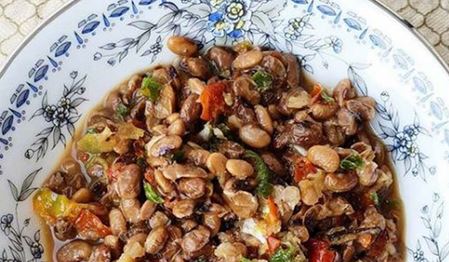
    A movie named Axone — also spelt akhuni —soya bean dish of Nagaland has been recently released.

    The traditional ‘Axone’ dish is very unique in itself. However, one must note that it does NOT carry any GI tag. Still, there is a possibility of it being asked in match the pair type questions.

    What is Axone?

    • Axone — also spelt akhuni — is a fermented soya bean of Nagaland, known for its distinctive flavour and smell.
    • As much an ingredient as it is a condiment, Axone used to make pickles and chutneys, or curries of pork, fish, chicken, beef etc.
    • While it is called ‘axone’ in parts of Nagaland, fermented soya bean is cooked with, eaten and known by different names in different parts of Northeast India, including Meghalaya and Mizoram, Sikkim, Manipur as well in other South, Southeast and East Asian countries.
    • Axone is prepared and eaten across Nagaland but is particularly popular among the Sumi (also Sema) tribe. They use it in every meal.
  • Traditional art of Talamaddale

    The traditional art of ‘Talamaddale’, a variant of Yakshagana theatre, has gone virtual in times of COVID-19.

    Try this question from CSP 2017:

    Q.With reference to Manipuri Sankirtana, consider the following statements:

    1. It is a song and dance performance.
    2. Cymbals are the only musical instruments used in the performance.
    3. It is performed to narrate the life and deeds of Lord Krishna.

    Which of the statements given above is/are correct?

    (a) 1, 2 and 3.

    (b) 1 and 3 only

    (c) 2 and 3 only

    (d) 1 only

    Talamaddale theatre

    • Tala-Maddale is an ancient form of performance dialogue or debate performance in Southern India in the Karavali and Malnad regions of Karnataka and Kerala.
    • The plot and content of the conversation is drawn from popular mythology but the performance mainly consists of an impromptu debate between characters involving sarcasm, puns, philosophy positions and humour.
    • The main plot is sung from the same oral texts used for the Yakshgana form of dance- drama.
    • Performers claim that this was a more intellectual rendition of the dance during the monsoon season.

    How it is different from Yakshagana?

    • Unlike the Yakshagana performance, in the conventional ‘talamaddale,’ the artists sit across in a place without any costumes and engage in testing their oratory skills based on the episode chosen.
    • If music is common for both Yakshagana performance and ‘talamaddale’, the latter has only spoken word without any dance or costumes.
    • Hence it is an art form minus dance, costumes and stage conventions.
    • It has an ‘arthadhari’ who is an orator, a ‘bhagavatha’ (singer-cum-director), and a ‘maddale’ player.

    Back2Basics: Yakshagana

    • It is the oldest theatre form popular in Karnataka.
    • It emerged in the Vijayanagara Empire and was performed by Jakkula Varu
    • It is a descriptive dance drama.
    • It is presented from dusk to dawn.
    • The stories are drawn from Ramayana, Mahabharata and other epics from both Hindu and Jain tradition.
  • In news: Raja Parba Festival

    The Prime Minister has extended his greetings to the people of Odisha for the unique Raja Parba festival.

    Match the pair based question can be asked from festivals as such with pairs of name and celebrating state. Recently, the following festivals were also in the news: Ambubachi Mela, Thrisoor Puram, Meru Jatara, Nagoba Jatara etc.

    Also, note the similarities between the Raja Parba and Ambubachi Mela …

     About Raja Parba Festival

    • Raja Parba is Odisha’s three-day unique festival celebrating the onset of monsoon and the earth’s womanhood.
    • As a mark of respect towards the earth during her menstruation days, all agricultural works, like ploughing, sowing is suspended for the three days.
    • Raja Sankranti is the first day of the Ashara month.
    • It is celebrated on the day prior to the Sankranti, (Pahili Raja), the day of Sankranti, and the day after, known as Bhu Daha or ‘Basi Raja.
    • The festival is essentially the celebration of the earth’s womanhood.
    • It is believed that during this time the Mother Earth or Bhudevi undergoes menstruation.
    • The fourth day is the day of the ‘purification bath’.
    • As it is a celebration of womanhood, a lot of the focus is on young women, who wear new clothes, apply ‘Alata’ on their feet and enjoy folk songs while swinging on decorated rope swings.


  • Festivals in news: Kheer Bhawani Mela

    In the UT of Jammu and Kashmir, the Annual Kheer Bhawani Mela in Tulmulla village of Ganderbal district has been cancelled by its religious trust.

    Match the pair based question can be asked from festivals as such. Recently, the following festivals were in the news: Ambubachi Mela, Thrisoor Puram, Meru Jatara, Nagoba Jatara etc.

    Try this:

    Q. Consider the following pairs:

    Traditions                                            Communities

    1. Chaliha Sahib Festival              —          Sindhis

    2. Nanda Raj Jaat Yatra                —          Gonds

    3. Wari-Warkari                               —          Santhals

    Which of the pairs given above is/are correctly matched ? (CSP 2017)

    (a) 1 only

    (b) 2 and 3 only

    (c) 1 and 3 only

    (d) None of the above

    Kheer Bhawani Mela

    • The festival witnesses lakhs of Hindu pilgrims from across the country largely the Kashmiri Pandit Community, who throngs the famous Ragyna Devi Temple which is popularly known as “Mata Kheer Bhawani”.
    • The festival falls on the auspicious day of “Zeshta Ashtami”.
    • The term kheer refers to rice pudding that is offered in the spring to propitiate the Goddess, which became part of the name of the temple.
    • The devotees have been asked to cooperate with the authorities and perform the worship of the Goddess at their homes only.
    • However, the holy rituals and Aarti of the Deity will be conducted as per the tradition which will be shared with the devotees via social media.

    Significance

    • Kheer Bhawani Mela is one of the biggest religious functions of Kashmiri Pandit Community.
    • It is believed and rather has been seen that the colour of the water in the spring around the Kheer Bhawani Temple changes its colour with the change in the circumstances of the Kashmir valley.
  • Purandara Dasa and his legacy

    The Department of Archaeology, Karnataka has commenced field research work regarding the birthplace of Purandara Dasa who is held as the father figure of Carnatic music.

    Recently there was a news on Lord Basaveshwara. Now comes the other popular saint.

    Vaishnavism and Shaivism are the two most profound strands of Bhakti Movement in Indian history. Enlist all the Bhakti Saints and their theistic philosophy and teachings. Try to spot the minute differences between them.

    Purandara Dasa

    • Purandara Dasa (1484 –1565) was a Haridasa, a renowned composer of Carnatic music, a great devotee of the Supreme Lord Krishna, a Vaishnava poet, a saint and a social reformer.
    • He was a disciple of the Dvaita philosopher-saint Vyasatirtha, and a contemporary of yet another Haridasa, Kanakadasa.
    • He was a composer, singer and one of the chief founding-proponents of South Indian classical music (Carnatic music).
    • In honour of his significant contributions to Carnatic music, he is widely referred to as the Pitamaha (lit. “father” or “grandfather”) of Carnatic music.
    • He is respected as an Avatara (incarnation) of the great sage Narada (a celestial being who is also a singer).

    Confusions over his birthplace

    • As ‘Purandara Vithala’ was the pen name of his compositions, it was widely believed that the mystic poet was born in Purandar (near Pune), Maharashtra.
    • However, many in Malnad claimed that he hailed from this region.
    • According to historians, Araga in Malnad was a buzzing commercial centre during the Vijayanagar rule, the period to which the poet belonged to.
    • Prior to his initiation to Haridasa tradition, Purandara Dasa was a rich merchant and was called as Srinivasa Nayaka.

    Back2Basics: Bhakti Movement

    • The Bhakti movement refers to the theistic devotional trend that emerged in medieval Hinduism.
    • It originated in eighth-century south India and spread northwards.
    • It swept over east and north India from the 15th century onwards, reaching its zenith between the 15th and 17th century CE.
    • It has traditionally been considered as an influential social reformation in Hinduism and provided an individual-focused alternative path to spirituality regardless of one’s birth or gender
    • The salvation which was previously considered attainable only by men of Brahmin, Kshatriya and Vaishya castes, became available to everyone.
  • Rail adukku pathiram Utensils of Tamil Nadu

    The rail adukku pathiram a traditional set of kitchen utensils in Tamil Nadu has become the gathered attention of all over the past few days.

    The traditional ‘rail adukku pathiram’ set of utensils are very unique in itself. However, one must note that it does NOT carry any GI tag and is completely out of use. Still, there is a possibility of it being asked in match the pair type questions asking – Q) Which among the following artefacts from Tamil Nadu carries a GI Tag?

    Rail adukku pathiram

    • The rail adukku pathiram consists of 14 vessels of different sizes, neatly placed in a compact manner inside the largest container.
    • The vessels were earlier used by families to carry groceries and cook food during train journeys.
    • These vessels were used to cook food for a mini-wedding. The interesting aspect is the compact size and easy to carry.
    • It has two vessels to cook vegetables, a sippal plate to boil rice, a frying pan, a sombu, a bronze pot to carry water and vessels of varying sizes to cook food.
    • Many in Tamil Nadu had forgotten about the existence of these multi-layered vessels until a video surfaced online recently.
  • Person in news: Ramkinkar Baij

    Ministry of Culture’s has organised virtual tour titled “Ramkinkar Baij | Journey through silent transformation and expressions” to commemorate his 115th Birth Anniversary.

    We can expect a description based question in prelims like-

    Q. “In 1925, he made his way to Kala Bhavana, the art school at Santiniketan and was under the guidance of Nandalal Bose. Encouraged by the liberating, intellectual environment of (Tagore’s) Santiniketan, his artistic skills and intellectual horizons blossomed, thus acquiring greater depth and complexity. One of the earliest modernists in Indian art, he assimilated the idioms of the European modern visual language and yet was rooted in his own Indian ethos.”

    Who is the imminent personality discussed?

    Who was Ramkinkar Baij?

    • Ramkinkar Baij (1906-1980), one of the most seminal artists of modern India, was an iconic sculptor, painter and graphic artist.
    • He was born in Bankura, West Bengal, into a family of little economic and social standing and grew by his sheer determination into one of the most distinguished early modernists of Indian art.
    • In 1925, he made his way to Kala Bhavana, the art school at Santiniketan and was under the guidance of Nandalal Bose.
    • Encouraged by the liberating, intellectual environment of (Tagore’s) Santiniketan, his artistic skills and intellectual horizons blossomed, thus acquiring greater depth and complexity.

    His works

    • One of the earliest modernists in Indian art, he assimilated the idioms of the European modern visual language and yet was rooted in his own Indian ethos.
    • His themes were steeped in a deep sense of humanism and an instinctive understanding of the symbiotic relationship between man and nature.
    • Both in his paintings and sculptures, he pushed the limits of experimentation and ventured into the use of new materials.
    • For instance, his use of unconventional material, for the time, such as cement concrete for his monumental public sculptures set a new precedent for art practices.
    • The use of cement, laterite and mortar to model the figures, and the use of a personal style in which modern western and Indian pre-classical sculptural values were brought together was equally radical.

    Popular recognition

    • Although his work was passed over for quite a while, gradually it began to get both national and international attention.
    • He was invited to participate in the Salon des Réalités Nouvelles in 1950 and in the Salon de Mai in 1951.
    • In the national honours began to come his way one after the other.
    • In 1970, the Government of India honoured him with the Padma Bhushan for his irrefutable contribution to Indian art.
    • In 1976 he was made a Fellow of the Lalit Kala Akademi.
    • In 1976, he was conferred the honorary Doctoral Degree of ‘Desikottama’ by Visva Bharati, and in 1979 an honorary D. Litt by Rabindra Bharati University.
  • Toda Embroidery of the Nilgiris

    Many women and indigenous Toda artisans from the Nilgiris are producing thousands of stylish, embroidered masks for local residents, police, and sanitary workers.

    Recently, the Assamese Gamosa was in new. Now the Pukhoor Embroidery has made it into the list. Keep a note of all such handicrafts. We can expect a match the pair based prelim question.

    Toda Embroidery

    • The Toda Embroidery, also locally known as “pukhoor” is an artwork among the Toda pastoral people of Nilgiris, in Tamil Nadu, made exclusively by their women.
    • The embroidery, which has a fine finish, appears like a woven cloth but is made with the use of red and black threads with a white cotton cloth background.
    • Both sides of the embroidered fabric are usable and the Toda people are proud of this heritage.
    • This handicraft product is listed as a geographically tagged product and is protected under the Geographical Indications of Goods (Registration & Protection) Act (GI Act) 1999.

    Related facts

    • The local terms used to describe the embroidery work are ‘kuty’ or ‘awtty’ meaning “stitching” and ‘kutyvoy’ meaning the embroidered piece.
    • The materials used in this work are roughly woven white cloth, woollen black and red threads with use occasionally of blue threads and manufactured needles.
    • The designs developed relate to nature and the daily cycle of life.
    • The patterns used in Toda embroidery do not cover many floral motifs but generally cover celestial bodies (like Sun and Moon), reptiles, animals, and horns of buffaloes, made in crimson and black colours.
    • Rabbit ears are a constant depiction on the boundary of the embroidered cloth. Another common design in the form of black triangles in a box design is done in honour of their first priest.
    • Women who do embroidery consider their work as a “tribute to Nature”.
    • As a traditional garment, it is worn by both men and women at all ceremonial occasions and also at funerals. Elderly people of the community wear this cloth daily.
  • Festival in news: Chithirai Festival

    For the first time, in place of Madurai’s Chithirai Festival, a simple celestial union is set to take place that will be streamed online.

    Match the pair based question can be asked from festivals as such. Recently, the following festivals were in the news: Ambubachi Mela, Thrisoor Puram, Meru Jatara, Nagoba Jatara etc.

    Chithirai Festival

    • Chithirai Festival or Chithirai Thiruvizha is an annual celebration celebrated in the city of Madurai during the month of April.
    • It is celebrated during the Tamil month of Chithirai.
    • It lasts for one month of which the first 15 days mark the celebrations of the coronation of Goddess Meenakshi and the Marriage of Lord Sundareswara and Goddess Meenakshi.
    • The next 15 days mark the celebrations of the Journey of Lord Alagar from Kallazhagar temple in Alagar Koyil to Madurai.

    About Meenakshi Temple

    • The ancient city of Madurai, more than 2,500 years old, was built by the Pandyan king, Kulashekarar, in the 6th century B.C.
    • But the reign of the Nayaks marks the golden period of Madurai when art, architecture and learning flourished expansively.
    • The most beautiful buildings in the city including its most famous landmark, the Meenakshi temple, were built during the Nayak rule.
    • Located in the heart of the city, the Meenakshi-Sundareshwarar temple is dedicated to goddess Meenakshi, the consort of lord Shiva.
    • The sculpted pillars are adorned with the exquisite murals that celebrate the ethereal beauty of princess Meenakshi and the scenes of her wedding with Lord Shiva.
    • The pillars depict scenes from the wedding of Meenakshi and Sundareswarar. There are 985 richly carved pillars here and each one surpasses the other in beauty.