Nepal Prime Minister Balendra Shah stated in Parliament that Nepal has also “encroached upon Indian territory in many places,” triggering political controversy in Nepal.
Key Highlights
The statement was made while discussing the disputed:
Kalapani
Lipulekh
Limpiyadhura regions.
Opposition lawmakers in Nepal demanded clarification and removal of the remarks from parliamentary records.
India-Nepal Border Dispute
Main disputed areas:
Kalapani: A strategic Himalayan region near the India-Nepal-China trijunction.
Lipulekh Pass: Important trade and Kailash Mansarovar pilgrimage route.
Limpiyadhura: Claimed by Nepal as part of its territory.
Background of the Dispute
The dispute intensified after:
India released a new political map in 2019.
Nepal amended its Constitution in 2020 to include the disputed regions in its official map.
Nepal bases its claims mainly on interpretations of the: Treaty of Sugauli (1816).
What is Dasgaja?
“Dasgaja” refers to the no man’s land along the India-Nepal border.
Nepal’s Foreign Ministry later clarified that the PM’s remarks referred mainly to:
Cross border occupation
Technical boundary irregularities in riverine areas.
Treaty of Sugauli (1816)
Signed between the East India Company and the Kingdom of Nepal.
Signed after the Anglo-Nepal War.
Importance: Forms the basis of the present India-Nepal boundary disputes.
India’s Position
India maintains that:
Lipulekh lies within Indian territory.
It is a historic trade and pilgrimage route.
India supports resolving disputes through diplomatic dialogue.
[2020] Consider the following statements:
1. The value of Indo-Sri Lanka trade has consistently increased in the last decade
2. “Textile and textile articles” constitute an important item of trade between India and Bangladesh.
3. In the last five years, Nepal has been the largest trading partner of India in South Asia.
Which of the statements given above is/are correct?
PYQ Relevance[UPSC 2020] Quadrilateral Security Dialogue (Quad)’ is transforming itself into a trade bloc from a military alliance, in present times. Discuss.Linkage: The PYQ is directly linked to the article as it examines the Quad’s evolution from a security-focused platform to cooperation in critical minerals, infrastructure, maritime security, supply chains, and technology.
Mentor’s Comment
The recent Quad Foreign Ministers’ Meeting in New Delhi reaffirmed the grouping’s commitment to a “Free and Open Indo-Pacific” (FOIP), maritime security, critical minerals, and resilient supply chains. Yet, the meeting also exposed a deeper contradiction: while the Quad seeks strategic coherence, its members increasingly pursue divergent geopolitical priorities. The issue gains importance as India prepares for a larger Indo-Pacific role while simultaneously managing strategic autonomy amid growing U.S.-China rivalry.
What is Quadrilateral Security Dialogue (Quad)?
The Quad is a diplomatic partnership between Australia, India, Japan, and the United States committed to supporting a peaceful, stable and prosperous Indo-Pacific that is inclusive and resilient.
Why was the Quad established, and how has it evolved institutionally?
Origins in Humanitarian Cooperation: The Quad emerged after the 2004 Indian Ocean tsunami, when India, Japan, Australia, and the U.S. coordinated disaster relief operations.
Initial Formation (2007): The grouping formally began at the official level amid concerns over maritime security and regional stability in the Indo-Pacific.
Temporary Dormancy: Strategic hesitation and Chinese opposition weakened momentum after 2007, leading to institutional stagnation.
Revival (2017): Re-emerged amid concerns over China’s assertive maritime posture, militarisation in the South China Sea, and supply chain vulnerabilities.
Leadership Upgrade (2021): Transitioned into leader-level summits, reflecting institutional consolidation and strategic confidence.
India’s Chairmanship (2024-26): India assumed the Quad Chair in 2024 but has faced delays in convening the summit due to diplomatic tensions and scheduling disruptions.
Why is the Quad increasingly important in the Indo-Pacific strategic architecture?
Maritime Security: Strengthens regional monitoring through the Indo-Pacific Partnership for Maritime Domain Awareness (IPMDA) to track illegal maritime activities.
Surveillance Coordination: Expands operational cooperation through the Indo-Pacific Maritime Surveillance Collaboration (IPMSC) and a Quad-at-Sea Ship Observer Mission.
Critical Minerals Cooperation: Reduces excessive dependence on concentrated supply chains, particularly concerning China’s dominance in rare earth processing.
Infrastructure Development: Marks a shift from dialogue to implementation through the first-ever Quad infrastructure project involving port development in Fiji.
Energy Security: Improves resilience against geopolitical disruptions affecting fuel and strategic supply routes.
Rules-Based Order: Reaffirms commitment to Freedom and Openness in the Indo-Pacific (FOIP), sovereignty, territorial integrity, and adherence to international law, especially UNCLOS.
How do divergent strategic interests constrain the Quad’s effectiveness?
China Perception Gap: India prioritises border security and strategic autonomy, Japan focuses on East China Sea tensions, Australia emphasises economic-security balancing, while the U.S. treats the Quad as a pillar of Indo-Pacific containment.
West Asia Contradictions: Members expressed concern regarding Iranian actions but avoided direct criticism of the U.S.-Israel actions, exposing selective strategic positioning.
Russia Factor: U.S. geopolitical priorities increasingly diverge from India’s long-standing strategic engagement with Russia.
Consultation Deficit: Limited coordination during crises such as the West Asia conflict raises questions regarding the Quad’s effectiveness as a consultative mechanism.
Trade and Tariff Frictions (2025): Disagreements over sanctions, trade measures, and Operation Sindoor claims disrupted plans for a Delhi summit.
Leadership Discontinuity: India may transfer the Chair to Australia without hosting a summit, potentially signalling reduced momentum.
Institutional Credibility: Regular summits remain essential for sustaining political commitment and strategic continuity.
Can the Quad move beyond strategic signalling toward functional cooperation?
Climate Cooperation: Supports resilient infrastructure and climate adaptation in vulnerable Indo-Pacific states.
Health Security: Enhances vaccine partnerships and emergency preparedness frameworks.
Debt and Infrastructure Financing: Provides alternatives to debt-heavy development models in the Indo-Pacific.
Supply Chain Resilience: Diversifies production ecosystems for semiconductors, pharmaceuticals, and strategic minerals.
Technology Partnerships: Facilitates cooperation in critical and emerging technologies.
What should India’s approach toward the Quad be?
Strategic Autonomy: Maintains engagement without entering formal military alliances.
Issue-Based Cooperation: Prioritises maritime security, supply chains, infrastructure, and technology instead of alliance politics.
Regional Balancing: Ensures Indo-Pacific stability while preserving ties with Russia, West Asia, ASEAN, and the Global South.
Institutional Deepening: Strengthens continuity through regular summits, implementation mechanisms, and operational coordination.
Conclusion
The Quad’s challenge lies not in institutional survival but strategic coherence. Maritime cooperation, critical minerals, infrastructure, and technology partnerships continue to provide functional relevance. However, divergent threat perceptions and unilateral geopolitical actions risk weakening collective purpose. Sustained consultation, regular summits, and issue-based cooperation remain essential to ensure that the Quad evolves as a credible Indo-Pacific platform rather than a forum shaped by competing national priorities.
Germany and the Netherlands announced the establishment of a joint NATO tactical headquarters in the Baltic region to strengthen deterrence against Russia.
Key Highlights
The joint command centre is called:
1GNC (German-Netherlands Corps)
Will operate mainly in:
Estonia
Latvia
Can command up to 50,000 troops
Functions of 1GNC
Planning military exercises
Operational command during conflicts
Strengthening NATO’s eastern flank
Rapid military response capability
About the German-Netherlands Corps
Established in 1995
Headquarters located in Münster
Germany and Netherlands rotate leadership
Supported by personnel from 14 NATO countries
Note: The Baltic region in Northern Europe comprises the countries surrounding the Baltic Sea. It is most commonly divided into the Baltic States (Estonia, Latvia, and Lithuania), alongside neighboring nations like Sweden, Finland, Denmark, Germany, Poland, and Russia.
[2025] Consider the following countries: I. Austria II. Bulgaria III. Croatia IV. Serbia V. Sweden VI. North Macedonia How many of the above are members of the North Atlantic Treaty Organization?
PYQ Relevance[UPSC 2022] Discuss global warming and mention its effects on the global climate. Explain the control measures to bring down the level of greenhouse gases which cause global warming, in the light of the Kyoto Protocol, 1997.Linkage: CBAM directly links climate action with trade regulation, making carbon emissions economically consequential for exports. It bridges climate governance and international trade policy.
Mentor’s Comment
The European Union’s Carbon Border Adjustment Mechanism (CBAM) will enter its definitive phase from January 1, 2026, imposing a carbon-linked levy on imports based on embedded emissions. This marks a major shift because, for the first time, global trade access is increasingly being linked to carbon intensity of production rather than conventional tariffs alone. For India, sectors such as steel, cement, aluminium, fertilizers, electricity, and hydrogen face direct exposure.
What is the Carbon Border Adjustment Mechanism (CBAM)?
It is the European Union’s policy tool designed to put a fair price on carbon emitted during the production of carbon-intensive goods entering the EU.
By charging importers for embedded emissions, it aims to prevent “carbon leakage,” ensuring EU producers are not at a disadvantage compared to foreign producers and encouraging cleaner global industrial production.
Key Aspects of CBAM:
Purpose: Mitigates the risk of carbon leakage, where companies move production to countries with lenient environmental regulations.
Covered Sectors: Initially, CBAM covers imports of iron and steel, cement, fertilizers, aluminum, hydrogen, and electricity.
How it Works: Importers must report the GHG emissions embedded in their products. From 2026, they will need to purchase “CBAM certificates” to pay for these emissions, aligned with the carbon price paid by EU producers under the EU Emissions Trading System (ETS).
Goal: The policy is a central part of the “Fit for 55” package, aiming for a 55% reduction in greenhouse gas emissions by 2030, compared to 1990 levels.
How is CBAM reshaping the rules of global trade?
Carbon-linked Market Access: Links export competitiveness to embedded carbon emissions rather than only product quality or price competitiveness.
Carbon Leakage Prevention: Imposes charges on imported products to prevent industries from relocating production to countries with weaker environmental regulations.
Trade Governance Shift: Moves global trade away from traditional tariff barriers toward climate-linked compliance mechanisms.
Policy Diffusion: Encourages wider adoption of carbon-pricing policies by developed economies, increasing compliance burdens globally.
Competitiveness Redefinition: Makes production efficiency dependent not only on cost but also on carbon efficiency of manufacturing processes.
Example: The EU’s CBAM applies to steel, cement, aluminium, fertilizers, electricity, and hydrogen, sectors with high embedded carbon intensity.
Why does CBAM pose a major challenge for India’s exports?
Export Competitiveness Risk: Increases costs for carbon-intensive exports entering the European market.
Steel and Aluminium Exposure: Creates immediate vulnerabilities because these sectors depend significantly on European markets and involve carbon-intensive production.
Compliance Burden: Forces exporters to adopt cleaner technologies and stricter reporting systems to retain market access.
Profit Margin Compression: Shrinks margins as firms absorb additional compliance costs or face stricter contractual requirements.
Buyer Preference Shift: Encourages European buyers to prefer low-emission suppliers, reducing competitiveness of carbon-intensive exporters.
Example: Although EU importers formally pay CBAM charges, the burden may shift to Indian exporters through stricter contracts and supplier selection mechanisms.
How could CBAM indirectly affect India’s domestic economy?
Fertilizer Price Transmission: Raises input costs because India imports fertilizers from regions affected by CBAM-related carbon pricing.
Import Cost Escalation: Increases prices of imported emission-intensive goods, affecting production costs domestically.
Inflationary Pressure: Creates cost-push inflation through higher import prices of industrial inputs.
Supply Chain Spillover: Extends impacts beyond directly targeted export sectors through global production linkages.
Example: Major fertilizer exporters to India, Egypt, Russia, Morocco, and China, may pass carbon-compliance costs into export prices.
How is CBAM different from traditional non-tariff measures (NTMs)?
Structural Difference: Functions as a price-based and quantifiable carbon levy, unlike conventional product standards.
Compliance Nature: Traditional NTMs rely on qualitative product standards, whereas CBAM directly prices embedded emissions.
Reduced Interpretational Scope: Creates measurable obligations linked to carbon emissions rather than broad compliance requirements.
Carbon Accountability: Establishes a direct relationship between production emissions and market access.
Key Distinction: Traditional product standards determine whether a product qualifies for entry. CBAM determines how expensive market access becomes based on carbon intensity.
Why are developing countries particularly vulnerable to carbon-linked trade barriers?
Technology Constraints: Face limited access to low-carbon technologies and cleaner industrial systems.
Cost Asymmetry: Experience higher transition costs because carbon-neutral production remains expensive.
Equity Concerns: Encounter climate-linked barriers despite historically lower contributions to global emissions.
Market Access Restrictions: Risk exclusion from developed markets if carbon standards tighten further.
Trade Negotiation Imbalance: Face pressure to comply despite differences in developmental capacity.
Example: India’s ongoing Free Trade Agreement (FTA) negotiations with the European Union continue even as CBAM raises concerns regarding fair market access.
What domestic reforms must India undertake to remain competitive?
Clean Energy Investment: Strengthens industrial decarbonisation through renewable energy and cleaner fuel adoption.
Carbon Efficiency: Improves industrial competitiveness through lower emission-intensive production processes.
Industrial Modernisation: Facilitates adoption of cleaner technologies in steel, cement, aluminium, and fertilizer sectors.
Soil Health Management: Reduces fertilizer dependency through effective implementation of the Soil Health Card Scheme and balanced nutrient application.
Domestic Production Capacity: Lowers import vulnerability by expanding local manufacturing of emission-intensive inputs.
Carbon Policy Framework: Ensures gradual implementation of domestic carbon-pricing mechanisms.
How should India respond at the international level?
Equitable Trade Negotiation: Seeks fair treatment for developing countries in climate-linked trade regimes.
Transition Support: Demands technology transfer and transitional finance from developed countries.
Climate Justice Framework: Strengthens arguments around Common But Differentiated Responsibilities (CBDR).
Multilateral Coordination: Builds coalitions among developing countries against discriminatory carbon-linked trade measures.
WTO Compatibility Concerns: Questions whether climate-linked tariffs violate principles of non-discrimination in trade.
Conclusion
CBAM represents a structural transformation in global trade where carbon intensity increasingly determines market access. For India, the challenge lies not merely in adapting to climate-linked trade regimes but in balancing industrial competitiveness, developmental priorities, and climate commitments. A calibrated strategy combining domestic industrial decarbonisation, technology adoption, and equitable global negotiations will remain essential.
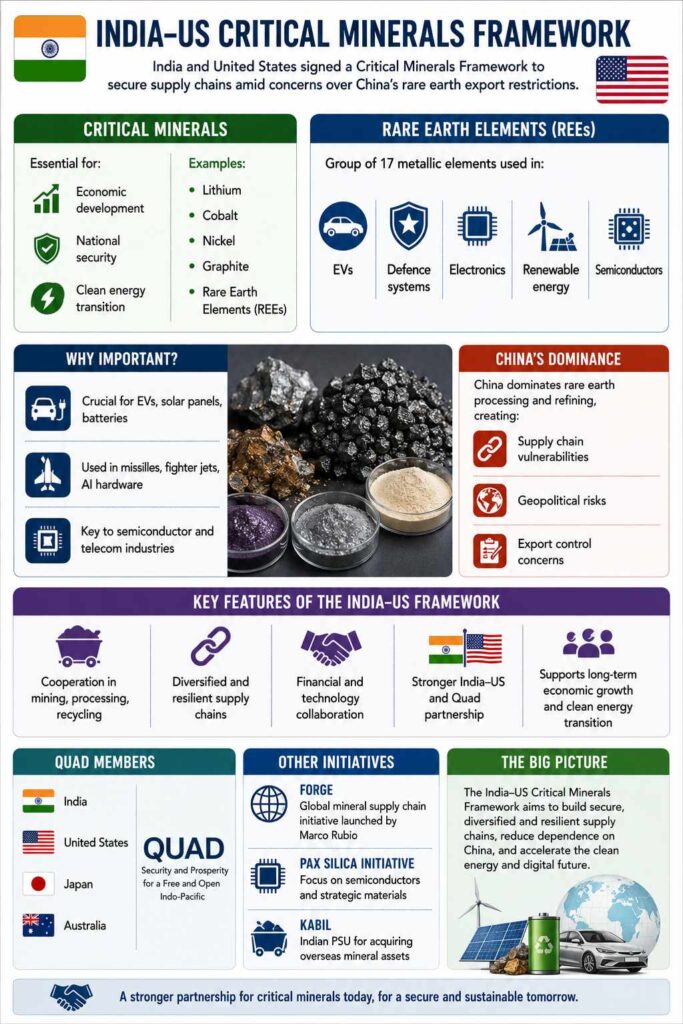
India and the United States signed a Critical Minerals Framework to secure supply chains amid concerns over China’s rare earth export restrictions.
Critical Minerals
Essential for:
Economic development
National security
Clean energy transition
Examples: Lithium, Cobalt, Nickel, Graphite, and Rare Earth Elements (REEs)
Rare Earth Elements (REEs)
Group of 17 metallic elements used in: EVs, Defence systems, Electronics, Renewable energy, and Semiconductors
Why Important?
Crucial for EVs, solar panels, batteries
Used in missiles, fighter jets, AI hardware
Key to semiconductor and telecom industries
China’s Dominance
China dominates rare earth processing and refining, creating:
Supply chain vulnerabilities
Geopolitical risks
Export control concerns
[2025] Consider the following statements: I. India has joined the Minerals Security Partnership as a member. II. India is a resource-rich country in all the 30 critical minerals that it has identified. III. The Parliament in 2023 has amended the Mines and Minerals (Development and Regulation) Act, 1957 empowering the Central Government to exclusively auction mining lease and composite license for certain critical minerals. Which of the statements given above are correct?
Muslim pilgrims gathered at the Mount of Mercy (Jabal al-Rahmah) on the plain of Arafat near Mecca during the annual Hajj pilgrimage.
What is Hajj?
Hajj is the annual Islamic pilgrimage to Mecca and one of the Five Pillars of Islam. It is performed during the Islamic month of Dhu al-Hijjah, mainly from the 8th to 12th day.
Importance
Mandatory once in a lifetime for every financially and physically capable Muslim.
Five Pillars of Islam
Shahada (Faith)
Salah (Prayer)
Zakat (Charity)
Sawm (Fasting during Ramadan)
Hajj (Pilgrimage)
What is Arafat?
Arafat is a plain about 20 km southeast of Mecca where pilgrims gather on the 9th day of Dhu al-Hijjah. It is considered the most important ritual site of Hajj.
Mount of Mercy (Jabal al-Rahmah)
Religious significance:
Prophet Muhammad delivered his Farewell Sermon here.
Islamic tradition believes Adam and Eve reunited here after separation.
[2022] The term “Levant” often heard in the news roughly corresponds to which of the following regions?
[A] Region along the eastern Mediterranean shores
[B] Region along North African shores stretching from Egypt to Morocco
PYQ Relevance[UPSC 2018] In what ways would the ongoing US-Iran Nuclear Pact Controversy affect the national interest of India? How should India respond to this situation?Linkage: The PYQ examines the impact of West Asian geopolitical instability and sanctions regimes on India’s energy security and foreign policy. The article discusses how sanctions, maritime insecurity, and disruptions around the Strait of Hormuz directly threaten India’s crude imports and economic stability.
Mentor’s Comment
The United States has allowed a key sanctions waiver on Russian seaborne crude to expire. This has forced major buyers like India to navigate stricter compliance amid volatile global energy markets. This shift restricts access to discounted Russian oil. The development comes at a time of heightened geopolitical instability in West Asia, maritime disruptions in critical sea lanes, and increasing vulnerability of global supply chains.
How does the U.S. decision alter the global energy equilibrium?
Sanctions Tightening: Restricts Russia’s ability to export seaborne oil freely, potentially reducing global supply flexibility and increasing market volatility.
Fragile Balancing Mechanism: Disturbs the earlier Western approach of sanctioning Russia while simultaneously preventing global price spikes through selective flexibility.
Geopolitical Spillover: Intensifies vulnerabilities caused by the Ukraine conflict, Red Sea disruptions, Iran-related tensions, and maritime insecurity.
Price Sensitivity: Alters freight rates, insurance premiums, and tanker availability, creating ripple effects across oil-importing nations.
Contradiction in Western Objectives: Creates tension between reducing Russia’s oil revenues and maintaining lower inflation and uninterrupted energy flows globally.
Why is India particularly vulnerable to disruptions in Russian oil trade?
Import Dependence: India imports nearly 90% of its crude oil requirements, making external energy shocks economically significant.
Third-Largest Oil Importer: India ranks among the world’s largest energy consumers, increasing exposure to global price fluctuations.
Discounted Russian Crude: Russian oil after 2022 acted as an economic stabiliser by reducing import bills and improving refinery margins.
Inflation Transmission: Rising crude prices increase transport costs, food inflation, fertiliser subsidies, and household expenditure.
Industrial Competitiveness: Expensive energy raises manufacturing costs and affects export competitiveness.
Supply Diversification: Russian imports reduced overdependence on West Asian suppliers and provided flexibility during global disruptions.
How do energy shocks transmit into India’s economy?
Higher Crude Prices: Increase landed import costs, widen the current account deficit, and pressure the rupee.
Strait of Hormuz Vulnerability: Disruptions create supply uncertainty because a large share of India’s crude and LPG imports transit through these waters.
Shipping Insurance Surge: Raises transportation costs due to higher war-risk premiums during geopolitical tensions.
Refinery Stress: Constrains refining margins and increases sourcing complexity.
Fuel Logistics Pressure: Affects LPG and petroleum product supply chains, increasing domestic energy stress.
Table: How Energy Shocks Affect India
Energy Shock
Immediate Impact
Secondary Impact on India
Higher crude oil prices
Costlier imports
Inflation and rupee pressure
Strait of Hormuz disruption
Supply uncertainty
LPG and fuel logistics stress
Shipping insurance surge
Higher landed crude cost
Refining margin pressure
Russian crude restrictions
Reduced supply flexibility
Higher sourcing costs
Freight disruptions
Delayed cargoes
Inventory management stress
Why are sanctions increasingly colliding with market realities?
Fear Premium: Oil prices react not only to shortages but also to anticipated disruptions, often driving prices sharply upward.
Hydrocarbon Dependence: Despite renewable expansion, global transport, aviation, petrochemicals, agriculture, and trade logistics remain heavily oil-dependent.
Revenue Resilience: Russia can continue earning substantial revenues through elevated prices despite reduced export volumes.
Market Pragmatism: Previous temporary waivers reflected recognition that excessive restrictions destabilise global markets.
Energy-Economics Contradiction: Harder sanctions risk worsening inflation and energy insecurity for importing economies.
How is energy security being redefined in the 21st century?
Shift from Physical Scarcity: Energy insecurity now stems less from supply shortages and more from disruptions in shipping, sanctions, tanker blacklisting, financial restrictions, and payment barriers.
Geopolitical Embeddedness: Energy flows increasingly reflect geopolitical alignments rather than purely commercial logic.
Maritime Risks: Strategic chokepoints such as the Strait of Hormuz and Bab-el-Mandeb have become central to global energy security.
Financial Vulnerability: Banking restrictions and sanctions increasingly shape energy access.
Strategic Competition: Energy trade is increasingly influenced by rival geopolitical blocs.
What long-term energy strategy should India adopt?
Strategic Autonomy: Preserves independent energy decision-making amid competing geopolitical blocs.
Conclusion
The tightening of restrictions on Russian oil underscores the growing fusion of geopolitics and energy economics. For India, the challenge extends beyond temporary price volatility to structural energy vulnerability. Long-term resilience will depend on diversified sourcing, stronger reserves, domestic exploration, maritime preparedness, and accelerated clean-energy transition. In an increasingly fragmented world, energy security will remain central to economic sovereignty and strategic autonomy.
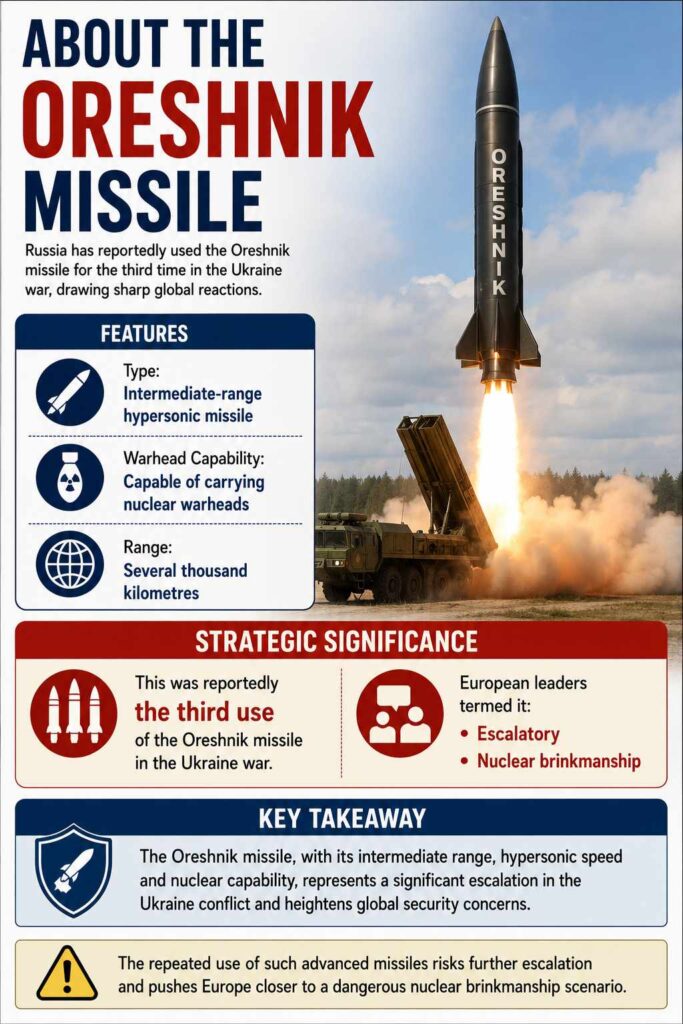
Russia launched a large-scale missile and drone attack on Ukraine, including the use of the hypersonic Oreshnik missile near Kyiv.
Key Highlights
Russia carried out one of the heaviest bombardments on: Kyiv
Hundreds of Drones and Missiles were used.
About the Oreshnik Missile
Features
Intermediate-range hypersonic missile [Range of 3,000 km to 5,500 km]
Capable of carrying: Nuclear warheads
Strategic Significance
This was reportedly: The third use of the Oreshnik missile in the Ukraine war.
European leaders termed it:
Escalatory
Nuclear brinkmanship
[2023] Consider the following countries 1. Bulgaria 2. Czech Republic 3. Hungary 4. Latvia 5. Lithuania 6. Romania How many of the above countries share a land border with Ukraine?
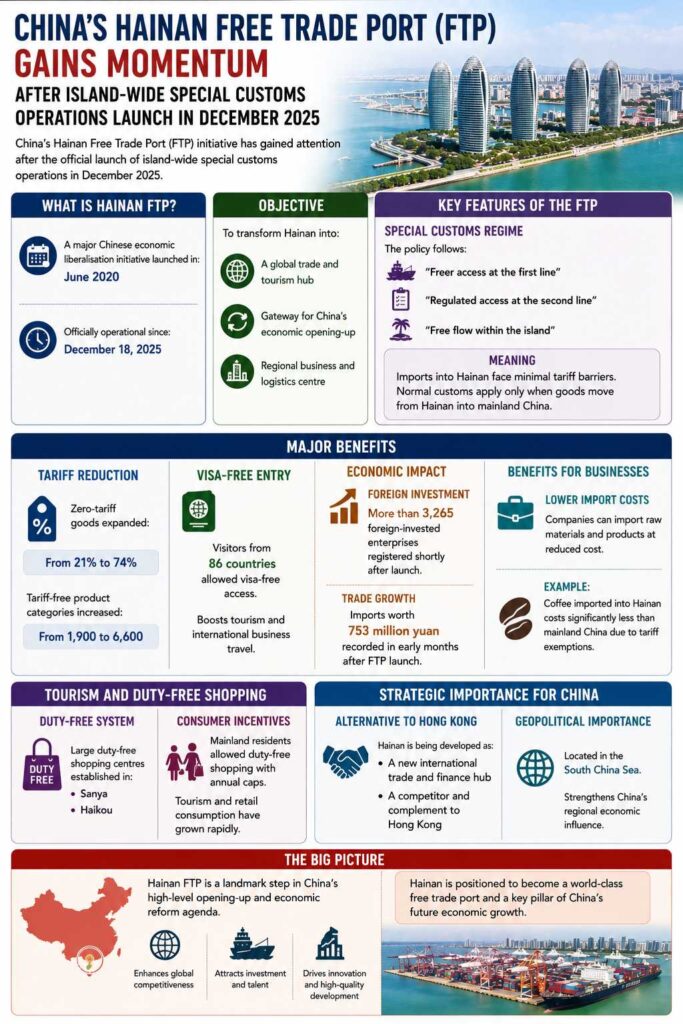
China’s Hainan Free Trade Port (FTP) initiative has gained attention after the official launch of island-wide special customs operations in December 2025.
What is Hainan FTP?
A major Chinese economic liberalisation initiative launched in June 2020
Officially operational since December 18, 2025
Objective
To transform Hainan into:
A global trade and tourism hub
Gateway for China’s economic opening-up
Regional business and logistics centre
Key Features of the FTP
The policy follows:
“Freer access at the first line”
“Regulated access at the second line”
“Free flow within the island”
Meaning
Imports into Hainan face minimal tariff barriers.
Normal customs apply only when goods move from Hainan into mainland China.
Major Benefits
Tariff Reduction
Zero-tariff goods expanded From 21% to 74%
Tariff-free product categories increased From 1,900 to 6,600
Visa-Free Entry
Visitors from 86 countries allowed visa-free access.
Boosts tourism and international business travel.
Economic Impact
Foreign Investment: More than 3,265 foreign-invested enterprises registered shortly after launch.
Trade Growth
Imports worth 753 million yuan recorded in early months after FTP launch.
Benefits for Businesses
Lower Import Costs: Companies can import raw materials and products at reduced cost.
Example: Coffee imported into Hainan costs significantly less than mainland China due to tariff exemptions.
Tourism and Duty-Free Shopping
Duty-Free System
Large duty-free shopping centres established in:
Sanya
Haikou
Consumer Incentives
Mainland residents allowed duty-free shopping with annual caps.
Tourism and retail consumption have grown rapidly.
Strategic Importance for China
Alternative to Hong Kong
A new international trade and finance hub
A competitor and complement to Hong Kong
Geopolitical Importance
Located in the South China Sea
Strengthens China’s regional economic influence.
[2022] Which one of the following statements best reflects the issue with Senkaku Islands, sometimes mentioned in the news?
a) It is generally believed that they are artificial islands made by a country around South China Sea. b) China and Japan engage in maritime disputes over these islands in East China Sea. c) A permanent American military base has been set up there to help Taiwan to increase its defence capabilities. d) Though International Court, of Justice declared them as no man’s land, some South-East Asian countries claim them.
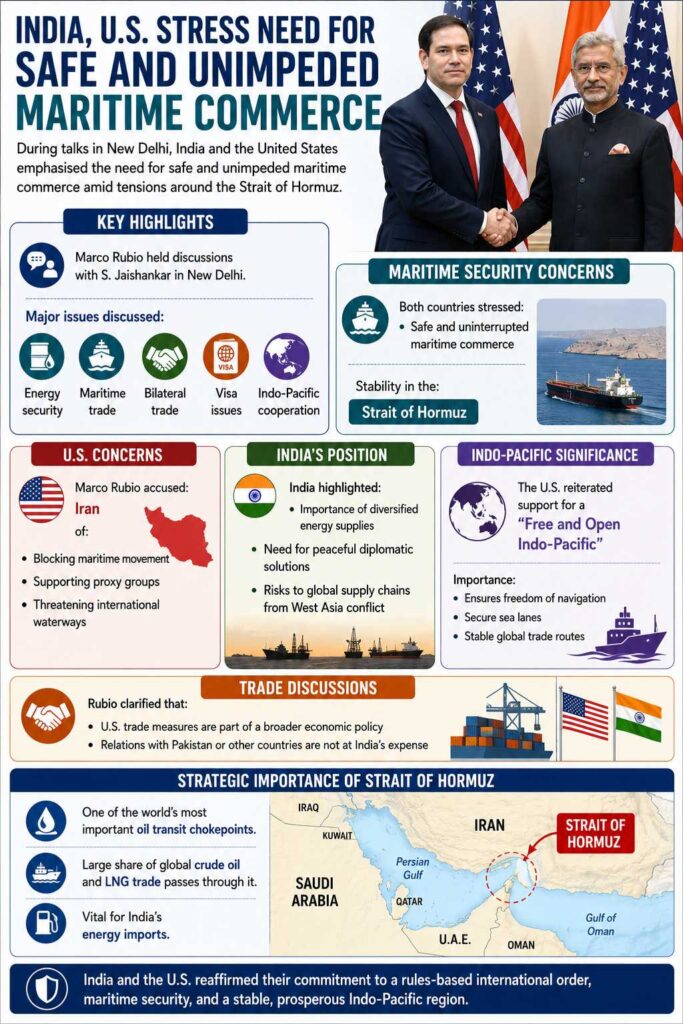
During talks in New Delhi, India and the United States emphasised the need for safe and unimpeded maritime commerce amid tensions around the Strait of Hormuz.
Key Highlights
Marco Rubio held discussions with S. Jaishankar in New Delhi.
Major issues discussed:
Energy security
Maritime trade
Bilateral trade
Visa issues
Indo-Pacific cooperation
Maritime Security Concerns
Both countries stressed:
Safe and uninterrupted maritime commerce
Stability in the: Strait of Hormuz
U.S. Concerns
Marco Rubio accused Iran of:
Blocking maritime movement
Supporting proxy groups
Threatening international waterways
India’s Position
India highlighted:
Importance of diversified energy supplies
Need for peaceful diplomatic solutions
Risks to global supply chains from West Asia conflict
Indo-Pacific Significance
The U.S. reiterated support for: A “Free and Open Indo-Pacific”
Importance
Ensures:
Freedom of navigation
Secure sea lanes
Stable global trade routes
Trade Discussions
U.S. trade measures are part of a broader economic policy
Relations with Pakistan or other countries are not at India’s expense
Strategic Importance of Strait of Hormuz
One of the world’s most important oil transit chokepoints.
Large share of global crude oil and LNG trade passes through it.
Vital for India’s energy imports.
Consider the following statements: Statement-I: Recently, the United States of America (USA) and the European Union (EU) have launched the Trade and Technology Council”. Statement-II: The USA and the EU claim that through this they are trying to bring technological progress and physical productivity under their control. Which one of the following is correct in respect of the above statements?
[A] Both Statement-I and Statement-II are correct and Statement-II is the correct explanation for Statement-I.
[B] Both Statement-I and Statement-II are correct and Statement-II is not the correct explanation for Statement-I.
[C] Statement-l is correct but Statement-II is incorrect.
[D] Statement-I is incorrect but Statement-II is correct.