Mains Ready By December. Smash Mains & Smash PYQ Admissions Open

GS Paper: GS2-18.Bilateral, regional and global groupings and agreements involving India and/or affecting India’s interests.

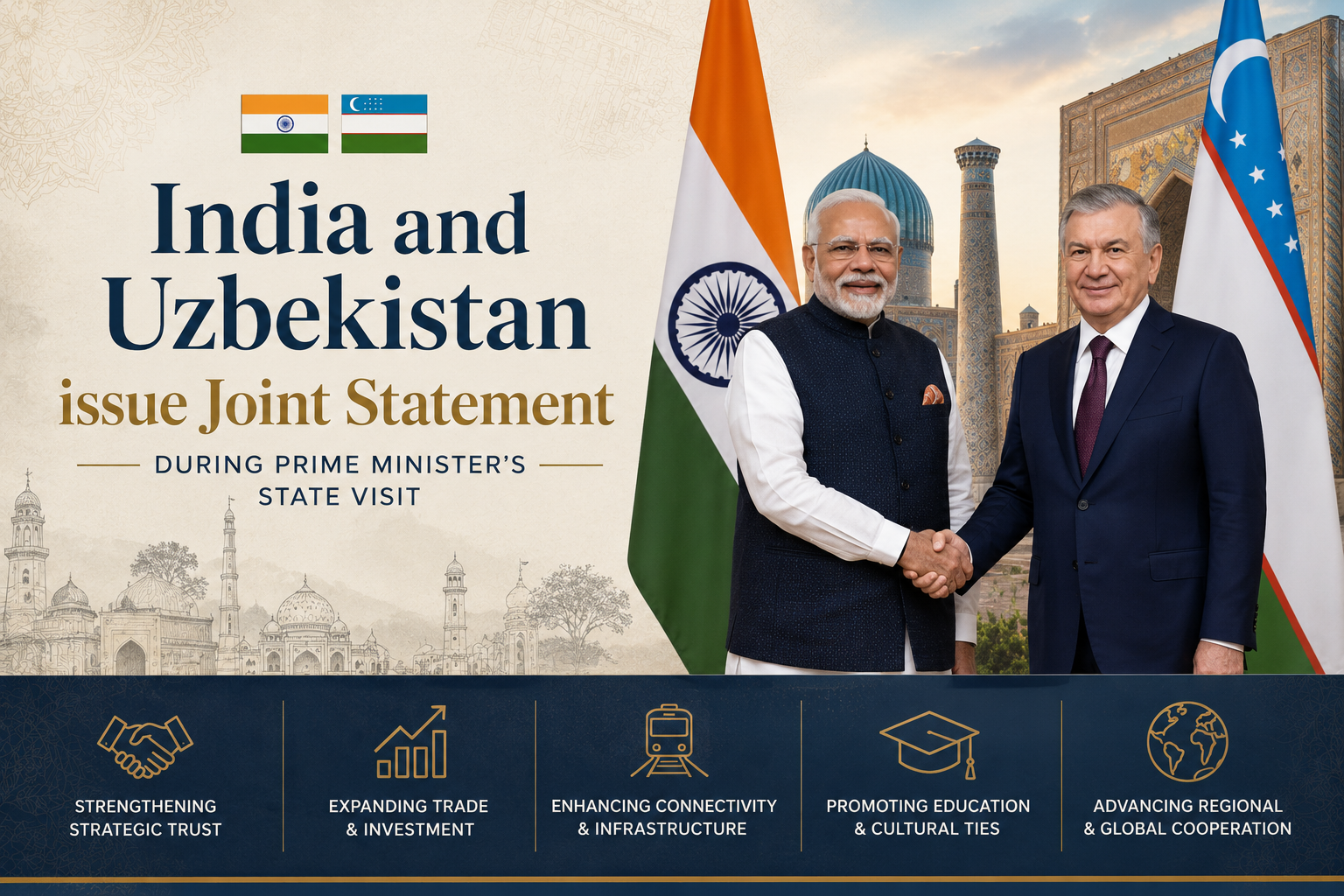
  • India and Uzbekistan issue Joint Statement during Prime Minister’s State Visit

    India and Uzbekistan issue Joint Statement during Prime Minister’s State Visit

    Why in the News

    India and Uzbekistan issued a Joint Statement during the State Visit of the Prime Minister to Uzbekistan.

    Core facts

    1. Event: A bilateral State Visit produced a Joint Statement, a List of Outcomes, and official talks. PRIDs 2304718, 2304704, 2304715.
    2. Track record: The relationship is a Comprehensive Strategic Partnership.
    3. Unverified detail: The specific agreements, Memoranda of Understanding (MoUs) and quantified deliverables listed in the release body could not be verified this run. The signed outcomes should be confirmed once PIB pages resolve.

    Static Context

    1. Uzbekistan: It is a double landlocked country in Central Asia. It borders Afghanistan, Kazakhstan, Kyrgyzstan, Tajikistan and Turkmenistan.
    2. Shanghai Cooperation Organisation (SCO): Both India and Uzbekistan are members. India became a full member in 2017. Tashkent is an early SCO capital in the grouping’s history.
    3. Connectivity: India reaches Central Asia through the International North South Transport Corridor (INSTC) and the Chabahar Port in Iran. These routes bypass Pakistan.
    4. Ashgabat Agreement, 2018: India joined this transport and transit corridor connecting Central Asia with Iran and Oman.
    5. India Central Asia format: India engages the five Central Asian Republics (CARs) through a dedicated summit and dialogue mechanism.

    Prelims angle

    Uzbekistan’s Central Asian geography, its SCO membership, the INSTC end points, and the Ashgabat Agreement are the testable static hooks.

    Mains angle

    GS Paper 2 (India and its neighbourhood, bilateral and regional groupings). A question can assess India’s strategic and connectivity interests in Central Asia against the entrenchment of outside powers.

    “[2024, GS Paper 2, 15 marks] Critically analyse India’s evolving diplomatic, economic and strategic relations with the Central Asian Republics (CARs) highlighting their increasing significance in regional and global geopolitics.”

    “[2025] India is one of the founding members of the International North-South Transport Corridor (INSTC), a multimodal transportation corridor, which will connect

    (a) India to Central Asia to Europe via Iran

    (b) India to Central Asia via China

    (c) India to South-East Asia through Bangladesh and Myanmar

    (d) India to Europe through Azerbaijan

    “[2022] Consider the following countries :

    1. Armenia

    2. Azerbaijan

    3. Croatia

    4. Romania

    5. Uzbekistan

    Which of the above are members of the Organization of Turkic States ?

    (a) 1, 2 and 4

    (b) 1 and 3

    (c) 2 and 5

    (d) 3, 4 and 5
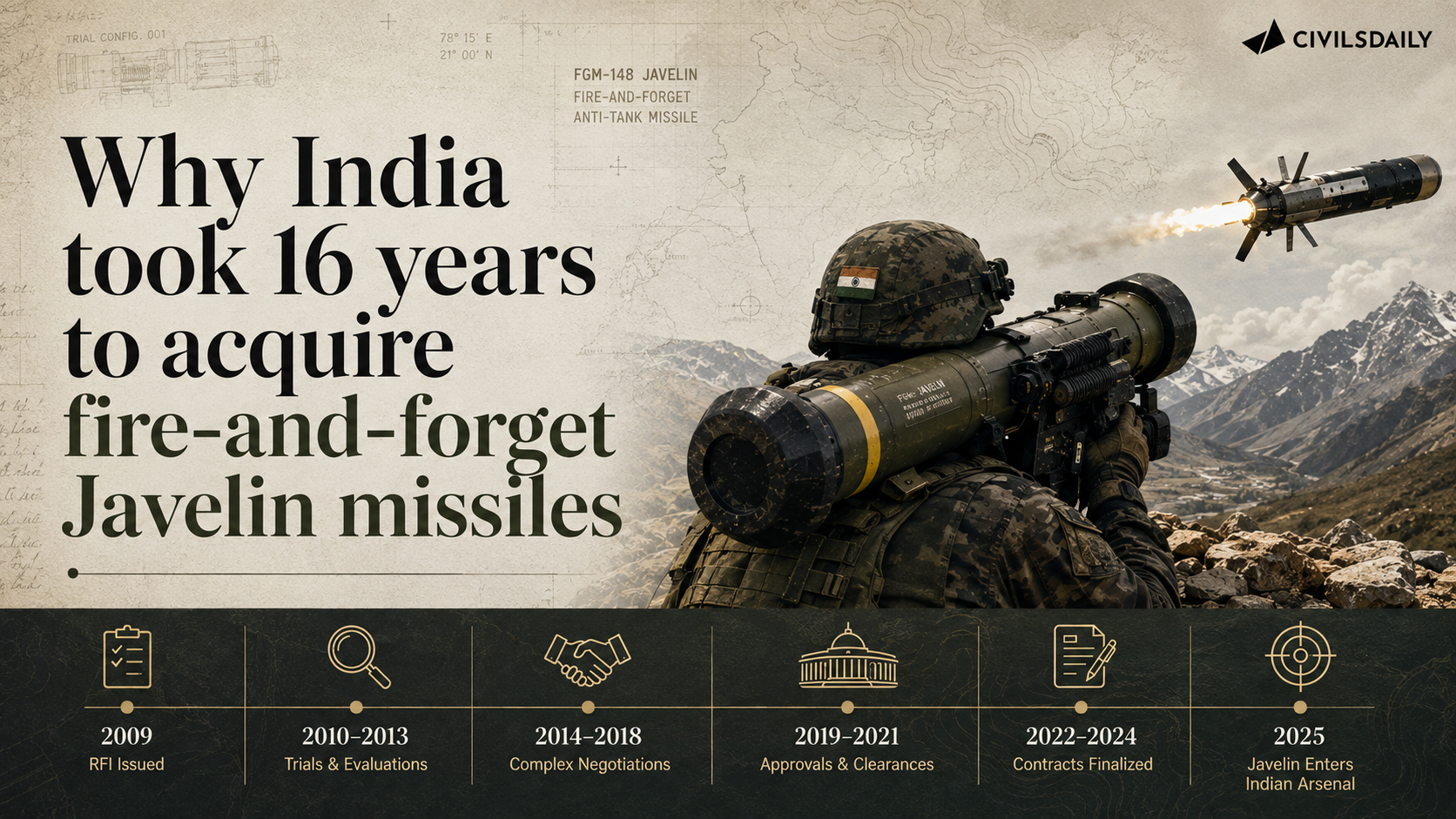
  • Why India took 16 years to acquire fire-and-forget Javelin missiles

    Why India took 16 years to acquire fire-and-forget Javelin missiles

    Why in the News

    India has finalised a deal to purchase the Javelin anti-tank guided missile (ATGM) system from the United States through its Foreign Military Sales (FMS) process. The purchase closes a process that began in 2010 and was shelved and revived several times in between. The original attempt collapsed over the American refusal to release the missile’s core seeker technology, and the alternative India turned to in its place, Israel’s Spike system, also failed to convert into a contract. The tension is that the deal has now closed on terms India rejected sixteen years ago, since co-production of a finished round is a different thing from the full transfer of technology that was demanded the first time.

    What is the Javelin anti-tank guided missile?

    1. What it is: A third generation, man portable anti-tank guided missile produced in the United States, designed to be carried and fired by a two person infantry team.
    2. Fire and forget guidance: The operator locks the missile onto the target before launch and the missile then guides itself to impact. The firing team can leave the position immediately, which a wire guided missile does not allow.

    Why did India want the Javelin in 2010?

    1. The stated intent: In August 2010 the Defence Minister told Parliament that the government intended to procure third generation Javelin missiles through the FMS route, and that the procurement would include a transfer of technology.
    2. The inventory gap: The move was driven by a shortage of anti-tank guided missiles in the Indian Army’s inventory.
    3. The indigenous programme slipped: The original timelines for the indigenous systems being developed by the Defence Research and Development Organisation (DRDO) had been delayed.
    4. What it was meant to replace: The idea was to replace the ageing Milan-2T and Konkurs missile systems then in use with the Army.
    5. Where the preference came from: United States forces actively showcased the system during the 2009 bilateral exercise Yudh Abhyas, after which it was highlighted as the choice to immediately fill the gap.

    Why did the first attempt collapse?

    1. The technology restriction: The acquisition was shelved because of stringent technology transfer restrictions imposed by Washington.
    2. The specific component withheld: The United States refused to share the missile’s core seeker technology, the imaging sensor that identifies and tracks the target, under a 100 per cent transfer of technology model.
    3. The consequence: The refusal caused India to pivot to Israel’s Spike missile system, manufactured by Rafael Advanced Defense Systems, in 2014.

    What happened to the Spike alternative?

    1. Why Spike was chosen: In 2014 India went ahead with Spike over the Javelin, on the understanding that it could offer greater flexibility of technology transfer and local production.
    2. The order cleared: The Defence Acquisition Council cleared the purchase of over 8,000 Spike missiles.
    3. Why it was cancelled: Concerns over the system’s performance in trials, over technology transfer, and over progress in India’s own man portable missile programme led to cancellation of the $500 million order in 2017.
    4. Revived and shelved again: The deal was revived in 2018 following the Israeli Prime Minister’s visit, and was subsequently shelved again.
    5. The stopgap purchase: India undertook an emergency purchase of a limited quantity of the fourth generation Spike-LR missiles in 2019 to meet an immediate operational gap.
    6. What did get built: In August 2023 Kalyani Rafael Advanced Systems, a joint venture between the Kalyani Group and Rafael, said it had won a Rs 287.51 crore order from the Defence Ministry for the supply of the missile systems.

    What changed to make the second attempt succeed?

    1. A different bilateral setting: The Javelin reappeared in India United States strategic discussions at a point when defence cooperation between the two countries had deepened.
    2. Co-production replaced technology transfer as the ask: A United States Congressional Research Service report updated in 2025 noted that co-production discussions involving the missile were ongoing.
    3. The industrial tie-up: In February 2025 the Javelin Joint Venture, a partnership between Lockheed Martin and Raytheon, said it was exploring co-assembly and co-production in India. It signed a memorandum of understanding with Bharat Dynamics Limited.
    4. The operational trigger: Discussions gained pace after Operation Sindoor in May 2025.
    5. The two track negotiation: By July 2025 India was negotiating for the systems both as an emergency procurement and through a long term contract, the latter likely involving co-production of the weapon systems.
    6. The clearance: Washington officially cleared the sale in November 2025.

    Challenges to the Javelin acquisition

    1. A government to government sale surrenders schedule control: Under Foreign Military Sales the buyer contracts with the United States government rather than with the manufacturer, so delivery follows the seller’s production queue. Eg. GE Aerospace’s F404 engine deliveries for the Tejas Light Combat Aircraft programme ran late as European demand for American systems surged after 2024. Fix. Write dated delivery milestones with defined penalties into the Letter of Offer and Acceptance rather than relying on the standard schedule.
    2. Co-assembly is not the technology that was withheld: An arrangement to assemble finished rounds in India leaves the guidance package as an imported item, which is the precise gap that stalled the 2010 attempt. Eg. Indian co-production of imported systems has historically stopped at airframe and integration work. Fix. Tie offset credit to manufacture of the seeker and its imaging components rather than to assembly hours.
    3. Unit cost limits how deep the stock can go: A fire and forget round with an imaging seeker costs many times what a wire guided round costs, which restricts the number of rounds a formation can hold. Eg. The 2019 purchase of Spike-LR was a limited emergency buy rather than an inventory replacement. Fix. Pair the import with volume production of DRDO’s Man Portable Anti-Tank Guided Missile so the expensive round is reserved for the hardest targets.
    4. Four missile families in one role: The Army would operate legacy Milan and Konkurs stock, Spike, Javelin and the indigenous system together, multiplying training pipelines and spares chains. Eg. The Kalyani Rafael line and a Bharat Dynamics Limited line would produce competing rounds for the same infantry task. Fix. Fix a role split by range band and phase the legacy systems out on a published timetable.

    Conclusion

    India has been short of man portable fire and forget anti tank missiles for more than a decade. The purchase answers that operational gap rather than any shift in acquisition policy, and the indigenous programme’s repeated slippage is what left the gap open. The marker to watch is whether the domestic arrangement moves past final assembly into seeker manufacture, since that is the component the first attempt broke on. If it does not, the deal has bought rounds rather than capability, and a one time exception starts to look like the practice.

    Back2Basics: Foreign Military Sales

    1. What it is: The United States government’s programme for selling defence articles, services and training to foreign governments and international organisations.
    2. How the transaction runs: The buyer contracts with the United States government, which then places the order with the manufacturer on the buyer’s behalf, so there is no direct commercial contract with the company.
    3. Who administers it: The Defense Security Cooperation Agency, under the Department of Defense, runs the programme under the Arms Export Control Act, 1976.
    4. The Congressional step: Sales above set value thresholds must be notified to the United States Congress before a Letter of Offer and Acceptance is issued to the buyer.

    Matching Previous Year Question

    “[2021, GS3, 10 marks] How is S-400 air defence system technically superior to any other system presently available in the world?”

  • India, Uzbekistan elevate strategic relationship

    India, Uzbekistan elevate strategic relationship

    Why in the News

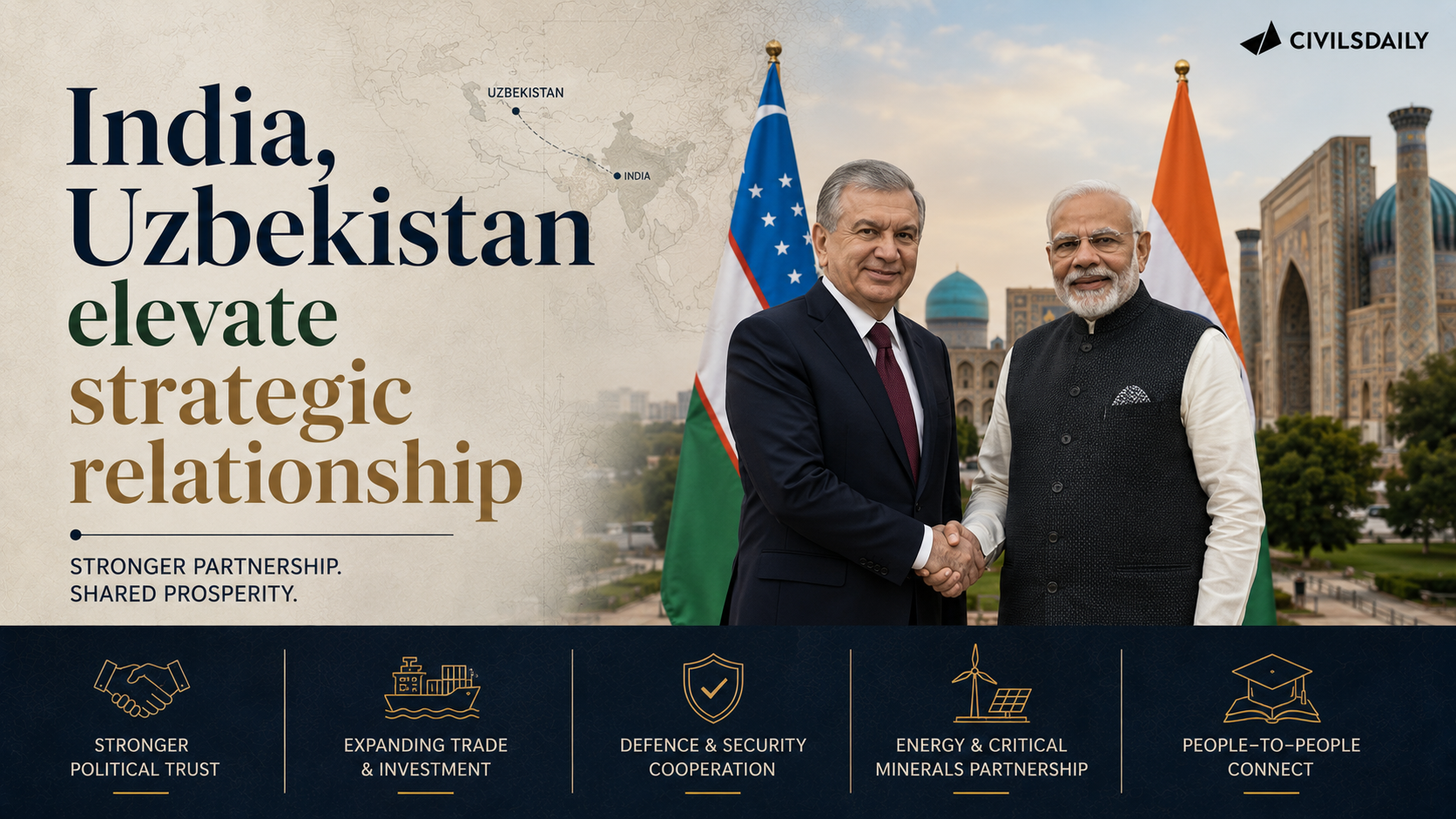
    India and Uzbekistan have elevated their ties to a Comprehensive Strategic Partnership and set a target of 5 billion dollars in annual trade by 2030.

    What is a Comprehensive Strategic Partnership?

    1. The top tier: It is the highest category in India’s graded system of bilateral partnerships, above a strategic partnership, and it signals cooperation across security, economic and technology domains rather than in a single sector.
    2. What it actually commits: The designation carries no treaty obligation, and it works by creating standing institutional machinery and periodic political level review.

    What was actually signed?

    1. Eleven agreements: The instruments cover mining, culture, education, tourism and ayurveda among other areas.
    2. A payments link: A commercial pact between National Payments Corporation of India (NPCI) International Payments Limited (NIPL), the international arm of the operator of India’s Unified Payments Interface (UPI), and Uzbekistan’s National Interbank Processing Centre JSC will let Indian UPI applications scan Uzbekistan’s national QR code, the UZQR, for merchant payments.
    3. Buddhist heritage: A Letter of Intent covers restoration and conservation of the Fayaz Tepa and Kara Tepa Buddhist sites in southern Uzbekistan, ancient monasteries marking the spread of Buddhism along the Silk Road.
    4. An environmental grant: India announced a grant of 1 million dollars for afforestation in the Aral Sea region.
    5. Education instruments: 100 Lal Bahadur Shastri scholarships for Hindi language study and an Indian Council for Cultural Relations (ICCR) Sanskrit Chair at the Tashkent State University of Oriental Studies were announced.

    Why does the resource agenda dominate the package?

    1. Uranium supply: The two sides agreed to establish a framework for the long term supply of uranium from Uzbekistan to India, with the agreement stated to be close to signature.
    2. Why the fuel matters: India’s domestic uranium is limited in quantity and grade, so fuel for its pressurised heavy water reactors depends on imported supply arrangements.
    3. Critical minerals: Both agreed to expand cooperation through joint projects in geological exploration, mining, mineral processing and the development of integrated value chains.
    4. What joint exploration changes: An equity route into a deposit is different from a purchase contract, since it converts a buyer into a part owner of the supply.

    What economic base does the trade target rest on?

    1. Current volume: Bilateral trade stood close to 1 billion dollars in 2025-26.
    2. The gap to be closed: The 5 billion dollar goal by 2030 requires roughly a fivefold increase in under five years.
    3. India’s standing: India is among the top 10 trading partners of Uzbekistan.
    4. Sectors named for expansion: Trade and investment, infrastructure, innovation, agriculture, pharmaceuticals, health, information technology, digital public infrastructure and education.

    How is the partnership being institutionalised?

    1. The joint commission is upgraded: The existing joint commission moves from the level of secretaries to ministerial level.
    2. A new council: A Coordination Council at the level of Foreign Ministers will provide direction across all aspects of the cooperation.
    3. The regional format: Both reaffirmed engagement within the Central Asia-India format at the level of Heads of State.
    4. A stated order preference: Both stressed the need for a free, open and rules based international order, built on their existing multilateral cooperation.

    What is the security content of the elevation?

    1. Defence industries, not procurement: Both sides will promote direct linkages, co-production and co-development between their defence industries rather than a buyer and seller relationship.
    2. Named threats: Terrorism, extremism and separatism were identified as serious challenges to the entire region, with zero tolerance stated as the shared position.

    Challenges to India’s partnership with Uzbekistan

    1. No usable overland route: India has no land access to Central Asia, since the direct corridor runs through Pakistan, which does not permit transit trade towards Afghanistan and beyond. Eg. Indian cargo to the region moves through Iran’s Chabahar port and then by road, lengthening both transit time and cost. Fix. Complete the Chabahar to Zahedan rail link and operationalise the International North South Transport Corridor (INSTC) with an Uzbek transit agreement attached.
    2. Chinese economic primacy in the region: China is Uzbekistan’s largest trading partner and infrastructure financier, so an Indian trade target competes for market share already held. Eg. The China-Kyrgyzstan-Uzbekistan railway under construction gives Chinese goods a shorter route into the region. Fix. Concentrate on segments where India holds a cost advantage, pharmaceuticals, information technology services and digital public infrastructure, rather than on generalised volume.
    3. A supply framework is not a delivery route: Uranium supply still needs a transport corridor and safeguards arrangements acceptable to the supplier before a contract means anything. Eg. Consignments from Central Asia reach India by sea after long overland movement, which raises both cost and handling risk. Fix. Tie the supply agreement to a designated transit corridor and a fixed price formula rather than negotiating logistics consignment by consignment.
    4. Settlement frictions cap small trade: The Uzbek som is thinly traded and correspondent banking links between the two countries are limited, so settlement costs weigh heavily on modest volumes. Eg. Indian exporters to Central Asia routinely settle through third country banks in the Gulf. Fix. Extend the rupee vostro account arrangement to Uzbek banks alongside the retail payments pact.
    5. Russian primacy narrows the defence agenda: Uzbekistan’s military procurement, training and doctrine remain oriented towards Russia, which limits the room for co-development with a third partner. Eg. Uzbekistan suspended its Collective Security Treaty Organization membership in 2012 and retained its bilateral defence relationship with Russia. Fix. Focus co-production on segments Russia does not supply, such as light armoured vehicles, small arms and unmanned systems.

    Conclusion

    What to watch is the signature of the uranium supply agreement and the first meeting of the new Coordination Council, since these are the two commitments that either produce a document or do not. The wider test is whether an announced trade target survives without a preferential trade instrument or a working transit route behind it.

    Back2Basics

    1. Doubly landlocked: It is one of only two doubly landlocked countries in the world, along with Liechtenstein, so its exports must cross at least two international borders to reach a seaport.
    2. Neighbours: It borders Kazakhstan, Kyrgyzstan, Tajikistan, Afghanistan and Turkmenistan.
    3. Resource base: It is among the world’s leading uranium producers and holds substantial gold, natural gas and copper reserves.
    4. The Aral Sea: The Aral Sea, shared with Kazakhstan, shrank drastically after Soviet era diversion of the Amu Darya and Syr Darya rivers for cotton irrigation.

    “[2024, GS2, 10 marks] Critically analyse India’s evolving diplomatic, economic and strategic relations with the Central Asian Republics (CARs) highlighting their increasing significance in regional and global geopolitics.”

  • PM visit to Uzbekistan, Kyrgyz Republic: Why Central Asia matters for India (Explainer)

    PM visit to Uzbekistan, Kyrgyz Republic: Why Central Asia matters for India (Explainer)

    Why in the News

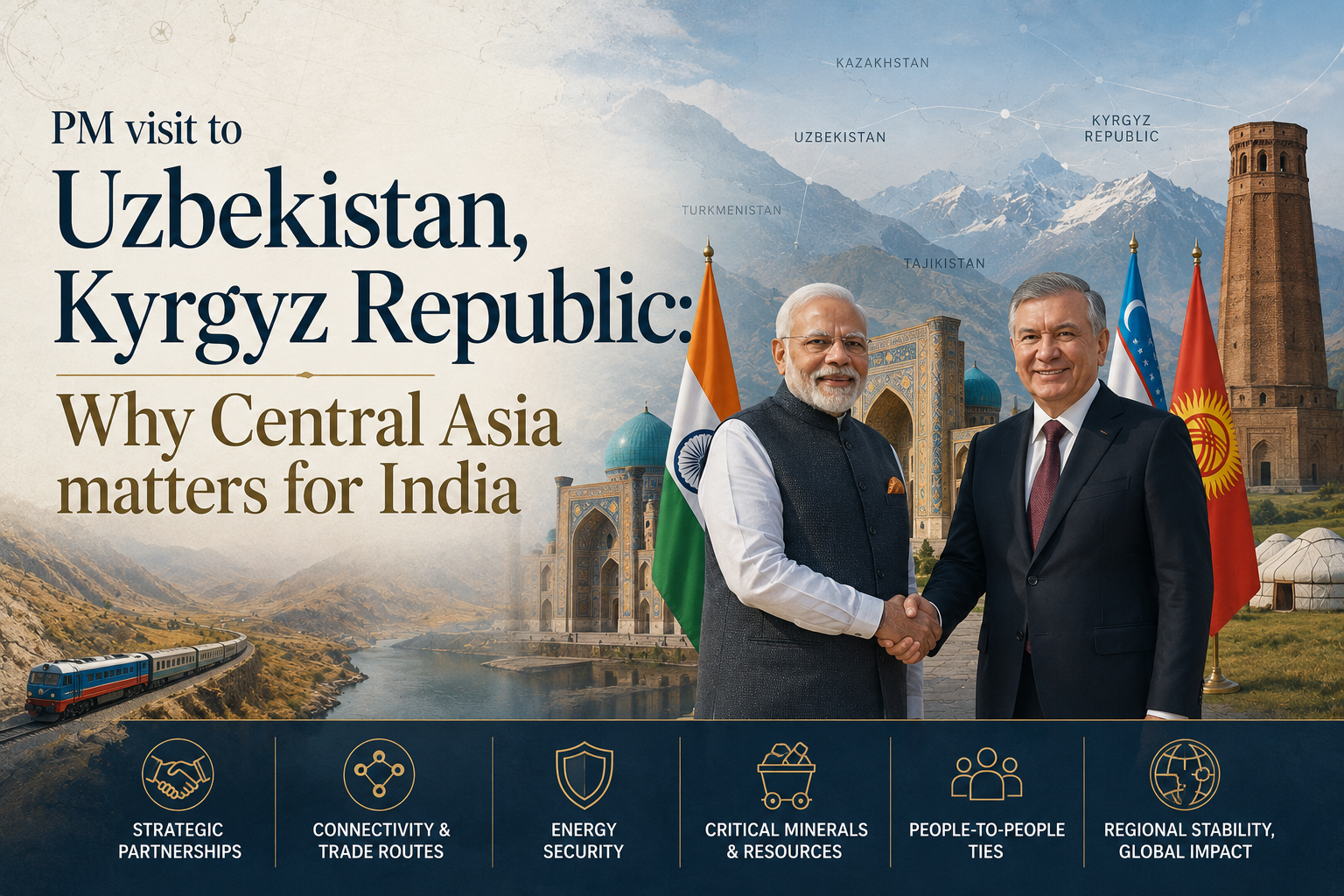
    Prime Minister Narendra Modi is visiting Uzbekistan from August 29 to 30 on a bilateral visit, followed by the Kyrgyz Republic for the 26th Shanghai Cooperation Organisation (SCO) Summit from August 31 to September 1. The visit continues India’s focused Central Asia engagement, which began in 2012 with the “Connect Central Asia” policy and was reinforced when Modi became the first Indian Prime Minister to visit all five Central Asian countries in July 2015.

    What resources make Central Asia strategically valuable?

    1. Kazakhstan holds major mineral wealth: Kazakhstan has one of the world’s biggest uranium reserves along with substantial deposits of coal, lead, zinc, gold and iron ore.
    2. The Kyrgyz Republic offers gold and hydropower: The Kyrgyz Republic’s economy is built significantly around gold mining and hydropower generation potential.
    3. Turkmenistan holds vast natural gas reserves: Turkmenistan has one of the world’s largest natural gas reserves, a resource base central to regional pipeline politics.
    4. Tajikistan and Uzbekistan add hydropower, gold and uranium: Tajikistan has substantial hydropower potential, while Uzbekistan holds gold, uranium and natural gas reserves of its own.

    Why is India competing for strategic space in Central Asia?

    1. Countering China’s regional investments: China’s President Xi Jinping visited four of the five Central Asian countries in September 2022, his first overseas trip after the Covid-19 disruption, and China has made major investments in the region through its Belt and Road Initiative, which India does not want to see capture the post-Soviet space unchallenged.
    2. Security concerns following the Taliban takeover: India’s engagement is driven partly by the need for security cooperation in the wake of the Taliban’s return to power in Afghanistan, since Central Asia borders Afghanistan directly.
    3. Energy and connectivity needs: India’s interest includes Kazakhstan’s uranium reserves, Turkmenistan’s role in the proposed Turkmenistan-Afghanistan-Pakistan-India gas pipeline, and connectivity plans built around the International North-South Transport Corridor.
    4. A cultural outreach signal in 2022: India invited Central Asian leaders to the Republic Day celebrations in January 2022, an early diplomatic signal of the outreach it has since built on.

    What challenges constrain India’s Central Asia engagement?

    1. No overland access through Pakistan: Pakistan blocks India’s direct overland transport access to Central Asia, forcing India to route connectivity plans through the International North-South Transport Corridor and the Chabahar port in Iran instead. Eg. India’s push to integrate the Corridor with Chabahar exists specifically because the shorter, direct land route through Pakistan is closed to it. Fix. Prioritise completion of the Chabahar-linked rail and road segments of the Corridor on a fixed timeline, since it is the only viable alternative connectivity route available to India.
    2. Radicalisation risk along the Taliban-adjacent frontier: Central Asia is widely seen as the northern boundary of the Islamic world, and the Taliban’s ascent next door raises the risk of radicalism and a possible regrouping of the Islamic State within the region. Eg. Central Asian governments have flagged the security implications of Afghanistan’s instability spilling across shared borders. Fix. Expand India’s existing counter-terrorism training and intelligence-sharing arrangements with Central Asian states as a standing component of the engagement, not an occasional add-on.
    3. Russia-Ukraine spillover creating local churn: The Russia-Ukraine conflict has pushed some Russians with money and skills, but unable to move to the West, toward these Central Asian countries, which could bring inflows of talent and funds alongside social tension. Eg. Reports point to a rising Russian presence in Central Asian cities since the conflict began, altering local economic and social dynamics.

    What civilisational and trade links does India draw on?

    1. Deep historic ties with Uzbekistan: The only known Buddhist monastery in Central Asia is at Kara Tepa in Termez, Uzbekistan, an important centre during the Kushana era when Buddhist influence spread into the region, and close to 3,000 words are shared between Hindi and Uzbek.
    2. Shared cuisine as a marker of the connection: Similarities exist across Indian and Central Asian food traditions, including ghee and sariyok, samosa and samsa, naan and non, and pulao and pilaf.
    3. A meaningful trade relationship with Uzbekistan: India is among Uzbekistan’s top 10 trading partners, with bilateral trade in 2025-26 close to $1 billion.

    What is the SCO summit’s composition and agenda?

    1. A ten-member grouping with wide partner networks: The SCO comprises 10 member states, India, Belarus, China, Iran, Kazakhstan, Kyrgyzstan, Pakistan, Russia, Tajikistan and Uzbekistan, alongside 15 Dialogue Partners including Kuwait, Saudi Arabia, the UAE and Turkiye, and two Observers, Mongolia and Afghanistan.
    2. India joined the grouping in 2017: India has been a full SCO member since 2017, and this year’s summit also marks the third edition of the SCO+ format, expected to bring in additional states and bodies such as the United Nations and the Collective Security Treaty Organization.

    Conclusion

    Modi’s back-to-back Uzbekistan visit and SCO summit attendance extend a Central Asia policy that dates to 2012, aimed at securing energy access, countering Chinese influence and building connectivity around Pakistan’s blockage of overland routes. The next milestone is the Bishkek summit itself, from August 31 to September 1, and whatever bilateral outcomes emerge from the Uzbekistan leg beforehand.

    Back2Basics: What is the International North-South Transport Corridor (INSTC)?

    1. A multimodal route bypassing Pakistan: The International North-South Transport Corridor is a multimodal transport link connecting India to Russia and Europe via Iran, Azerbaijan and Central Asia, designed to move goods by ship, rail and road, and it is the route India relies on to reach Central Asia given the absence of direct overland access through Pakistan.

    [2025] India is one of the founding members of the International North-South Transport Corridor (INSTC), a multimodal transportation corridor, which will connect

    [A] India to Central Asia to Europe via Iran

    [B] India to Central Asia via China

    [C] India to South-East Asia through Bangladesh and Myanmar

    [D] India to Europe through Azerbaijan (2017, same Microtheme).

  • In India-China diplomacy, wariness is the only normal In India-China diplomacy, wariness is the only normal

    In India-China diplomacy, wariness is the only normal In India-China diplomacy, wariness is the only normal

    Why in the News

    National Security Adviser Ajit Doval met Chinese Foreign Minister Wang Yi in Beijing on August 25 for the 25th round of Special Representatives (SR) talks on the India-China boundary. India and China first issued separate readouts, then released an identical eight-point joint consensus on August 26, agreeing to push for “Early and Substantial Harvest” on boundary delimitation, two new military meeting points, two new border hotlines, an Expert-Level Mechanism on trans-border rivers, facilitation of the Kailash-Mansarovar Yatra, resumption of border trade, and the next SR round in India in 2027.

    What does the joint statement’s careful language reveal about the relationship?

    1. A delayed but fast-negotiated text: The 24 hour gap between the separate initial statements and the identical joint text suggests consensus took time to build, but once found, the text was agreed within 18 hours, signalling political intent at the highest level ahead of a packed diplomatic fortnight.
    2. Deliberate avoidance of contentious terms: Both sides avoided the words “Tibet” or “Xizang” in the joint text, referring only to the Kailash-Mansarovar Yatra and border trade through three passes, and used the dual naming, Kailash and Gang Rinpoche, Manasarovar and Mapam Yun Tso, to sidestep sovereignty-loaded terminology.
    3. New hotlines require internal clearance in Beijing: Until now, the only functional military hotline was in the Western sector, Ladakh; extending hotlines and meeting points to the Eastern sector, Arunachal Pradesh, which China claims as South Tibet, would have required internal Chinese clearance, since it touches a claim China treats as sensitive.

    Why is China’s stance on the BRICS summit significant?

    1. Calibrated ambiguity on Xi Jinping’s participation: China has said it “supports India in hosting a successful BRICS summit” in Delhi on September 12 but has stayed evasive on whether President Xi Jinping will personally attend, a position the writer reads as deliberate tactical ambiguity rather than indecision.
    2. India’s leverage is constrained by external pressure: India has to accept this ambiguity given its trade-economic vulnerability and the geopolitical turbulence triggered by President Donald Trump’s tariff actions, which narrows India’s room to press Beijing on the BRICS question.

    Challenges to sustaining the India-China diplomatic thaw

    1. The boundary dispute remains structurally unresolved: “Early and Substantial Harvest” language covers delimitation, mapping where the border lies, but explicitly operates without prejudice to the final settlement under the 2005 Agreement on Political Parameters, so no boundary line is actually being fixed. Eg. The Eastern sector hotline extension itself required Beijing’s internal clearance precisely because the underlying territorial claim remains contested. Fix. Use the Expert-Level Mechanism agreed in the joint statement to convert delimitation “harvest” language into a scheduled, verifiable set of mapping milestones rather than an open-ended process.
    2. Trust deficit persists beneath cooperative language: Both governments continue to issue separate domestic-facing statements before agreeing a joint text, reflecting a persistent gap between what each side is willing to say to its own public and what it is willing to commit to jointly. Eg. India’s initial embassy statement was notably more restrained than Beijing’s warmer framing of “global and strategic significance,” before both converged on the identical joint text a day later.

    Conclusion

    The writer’s central argument is that deeply embedded wariness, not a failure of diplomacy, is the operating method of India-China relations: both sides manage friction through carefully calibrated joint language, incremental confidence-building measures and studied ambiguity on sensitive questions such as Tibet and Xi Jinping’s BRICS attendance. The near-term test of this method will be the SCO summit in Bishkek from August 31 to September 1 and the BRICS summit in Delhi on September 12.

    India-China Relations

    1. A boundary dispute rooted in the 1962 war: India and China share an unresolved boundary along the Line of Actual Control (LAC), the subject of the 1962 Sino-Indian War, and have since built a layered set of confidence-building mechanisms rather than a settled border.
    2. The Special Representatives mechanism: Established in 2003, the SR talks are the highest-level bilateral channel for discussing a framework settlement of the boundary question, distinct from routine military and diplomatic contacts.
    3. Galwan reset the relationship’s tenor: The 2020 Galwan Valley clash, the first fatal India-China military confrontation in over four decades, froze high-level engagement for years before talks such as the current SR round resumed.
    4. Trade imbalance runs alongside the security relationship: India runs a large and persistent trade deficit with China even as both sides pursue diplomatic normalisation, a structural feature of the relationship independent of the boundary talks.

    Key Facts about India-China Relations

    1. Agreement on Political Parameters, 2005: Sets out the guiding political parameters and principles for a boundary settlement, and remains the reference framework the current “Early and Substantial Harvest” language explicitly operates without prejudice to.
    2. SCO membership since 2017: India and China are both members of the Shanghai Cooperation Organisation, the same platform hosting the Bishkek summit immediately after the current round of SR talks.

    Challenges in India-China Relations

    1. Unresolved boundary despite repeated confidence-building measures: Decades of hotlines, meeting points and expert mechanisms have reduced the risk of miscalculation without resolving the underlying territorial claims. Eg. The Eastern and Middle sector hotlines agreed in the current round only supplement, rather than replace, the unresolved 2005 political parameters framework. Fix. Anchor future confidence-building measures to specific, dated delimitation milestones rather than open-ended review mechanisms.
    2. Structural trade dependence on China: India’s electronics, pharmaceutical and solar manufacturing sectors remain dependent on Chinese intermediate goods and active pharmaceutical ingredients, a vulnerability that persists regardless of the state of boundary diplomacy. Eg. India’s trade deficit with China has stayed among its largest with any single country for over a decade. Fix. Accelerate production-linked incentive schemes targeting the specific intermediate goods categories where import dependence is highest, rather than broad-based manufacturing incentives.

    Back2Basics: What is the Line of Actual Control (LAC)?

    1. A de facto, not a demarcated, boundary: The Line of Actual Control is the notional line separating Indian-controlled and Chinese-controlled territory, distinct from an internationally recognised or mutually demarcated border, and both sides hold differing perceptions of exactly where it runs in several sectors.
  • India, Kuwait hold inaugural key dialogue in Delhi to bolster defence ties

    Why in the News

    India and Kuwait held the inaugural meeting of the India-Kuwait Joint Defence Committee in New Delhi on August 28. Both sides agreed to expand bilateral defence cooperation across training, military exercises, industry, and research and development. The meeting operationalises the Memorandum of Understanding (MoU) on Defence Cooperation signed during Prime Minister Narendra Modi’s visit to Kuwait in December 2024.

    Why does an institutionalised defence dialogue with Kuwait matter for India?

    1. A first standing forum with a Gulf monarchy on defence: The Joint Defence Committee gives India and Kuwait a recurring institutional channel, rather than one-off visits, to advance training, joint exercises, defence industry links and research and development.
    2. Extends India’s Gulf defence footprint beyond energy ties: India’s engagement with the Gulf has historically centred on energy imports and the diaspora; a dedicated defence committee with Kuwait signals a broadening of the relationship into security cooperation, alongside similar frameworks India already runs with Saudi Arabia and the United Arab Emirates.
    3. Kuwait sits at a sensitive maritime chokepoint: Kuwait’s location near the head of the Persian Gulf and the Strait of Hormuz gives India a stake in the security of a route through which a large share of its crude oil imports transit.

    Challenges to the India-Kuwait defence relationship

    1. Limited defence-industrial base on the Kuwaiti side: Kuwait’s domestic defence manufacturing capacity is minimal, so cooperation is likely to stay import and training-oriented rather than co-production, unlike some of India’s other defence partnerships. Eg. India’s co-production discussions with the United States on the Javelin missile system have no current parallel in the Kuwait relationship. Fix. Use the Joint Defence Committee’s industry track to identify smaller co-development areas, such as maintenance, repair and overhaul services, where Kuwait’s capacity constraints are less binding.
    2. Competing suppliers already entrenched in the Gulf: Gulf states, including Kuwait, have longstanding defence procurement relationships with the United States, the United Kingdom and France, which limits the near-term scope for India to secure large equipment sales. Eg. Kuwait’s air defence and fighter fleets are built around US and European platforms, leaving India’s defence exports pitch centred on niche systems and services rather than big-ticket sales.

    Conclusion

    The inaugural Joint Defence Committee meeting converts the 2024 MoU into a standing institutional mechanism, marking a modest but concrete step in India’s effort to deepen security ties with the Gulf beyond energy and trade. The substantive test will be whether the committee produces actual joint exercises, training exchanges or industry tie-ups before its next meeting.

    What is the Gulf Cooperation Council (GCC)?

    1. A regional grouping, not Kuwait’s own body: The Gulf Cooperation Council is a political and economic union of six Gulf Arab states, Kuwait, Saudi Arabia, the UAE, Qatar, Bahrain and Oman, formed in 1981 to coordinate economic, security and foreign policy matters among them.
    2. India engages the GCC bilaterally, not as a bloc: India does not have a defence framework with the GCC as a single entity; agreements such as the Joint Defence Committee are negotiated bilaterally with individual member states like Kuwait.
  • India seals deal to purchase Javelin anti-tank missile system from US

    India seals deal to purchase Javelin anti-tank missile system from US

    Why in the News

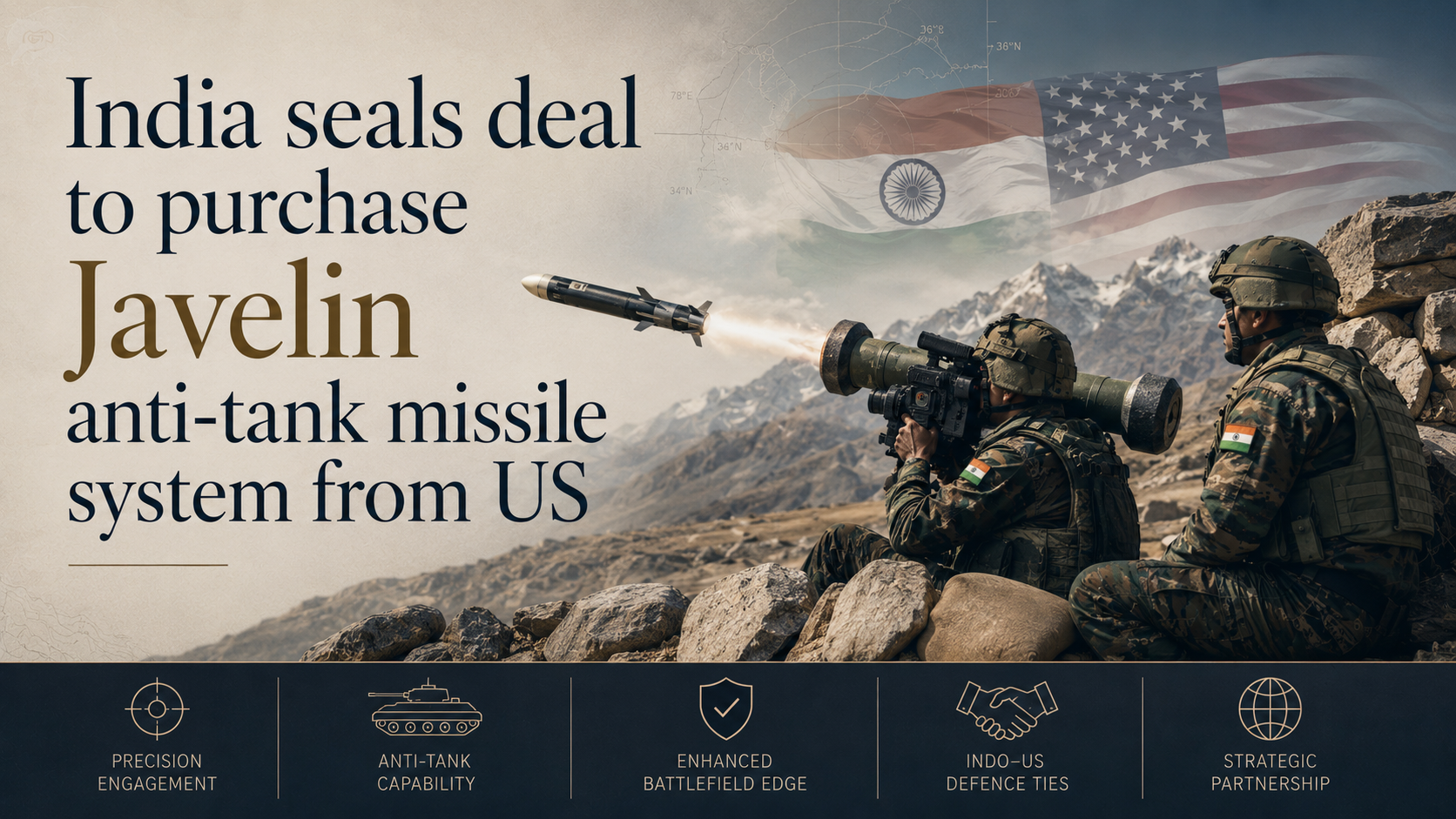
    India has finalised a deal to buy the Javelin anti-tank guided missile system from the United States, with the Indian Army signing a Letter of Offer and Acceptance through the US Foreign Military Sales process. The US Embassy called the signing a “milestone” that strengthens the US-India Major Defence Partnership and opens discussions on co-production, extending a series of recent India-US defence deals that followed Operation Sindoor.

    What is the Javelin system, and how was the deal concluded?

    1. A man-portable, fire-and-forget missile: The Javelin is a single, man-portable, fire-and-forget, medium-range anti-tank guided missile designed for use against armoured vehicles and fortified positions. “Fire-and-forget” means soldiers do not need to remain exposed after launch, and “man-portable” means it can be carried by soldiers, a combination that makes it particularly effective.
    2. Produced by a joint venture, used by Ukraine: The Javelin is manufactured by the Javelin Joint Venture, a partnership between RTX and Lockheed Martin, and is used by the US Army and Marine Corps as well as several international customers, including Ukraine in its war with Russia.
    3. A prior clearance preceded the final signing: In November last year, the US had approved a possible foreign military sale of 100 FGM-148 Javelin rounds, one Javelin missile and 25 Javelin Lightweight Command Launch Units and related equipment, estimated at $45.7 million, ahead of Friday’s signed agreement.

    What does the deal signal for US-India defence ties?

    1. Co-production is now under discussion: US Defence Secretary Pete Hegseth said in May that Washington had committed to pursuing co-production of Javelin munitions with India, calling it a real, tangible step to improve the collective readiness of both forces.
    2. Part of a broader run of recent procurements: The Javelin purchase follows India’s acquisition of 216 M982A1 Excalibur tactical projectiles, a planned purchase of six additional Boeing P-8I maritime patrol and anti-submarine warfare aircraft, US approval of support services and equipment for Apache helicopters worth $198.2 million, a five-year, Rs 7,995 crore support agreement for the MH-60R helicopter fleet, and an October 2024 deal for 31 MQ-9B High Altitude Long Endurance drones.
    3. Built on the 2024 defence partnership framework: India and the US signed the framework for the US-India Major Defence Partnership last October, a framework the current wave of procurements, including the Javelin deal, sits within.

    What is the Foreign Military Sales process?

    A government-to-government US arms transfer route: Foreign Military Sales is the US government’s mechanism for selling defence equipment and services to foreign governments, under which the US government, rather than the manufacturer directly, administers the sale.

  • To Zohran Mamdani: The RSS chief you may not know

    Why in the News

    A senior advocate who served as one of three mediators in the Ayodhya-Babri Masjid-Ram Janmabhoomi dispute has written an open letter responding to New York Mayor Zohran Mamdani’s criticism of Rashtriya Swayamsevak Sangh (RSS) chief Mohan Bhagwat, recounting Bhagwat’s role in restraining celebration after the 2019 Ayodhya settlement and in the later Gyanvapi mosque controversy in Varanasi. The piece sets Bhagwat’s public restraint against a moment when the judiciary itself, rather than the RSS, departed from the settled position on the Places of Worship Act, 1991.

    What role did Bhagwat play around the Ayodhya settlement?

    1. Restraint after the 2019 verdict: Bhagwat insisted there should be no celebration or jubilation over the Ayodhya outcome, since this would be provocative to the other side, and the moment passed largely without triggering wider unrest.
    2. A stated limit on the RSS’s claims: Bhagwat said the RSS’s interest was confined to the Ram Mandir and that it was not seeking to reclaim any other place of worship, a statement the writer says helped temper the Vishva Hindu Parishad’s publicly stated list of other disputed mosques.

    What happened in the Gyanvapi case, and how did Bhagwat respond?

    1. A departure from precedent in the Gyanvapi ruling: Justice D.Y. Chandrachud, then a puisne judge who had earlier delivered part of the Ayodhya judgment, remarked in the Gyanvapi case that it remained open to the court to examine whether the site was a mosque or a temple, a position the writer characterises as a departure from the Ayodhya judgment’s own reasoning on the Places of Worship Act.
    2. Bhagwat’s public intervention: Bhagwat responded the following day by saying “one cannot go looking for shivlings in every mosque,” a statement the writer frames as running counter to the direction the Court’s own remark had opened up.

    Conclusion

    The writer argues that Bhagwat’s recorded public positions, restraint after Ayodhya and the remark against searching for shivlings in every mosque, reflect a stated commitment to inter-community harmony that Mamdani’s criticism of the RSS chief does not account for, and proposes that the two meet and talk during Bhagwat’s visit to the United States.

    What is the Places of Worship Act, 1991?

    1. Statutory freeze on religious character: The Places of Worship (Special Provisions) Act, 1991 mandates that the religious character of every place of worship, as it existed on 15 August 1947, be maintained and prohibits its conversion, with the Ayodhya dispute exempted as a case already in litigation when the law was enacted.
    2. Held to embody a Basic Structure value: In the Ayodhya judgment, the Supreme Court held that the Act embodies the constitutional values of secularism and is part of the Basic Structure of the Constitution.
  • FM: Closer India-Canada economic ties important amid global uncertainty

    FM: Closer India-Canada economic ties important amid global uncertainty

    Why in the News

    The Union Finance Minister has said closer economic cooperation between India and Canada carries greater significance amid a rapidly changing global landscape marked by geopolitical uncertainty, and called for stronger partnerships to build resilient, sustainable and inclusive economies. The remarks came after the inaugural India Canada Economic and Financial Dialogue, the first such dialogue between the two countries. The Finance Minister said the dialogue reflects a shared ambition to move beyond traditional trade in goods and services toward a deeper partnership covering investment, finance, capital markets and regulatory cooperation.

    What is the India Canada Economic and Financial Dialogue?

    1. About: It is a bilateral mechanism between the Indian and Canadian finance ministries to coordinate on macroeconomic policy, financial sector cooperation and multilateral economic issues, launched with its inaugural round.
    2. Scope of discussions: The inaugural round covered three areas, macroeconomic developments and domestic policy priorities in both countries, avenues for financial sector cooperation, and broader international and multilateral cooperation on shared interests.
    3. Anchored in a wider strategic goal: The Prime Minister and his Canadian counterpart have set an ambitious goal for strengthening bilateral ties, and the dialogue is meant to give that goal fresh momentum and direction.

    What case did the Finance Minister make for closer India Canada cooperation?

    1. Global uncertainty is the backdrop: The Finance Minister described the world as going through a profound transformation with constantly evolving geopolitical and economic realities, making resilient partnerships more important.
    2. India’s economy was presented as a stable partner: The Finance Minister highlighted India’s “remarkable macroeconomic resilience” and pointed to complementarities between the two economies as grounds for expanding investment and economic cooperation.

    What specific areas of financial cooperation did the two sides identify?

    1. Cross border payments and financial stability: The two sides explored cooperation on cross border payment systems and measures to safeguard financial stability.
    2. Fintech and capital markets: Discussions also covered cooperation in financial technology and capital markets, part of the plan to move beyond goods and services trade into deeper financial integration.

    Conclusion

    The inaugural dialogue has set out macroeconomic policy coordination, financial sector cooperation and multilateral engagement as its three working areas. No date has been set for the next round, but the framework is intended to carry forward the broader bilateral goal the Prime Minister and his Canadian counterpart have set for the relationship.

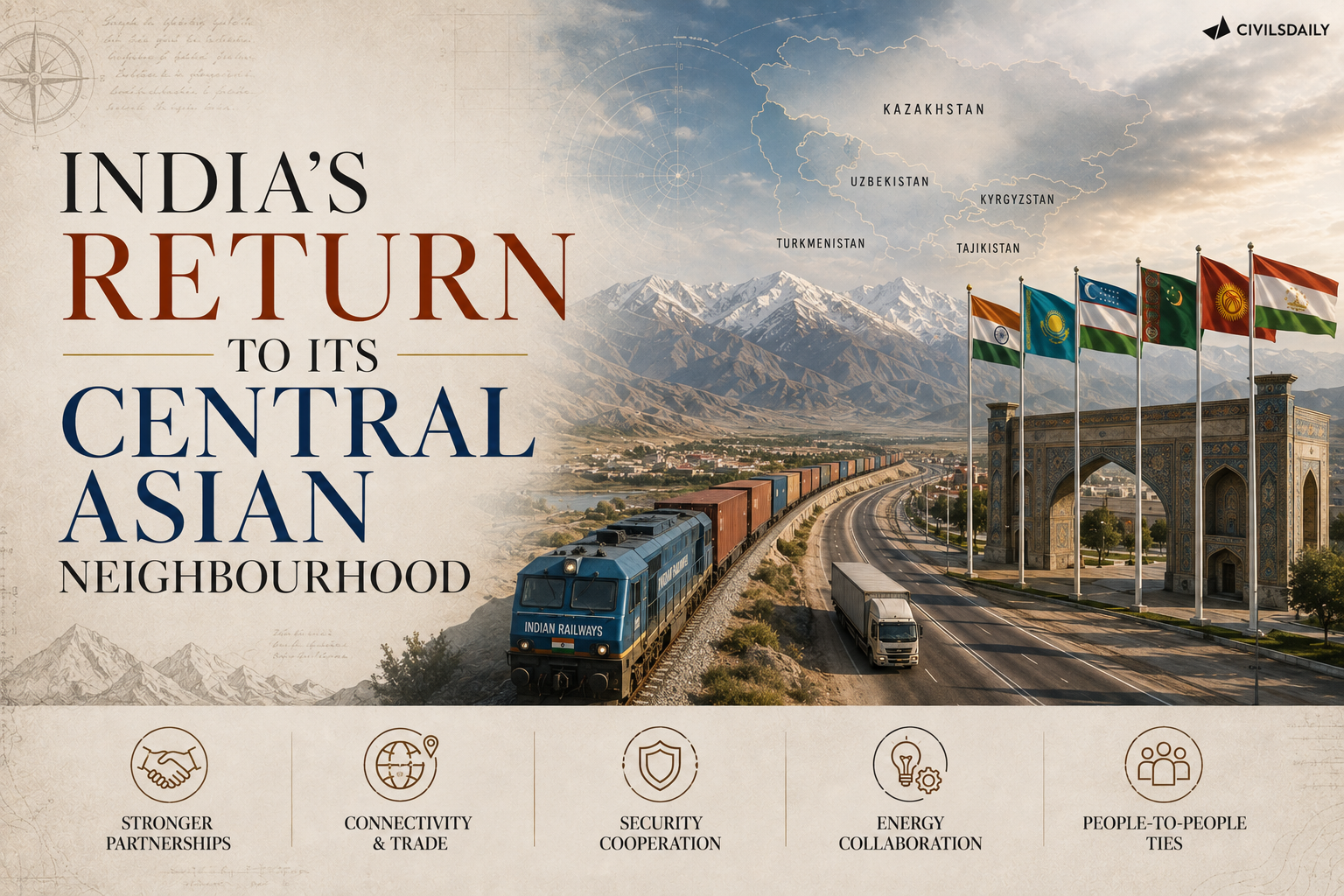
  • India’s return to its Central Asian neighbourhood

    India’s return to its Central Asian neighbourhood

    Why in the News

    The Prime Minister is set to travel to Central Asia, beginning with a state visit to Uzbekistan and followed by participation in the Shanghai Cooperation Organisation (SCO) summit of Heads of State in Bishkek, the Kyrgyz capital once called Frunze in Soviet times. The visit follows a decade long build up in India’s outreach to the region, a landmark 2015 tour of all five Central Asian states, India’s entry into the SCO as a full member in 2017, and the invitation extended to all five Central Asian leaders as chief guests for Republic Day in 2022. Central Asia sits between Russia and China, both of which still shape its politics and economy, while Pakistan seeks to claim the region’s historical and religious lineage as its own. The visit tests how far India can convert a civilisational and diplomatic relationship into a substantive one without a shared land border.

    Why does India treat Central Asia as its neighbourhood despite the absence of a land border?

    1. A civilisational link substitutes for geography: Central Asia shares deep ties with India in culture, religion, language and architecture, and India is separated from Tajikistan only by the narrow Wakhan corridor inside Afghanistan.
    2. Pakistan contests this claim: Pakistan seeks to use religious affinity to claim the region’s historical lineage for itself and to cut India off from these connections, an approach that has not succeeded so far.
    3. The region is turning outward: Central Asian states are increasingly looking beyond Russia and China for development partners, and view India’s plural, moderate and democratic experience with admiration rather than suspicion.

    How has India built its Central Asia engagement over the past decade?

    1. The 2015 visit ended a policy of deference: The Prime Minister’s 2015 tour of all five Central Asian states marked the end of India’s earlier practice of deferring to Russia in what it treated as Moscow’s periphery.
    2. SCO membership followed in 2017: India was admitted to the Shanghai Cooperation Organisation as a full member in 2017, the same year Pakistan was admitted, sponsored respectively by Russia and China.
    3. A dialogue mechanism followed the pandemic: An unprecedented invitation to all five Central Asian leaders as Republic Day chief guests in 2022 was forced online by the COVID 19 pandemic, but still produced the India Central Asia Dialogue as a standing mechanism for cooperation.

    Why does the visit begin with Uzbekistan?

    1. Uzbekistan has been the region’s most dynamic reformer: Ties with Uzbekistan have improved steadily under its president since 2016, and the country is regarded as the most forward looking in the region on diversifying its foreign policy.
    2. Its counter terrorism record matters to India: Uzbekistan has taken an uncompromising line against terrorism and extremism, and its close knowledge of and pragmatic approach to Afghanistan and the Taliban is of direct value to India.
    3. It anchors India’s alternative connectivity plans: India has held detailed talks with Uzbekistan on alternative rail and road routes through Iran and Afghanistan, links that need to be revisited given recent developments in both countries.

    What other powers is India competing with in the region?

    1. Russia and China remain the dominant powers: Central Asia is landlocked between the two, and both continue to shape the region’s politics and economy even as their relative influence shifts, Russia’s weakening and China’s growing.
    2. Turkiye and Iran hold cultural and economic sway: Both countries are described as dominant influences in the region alongside Russia and China.
    3. The United States and European Union are entering the space: Both are working their way into Central Asia as Russia’s grip loosens.
    4. Radicalisation spillover from Afghanistan is a shared anxiety: China fears the spread of radicalisation into its border regions from Afghanistan, an anxiety the region shares along with memories of attacks such as the 2024 Crocus City Hall attack in Moscow.

    What is India’s position inside the SCO?

    1. The SCO has grown well beyond its founding core: What began as the “Shanghai Five” grouping in 1996 has grown, in its 25th year, to 10 members, 15 dialogue partners and two observers.
    2. India engages the SCO on geography, not ideology: India has been a regular participant at SCO Head of State meetings except in 2024, and has pushed ideas on economic, technological and civilisational cooperation, including a vision of security, connectivity and opportunity put forward at last year’s Tianjin summit.
    3. India offers a counterweight within the SCO’s China Pakistan dyad: Negotiating inside the SCO against a China Pakistan axis is demanding, and for a country as dependent on China as Kyrgyzstan, India’s presence in the SCO offers a genuine alternative.

    Challenges to India’s Central Asia outreach

    1. Weak physical connectivity limits how far ties can grow: India has no direct land or transit route into Central Asia, so trade and people movement rely on routes through third countries. Eg. Talks on alternative rail and road links through Iran and Afghanistan remain unfinished even after years of discussion. Fix. Operationalise the Chabahar port route and conclude a transit framework with Uzbekistan and other Central Asian states independent of Afghan transit uncertainty.
    2. China’s economic footprint outpaces India’s: China’s connectivity and trade financing in the region dwarf India’s presence in infrastructure and investment. Eg. China has built rail links and pipeline corridors connecting Central Asia directly to its own territory, a scale of investment India has not matched. Fix. Use lines of credit and the India Central Asia Dialogue to fund discrete, deliverable projects in energy, health and digital infrastructure rather than compete on scale.
    3. Russia’s traditional primacy still shapes the region’s security choices: Most Central Asian states retain security arrangements with Russia through the Collective Security Treaty Organisation, limiting how far they can diversify. Eg. Kyrgyzstan and Tajikistan continue to host Russian military bases. Fix. Build India’s security cooperation around counter terrorism training and disaster response, areas that do not compete with existing Russian linked security arrangements.

    Conclusion

    The visit signals a deliberate, structured attempt to convert a civilisational relationship into a strategic one, anchored first in Uzbekistan and then in the SCO platform. Connectivity gaps and the entrenched primacy of Russia and China in the region mean this return builds incrementally rather than displacing existing power structures. How far India can embed itself economically and strategically in Central Asia will depend on sustained follow through on the India Central Asia Dialogue rather than on the visit itself.

    Back2Basics

    What is the Shanghai Cooperation Organisation?

    1. Origin: It began in 1996 as the “Shanghai Five”, grouping China, Russia, Kazakhstan, Kyrgyzstan and Tajikistan, and was renamed the Shanghai Cooperation Organisation in 2001 when Uzbekistan joined.
    2. Mandate: It focuses on regional security, counter terrorism, economic cooperation and connectivity among its Eurasian member states.
    3. Headquarters: Its secretariat is based in Beijing.

    [2024] “Critically analyse India’s evolving diplomatic, economic and strategic relations with the Central Asian Republics (CARs) highlighting their increasing significance in regional and global geopolitics.”