Mains Ready By December. Smash Mains & Smash PYQ Admissions Open

GS Paper: GS2-18.Bilateral, regional and global groupings and agreements involving India and/or affecting India’s interests.

  • How India could play a meaningful role in the conflict in West Asia

    Why in the News?

    With escalating tensions between Iran and Israel, India’s Ministry of External Affairs she emphasized the need to prevent regional escalation, urging all parties to resolve issues through dialogue and diplomacy for stability.

    Can India act as a mediator in the Iran-Israel conflict? 

    • India maintains strong strategic and economic ties with both Israel and Iran, allowing it to communicate with both parties. This balanced relationship positions India as a potential neutral mediator.
    • India’s stature on the global stage is rising, and its history of non-alignment and support for peaceful dialogue gives it credibility. However, balancing its strategic partnerships with Israel, Iran, and key Arab states will be challenging.

    What are India’s strategic interests in West Asia?

    • Energy Security: West Asia is crucial for India’s energy needs, supplying about 80% of its oil imports. A wider conflict could disrupt these supplies and increase energy prices, impacting India’s economy significantly.
    • Economic Ties: India has invested heavily in its relationships with West Asian countries, viewing the region as an extension of its neighborhood. This includes trade partnerships and investments, particularly with major Arab nations and Israel.
    • Security Concerns: India shares concerns with both Iran and Israel regarding terrorism, particularly threats emanating from Pakistan and Afghanistan. This common ground could facilitate dialogue but also complicates India’s diplomatic balancing act.

    How does India’s relationship with regional powers influence its role?

    • Regional Dynamics: Other regional players such as Qatar, Egypt, Saudi Arabia, and Turkey also influence the situation. Qatar has been active in mediating between conflicting parties, while Egypt’s geographical proximity to Gaza positions it as a key player in ceasefire discussions.
      • Saudi Arabia’s leadership role in the Islamic world adds another layer of complexity to India’s diplomatic efforts.
    • Multi-faceted Role: While India maintains strong defense and economic relations with Israel, it also relies on Iran for energy supplies and has historical ties to various Arab nations.
      • Balancing these relationships is critical for India’s foreign policy strategy.

    Way forward: 

    • Diplomatic Engagement and Back-Channel Diplomacy: India can leverage its balanced ties with Israel, Iran, and key Arab states to facilitate back-channel communication, focusing on de-escalation and humanitarian relief.
      • India’s non-aligned stance and growing global influence position it as a credible facilitator for peaceful dialogue.
    • Multilateral Approach: India should work through international forums like the United Nations and coordinate with other regional players like Qatar, Egypt, and Saudi Arabia. This multilateral engagement would enhance its role while avoiding the risks of taking sides in the conflict.
  • China-Vietnam red diplomacy 

    Why in the News?

    Vietnamese President’s recent trip to China seeks to rekindle the historical ties and camaraderie between Mao Zedong and Ho Chi Minh, to strengthen political trust in their bilateral relationship strategically.

    Current Diplomatic Relationship between China and Vietnam:

    • Revived Political Trust: Vietnamese President to Lam’s visit to China sought to revive the historical comradeship between Mao Zedong and Ho Chi Minh.
      • This visit aimed to strategically strengthen political trust and enhance the comprehensive strategic cooperative partnership between the two communist nations.
    • Joint Statement on Cooperation: Both countries reaffirmed their commitment to advancing socialism and expressed their desire to build a “Vietnam-China community with a shared future.”
    • Economic and Strategic Agreements: The visit resulted in 14 agreements covering areas such as connectivity, infrastructure, healthcare, and media.
      • Trade between the two nations remains robust, with China being Vietnam’s largest import market and a significant investor. Bilateral trade in 2023 reached $171.9 billion.

    How do recent events reflect the complexities of Vietnam’s foreign policy towards China?

    • Bamboo Diplomacy: Vietnam’s foreign policy, known as “Bamboo Diplomacy,” is based on flexibility and resilience.
      • It aims to maintain strong ties with multiple global powers, including China, while also hedging its bets with the U.S., India, Russia, and Japan to counterbalance Chinese dominance.
    • Economic Dependence vs. Strategic Hedging: Vietnam’s growing economic interdependence with China, reflected in trade and investment, contrasts with its efforts to hedge against over-reliance by fostering ties with other global players. This balancing act illustrates Vietnam’s pragmatic approach to foreign policy.

    Challenges Vietnam Faces in Maintaining Sovereignty Amid Growing Chinese Influence:

    • Territorial Disputes: The ongoing territorial contestation over the Paracel Islands in the South China Sea poses a significant challenge for Vietnam.
    • Economic Dependence: While Vietnam benefits from economic ties with China, the growing trade deficit and increased Chinese investments create a dependency that could challenge Vietnam’s autonomy in decision-making, especially in strategic areas like infrastructure and connectivity.
    • Strategic Hedging and Sovereignty: Vietnam’s efforts to hedge against Chinese influence through partnerships with the U.S., Japan, and India.

    Note: Hedging refers to a strategic approach taken by a country to safeguard its interests and security in a complex and uncertain environment.

    Way forward:

    • Enhance Bilateral Engagement: India should deepen its strategic partnership with Vietnam through increased economic cooperation, cultural exchanges, and joint defense initiatives.
    • Support Regional Multilateralism: India should actively participate in regional forums and initiatives that promote multilateral cooperation, such as the Quad and ASEAN-led dialogues.
  • In France, a summit for diplomacy, tech and diversity

    Why in the News?

    France is set to host more than 100 heads of state, government leaders, and senior officials for the 19th Francophonie Summit on October 4-5, 2024.

    How can Technology Enhance Diplomatic Efforts Between India and France?

    • Digital Collaboration: The summit emphasizes cooperation in digital technology, which can strengthen ties through joint projects, knowledge sharing, and innovation in areas like AI and cybersecurity.
    • Facilitating Communication: Technology, particularly AI, can enhance communication between diplomats and stakeholders, enabling more efficient exchanges and negotiations in multiple languages.
    • Showcasing Innovations: Events like the FrancoTech Fair will provide platforms for Indian and French innovators to collaborate on addressing common challenges, fostering deeper bilateral relations through shared technological advancements.

    What Role Does Diversity Play in Shaping Diplomatic Strategies?

    • Cultural Exchange: Emphasizing multilingualism and cultural diversity fosters mutual understanding and strengthens relationships, allowing for more nuanced diplomatic interactions.
    • Inclusive Decision-Making: Acknowledging diverse perspectives helps create more representative and effective diplomatic strategies, ensuring that various stakeholders are considered in negotiations.
    • Promotion of Values: Embracing diversity aligns with the core values of democracy and human rights, which can enhance the credibility and appeal of diplomatic efforts.

    What are the Implications of Global Cooperation in Addressing Contemporary Issues?

    • Shared Responsibility: Global cooperation is essential for addressing challenges like climate change, health crises, and digital governance, promoting collective action and resource sharing among nations.
    • Strengthening Multilateral Institutions: Enhancing cooperation leads to reforms in institutions like the UN, World Bank, and IMF, making them more effective and responsive to global needs.
    • Fostering Innovation: Collaborative efforts among nations can drive innovation in technology and policy, enabling quicker and more effective responses to pressing global issues and facilitating knowledge exchange.

    Way forward: 

    • Establish Joint Innovation Initiatives: India and France should create collaborative platforms for research and development in emerging technologies, focusing on areas like AI, cybersecurity, and digital infrastructure to enhance diplomatic relations and tackle common global challenges.
    • Promote Multicultural Diplomatic Engagement: Both nations should prioritize cultural exchanges and inclusive dialogue that reflect diverse perspectives, thereby strengthening mutual understanding and fostering more effective and representative diplomatic strategies.
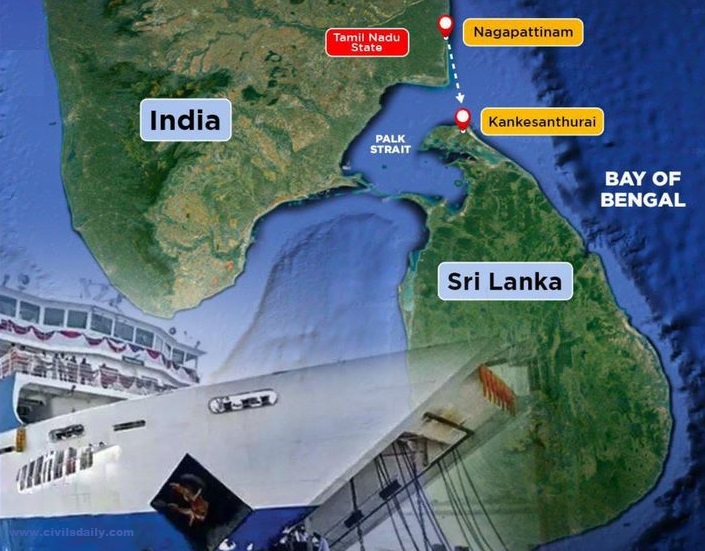
  • Places in news: Palk Strait

    Why in the News?

    The Nagapattinam-Kankesanthurai ferry service has been resumed along the Palk Strait between India and Sri Lanka after 40 years.

    About Palk Strait

    Location Narrow water body separating Tamil Nadu, India, and Sri Lanka.
    Name Origin Named after Robert Palk, a British Raj-era Governor of Madras Presidency (1755-1763).
    Geographic Boundaries Southern boundaries include Pamban Island (India), Adam’s Bridge (shoals), Gulf of Mannar, and Mannar Island (Sri Lanka).
    Connection Connects the Bay of Bengal in the northeast with the Gulf of Mannar in the southwest.
    Alternate Name Southwestern part of the strait is known as Palk Bay.
    Dimensions Width varies from 64 to 137 km, length is approximately 137 km, and depth is less than 330 feet (100 meters).
    River Inflows Vaigai River in Tamil Nadu flow into the Palk Strait.
    Historic Context
    • Key maritime link between India and Sri Lanka, facilitating trade, cultural exchanges, and religious pilgrimages.
    • Played a vital role in the British colonial trade routes, but ferry services were halted due to the 1964 cyclone and the Sri Lankan civil war in 1983.
    Present Significance Supports regional trade, tourism, and people-to-people connections, while fostering economic development in both India and Sri Lanka.
  • UK backs permanent seat in UNSC for India

    Why in the News?

    UK PM Keir Starmer has expressed strong support for India’s bid for a permanent seat at the United Nations Security Council (UNSC).

    About United Nations Security Council (UNSC)

    Details
    Establishment By the UN Charter in 1945 as one of the six principal organs of the United Nations.
    Other UN Organs General Assembly, Trusteeship Council, Economic and Social Council, International Court of Justice, Secretariat
    Primary Responsibility Maintaining international peace and security
    Headquarters New York City, USA
    Members 15 members: 5 permanent members (US, UK, Russia, China, France) and 10 non-permanent members (elected for two-year terms)
    Permanent Members US, UK, Russia, China, France
    Non-permanent Members 10 elected members; require two-thirds majority in the General Assembly to be elected
    Presidency Rotation Every month among the 15 members
    Voting and Veto Power Permanent members have veto power; non-permanent members have no veto but resolutions require at least 7 non-permanent members’ votes for approval, even with unanimous permanent support
    India’s Participation India has been elected as a non-permanent member of the UNSC eight times: 1950-51, 1967-68, 1972-73, 1977-78, 1984-85, 1991-92, 2011-12, 2021-22
    Responsibilities & Powers Mediation, dispatching UN missions, appointing envoys, issuing ceasefire directives, peacekeeping, sanctions, arms embargo, and issuing binding resolutions
    UNSC Reforms Process Stage 1: Requires a two-thirds majority (128 votes) in the General Assembly (193 member states) for approval.
    Stage 2: Amended Charter must be ratified by at least two-thirds of member states, including all five permanent members, who may exercise veto power. Their national parliaments also influence the ratification process.


    PYQ:

    [2009] The Security Council of UN consists of 5 permanent members, and the remaining 10 members are elected by the General Assembly for a term of:

    (a) 1 year

    (b) 2 years

    (c) 3 years

    (d) 5 years

    [2015] Discuss the impediments India is facing in its pursuit of a permanent seat in the UN Security Council.

  • Taking stock of global nuclear disarmament

    Why in the News?

    September 26 is recognized on the United Nations calendar as the International Day for the Total Elimination of Nuclear Weapons.

    What is the current state of global nuclear disarmament efforts?

    • Treaty on the Prohibition of Nuclear Weapons (TPNW): The TPNW, in force since 2021, is the first legally binding international agreement that comprehensively bans nuclear weapons. As of July 2024, it has 70 states parties and 27 signatories yet to ratify, covering nearly 50% of the world’s states.
    • Non-Proliferation Treaty (NPT): The NPT, in effect since 1970, remains the foundational treaty aimed at preventing the spread of nuclear weapons and promoting eventual disarmament. However, it has been criticized for its limited focus on actual disarmament.
    • Persistent Objectors: Nuclear-armed states (such as the U.S., Russia, China, India, and Pakistan) and their allies have consistently opposed the TPNW, refusing to be bound by its provisions.

    What are the key obstacles hindering further nuclear disarmament?

    • Nuclear Deterrence Doctrine: The belief in nuclear deterrence — the idea that possessing nuclear weapons prevents attacks — is a central justification for continued nuclear armament.
    • Nuclear-Weapon States’ Resistance: The nuclear-armed states, including the U.S., Russia, China, India, and others, continue to view nuclear weapons as essential to their security strategies, despite claims of disarmament commitments under the NPT.
    • Geopolitical Conflicts: Ongoing geopolitical tensions, such as Russia’s invasion of Ukraine, China’s rising military power, North Korea’s nuclear tests, and Iran’s uranium enrichment, have exacerbated the global nuclear threat, further impeding disarmament efforts.
    • Lack of Enforcement Mechanisms: The TPNW, while normatively important, lacks robust enforcement mechanisms. It depends on the voluntary commitment of states, and nuclear possessors do not face direct penalties for non-compliance.

    What steps can be taken to reinvigorate the nuclear disarmament agenda? (Way forward)

    • Strengthening International Advocacy: Civil society, former political leaders (including NATO officials), and international organizations should continue advocating for disarmament and urging nuclear-armed states and their allies to reconsider their stance. Public pressure could create the political will for further disarmament steps.
    • Engagement of Non-Nuclear States: States that are non-nuclear but support the TPNW should work to expand the treaty’s footprint, encouraging more countries to ratify and actively participate in its framework. This could help isolate nuclear possessors diplomatically and morally.
    • Building Confidence through Arms Control Treaties: Reviving arms control agreements, such as the Comprehensive Test Ban Treaty (CTBT) and the New START treaty, would be important milestones in reducing nuclear risks.

    About CTBT: 

    • Complete Ban on Nuclear Testing: The CTBT prohibits all forms of nuclear explosions—whether for military or civilian purposes—across all environments, including underground, atmospheric, and underwater.
    • Robust Verification Mechanism: The treaty includes an International Monitoring System (IMS) of over 300 monitoring stations worldwide, capable of detecting nuclear tests, as well as provisions for on-site inspections to ensure compliance with the treaty’s terms.
    • India is not a signatory to the Comprehensive Nuclear-Test-Ban Treaty (CTBT).
    • Diplomatic Pressure and Dialogue: Encouraging diplomatic dialogue, especially among the major nuclear powers, could help mitigate tensions and create pathways to gradual disarmament. Leaders must explore confidence-building measures, transparency, and mutual reductions in nuclear arsenals.
  • Minerals Security Partnership Finance Network (MSFN)

    Why in the News?

    India has officially joined the US-led Minerals Security Finance Network (MSFN), a global initiative to strengthen cooperation in securing critical mineral supply chains.

    What is the Minerals Security Finance Network (MSFN)?

    • The MSFN is an initiative emerging from the Minerals Security Partnership (MSP), established by the US in 2022.
    • It aims to promote cooperation, information exchange, and co-financing among countries.
    • It brings together development finance institutions (DFIs) and export credit agencies (ECAs) from partner nations to facilitate investments in critical mineral supply chains.
    • It seeks to meet the increasing global demand for critical minerals and reduce dependence on dominant suppliers like China.

    About Minerals Security Partnership (MSP):

    Details
    Established 2022, by the United States
    Objective To ensure a stable, diversified, and secure supply of critical minerals essential for the global clean energy transition.
    Members 13 countries and the European Commission, including:
    United States, Australia, Canada, Estonia, Finland, France, Germany, India, Italy, Japan, Republic of Korea, Norway, Sweden, and the European Union.
    Focus Areas • Securing critical minerals such as lithium, cobalt, nickel, and rare earth elements.
    • Reducing dependency on dominant suppliers like China.
    • Promoting cooperation between development finance institutions (DFIs) and export credit agencies (ECAs) to finance critical mineral projects.
    Significance for India • India joined in June 2023, aiming to secure minerals for its growing electric vehicle (EV) and electronics sectors.
    • India seeks to diversify its supply sources from Argentina, Chile, Australia, and Africa.

    Significance of Critical Minerals

    • Critical minerals are elements essential for the manufacturing of renewable energy technologies, such as electric vehicle (EV) batteries, solar panels, wind turbines, and semiconductors.
    • Some of the most important critical minerals include:
      • Lithium: Essential for EV batteries.
      • Cobalt: Used in batteries and electronics.
      • Nickel: Key for battery manufacturing.
      • Rare earth elements (REEs): Used in semiconductors, high-tech electronics, and military applications.
    • The global demand for these minerals is rapidly rising as countries aim to shift away from fossil fuels to renewable energy sources.
    • China is currently the world leader in both the mining and processing of many of these critical minerals, creating concerns about the concentration and resilience of supply chains.
    • Securing a reliable, diversified supply of critical minerals is essential for nations looking to achieve their clean energy goals and ensure economic stability in high-tech sectors.

    PYQ:

    [2012] Recently, there has been a concern over the short supply of a group of elements called ‘rare earth metals’. Why?

    1. China, which is the largest producer of these elements, has imposed some restrictions on their export.
    2. Other than China, Australia, Canada and Chile, these elements are not found in any country.
    3. Rare earth metals are essential for the manufacture of various kinds of electronic items and there is a growing demand for these elements.

    Which of the statements given above is/are correct?

    (a) 1 only
    (b) 2 and 3 only
    (c) 1 and 3 only
    (d) 1, 2 and 3

  • Quad meet launches maritime and health initiatives

    Why in the News?

    The recent summit of the Quad leaders resulted in several significant initiatives aimed at enhancing cooperation among the member countries—India, the United States, Australia, and Japan.

    What are the initiatives taken by QUAD?

    • Quad Cancer Moonshot: This initiative focuses on combating cervical cancer, with India committing $10 million for screening efforts. The Serum Institute of India and Gavi aim to provide up to 40 million vaccines for the region, pending regulatory approvals.
    • Quad-at-Sea Ship Observer Mission: Scheduled for 2025, this mission aims to enhance interoperability and maritime safety among Quad nations.
    • Logistics Network Pilot Project: This project will facilitate the sharing of airlift capacity among Quad countries to support disaster response efforts across the region.
    • Maritime Initiative for Training in the Indo-Pacific (MAITRI): This initiative focuses on training Quad partners to monitor and secure their waters, enforce laws, and deter unlawful behavior. India is set to host the first MAITRI workshop in 2025.
    • Maritime Legal Dialogue: A new dialogue has been launched to uphold a rules-based order in maritime operations, condemning aggressive actions, particularly those related to China.

    What is MAITRI? 

    • MAITRI, or Maritime Initiative for Training in the Indo-Pacific, is a program designed to enhance the maritime capabilities of Quad partners.

    Its implications include:

    • Capacity Building: By training personnel from partner nations, MAITRI aims to improve their ability to monitor and secure their maritime territories effectively.
    • Enhanced Cooperation: The initiative fosters closer collaboration among Quad countries in maritime security, which is crucial given rising tensions in regions like the South China Sea.
    • Regional Stability: By equipping nations with better tools and knowledge to enforce maritime laws and deter unlawful activities, MAITRI contributes to greater stability in the Indo-Pacific region.

    What is the effectiveness of QUAD in recent times?

    • Condemnation of Aggression: The Quad has taken a strong stance against aggression in the East and South China Seas, signaling unity among member states regarding regional security concerns.
    • Support for Ukraine: The leaders expressed deep concern over the war in Ukraine and reiterated their commitment to international law, showcasing a collective approach to global issues beyond regional security.
    • Expanded Fellowship Programs: The Quad fellowship program has been expanded to include additional scholarships for STEM education, reflecting a commitment to educational collaboration and capacity building in science and technology.
    • Focus on Health Initiatives: The launch of the Quad Cancer Moonshot demonstrates a proactive approach towards public health challenges, particularly in addressing cervical cancer through international cooperation.

    Way forward: 

    • Strengthen Maritime Security Collaboration: Quad nations should deepen cooperation through initiatives like MAITRI and the Quad-at-Sea mission to enhance maritime security, law enforcement, and interoperability in the Indo-Pacific, ensuring stability amidst regional tensions.
    • Expand Multilateral Health and Development Programs: Building on the success of initiatives like the Quad Cancer Moonshot, the Quad should further invest in collaborative healthcare, disaster response, and capacity-building projects to address pressing global challenges and strengthen resilience across member states.

    Mains PYQ:

    Q  Quadrilateral Security Dialogue (Quad) is transforming itself into a trade bloc from a military alliance, in present times Discuss. (UPSC IAS/2020)

  • India, USA signed pact to set up Semiconductor Pact for National Security

    Why in the News?

    India and the US have entered into an agreement to establish a semiconductor fabrication plant aimed at producing chips for national security, next-generation telecommunications, and green energy applications.

    Key Features of the Semiconductor Fabrication Plant

    • The semiconductor fab will focus on advanced sensing, communication, and power electronics.
    • The India Semiconductor Mission will support the project and involves a strategic partnership between Bharat Semi, 3rdiTech, and the US Space Force.
    • The plant will manufacture infrared, gallium nitride, and silicon carbide semiconductors, critical components for national security and commercial sectors.

    Shakti Partnership

    • The fab, titled “Shakti” (meaning power), is the first-ever technology partnership between Indian businesses and the US Space Force, and the first of its kind in the Quad, a strategic forum comprising India, the US, Japan, and Australia.
    • The project will focus on three key areas essential for modern warfare:
    1. Advanced sensing
    2. Advanced communications
    3. High-voltage power electronics
    • These areas also have significant applications in commercial sectors such as railways, telecom infrastructure, data centers, and green energy.


    About India’s Semiconductor Mission (ISM):

    Details
    Launch Year 2021
    Financial Outlay ₹76,000 crore under the Ministry of Electronics and IT (MeitY)
    Objective • Develop a sustainable semiconductor and display ecosystem in India
    • Reduce reliance on imports
    • Position India as a global leader in semiconductor manufacturing
    Core Focus Financial support for investments in:
    – Semiconductor fabs
    – Display fabs
    – Semiconductor design
    – Assembly, Testing, Marking, and Packaging (ATMP) facilities
    Components of ISM
    Scheme for Semiconductor Fabs • Provides fiscal support for setting up semiconductor wafer fabrication (fabs) facilities
    • Aims to attract large investments for semiconductor fabs in India
    Scheme for Display Fabs • Offers fiscal support for setting up TFT LCD/AMOLED display fabs
    • Encourages investments in display fabrication technologies
    Scheme for Compound Semiconductors • Provides 30% capital expenditure support for setting up Compound Semiconductors, Silicon Photonics, Sensors, and ATMP/OSAT facilities
    Design Linked Incentive (DLI) Scheme • Offers financial incentives and design infrastructure support for semiconductor design


    Significance of Next-Generation Telecom

    • Next-gen telecom (5G and beyond) will revolutionize industries with high-speed internet, IoT, AI, and smart infrastructure.
    • It is crucial for national security, economic competitiveness, and advancing green energy and sustainable development.
    • India’s adoption of 5G will drive innovation across sectors, promoting technological self-reliance and global leadership in telecommunications.
  • [20th September 2024] The Hindu Op-ed: Acclamation for an Indian leadership that still endures

    [20th September 2024] The Hindu Op-ed: Acclamation for an Indian leadership that still endures

    PYQ Relevance:

    Q) Do you think BIMSTEC is a parallel organisation like the SAARC? Waht are the similarities and dissimilarities between the two? How are Indian foreign policy objectives realized by forming this new organisation? (UPSC CSE 2022)

    Q) The Indian Diaspora has an important role to play in the South-East Asian country’s economy and society. Appraise the role of Indian Diaspora in South- East Asia in this context (UPSC CSE 2017)

    Q) What problems were pertinent to the decolonization in the Malay Peninsula? (UPSC CSE 2017)

    Mentor’s Comment:  Malaysian PM Anwar Ibrahim’s recent visit to India highlighted the enduring legacy of Jawaharlal Nehru and India’s leadership role in shaping the Global South agenda. He praised India’s G20 Chairmanship and Voice of Global South Summits, emphasizing the importance of Nehru’s vision for a just and prosperous nation. Despite domestic criticism, Nehru’s reputation remains intact globally. Anwar’s references to historical Indian figures reflect shared cultural heritage and intellectual ties. The visit aimed to strengthen India-Malaysia relations and promote cooperation on global issues while acknowledging complexities surrounding minority rights and regional conflicts.

    _

    Let’s learn!

    Why in the News?

    Malaysian PM Anwar Ibrahim during his visit to India (August 19-21, 2024),  praised India’s role in shaping the Global South agenda, highlighting its capacity for cooperation with the Global North and commending India’s G20 Chairmanship.

    Enduring Legacy of Nehru
    • Struggle against Imperialism: Nehru was deeply concerned with the fight against European colonial powers, particularly in Asia. 
    He believed newly independent nations should unite to resist imperialism and promote their sovereignty.
    • Asian Relations Conference: In 1947, Nehru organized the Asian Relations Conference in New Delhi, which aimed to foster solidarity among Asian countries and chart a collective path forward in the post-colonial era.
    • Non-Alignment Movement: Nehru championed the concept of non-alignment, advocating that newly independent states should not align with either the USA or the USSR during the Cold War. 
    This approach allowed these nations to maintain their sovereignty and avoid being drawn into great power conflicts.
    • Bandung Conference: Nehru played a crucial role in this conference, where leaders from Asian and African nations gathered to promote economic and cultural cooperation while opposing colonialism.
    This conference laid the groundwork for the Non-Aligned Movement (NAM), which sought to protect the interests of developing nations.

    Historical overview of India-Malaysia Relations since Nehru:

    • Early Ties and Independence: India and Malaysia share historical ties dating back over a millennium, influenced by trade and cultural exchanges established during the Chola Empire (9th-13th centuries).
      • India established diplomatic relations with the Federation of Malaya in 1957, coinciding with Malaysia’s independence.
    • Strengthening Bonds in the 1960s: The relationship flourished in the 1960s due to the personal rapport between Indian PM J. Nehru and Malaysian PM T. Rahman. This era marked a significant phase of political, economic, and socio-cultural cooperation.
    • Enhanced Strategic Partnership: In 2015, during Prime Minister Narendra Modi’s visit, India-Malaysia relations were elevated to an Enhanced Strategic Partnership, reflecting a commitment to deepen cooperation across various sectors.
    • High-Level Visits: Numerous high-level visits have nurtured ties, including visits by Indian Prime Ministers such as Indira Gandhi and Manmohan Singh, and Malaysian leaders like Mahathir Mohamad and Najib Razak.
    Areas of Cooperation:

    • Geopolitical Cooperation: Both countries are members of key international forums like the Commonwealth, NAM, and ASEAN, facilitating mutual cooperation on global issues.
    • Defense Ties: Since signing a defense cooperation memorandum in 1993, India and Malaysia have expanded military collaboration through joint exercises and training programs.
    • Economic Relations: Bilateral trade reached approximately USD 19.5 billion, with Malaysia being India’s 13th largest trading partner. Both nations engage in significant investment activities across various sectors.
    • Cultural and Diaspora Links: Malaysia hosts a large Indian diaspora (over 2.95 million), fostering cultural ties through institutions like the Indian Cultural Centre in Kuala Lumpur.

    Challenges and Complexities:

    • Political Dynamics: The relationship has faced challenges due to domestic political sentiments in Malaysia, particularly during Mahathir Mohamad’s tenure when he had to balance his Indian heritage with Malay nationalism.
    • Controversies: Issues such as the treatment of Indian expatriates in Malaysia have occasionally strained relations, but diplomatic efforts have often resolved these tensions.

    Conclusion: India-Malaysia relations since post-independence, despite facing challenges, the bilateral relationship remains robust, characterized by ongoing cooperation in various sectors and mutual respect for each nation’s sovereignty and cultural diversity

    https://www.thehindu.com/opinion/op-ed/acclamation-for-an-indian-leadership-that-still-endures/article68660980.ece