Mains Ready By December. Smash Mains & Smash PYQ Admissions Open

GS Paper: GS2-18.Bilateral, regional and global groupings and agreements involving India and/or affecting India’s interests.

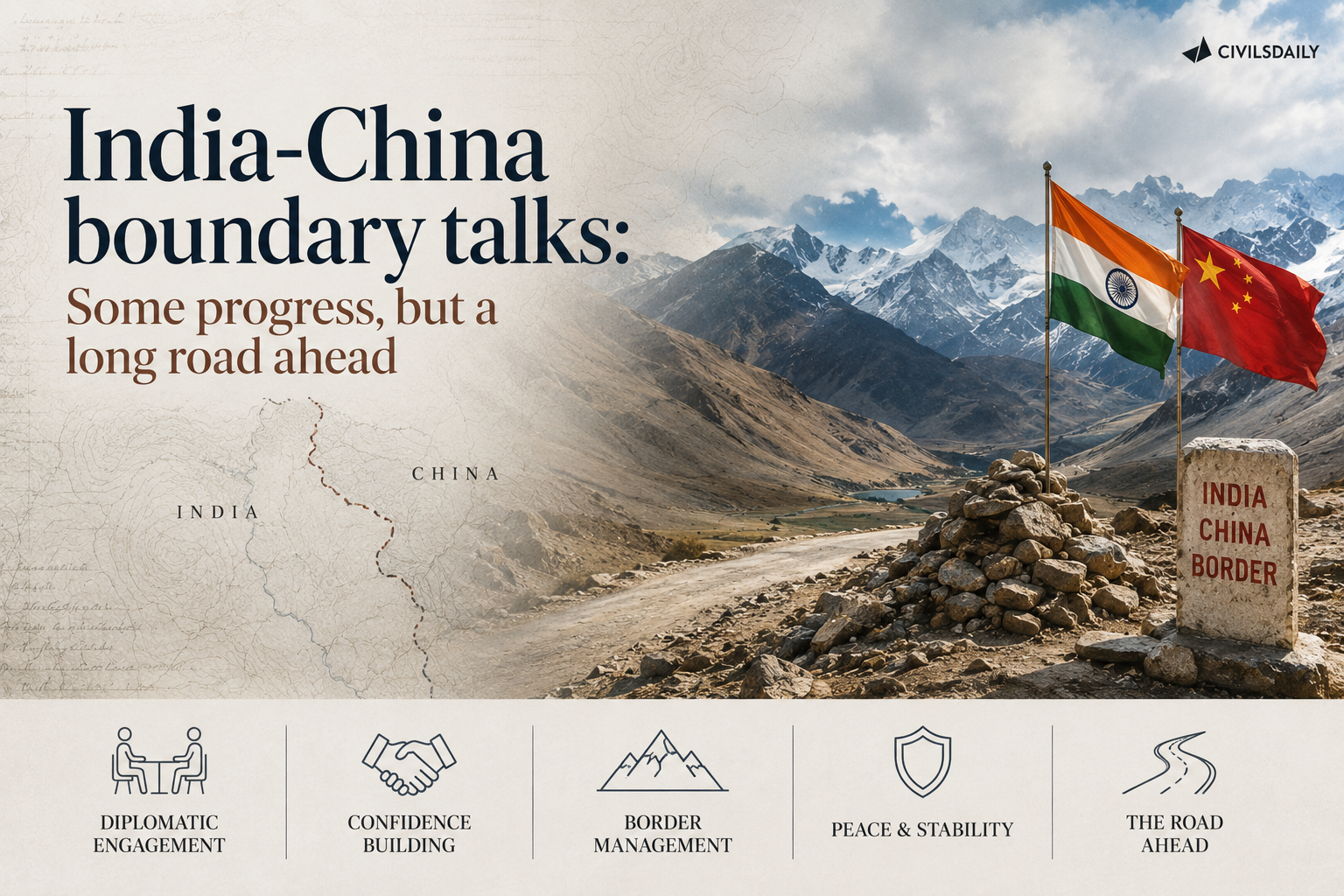
  • India-China boundary talks: Some progress, but a long road ahead

    India-China boundary talks: Some progress, but a long road ahead

    Why in the News

    An eight point consensus has emerged from the 25th round of talks between the Special Representatives of India and China, the National Security Advisor and the Chinese Foreign Minister, held in Beijing. The talks come ahead of the expected visit of the President of China to India for the BRICS Summit. The outcomes include agreement to advance a framework for settling the boundary question through an Expert Group and a Working Group, and to establish two new hotlines in the Eastern and Middle Sectors. Whether this procedural progress marks the start of genuine boundary delimitation, or repeats a decades long pattern of confidence building measures that stall before they mature, remains contested.

    What is the Special Representatives mechanism on the India China boundary?

    1. A political level channel: The Special Representatives mechanism is the designated political level channel, held at the level of the National Security Advisor and the Foreign Minister, tasked with negotiating a framework for settlement of the boundary question.
    2. The current round: The 25th round of talks was held in Beijing between the National Security Advisor and the Chinese Foreign Minister.
    3. Its relationship to implementation bodies: It operates alongside implementation level mechanisms such as the Working Mechanism for Consultation and Coordination on India China Border Affairs (WMCC), which handles border management and now houses the Expert Group and Working Group tasked with delimitation and management.

    What did the 25th round of talks agree to?

    1. Reaffirming peace along the border: The outcomes concern maintenance of peace and tranquillity in the border areas, and advancing negotiations on a framework for settlement of the boundary question in accordance with previous agreements.
    2. New task for the Expert Group and Working Group: There is a specific reference to advancing discussions through an Expert Group and a Working Group respectively, to explore an early harvest of boundary delimitation in appropriate sectors, and effective border management.
    3. Implementing an earlier understanding: The two sides agreed to implement last year’s understanding on additional General Level Mechanism or Senior Highest Military Commander meetings, along with establishing two hotlines in the Eastern and Middle Sectors.

    How has the border personnel meeting mechanism evolved since 1992?

    1. Origins in the Joint Working Group: In 1992, the Joint Working Group on the Boundary Question decided on confidence building measures such as Border Personnel Meetings, complementing forward movement on border trade.
    2. A subgroup that grew into an institutional mechanism: A subgroup of the Joint Working Group was created following the 1993 border peace and tranquillity agreement, the India China Expert Group of Diplomatic and Military Officials, which became the precursor to the Working Mechanism for Consultation and Coordination on India China Border Affairs, set up in 2012.
    3. New meeting points identified after 1995: After the success achieved in 1995 on disengagement at Sumdorong Chu, Lipulekh in the Middle Sector and Dichu in the Eastern Sector were identified as additional military meeting points.
    4. Not every point could be operationalised: The plan for meetings at Lipulekh was abandoned for want of infrastructure and because of adverse weather conditions. A trial meeting at Dichu, in the Kibithu sector of Arunachal Pradesh’s Anjaw district and the site of a notable 1962 battle in which the Kumaon Regiment fought, was finalised, but the chosen site on Madan Ridge proved contentious and no further meetings took place there.
    5. The proposal was revived only in 2014: It was then decided to hold regular meetings at Wacha, opposite Damai on the Chinese side, in the same Kibithu sector, in addition to existing venues across Bum La in Arunachal Pradesh and Nathu La in Sikkim.

    What do the new hotlines add to existing India China contact channels?

    1. The understanding they build on: Last year, the two sides had reached agreement in principle on working towards additional General Level or Senior Highest Military Commander meetings in the Eastern and Middle Sectors, similar to the existing mechanism in the Western Sector at Chushul and Moldo.
    2. Existing channels already in place: Hotlines already exist at Daulat Beg Oldie and Chushul, with informal communication at Demchok in the Western Sector, and similar hotlines at Nathu La in Sikkim and at Bum La and Kibithu in the Eastern Sector.
    3. What the new hotlines could achieve: The two additional hotline channels agreed for the Eastern and Middle Sectors could strengthen this existing capacity and help defuse local tensions.

    What broader thaw in ties has this round of talks followed?

    1. Political level consensus behind the process: The Special Representatives are working to realise the consensus reached between the Prime Minister and the President of China at Kazan in October 2024, and at Tianjin in August 2025, on improving ties.
    2. Other signs of normalisation: The resumption of the Kailash Mansarovar Yatra, the restoration of direct flights, and the resumption of border trade are meaningful steps in the same direction.

    What tensions temper optimism about this round of talks?

    1. It would be premature to call this delimitation: It would be premature to suggest that substantive boundary delimitation has already begun in earnest, since the Expert Group and the Working Group under the Working Mechanism for Consultation and Coordination are only now explicitly tasked with finalising their respective terms of reference, meaning the framework is being created and the process is being activated only incrementally.
    2. The road ahead is long: The task of achieving an early and substantial harvest of boundary delimitation and border management may be long and arduous, requiring patient negotiations.
    3. Piecemeal progress against an unsettled whole: There is also the question of piecemeal progress against a more holistic settlement of differences along the Line of Actual Control (LAC), since neither the Sikkim subsector nor the Middle Sector are free from their own unresolved differences.
    4. Negotiators need to be equal to a vexed history: The negotiators must be empowered to engage in meaningful discussions and must have sufficient experience in handling a matter that has proved difficult for previous generations.

    Conclusion

    This round of Special Representative talks has advanced the procedural architecture for the India China boundary question, through new hotlines and a formal mandate for the Expert Group and Working Group, ahead of the expected visit of the President of China for the BRICS Summit. Genuine boundary delimitation has not yet begun, and the decades long history of the border personnel meeting mechanism shows that such confidence building steps can stall for years before they mature. Whether the newly mandated Expert Group and Working Group convert this round’s procedural momentum into an actual settlement remains to be seen.

    Back2Basics: Line of Actual Control (LAC)

    1. Definition: The LAC separates Indian controlled territory from Chinese controlled territory along the unsettled boundary between the two countries.
    2. Three sectors: It is divided into three sectors, the Eastern Sector covering Arunachal Pradesh and Sikkim, the Middle Sector covering Uttarakhand and Himachal Pradesh, and the Western Sector covering Ladakh.

    “[2024, GS3, 15 marks] India has a long and troubled border with China and Pakistan fraught with contentious issues. Examine the conflicting issues and security challenges along the border. Also give out the development being undertaken in these areas under the Border Area Development Programme (BADP) and Border Infrastructure and Management (BIM) Scheme.”
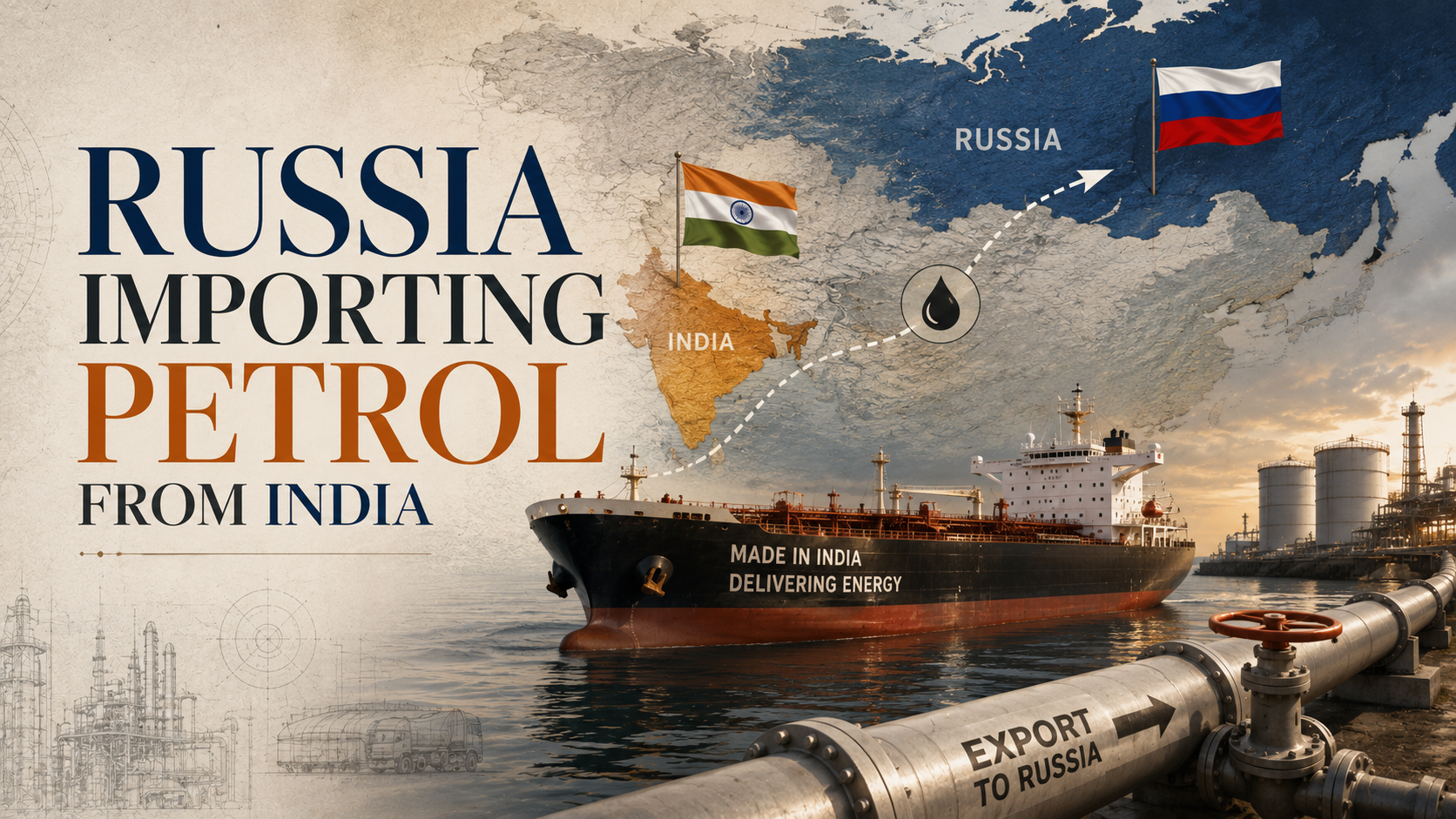
  • Russia turns to India to meet petrol demand after oil infra takes a hit in Ukraine strikes

    Russia turns to India to meet petrol demand after oil infra takes a hit in Ukraine strikes

    Why in the News

    Repeated Ukrainian strikes on Russian oil refineries, combined with routine maintenance, strong summer demand and logistical bottlenecks, have cut Russia’s domestic petrol supply. Russia imported over one million barrels of petrol from India, mainly from Nayara Energy’s Vadinar refinery, over June and July 2026, according to ship tracking data.

    What does the trade data show?

    1. Rising volumes over two months: Gasoline exports from India to Russia rose from about 12,000 barrels per day in June 2026 to about 21,000 barrels per day in July 2026, together close to a million barrels, with the trend reported to have continued into August.
    2. Vadinar as the main Indian source: Three cargoes of around 320,000 to 350,000 barrels each were shipped to Russia from the Vadinar refinery, which has significant Russian shareholding. Additional volumes may have reached Russia through ship-to-ship transfers and vessels with undeclared destinations.
    3. Belarus and Kazakhstan remain the largest suppliers: Most of Russia’s imported gasoline still comes from Belarus, where one of two refineries is 42% owned by a Russian consortium and processes only Russian crude. Kazakhstan is a net petrol importer itself and cannot supply large volumes.
    4. Russia has restricted its own exports to protect domestic supply: Moscow has curbed diesel exports ahead of winter and placed volume limits on petrol sold per vehicle at fuel stations in several regions, since its refining system produces a comfortable diesel surplus but only a thin petrol buffer over domestic demand.

    Why does this mark a reversal in the India-Russia energy relationship?

    1. India’s established role has been as buyer, not supplier: Russian crude, discounted after Western sanctions cut off Moscow’s traditional European buyers following its invasion of Ukraine, now makes up the largest share of India’s crude import basket.
    2. The new flow runs in the opposite direction: India is now supplying a refined product back to Russia, derived in part from the same Russian crude it imports, a flow that did not exist before June 2026.

    Petrol vs Diesel Situation

    Petrol

    • More vulnerable to supply disruptions.
    • Domestic refinery output normally only slightly exceeds demand.
    • Russia has:
      • Restricted exports.
      • Limited petrol supplies at some fuel stations.
      • Adjusted product specifications to protect domestic availability.

    Diesel

    • Russia is relatively better supplied.
    • Its refining system produces more diesel than domestic consumption requires.
    • Nevertheless, Russia has also restricted diesel exports to build a cushion before winter.

    Why is India Important?

    • India has substantial refining capacity and exportable petroleum products.
    • Indian refineries continue to receive large quantities of Russian crude oil.
    • Some petrol exported to Russia may therefore be produced from Russian crude refined in India.
    • This creates an increasingly complex two-way India-Russia energy relationship.

    Conclusion

    The shift shows India’s refining capacity, especially at plants processing discounted Russian crude, has become a swing supplier for Russia’s own domestic fuel shortfall. Whether the flow continues depends on how quickly Russia can repair refining capacity damaged by continuing strikes.

    “[2024] Consider the following statements:
    Statement-I: Recently, Venezuela has achieved a rapid recovery from its economic crisis and succeeded in preventing its people from fleeing/emigrating to other countries.
    Statement-II: Venezuela has the world’s largest oil reserves.
    Which one of the following is correct in respect of the above statements?
    (a) Both Statement-I and Statement-II are correct and Statement-II explains Statement-I
    (b) Both Statement-I and Statement-II are correct, but Statement-II does not explain Statement-I
    (c) Statement-I is correct, but Statement-II is incorrect
    (d) Statement-I is incorrect, but Statement-II is correct

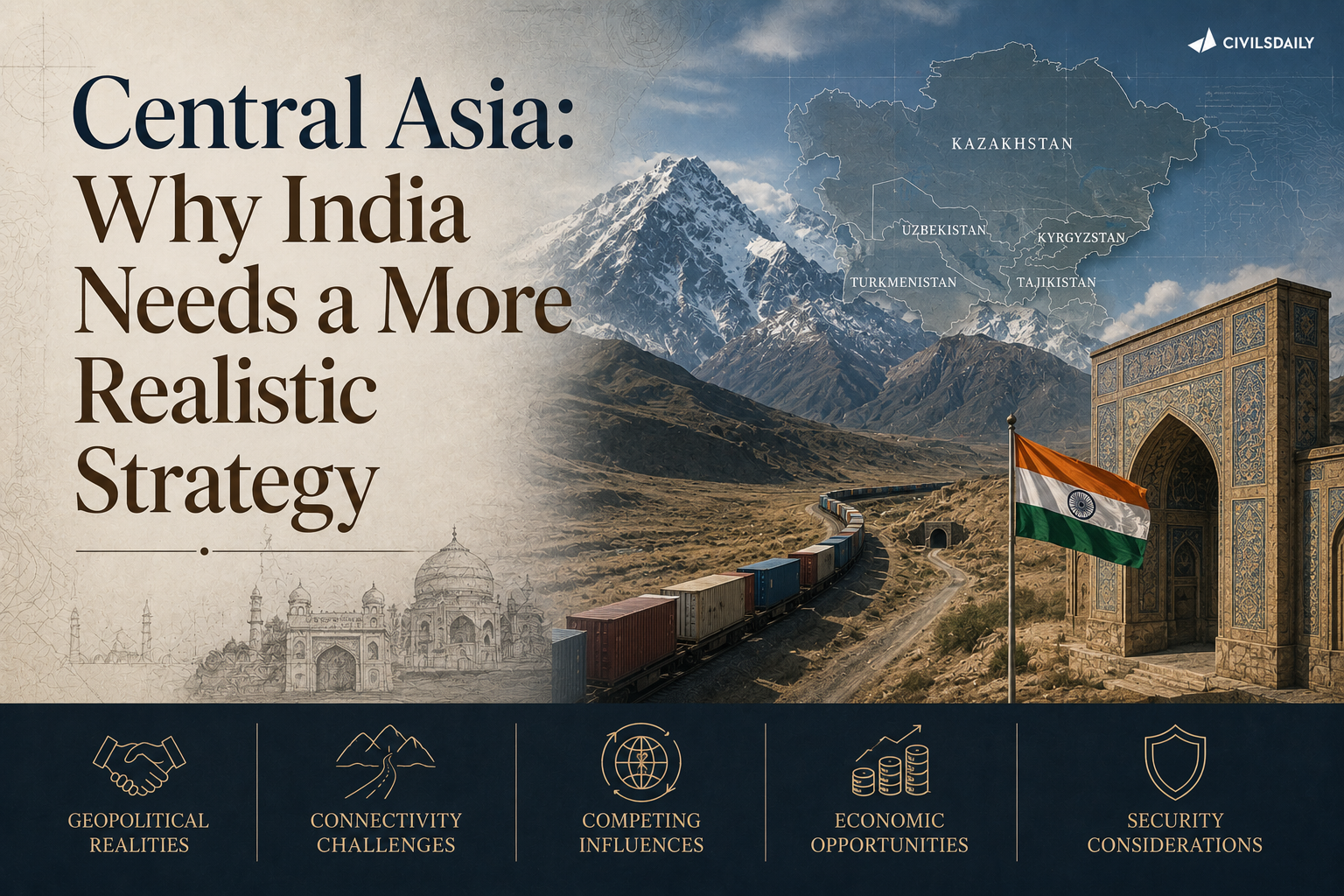
  • Our Central Asia strategy needs less romance, more realism

    Our Central Asia strategy needs less romance, more realism

    Why in the News

    Prime Minister Modi visits Uzbekistan and the SCO summit in Kyrgyzstan this week, entering a Central Asia that bears little resemblance to the region he toured in 2015. Central Asia has gained independent geopolitical agency and diversified its great-power relationships, exposing the gap between India’s ambition for strategic reconnection and its actual capacity for access and investment.

    How has Central Asia’s regional coherence altered its position between competing powers?

    • Central Asian Five consolidation: Since 2018 the five states have met regularly at summit level and signed a friendship treaty, moving toward organisational substance as a Central Asian community.
    • C-6 expansion: The Central Asian Five invited Azerbaijan to form the C-6, linking the region more closely to the Caucasus and Türkiye.
    • Fergana Valley settlement: Uzbekistan, Kyrgyzstan and Tajikistan settled long-running border disputes in the Fergana Valley, removing a structural source of intra-regional friction.
    • Intra-regional trade growth: Rising intra-regional trade has reinforced political cooperation, converting Central Asia into a region in its own right rather than the sum of five post-Soviet republics.

    What do recent institutional realignments show about Central Asia’s shift toward the Greater Middle East and the West?

    • Kazakhstan–Abraham Accords: Kazakhstan announced accession to the Abraham Accords at the Washington summit with the US in November 2025.
    • Board of Peace charter: Azerbaijan, Kazakhstan and Uzbekistan signed the charter of Trump’s Board of Peace at Davos in January 2026.
    • Organisation of Turkic States: Türkiye converted the OTS from a cultural forum into an instrument for political, economic and defence cooperation across Central Asia.
    • US bureau reorganisation: Washington restructured the State Department in 2006 to group Central Asia with Afghanistan and the Subcontinent, an earlier connectivity bet that Afghan instability defeated.

    What geographic constraints continue to block India’s direct access to Central Asia?

    • Land route blockage: Pakistan blocks India’s overland route, and Afghan instability rules out an alternate land corridor.
    • Chabahar disruption: The Iran–US conflict has complicated Chabahar and the International North-South Transport Corridor, leaving India’s one built connectivity node idle.
    • Emerging unaddressed issues: Central Asian states have moved toward pragmatic engagement with the Taliban, but new problems like Amu Darya water-sharing are arising in areas where India has no established role.

    Why can India not replicate other external powers’ approaches in Central Asia?

    • Diplomatic precondition unmet: Delhi has not resolved whether to extend diplomatic flexibility toward Pakistan, Türkiye and Azerbaijan, flexibility that would expand its room for manoeuvre.
    • Capability gap: India cannot match China’s infrastructure spending, Russia’s geographic advantages, Europe’s financial resources, or Türkiye’s Caspian access.
    • Multi-vector environment: Central Asian states engage all major powers and commit exclusively to none, closing off the option of an exclusive partnership regardless of capability.

    Conclusion

    India’s Central Asia policy should replace romantic historical framing with a realistic assessment of its access constraints and capabilities, and build engagement incrementally from that assessment rather than from renewed aspiration.

    Back2Basics

    1. Central Asian Republics (CARs): The five states that emerged from the dissolution of the Soviet Union in 1991: Kazakhstan, Kyrgyzstan, Tajikistan, Turkmenistan, and Uzbekistan, sharing historic trade and cultural links with India through the Silk Route.

    “[2024, GS2, 10 marks] Critically analyse India’s evolving diplomatic, economic and strategic relations with the Central Asian Republics (CARs) highlighting their increasing significance in regional and global geopolitics.”

  • Gor in Srinagar: a one-man mission to strengthen a sputtering relationship

    Why in the News

    The US Ambassador to India, Sergio Gor, visited Srinagar and described Jammu and Kashmir as an “important part of India,” a remark read against India’s longstanding sensitivity to any US position on Kashmir and against President Trump’s earlier offer to mediate on the Kashmir dispute. India has consistently rejected any third-party mediation on Kashmir, treating it as a strictly bilateral matter with Pakistan, or as a purely internal matter following the 2019 reorganisation of the erstwhile State. An Ambassador’s remark affirming Jammu and Kashmir’s place within India, delivered from Srinagar itself, sits at the point where the US-India-Pakistan strategic triangle and India’s own sensitivity over Kashmir mediation intersect.

    Why does an Ambassador’s Kashmir remark carry this much weight?

    1. India rejects third-party mediation on Kashmir as a matter of settled position: New Delhi has consistently maintained that any Kashmir-related issue with Pakistan is bilateral, and that Jammu and Kashmir’s internal status is a purely domestic matter following its 2019 reorganisation, a position any external actor’s remark on the region is read against.
    2. Contrasts with Trump’s earlier mediation offer: President Trump had earlier offered to mediate the Kashmir dispute between India and Pakistan, an offer India rejected, making the Ambassador’s affirmation of Jammu and Kashmir as part of India a notable contrast within the same US administration’s public statements.
    3. Location of the remark adds to its significance: A statement affirming Jammu and Kashmir’s status as part of India, made from Srinagar itself rather than from Washington or New Delhi, is read as a more deliberate signal than the same words delivered elsewhere would carry.

    How does this fit the broader US-India-Pakistan strategic triangle?

    1. The US maintains parallel relationships with both India and Pakistan: Washington’s engagement with Pakistan, including on counter-terrorism and regional stability, runs alongside its deepening strategic partnership with India, a balancing act that surfaces whenever a US official’s statement touches Kashmir.
    2. India’s sensitivity stems from past instances of perceived hyphenation: India has historically pushed back against any US framing that treats India and Pakistan as a linked pair on Kashmir, since India seeks its relationship with the United States assessed on its own terms rather than through a Pakistan-linked lens.
    3. The remark functions as reassurance amid broader friction points: With trade tariffs, H-1B visa fees and differing approaches to Russia already straining the relationship, an unambiguous Kashmir remark serves as a low-cost way for the Ambassador to reaffirm alignment with India’s position on a historically sensitive issue.

    Conclusion

    The Ambassador’s Srinagar remark reads as a deliberate reassurance to India at a moment when trade and visa disputes have strained the relationship, and it stands in contrast to the mediation offer that preceded it. Whether the remark reflects a settled US position or an individual Ambassador’s own initiative will become clearer only if it is echoed at the presidential or State Department level.

    Frictional points in India-US relations

    1. India-Pakistan hyphenation: Statements or offers that treat India and Pakistan as a linked pair, most visibly President Trump’s mediation offer on Kashmir and his claim to have brokered an end to Operation Sindoor, run against India’s insistence on being engaged independently of Pakistan.
    2. Trade and tariff disputes: Disagreements over tariffs, data localisation rules, and price caps on medical devices such as coronary stents have created recurring points of economic friction between the two countries.
    3. The H-1B visa fee increase: A steep rise in the H-1B visa fee, reported at around $100,000, directly affects the competitiveness of India’s information technology sector, which relies heavily on H-1B-based deployment of Indian professionals to the United States.
    4. Divergence over Russia and Iran: India’s continued engagement with Russia, including energy purchases and defence systems such as the S-400, and its interest in Iran’s Chabahar Port, sit uneasily against US sanctions policy on both countries.
    5. Strategic autonomy versus alliance expectations: India’s practice of engaging simultaneously with the Shanghai Cooperation Organisation, BRICS, and the Quadrilateral Security Dialogue reflects a multi-alignment approach that does not map onto the closer alliance-style alignment the United States sometimes expects of partners.

    Back2Basics: Jammu and Kashmir’s post-2019 status

    1. Reorganised in August 2019 under the Jammu and Kashmir Reorganisation Act, 2019, which revoked the special status previously available under the now-abrogated Article 370 and split the former State into two Union Territories, Jammu and Kashmir, and Ladakh.
    2. India treats the region’s internal status as a purely domestic matter, not open to third-party mediation or comment.
    3. Any dispute with Pakistan over the region is treated by India as strictly bilateral, governed by the Shimla Agreement of 1972, which committed both countries to resolving differences through bilateral negotiation.

    Matching Previous Year Question

    “[2026] The Chancellor of Germany visited India in January 2026. Which of the following is/are NOT correct in terms of outcomes?
    1. MoU between All India Institute of Ayurveda and University of Hamburg
    2. MoU on Youth Hockey Development between Hockey India and German Hockey Federation
    3. Establishment of a bilateral dialogue mechanism on the Indo-Pacific
    4. Opening of an Honorary Consul of Germany in Lucknow
    (a) 2 and 3
    (b) 1 and 4
    (c) 3 and 4
    (d) 1 only
    ANSWER: B”

  • Jaishankar meets Putin in Moscow ahead of Modi-Putin SCO and BRICS meetings

    Why in the News

    The External Affairs Minister, S. Jaishankar, met the President of Russia, Vladimir Putin, in Moscow for the 27th session of the India-Russia Inter-Governmental Commission on Trade, Economic, Scientific, Technological and Cultural Cooperation (IRIGC-TEC). The two sides discussed trade, energy, fertilisers, nuclear energy and high technology, working toward a bilateral trade target of $100 billion by 2030. The meeting is the first of three planned engagements between the Prime Minister and the Russian President this cycle: the Shanghai Cooperation Organisation (SCO) summit in Kyrgyzstan from August 31 to September 1, and the BRICS summit in New Delhi on September 12 and 13.

    What did the IRIGC-TEC session cover?

    1. Trade target of $100 billion by 2030: The two sides reaffirmed a bilateral trade target of $100 billion by 2030, a goal that requires sustained growth beyond current trade levels driven mainly by energy imports.
    2. Energy cooperation, including crude and nuclear: Discussions covered continued crude oil trade alongside civil nuclear energy cooperation, an area where Russia has an established role in building reactor capacity in India.
    3. Fertiliser supply arrangements: Fertiliser imports from Russia, a category that has grown in importance for India’s agricultural input security, featured in the discussions.
    4. High technology cooperation: The two sides also discussed cooperation in high technology, an area the two governments have flagged for expansion beyond the traditional defence and energy relationship.
    5. The 27th session of a long-running mechanism: The IRIGC-TEC (the standing bilateral commission that reviews India-Russia economic and technical cooperation) meeting in Moscow was its 27th session, indicating a mechanism that has operated continuously across multiple political cycles in both countries.

    Why does this meeting matter ahead of two summit-level meetings?

    1. First of three Modi-Putin engagements in this cycle: The Moscow meeting precedes two summit-level meetings between the Prime Minister and the Russian President, at the SCO summit in Kyrgyzstan from August 31 to September 1 and the BRICS summit in New Delhi on September 12 and 13, making the ministerial visit a preparatory step for both.
    2. Sets the working agenda before leader-level talks: Ministerial-level discussions on trade, energy and technology at the IRIGC-TEC session lay the groundwork that the two leaders are expected to build on when they meet at the multilateral summits.
    3. Multiple engagements in a short span signal sustained bilateral priority: Three India-Russia engagements within roughly three weeks, spanning a bilateral commission, a regional grouping summit and a cross-regional grouping summit, reflect the continuing weight both countries place on the relationship despite Russia’s international isolation over the Ukraine conflict.

    Conclusion

    The Moscow meeting sets the working agenda for a $100 billion 2030 trade target and advances discussions on energy, fertilisers and technology ahead of two further Modi-Putin meetings at the SCO summit in Kyrgyzstan and the BRICS summit in New Delhi. Whether the trade target is met will depend on how much of the current energy-driven trade can be diversified into the technology and industrial cooperation areas discussed in Moscow.

    Back2Basics: India-Russia Inter-Governmental Commission on Trade, Economic, Scientific, Technological and Cultural Cooperation (IRIGC-TEC)

    1. The standing bilateral mechanism, co-chaired at the ministerial level, that reviews and advances India-Russia cooperation across trade, energy, science, technology and cultural exchange.
    2. Operates as one of two parallel Inter-Governmental Commissions with Russia, alongside a separate one focused on military-technical cooperation.
    3. Meets periodically, with sessions numbered sequentially; the Moscow meeting was its 27th session.
    4. Functions as the working-level track that prepares the ground for leader-level India-Russia summits.

    Matching Previous Year Question

    “[2026] The Chancellor of Germany visited India in January 2026. Which of the following is/are NOT correct in terms of outcomes?
    1. MoU between All India Institute of Ayurveda and University of Hamburg
    2. MoU on Youth Hockey Development between Hockey India and German Hockey Federation
    3. Establishment of a bilateral dialogue mechanism on the Indo-Pacific
    4. Opening of an Honorary Consul of Germany in Lucknow
    (a) 2 and 3
    (b) 1 and 4
    (c) 3 and 4
    (d) 1 only
    ANSWER: B”

  • A bday wish with perfect timing: Why PM’s greeting to Sitharaman says a lot

    Why in the News

    The Union Finance Minister led a four minister delegation to the 4th India Singapore Ministerial Roundtable (ISMR) in Singapore on 19 and 20 August 2026. The Prime Minister had greeted her on her birthday on 18 August, crediting her role in India’s reforms and economic development and in the Centre’s endeavours for a strong and self reliant India. The greeting arrived as the organisational revamp in the ruling party revived talk of a Union Cabinet reshuffle. The exchange is read in Delhi as a vote of confidence in the office that currently carries both the external economic file and the domestic industrial and banking agenda.

    What is the India Singapore Ministerial Roundtable?

    1. A ministerial level bilateral mechanism: The roundtable is the platform on which the two governments review progress in India Singapore collaboration and identify new areas of work.
    2. Its format: It convenes several ministers from each side at once rather than a single counterpart pairing, which allows cross portfolio decisions in one sitting.
    3. Six pillars of cooperation: The roundtable is organised around advanced manufacturing, connectivity, digitalisation, healthcare and medicine, skills development, and sustainability.
    4. The current round: The fourth roundtable was held on 19 and 20 August 2026.

    What is the National Industrial Corridor Development and Implementation Trust?

    1. The special purpose vehicle for industrial corridors: The trust is the central body that funds and implements India’s industrial corridor projects, including trunk infrastructure inside the corridor nodes.
    2. How it is supervised: An Apex Monitoring Authority chaired by the Union Finance Minister reviews its progress with the concerned States and central ministries.

    Which ministries carried the delegation and why does that composition matter?

    1. Four portfolios in one delegation: The Finance Minister led a delegation comprising the Minister of External Affairs, the Minister for Commerce and Industry, and the Minister of State for Electronics and Information Technology and for Commerce and Industry.
    2. What that combination covers: Finance, diplomacy, trade and technology were represented together, which matches the roundtable’s own spread from advanced manufacturing to digitalisation.
    3. Who was recorded as leading: The Ministry of Finance specified that the Finance Minister was leading the delegation, which places the economic ministry rather than the foreign ministry at the head of a bilateral engagement.

    What is the political reading of the greeting?

    1. The occasion and the words used: The Prime Minister’s birthday message on 18 August credited the Finance Minister’s role in India’s reforms and economic development and in the effort towards a strong and self reliant India.
    2. The reply: The Finance Minister responded within the hour, stating that the Prime Minister’s guidance had always served as a motivation.
    3. The timing: The exchange followed the organisational revamp in the ruling party, which had renewed speculation about a Union Cabinet reshuffle.
    4. The standing it confirms: The exchange is read in Delhi’s power corridors as a vote of confidence in India’s longest serving full time woman finance minister.

    What economic conditions frame the Finance Ministry’s current workload?

    1. A growth and inflation target held together: India is seeking to maintain its 7 percent growth momentum and to keep inflation in check at the same time.
    2. Two external shocks in the same period: The economy is absorbing capital outflows alongside energy and supply chain disruptions resulting from the West Asia conflict.
    3. Why the reforms reference matters now: A public endorsement of the reforms record lands at the point where external shocks, and not domestic demand, are the binding constraint on growth.

    What did the industrial corridor review ask of the States?

    1. The meeting held: The Finance Minister chaired the third meeting of the Apex Monitoring Authority of the National Industrial Corridor Development and Implementation Trust on 17 August.
    2. Who attended: The Minister for Commerce and Industry, the Chief Minister of Madhya Pradesh and the Vice Chairman of NITI Aayog were present.
    3. What the States were asked to do: States were urged to resolve bottlenecks relating to land, connectivity, utilities and statutory clearances in industrial corridors.
    4. Why the ask sits with the States: Each of those four bottlenecks is a State subject in practice, so central capital does not convert into an operating industrial node without State action.

    What has the outreach to young citizens argued?

    1. The political context: After the students’ protest at Jantar Mantar, the Finance Minister was among the few leaders of the ruling party fronted to make an outreach to young citizens.
    2. The positions stated: She said the young have their ears closer to the ground, denied that the government ever tried to stop protests over examination paper leaks, and acknowledged issues in the education and employment sectors.
    3. The structural point on higher education: She said university courses do not ready graduates for jobs and do not ready them for entrepreneurship either.
    4. The specific illustration used: A bachelor’s degree in Economics or Political Science leads a student to a master’s degree. The student still needs something more after that to be employable.

    What was asked of the public sector banks?

    1. The meetings held: The Finance Minister met the chiefs of 12 public sector banks during the same week.
    2. The instruction given: Banks were nudged to raise their appeal to young customers without sacrificing the prudence the business requires.
    3. The reasoning offered: Young customers who grew up with smartphones expect banking to be simple, intuitive, personalised and available at all times.
    4. The suggested method: Banks were asked to consult young people on customer facing operations rather than to redesign the institution from the top.

    Conclusion

    The week placed one economic ministry at the head of a four minister bilateral delegation abroad and at the chair of the industrial corridor and public sector banking reviews at home. The current status is a completed fourth ministerial roundtable across six agreed pillars of India Singapore cooperation, with no new agreement announced. The next markers are the follow up on the pillars agreed at the roundtable and the resolution by States of the land, connectivity, utility and clearance bottlenecks flagged in the corridor review.

    What is the Act East Policy?

    1. About: The Act East Policy, launched in 2014, is India’s framework for engagement with Southeast Asia and the wider Indo-Pacific, and it added a security and connectivity dimension to the trade focused Look East Policy of 1991.
    2. Rationale: It was designed to place the North Eastern Region at the heart of India’s external engagement and to prevent the region east of India from becoming a single power’s sphere.
    3. The four pillars: Commerce, culture, connectivity and capacity building are the policy’s stated components, covering trade agreements, civilisational links, physical and digital connectivity, and training and development assistance.
    4. Where it stands: Ties with the Association of Southeast Asian Nations (ASEAN) were elevated to a Comprehensive Strategic Partnership in 2022, the highest tier of the bloc’s partnership arrangements.

    Key Facts about India Singapore Relations

    1. The first comprehensive trade agreement: India and Singapore signed a Comprehensive Economic Cooperation Agreement in 2005, the first such agreement India concluded with any country.
    2. Payments linkage: The linking of India’s Unified Payments Interface with Singapore’s PayNow in 2023 enabled low cost real time cross border remittances between the two countries.
    3. Defence links: SIMBEX, conducted since 1994, is India’s longest running bilateral naval exercise, and Changi Naval Base features in India’s network of logistics access points in the region.

    Challenges in India’s Act East Engagement

    1. Slow project delivery undermines credibility: India is repeatedly compared unfavourably with faster moving partners on connectivity projects. Eg. The Kaladan Multi Modal Transit Transport Project has faced over a decade of delays. Fix. Move the flagship connectivity projects to a single empowered implementation authority with published milestone dates.
    2. An asymmetric trade balance with the bloc: Tariff concessions have widened imports without a matching rise in Indian exports. Eg. India runs a trade deficit of about 40 billion dollars with ASEAN, driven by electronics and chemicals. Fix. Complete the review of the India ASEAN Trade in Goods Agreement with rules of origin tightened against third country transshipment.
    3. Exclusion from the regional trade architecture: Staying out of the Regional Comprehensive Economic Partnership keeps Indian firms outside the region’s integrated value chains. Eg. Supply chains relocating from East Asia often bypass India for members of that agreement. Fix. Pursue bilateral economic partnership agreements with individual member states to recover the lost market access.
    4. Instability on the land route: Civil conflict in Myanmar blocks the only land corridor connecting India to Southeast Asia. Eg. Work on the India Myanmar Thailand Trilateral Highway has stalled in contested territory. Fix. Prioritise the maritime and air legs of connectivity to Southeast Asia until the land route is secure.
    5. Competing port investments in the region: Rival infrastructure spending has produced a network of ports around India’s maritime approaches. Eg. The expansion of the Ream Naval Base in Cambodia has raised concerns about naval access. Fix. Deepen logistics support arrangements with regional partners so that Indian naval assets have reciprocal access along the same corridors.

    Matching Previous Year Question

    “No direct PYQ traced in the provided files. Closest microtheme: Bilateral Relations (International Relations).”

  • India, U.K. review bilateral defence ties at DCG meeting

    Why in the News

    India and the United Kingdom reviewed bilateral defence cooperation at the 25th India United Kingdom Defence Consultative Group (DCG) meeting in New Delhi on 21 August 2026. The Defence Secretary and the United Kingdom’s Permanent Under Secretary for Defence co chaired the meeting. Defence industry and research and development were the declared focus of the review. The two sides also acknowledged their maritime security cooperation in the Indo-Pacific and reaffirmed a commitment to mutual security and strategic autonomy. The meeting places the industrial and research pillar, rather than platform purchases, at the centre of a partnership that has historically been defined by equipment supply.

    What is the India United Kingdom Defence Consultative Group?

    1. The institutional channel for the defence relationship: The DCG is the standing bilateral mechanism at which the two defence establishments review the whole of their cooperation.
    2. Who leads it: It is co chaired at the level of the Defence Secretary on the Indian side and the Permanent Under Secretary for Defence on the British side.
    3. How long it has run: The New Delhi round was the 25th meeting of the group, which makes it one of the longer running bilateral defence dialogues India maintains.

    What is the India United Kingdom Vision 2035?

    1. The current roadmap for the partnership: Vision 2035 is the agreed framework that sets out where the two countries intend to take defence, technology, trade and security cooperation over the coming decade.
    2. The defence component: It is paired with a 10 year Defence Industrial Road map, which is the instrument the two sides use to sequence joint industrial and research work.

    What is the Indo-Pacific Oceans Initiative?

    1. India’s cooperative framework for the maritime region: The initiative is an India led arrangement announced in 2019. Partner countries take the lead on specific pillars such as maritime security, resources and capacity building.
    2. How partners participate: A country joins by leading or co leading a pillar rather than by signing a treaty, which is how the United Kingdom is engaged in it.

    What did the two sides review on defence industrial cooperation?

    1. Industry and research were the declared focus: The review of bilateral defence cooperation was framed around defence industry and research and development rather than around procurement.
    2. Where that work is anchored: Ongoing defence industrial cooperation was reviewed with particular emphasis on research and development under the India United Kingdom Vision 2035 and the 10 year Defence Industrial Road map.

    How will military to military exchanges expand?

    1. Three named channels of expansion: The two countries agreed to expand exchanges between their armed forces through joint exercises, training and capacity building initiatives.
    2. Why the format matters: Exercises and training create the interoperability that industrial cooperation alone cannot produce.
    3. The visit itself: The meeting marked the first visit to India by the British official in his current capacity. He laid a wreath at the National War Memorial during the visit.

    What does the maritime security agenda add?

    1. Cooperation acknowledged in the Indo-Pacific: Both sides recorded robust maritime security cooperation between the two countries in the Indo-Pacific.
    2. A new institution named: That cooperation includes the establishment of the Regional Maritime Security Centre of Excellence under the Indo-Pacific Oceans Initiative.

    What framing did the two sides put on the partnership?

    1. Regional security was discussed directly: The two sides exchanged views on regional peace and security.
    2. Two commitments reaffirmed: They reaffirmed their commitment to mutual security and to strategic autonomy, which retains each side’s freedom of independent decision.
    3. The declared basis of the relationship: They reiterated that the India United Kingdom Strategic Partnership is anchored in shared values of peace, stability, freedom and mutual respect.

    Challenges to the India United Kingdom Strategic Partnership

    1. Divergent positions on Russia: London has openly criticised the invasion of Ukraine, and New Delhi maintains its own relationship with Moscow. Eg. India’s continued crude imports from Russia have drawn repeated criticism in British parliamentary debate. Fix. Ring fence the disagreement in the political dialogue and keep the defence industrial track on its own timeline.
    2. Extremist activity abroad affecting bilateral trust: Separatist mobilisation on British soil is treated by India as a security matter and by Britain as a policing and speech matter. Eg. The Five Eyes investigation into the Nijjar killing, which includes the United Kingdom, strained the relationship. Fix. Create a standing bilateral mechanism to review threats to diplomatic premises and personnel with agreed timelines for response.
    3. Unsettled extradition of economic offenders: Cases pending for years in British courts weaken confidence in legal cooperation. Eg. The extradition of high profile fugitives such as Vijay Mallya and Nirav Modi remains unresolved. Fix. Agree a case management protocol with fixed review points so that requests do not stall indefinitely.
    4. Carbon border levies on Indian exports: The proposed Carbon Border Adjustment Mechanism threatens Indian steel and aluminium exports and is read in India as protectionism in an environmental form. Eg. Steel and aluminium are among India’s largest industrial exports to the European market. Fix. Negotiate a mutual recognition arrangement for India’s own carbon credit trading scheme so that a domestic carbon price is counted at the border.
    5. Migration and mobility remain unsettled: High visa fees and the health surcharge raise the cost of temporary movement, and no migration and mobility agreement covers the illegal migrant population. Eg. More than one lakh illegal Indian immigrants are estimated to be in the United Kingdom. Fix. Fast track the Double Contribution Convention so that Indian temporary workers are exempted from British National Insurance payments.
    6. Intellectual property divergence in pharmaceuticals: British insistence on tighter intellectual property norms conflicts with India’s priority of affordable medicines. Eg. Data exclusivity demands would delay generic entry for medicines India exports at scale. Fix. Keep intellectual property provisions at the standard set by the World Trade Organization agreement and settle the rest through voluntary licensing arrangements.

    Conclusion

    The defence relationship has moved from an equipment supply relationship to a joint industrial and research relationship, and the 25th DCG meeting recorded that shift rather than announcing a new agreement. The stage reached is a completed secretary level review under an agreed decade long roadmap, with no new procurement decision announced. The next markers are the delivery of projects under the 10 year Defence Industrial Road map and the operation of the Regional Maritime Security Centre of Excellence.

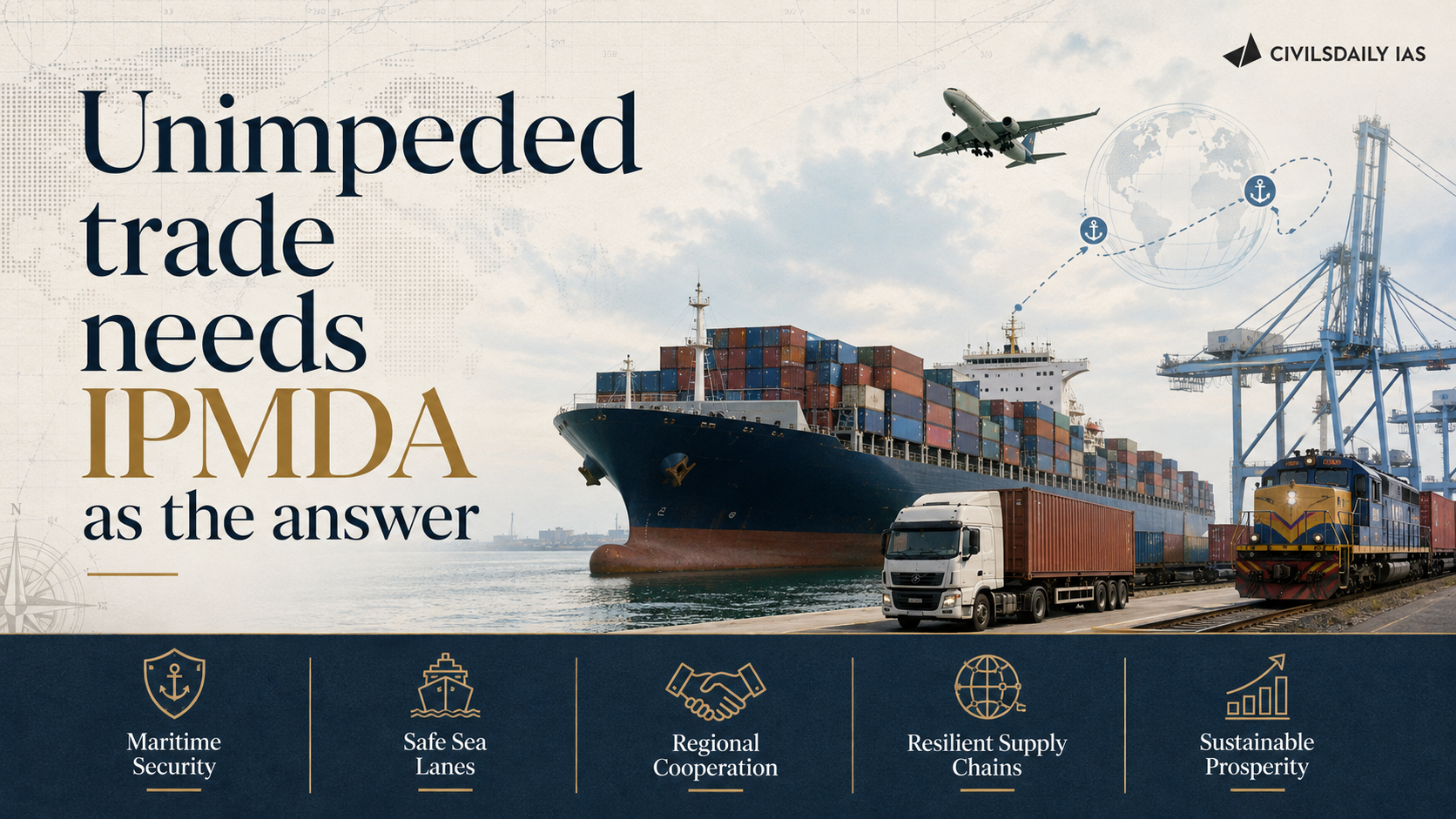
  • Unimpeded trade needs IPMDA as the answer

    Unimpeded trade needs IPMDA as the answer

    Why in the News

    Maritime domain awareness has been identified as the missing focus in United States and India cooperation on unimpeded trade, a term both sides have agreed to without qualification. The Foreign and Commerce Ministers of the two countries have underscored the need for reciprocal trade and energy agreements. The setting is adverse on three counts: mounting sanctions have strained the relationship, visa problems affect Indians travelling to the United States, and the war in West Asia has produced an energy crisis. What is contested is whether Washington can keep the sea lanes its economy depends on open without regional powers such as New Delhi carrying part of the surveillance load.

    What is the Indo-Pacific Partnership for Maritime Domain Awareness (IPMDA)?

    1. A Quad initiative launched in 2022: IPMDA was launched under the Quadrilateral framework of India, Australia, Japan and the United States as the most credible multilateral architecture yet devised for the surveillance problem.
    2. What it actually does: It is a technology based mechanism for sharing near real time maritime data across partner nations.
    3. What the data is for: The shared picture allows partners to detect, deter and respond to threats to the free flow of trade.
    4. Where its operationalisation rests: Its full operationalisation is anchored in cooperation between the United States and India under the Quad.

    What is maritime domain awareness (MDA)?

    1. A layered picture of activity at sea: MDA is the assimilation of data from several technologies into an effective understanding of the maritime domain.
    2. What the picture is used to judge: It covers the effects of maritime activity on security, safety, the economy and the environment together, rather than naval movement alone.

    What is the Automatic Identification System (AIS)?

    1. A transponder that broadcasts a ship’s identity and position: AIS is the transponder carriage requirement applied to vessels. A fitted vessel continuously transmits its identity, position, course and speed to nearby ships and shore stations.
    2. Why switching it off matters: A vessel that disables its transponder disappears from the civil tracking picture without leaving the water, which is the practice analysts call going dark.

    Why is the Indo-Pacific the artery on which the trade argument rests?

    1. The circulatory system of the global economy: The Indo-Pacific is a vast maritime corridor through which nearly 7 trillion dollars in trade flows annually.
    2. What the corridor connects: It links energy producers in the Persian Gulf to manufacturing hubs in East Asia and to consumer markets across the Americas.
    3. The chokepoints inside its waters: The Straits of Malacca, the Lombok and the Sunda straits, Hormuz, Bab-al-Mandeb and the Mozambique channel all sit within it, and each is crucial for both energy and container supplies.
    4. Why the West Asia crisis widened the frame: The crisis demonstrated that the region is a geostrategic location not only for India and the United States but for the rest of the world.

    What does the surveillance gap allow?

    1. A gap that is geographic, jurisdictional and institutional at once: The threat to the corridor is a convergence of state sponsored coercion, illegal maritime activity and a surveillance deficit that even the United States finds challenging to address alone.
    2. Vessels going dark: Hundreds of vessels across the Indian Ocean, the South China Sea and the Western Pacific routinely disable their AIS transponders, likely to evade sanctions and conceal cargo, which also creates safety and environmental threats.
    3. Contraband movement at sea: Such vessels may be engaged in smuggling or in ship to ship transfers of contraband, which never touch a monitored port.
    4. Fishing fleets outside the rules: Many smaller fishing vessels fall outside mandatory AIS carriage requirements and are found fishing illegally in other nations’ waters or on the high seas, which depletes regional stocks and undermines the food security of littoral states.
    5. Grey zone coercion: Non state and state affiliated actors conduct operations designed to intimidate and coerce. Those operations are calibrated to escape any legal or conventional military response.

    How does the shared surveillance architecture work?

    1. The 2026 collaboration layer: The Quad’s Indo-Pacific Maritime Surveillance Collaboration 2026 (IPMSC) sits under the IPMDA architecture and rests on the shared understanding that no country can monitor the vast oceans alone.
    2. What data is fused: It integrates commercial satellite based radio frequency monitoring, radar fusion and existing partner nation sensor networks.
    3. What the fusion produces: Sharing that fused data with like minded partners creates a layered, near continuous picture of maritime activity.
    4. The Indian acquisition behind it: India purchased SeaVision technology from the United States in 2025, along with software enhancements, training and the logistical support needed for mutual MDA cooperation.

    Why is cooperation between the United States and India necessary but not sufficient?

    1. The American interest is one of concentration: Regional cooperation in the Indian Ocean is essential for the United States if it is to focus on its immediate neighbourhood in the Pacific and the Atlantic.
    2. India already holds the matching institution: The Information Fusion Centre-Indian Ocean Region (IFC-IOR), established at Gurugram in 2018, is a natural institutional complement to the regional hub architecture of IPMDA.
    3. Why the arrangement suits India: IPMDA amplifies India’s reach without requiring it to surrender control over its own maritime data or decisions.
    4. The stated limit: With the basics already in place, cooperation between the two countries is necessary and not sufficient to cover the corridor.

    Which partners have to join for the architecture to cover the region?

    1. The Quad and Southeast Asia: Full potential is realised only through the active participation of existing Quad partners and of Association of Southeast Asian Nations (ASEAN) partner states.
    2. The Pacific Island nations: These states constitute critical maritime corridors and are indispensable to a continuous picture of the Pacific approaches.
    3. The European Union: The bloc has upheld the importance of free and open trade since the Hormuz crisis, which signals an appetite for engagement that Washington and New Delhi must cultivate.
    4. Smaller littoral partners: Bangladesh, the Maldives, the Seychelles, Sri Lanka and Fiji hold independent surveillance infrastructure of their own.
    5. Why their systems fail: Their waters are frequently exploited because those systems remain ineffective against maritime crimes that originate beyond their jurisdictions, which is precisely the gap a shared picture closes.

    What does the shift from presence to transparency change about deterrence?

    1. The old assumption has collapsed: The strategic environment has systematically dismantled the assumption that open trade is unilaterally sustainable.
    2. Contestation hardens into precedent: Freedom of navigation is increasingly contested, and contestation that goes unrebutted has become precedent in recent years.
    3. Transparency as a deterrent: In a region where coercion has become the currency of power, visibility of what happens at sea has to function as deterrence in its own right.

    Challenges to IPMDA

    1. Data classification limits what can be shared: Partners will not release sensor derived military data on the same terms as commercial satellite data, which thins the picture at the point where it matters. Eg. Radio frequency and radar tracks of naval auxiliaries are routinely withheld even among treaty allies. Fix. Build the shared layer on unclassified commercial data by default and keep classified feeds in a separate bilateral channel.
    2. Detection without enforcement changes nothing: A dark vessel identified in an exclusive economic zone still needs a ship or aircraft to intercept it. Eg. Illegal fishing fleets operating off East Africa are frequently tracked and rarely boarded. Fix. Pair the data hub with pooled coast guard patrol assets and pre agreed boarding arrangements between neighbouring states.
    3. ASEAN hesitancy about Quad branding: Several Southeast Asian states avoid initiatives read as an anti China bloc, which limits regional take up. Eg. Divergent positions within ASEAN on the South China Sea have repeatedly blocked a unified maritime response. Fix. Route the data offer through ASEAN centred bodies and existing information fusion centres rather than under a Quad label.
    4. Dependence on a single technology supplier: The picture rests on platforms and commercial imagery contracts controlled outside the region. Eg. India’s own MDA upgrade in 2025 came through the purchase of an American software platform. Fix. Fund an indigenous radio frequency satellite constellation so that the regional picture survives a supplier or sanctions disruption.
    5. Continuity of a leaders’ level grouping: The Quad has no secretariat or treaty base, so its programmes track political calendars in four capitals. Eg. The grouping failed to convene a leader level summit in 2025. Fix. Anchor the surveillance programme in a standing technical secretariat with its own multi year budget line.
    6. The dark fleet keeps growing faster than the sensors: Sanctions evasion has created a large fleet of ageing tankers with opaque ownership and no reliable insurance. Eg. Ship to ship transfers of sanctioned crude are routinely conducted outside monitored ports. Fix. Tie port entry and insurance recognition to a verified transponder record for the whole voyage.

    Conclusion

    Freedom of navigation in the Indo-Pacific can no longer be underwritten by a single navy, and the response has shifted from presence at sea to a shared picture of what happens at sea. IPMDA and its 2026 surveillance layer make that picture technically possible, and their value depends on whether capacity constrained littoral states, ASEAN members, the Pacific Islands and the European Union are inside the arrangement rather than outside it. What remains unresolved is enforcement, since detection produces deterrence only where a partner state can act on what it has been shown.

    “[2021, GS2, 15 marks] The newly tri-nation partnership AUKUS is aimed at countering China’s ambitions in the Indo-Pacific region. Is it going to supersede the existing partnerships in the region? Discuss the strength and impact of AUKUS in the present scenario.”

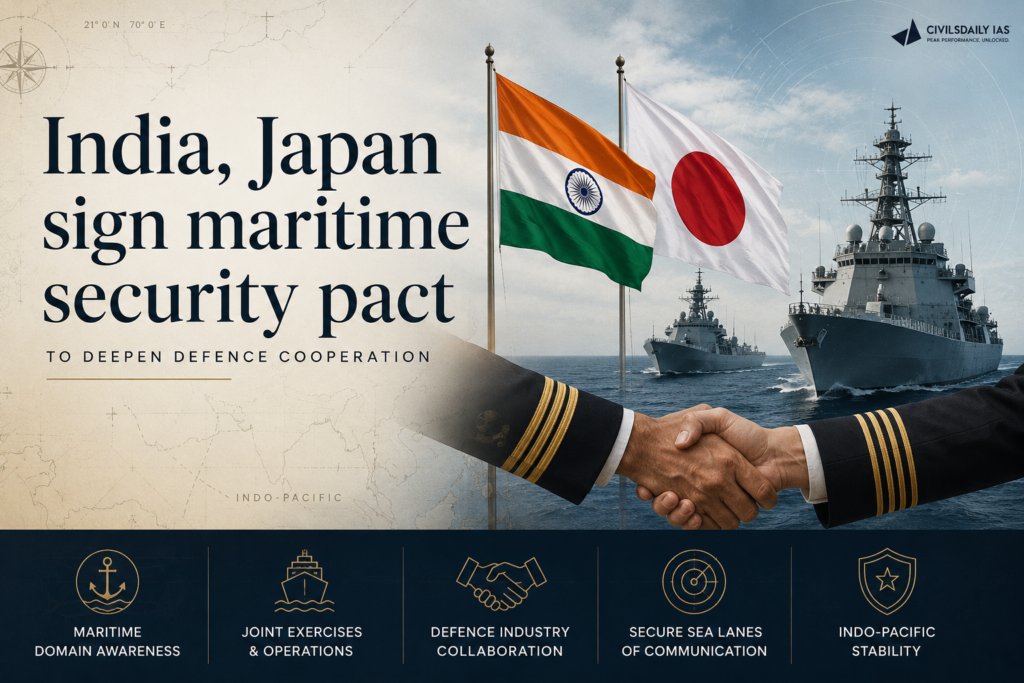
  • India, Japan sign maritime security pact to deepen defence cooperation

    Why in the News

    India and Japan signed a Memorandum of Arrangement on Maritime Security Cooperation on 20 August 2026, after bilateral talks between the two Defence Ministers in New Delhi. The arrangement converts a relationship built on periodic exercises into a standing operational framework covering maritime domain awareness, logistics access and ship repair. It also opens naval shipbuilding and design to joint development, moving the partnership from equipment transfer towards co-production.

    What is the Memorandum of Arrangement on Maritime Security Cooperation?

    1. Nature of the instrument: A Memorandum of Arrangement is a signed framework document recording the agreed areas of cooperation between two defence establishments. It creates a standing basis for activity without the binding force of a treaty.
    2. Parties it links: The arrangement connects the Indian Navy with the Japan Maritime Self-Defense Force.

    What is Maritime Domain Awareness?

    1. Definition: Maritime Domain Awareness (MDA) is the effective understanding of everything in the maritime space that affects security, safety, economy or the environment. It rests on tracking, identifying and sharing information on vessel movements.
    2. Why it is built with partners: No single navy can watch an entire ocean, so MDA depends on pooling radar, satellite and automatic identification system feeds across countries.

    What are Sea Lines of Communication?

    1. Definition: Sea Lines of Communication (SLOCs) are the primary maritime routes along which trade, energy and naval forces move between ports. Disruption of a SLOC affects supply rather than territory.
    2. Why they are defended jointly: A SLOC crosses several jurisdictions and the high seas, so its protection depends on coordinated patrolling and port access rather than any one state’s territorial control.

    What is the UNICORN antenna system?

    1. What it is: UNICORN is a Japanese shipborne integrated communications antenna system that houses multiple antennas inside a single composite mast. It lowers a warship’s radar cross section by removing external antenna clutter.

    What is ATLA?

    1. Full form and role: The Acquisition, Technology and Logistics Agency (ATLA) is Japan’s defence procurement and technology development body under its Ministry of Defense. It is the counterpart to India’s Defence Research and Development Organisation (DRDO) for joint technology work.

    What is the Japan India Special Strategic and Global Partnership?

    1. The label: It is the highest tier of India’s bilateral relationships, adopted in 2014, under which defence, economic and technology cooperation between the two countries is organised.

    What does the arrangement operationally commit the two navies to?

    1. Information sharing: The two sides agreed to deepen operational cooperation through information sharing, naval exercises, ship repair and logistics support.
    2. Maritime domain awareness and rescue: The framework covers maritime domain awareness, search and rescue, and humanitarian assistance and disaster relief between the Japan Maritime Self-Defense Force and the Indian Navy.
    3. Protection of sea lanes: The Ministers agreed to strengthen coordination for the protection of Sea Lines of Communications through reciprocal naval visits, joint exercises, and personnel and subject matter expert exchanges.
    4. Logistics and port access: Logistical support was extended to include access to ports and maintenance and repair facilities.
    5. Mine countermeasures: The two countries will move towards greater cooperation in mine countermeasures.

    How does the partnership move beyond equipment transfer into co-development?

    1. Naval shipbuilding and design: The two sides will explore joint development in naval shipbuilding and design, leveraging Japan’s technological expertise and India’s production capabilities.
    2. Make in India framework: They will discuss greater use of India’s shipbuilding capabilities under the Make in India framework.
    3. Reciprocal ship repair: Both countries will work towards reciprocal provision of ship repair facilities.
    4. First equipment marker: The shipborne UNICORN integrated communications antenna system was identified as the symbol of the growing defence equipment partnership, with a commitment to its early realisation.
    5. Research and industry channels: DRDO and ATLA will deepen cooperation in advanced defence technologies, and a Defence Industry Forum will be convened.

    What does the expansion of joint exercises signal about interoperability?

    1. Existing exercise set: The Ministers welcomed the expansion of bilateral military exercises, including Dharma Guardian and the Japan India Maritime Exercise (JIMEX), the two navies’ bilateral maritime exercise.
    2. Veer Guardian 26: The planned Veer Guardian 26 air exercise will see Japanese fighter aircraft participate in an exercise in India for the first time.
    3. Greater complexity: The two sides agreed to enhance the complexity of bilateral exercises rather than repeat existing formats.
    4. Unmanned systems and short notice drills: They agreed to integrate unmanned systems and to explore short notice joint exercises, which test readiness rather than choreography.
    5. Special forces and theatre commands: The two countries will promote exchanges between their Special Operations Forces and pursue cooperation with India’s integrated theatre commands after their establishment.

    What institutional machinery will carry the cooperation forward?

    1. A standing Working Group: The two sides agreed to establish a Working Group headed at the Director General and Joint Secretary level.
    2. Domains it coordinates: The Working Group spans operational, intelligence, equipment, technology and industrial domains.
    3. Industry channel: A Defence Industry Forum will be convened alongside the research level cooperation.
    4. Ministerial channel: The two sides agreed to accelerate discussions for the fourth India Japan 2+2 Foreign and Defence Ministerial Dialogue, to be held in Tokyo this year.
    5. Political framing: Both reaffirmed their commitment to deepen defence cooperation under the Japan India Special Strategic and Global Partnership and to work towards a free and open Indo Pacific amid heightened global tensions.

    Challenges to the India Japan maritime security arrangement

    1. Japan’s own legal constraints on transfers: Article 9 of Japan’s 1947 Constitution and the Three Principles on Transfer of Defence Equipment and Technology limit what Tokyo can sell or co-develop abroad. Eg. The US 2 amphibious aircraft deal, negotiated with India for over a decade, lapsed without an order.
    2. Cost and schedule risk in Japanese technology tie ups: High specification Japanese systems carry costs that Indian procurement budgets absorb poorly. Eg. The Mumbai Ahmedabad High Speed Rail Project, built on Japanese technology and a Japanese loan, slipped from its 2022 target to 2027 or later.
    3. Thin use of the existing logistics pact: Reciprocal access agreements deliver value only when used outside exercise windows. Eg. The Acquisition and Cross Servicing Agreement signed in September 2020 has been used largely around scheduled exercises rather than for continuous deployments.
    4. Naval balance shifting faster than the partnership: The regional force ratio is moving against both partners while the arrangement is still being institutionalised. Eg. The People’s Liberation Army Navy crossed 340 battle force ships by 2021, overtaking the United States fleet in numbers.
    5. Indian yard capacity limits co-production: Joint naval shipbuilding assumes yard capacity India has not yet built. Eg. India’s share of global shipbuilding is under 1 percent, in a sector dominated by China, South Korea and Japan.
    6. Incomplete theatre command reform: Cooperation with India’s integrated theatre commands is conditional on those commands existing. Eg. The Inter Services Organisation (Command, Control and Discipline) Act, 2023 created the legal basis for joint commands, but no theatre command had been stood up when the arrangement was signed.
    7. Chokepoint risks a bilateral pact cannot fix: Sea lane disruption often originates from non state actors outside either navy’s operating area. Eg. Houthi attacks in the Red Sea forced shipping to reroute around the Cape of Good Hope, adding weeks to voyages.

    Conclusion

    India and Japan have moved from periodic exercises to a signed operational framework covering maritime domain awareness, logistics access and ship repair, with naval shipbuilding and design opened to joint development. The arrangement’s institutional carrier is a Working Group at Director General and Joint Secretary level spanning operational, intelligence, equipment, technology and industrial domains. The next milestone is the fourth India Japan 2+2 Foreign and Defence Ministerial Dialogue, to be held in Tokyo this year, with the Veer Guardian 26 air exercise bringing Japanese fighter aircraft to India for the first time.

    “[2019, GS2, 10] ‘The time has come for India and Japan to build a strong contemporary relationship, one involving global and strategic partnership that will have a great significance for Asia and the world as a whole.’ Comment.”

  • Why Sergio Gor’s words in Srinagar are noteworthy

    Why in the News

    The United States Ambassador to India visited Srinagar on 19 August 2026 and described Jammu and Kashmir as an important part of India, on his first visit to the Valley and immediately after meeting the elected Chief Minister of Jammu and Kashmir. Seventy three years earlier American emissaries had come to the same Valley to raise the possibility of independence with Sheikh Abdullah, whose grandson now stood beside the ambassador. The distance between those two moments is the measure of how far the American position on Jammu and Kashmir has travelled since 1947.

    What is the Instrument of Accession?

    1. What it was: The legal document by which the ruler of a princely state acceded to either India or Pakistan at the end of British paramountcy in 1947, ceding defence, external affairs and communications to the acceding dominion.
    2. Its statutory basis: It was executed under the Government of India Act, 1935 as adapted by the Indian Independence Act, 1947, which gave rulers the choice of accession.
    3. In the case of Jammu and Kashmir: The Maharaja signed it on 26 October 1947 following the tribal invasion, which brought Indian forces into the state.
    4. Why it is contested in this story: American assessments questioned whether the Instrument by itself finally settled the state’s future, which is the legal proposition the ambassador’s statement now cuts against.

    What is Sadr-i-Riyasat?

    1. What it was: The title of the constitutional head of Jammu and Kashmir between 1952 and 1965, elected by the state legislature in place of a hereditary ruler. The office was replaced by a Governor appointed by the President through the Constitution (Sixth Amendment) to the Jammu and Kashmir Constitution in 1965.

    What is a demarche?

    1. What it is: A formal diplomatic representation made by one government to another, delivered in writing or in a scheduled meeting, recording a position or a protest. It ranks above an ordinary statement of protest because it is placed on the record between foreign ministries.

    What was the Kashmir Conspiracy Case?

    1. What it was: The prosecution launched against Sheikh Abdullah and his associates after his dismissal in 1953, alleging a conspiracy against the state and dealings aimed at detaching Jammu and Kashmir from India. It ran for years before being withdrawn, and it framed the political atmosphere around his contacts with foreign interlocutors.

    What exactly did the United States envoy say, and why does the venue matter?

    1. The statement: Visiting Srinagar, the ambassador declared that this is an important part of India.
    2. The setting: It was his first visit to the Valley, and he had just finished meeting the Chief Minister of Jammu and Kashmir, who is Sheikh Abdullah’s grandson.
    3. The follow up: He suggested that the United States travel advisory could be reviewed by Washington because of improvements in the security situation.
    4. The date: The statement was made on 19 August 2026.
    5. Why the location carries weight: The venue mattered as much as the words, since the same Valley was where American interlocutors had once raised the prospect of independence.
    6. The reaction: Pakistan did not merely protest, but lodged a formal demarche.

    Why is an ambassador’s sentence not the same as a change in policy?

    1. What it is not: A statement by an ambassador is not a treaty, a presidential proclamation, or a formal repudiation by the State Department of every position Washington has espoused since 1947.
    2. Why it still counts: Diplomacy operates through vocabulary, and a shift in the words a mission uses in public registers a shift in position even without a formal instrument.
    3. The measure applied: No objective student of Kashmir can fail to notice how far America has come between the language of the early 1950s and the language used in Srinagar.
    4. What remains open: Nothing in the statement withdraws or replaces the underlying documentary record of American legal assessments.

    How did American diplomacy engage the idea of an independent Kashmir in the early 1950s?

    1. The 1950 meetings: Loy Henderson, the American ambassador to India, secretly met Sheikh Abdullah in Kashmir twice in 1950.
    2. What the record shows: Henderson’s secret telegram records the Sheikh making a strong case for Kashmiri independence from both India and Pakistan.
    3. The condition Abdullah attached: He told Henderson that an independent Kashmir could survive only if it had the friendship of both India and Pakistan and economic assistance from the United States, directly or through the United Nations.
    4. How it entered Indian politics: American interest in Kashmir took on such political overtones that even Henderson’s wife entered Indian political mythology, and Indian leaders suspected that Americans were holding out the prospect of independence to Abdullah.
    5. The Stevenson visit: Adlai Stevenson, twice the Democratic Party’s candidate for the presidency and one of the most influential American internationalists of his era, visited Kashmir in May 1953 and talked to Abdullah.
    6. The effect in New Delhi: Those meetings sent shockwaves of suspicion through New Delhi, and American diplomatic records show that the then Prime Minister believed Stevenson’s conversations had encouraged Abdullah’s growing intransigence.
    7. What the episode establishes: An independent Kashmir was then conceivable enough in American diplomatic parlance for the Indian Prime Minister to worry that Washington might act to encourage it.

    What did those contacts cost Sheikh Abdullah inside Jammu and Kashmir?

    1. The dismissal: On 9 August 1953, Sheikh Abdullah was dismissed as prime minister of Jammu and Kashmir by the Sadr-i-Riyasat.
    2. The stated grounds: The dismissal came amid mounting suspicions in New Delhi about his commitment to the accession and his growing interest in an independent Kashmir.
    3. The role of the American contacts: His contacts with prominent Americans fed those suspicions directly.
    4. The legal aftermath: Those contacts later became part of the political atmosphere surrounding what came to be known as the Kashmir Conspiracy Case.
    5. The symmetry with 2026: Almost exactly seventy three years separate that dismissal from the ambassador’s statement in Srinagar.

    How did United Nations Security Council Resolution 47 shape the international framing of the dispute?

    1. American support: The United States supported Resolution 47 in 1948, which was adopted on 21 April that year.
    2. What it did: It placed the dispute in an international context and anticipated a plebiscite after a process of demilitarisation.
    3. The prescribed sequence: The sequence required Pakistan first to secure the withdrawal of the tribal invaders from the territory under its occupation.
    4. What happened to it: That prescribed sequence was never implemented.
    5. What it gave Pakistan: For years afterwards the resolution provided Pakistan with the diplomatic scaffolding it wanted, namely that Jammu and Kashmir was not an Indian question alone but an international dispute to be settled.
    6. America’s place in it: America was at the centre of that scaffolding.

    How far did the American legal position on the accession go?

    1. The document: A State Department memorandum of February 1950 set out the American legal assessment of the accession.
    2. Its characterisation: The memorandum described Jammu and Kashmir’s accession to India as contested.
    3. Its conclusion: It concluded that in the American legal assessment at the time, the Maharaja’s Instrument of Accession could not by itself have finally settled the state’s future.
    4. Why this matters: The position was not confined to the plebiscite procedure but went to the legal sufficiency of the accession instrument itself.

    Why did the position persist after the Cold War?

    1. The 1993 statement: In October 1993, Robin Raphel, freshly appointed assistant secretary of state for South Asian affairs in the Clinton administration, called Kashmir a disputed territory.
    2. The legal claim made: She said Washington did not recognise the legal validity of the Instrument of Accession as meaning that Kashmir was forever part of India.
    3. India’s reaction: India was aghast, and the then Prime Minister described such efforts at diplomatic suasion as pinpricks and minor mischief.
    4. The larger fact it revealed: Nearly five decades after 1947, the United States remained unwilling to couch its discussion of Jammu and Kashmir in terms that accepted India’s political description of the state without qualification.
    5. Why 2026 stands out against it: Measured against that record, the ambassador’s description in Srinagar marks the closing of an ambiguity that had survived the end of the Cold War.

    Why should a favourable American statement not produce triumphalism in New Delhi?

    1. Where the case was actually made: India’s case in Kashmir has ultimately been made most strongly by the people of Jammu and Kashmir themselves, not by shifts in foreign vocabulary.
    2. The standing test: The test has always been India’s ability to deepen constitutionalism, expand democracy and political reconciliation, deliver development, and ensure civil liberties for all citizens.
    3. Why the elected government matters: Srinagar’s elected government is what gives the Indian position its domestic foundation, which is why the ambassador’s meeting with the Chief Minister carried weight.
    4. What remains outstanding: A return to normal democratic politics and the restoration of statehood is essential, and no external statement substitutes for it.
    5. What has genuinely changed: The historical arc reflects India’s own transformation and the gradual exhaustion of the idea that Jammu and Kashmir is best handled through international mechanisms conceived in the bloodshed of Partition.
    6. The precise nature of the shift: America has not overwritten history but has accepted reality, having for decades dealt with Kashmir as a problem in search of a permanent political resting place, and having now implicitly acknowledged that history had already made a choice.

    Challenges to India’s position on Jammu and Kashmir

    1. Statehood has not been restored: The state’s downgrade to Union Territory status remains unreversed, which weakens the constitutionalism argument India rests on. Eg. Jammu and Kashmir became a Union Territory on 31 October 2019 under the Jammu and Kashmir Reorganisation Act, 2019.
    2. Diplomatic language can reverse with an administration: Positions expressed by an envoy carry no continuity guarantee across governments. Eg. The assistant secretary of state’s 1993 characterisation of Kashmir as disputed territory came four decades after the 1950 State Department memorandum and repeated its underlying reasoning.
    3. The plebiscite framing survives in the record: Resolutions never formally rescinded remain available for citation. Eg. Resolution 47 of 1948 remains on the Security Council record even though its prescribed sequence was never implemented.
    4. Pakistan retains a formal diplomatic channel: Every Indian gain in framing is met with a counter representation. Eg. Pakistan lodged a formal demarche after the ambassador’s statement in Srinagar.
    5. Security perception governs external normalisation: Third country advisories track incidents rather than political statements. Eg. The ambassador tied any review of the United States travel advisory to improvements in the security situation, not to political developments.
    6. Political reconciliation remains incomplete: Electoral revival does not by itself settle questions of autonomy and representation. Eg. The elected Chief Minister heads a government whose legislative competence is that of a Union Territory rather than a State.
    7. Third country hyphenation persists in crises: External powers revert to treating India and Pakistan as a pair during military escalation. Eg. External calls for restraint are directed at both countries simultaneously during every India Pakistan military exchange.

    Conclusion

    The American position on Jammu and Kashmir has moved from a February 1950 State Department memorandum calling the accession contested, through the plebiscite framing of Resolution 47 and the 1993 refusal to accept the Instrument of Accession as final, to an ambassador standing in Srinagar in August 2026 and calling it an important part of India. That arc closes an ambiguity but settles nothing that India itself must settle, since the case in Kashmir has been carried by the people of the region and by the quality of Indian constitutional practice there. The unfinished work is the return to normal democratic politics and the restoration of statehood, which no shift in foreign vocabulary can supply.

    “[2019, GS2, 15] “What introduces friction into the ties between India and the United States is that Washington is still unable to find for India a position in its global strategy, which would satisfy India’s National self-esteem and ambitions” Explain with suitable examples.”