Mains Ready By December. Smash Mains & Smash PYQ Admissions Open

GS Paper: GS2-18.Bilateral, regional and global groupings and agreements involving India and/or affecting India’s interests.

  • U.K.-India relationship

    relationship

    What’s the news?

    • India, the world’s largest democracy, has taken a momentous stride onto the global stage by hosting the G-20 summit, a pivotal forum fostering international cooperation.

    Central idea

    • India’s hosting of the G-20 summit takes center stage, as the UK underscores its commitment to free trade and cooperation. The growing Indian middle class emerges as a potential boon for UK businesses. Bilateral trade thrives with an eye on a Free Trade Agreement, while cultural ties and the Alive with Opportunity campaign enrich the partnership.

    Growing Indian middle class and bilateral trade relations

    • Projected Middle Class Surge: By 2050, India’s middle class is set to expand to a quarter of a billion consumers, signaling a significant opportunity for the UK.
    • Thriving Trading Partnership: The UK and India currently enjoy a thriving trading relationship that was valued at £36 billion in the year 2022.
    • UK as Top Investment Source: Fresh statistics from the UK’s Department for Business and Trade underscore India’s sustained status as the second-largest source of investment projects for the UK. In the last financial year, 118 new projects emerged, contributing to the creation of 8,384 jobs across the UK.
    • Reciprocal Trade and Investment: The partnership between the UK and India goes beyond investment, as the UK is also India’s sixth-largest investor. Over the period from April 2000 to March 2023, the UK invested $34 billion in India through foreign direct investment.
    • Mutually Beneficial Business Ventures: The interplay of trade and investment benefits both nations. With 618 UK companies operating in India, the cumulative turnover amounts to approximately $50 billion, and they collectively employ around 466,640 individuals directly as of 2021.

    Advancing an Ambitious Free Trade Agreement and Strengthening the Partnership

    • Ministerial Meeting: Scheduled discussions with Commerce Minister Piyush Goyal in India focus on progressing an ambitious Free Trade Agreement (FTA) to elevate bilateral trade relations.
    • UK’s Negotiating Expertise: Leveraging the UK’s trade negotiation track record, the objective is to expedite the FTA process with India. Addressing complexities in goods, services, and investment is crucial to establishing an encompassing agreement ensuring fairness and mutual benefit.
    • Diverse Partnership: Beyond trade, the UK-India partnership extends across culture, sports, education, and tourism, as epitomized by Prime Minister Narendra Modi’s living bridge metaphor.
    • Cinematic Bonds: Shared enthusiasm for Bollywood showcases the connection. The UK boasts one of the world’s largest Bollywood audiences. Landmarks like St. Paul’s Cathedral and Blenheim Palace feature in iconic films like Kabhi Khushi Kabhi Gham, cementing the cinematic relationship.
    • Vibrant Indian Diaspora: The Indian diaspora, over 1.6 million strong, plays a pivotal role in the UK. Contributions span education to the workforce, with Indian students forming a significant part of the UK’s international student community, reinforcing enduring ties.

    Unveiling the Alive with Opportunity Campaign

    • Campaign Launch: The UK proudly introduces the £1.5 million Alive with Opportunity marketing campaign, serving as a tribute to the robust bond between the UK and India.
    • Celebrating Exchange: This initiative is dedicated to celebrating the perpetual exchange of people, ideas, and culture between the two nations.
    • Trade Growth Objective: Aligned with the vision to double trade with India by 2030, the campaign aims to stimulate interest and demand for UK goods and services.
    • Business Growth Focus: The campaign also seeks to boost the UK’s potential for business growth through strengthened trade ties with India and by attracting fresh Indian investments.
    • Illuminating Connections: Over the course of the upcoming year, the campaign will cast a spotlight on the dynamic business, trade, cultural, and sporting connections between the UK and India across diverse platforms.
    • Emphasizing Opportunities: By highlighting these facets, the campaign underscores the significant opportunities embedded within the vibrant partnership.

    Conclusion

    • The India-UK-UKrtnership stands as a shining example of successful collaboration, underscored by burgeoning trade, investment, and shared values. As both nations continue their journey toward deeper ties, the prospects for mutual growth and prosperity appear brighter than ever.
  • 15th BRICS SUMMIT

    What’s the news?

    • India’s pivotal role in the upcoming BRICS summit in South Africa from August 22 to 24 underscores its evolving diplomatic challenges and potential impact on global geopolitics.

    Central idea

    • The global geopolitical stage is once again witnessing the active participation of India. With the BRICS (Brazil, Russia, India, China, and South Africa) summit around the corner, India finds itself at a crucial juncture of international diplomacy. This summit not only tests the waters of Indian diplomacy but also holds clues to the trajectory of global geopolitics.

    All you need to know about BRICS

    • BRICS is an acronym for the grouping of the world’s leading emerging economies, namely Brazil, Russia, India, China, and South Africa.
    • Jim O’Neill, a British economist, coined the term ‘BRIC’ to describe the four emerging economies of Brazil, Russia, India, and China. He made a case for BRIC on the basis of econometric analyses projecting that the four economies would individually and collectively occupy far greater economic space and become among the world’s largest economies.
    • The importance of BRICS is self-evident: it represents 42% of the world’s population, 30% of the land area, 24% of global GDP, and 16% of international trade.
    • The five BRICS countries are also members of the G-20.

    Agenda of the BRICS

    The regular annual summit and deliberation of BRICS has considerably widened over the years to encompass topical global issues such as:

    • International terrorism
    • Climate change
    • Food and energy security
    • International economic and financial situation
    • Reform of the Bretton Woods Institutions
    • Trade protectionism and the WTO

    Significance of BRICS for India

    • Economic Cooperation: BRICS countries together account for a substantial portion of the world’s population and GDP. For India, being part of this grouping allows for enhanced economic cooperation, trade, investment, and collaboration in various sectors, contributing to economic growth and development.
    • Global Influence and Voice: BRICS provides India with a platform to engage on the global stage and express its views on important international issues. As a member of BRICS, India’s voice is amplified in discussions related to global economic governance, trade, climate change, and more.
    • Geo-political: BRICS offers India the opportunity to diversify its economic and diplomatic engagements beyond traditional partners. It helps India strengthen ties with fellow emerging economies, reducing dependency on a few major economies.
    • Strategic : The BRICS Summit provides India with a forum for engaging in strategic dialogues with like-minded countries on various geopolitical and security matters. This is particularly important given India’s strategic interests in its neighborhood and beyond.
    • Trade and Investment Opportunities: BRICS countries offer substantial trade and investment opportunities for India. The collective market potential of these nations can help Indian businesses expand their global footprint and increase exports.
    • Development Cooperation: BRICS member countries often cooperate in areas of mutual interest, such as development financing, infrastructure projects, and technology sharing. This cooperation can benefit India’s efforts to address its development challenges.
    • Technology and Innovation Sharing: BRICS cooperation can facilitate the sharing of technology, innovation, and best practices among member countries, aiding India’s efforts to modernize its industries and infrastructure.
    • Joint Efforts on Global Challenges: BRICS members often work together to address global challenges, such as climate change, sustainable development, and poverty alleviation. Collaborative efforts can amplify India’s contributions to these issues.

    Achievements of BRICS

    • Establishment of the New Development Bank (NDB): BRICS countries established the New Development Bank in 2014 to fund infrastructure and sustainable development projects in member countries and other emerging economies.
    • Contingent Reserve Arrangement (CRA): The CRA was established to provide member countries with financial support in times of crisis. It acts as a mechanism to address short-term liquidity pressures and enhance financial stability among BRICS nations.
    • Economic Cooperation and Trade: BRICS countries have increased economic cooperation and trade among themselves.The BRICS Trade Fair promotes business-to-business interactions, showcasing products and services from member countries and facilitating trade deals.
    • Joint Efforts on Global Challenges: BRICS members have collaborated on addressing global challenges such as climate change, sustainable development, and poverty alleviation. BRICS members issued a joint declaration at the 2018 summit in South Africa, emphasizing their commitment to the Paris Agreement and sustainable development.
    • Academic and Cultural Exchanges: BRICS countries have promoted academic and cultural exchanges, fostering mutual understanding and collaboration among scholars, students, and cultural groups from member states.The BRICS Network University fosters collaboration among universities in member countries, promoting academic research and exchange programs.
    • Strengthened Global South Voice: BRICS has become a platform for emerging economies to assert their interests and perspectives on global issues. It has strengthened the representation of the Global South in international discussions.
    • Infrastructure Investment: The BRICS NDB has funded various infrastructure projects in member countries, contributing to development and job creation while addressing critical infrastructure gaps.The NDB approved a $1 billion loan to South Africa for renewable energy projects, supporting the country’s transition to cleaner energy sources.

    15th BRICS Summit 2023

    The 15th BRICS Summit was held in Johannesburg, South Africa, from 22-24 August 2023.

    The important highlights of the Summit are as follows:

    • Theme: “BRICS and Africa: Partnership for Mutually Accelerated Growth, Sustainable Development and Inclusive Multilateralism”.
    • Gifts from India: The PM of India gifted Bidri Surahi, Nagaland Shawl, and Gond Paintings to BRICS leaders.
    • BRICS-Africa Outreach and BRICS Plus Dialogue: India participated in the BRICS-Africa Outreach and BRICS Plus Dialogue:
    • Participation: The meeting included leaders from BRICS countries along with guest countries from Africa, Asia, and Latin America.
    • Invitation for International Initiatives: India extended invitations for countries to join international initiatives like the International Solar Alliance, One Sun One World One Grid, Coalition for Disaster Resilient Infrastructure, One Earth One Health, Big Cat Alliance, and Global Centre for Traditional Medicine.

    Joint Statement: Leaders express support for India’s G20 Presidency.

    • Support for G20 Presidencies: Backed Brazil and South Africa’s G20 Presidencies in 2024 and 2025, focusing on global South representation.
    • Opposition to Unilateral Measures: Condemned unilateral coercive actions, advocated inclusive multilateralism, and upheld international law.
    • Global Governance Enhancement: Aimed to improve global governance through agility, efficiency, representation, and democratic accountability.
    • Human Rights Cooperation: Committed to cooperating on human rights under equality and mutual respect principles within BRICS and international platforms.
    • Agriculture and Food Security: Strived for fair agricultural trade, ending hunger, sustainable agriculture, and resilient practices.
    • UN Reform: Supported comprehensive UN reform, including the Security Council, for enhanced democracy, effectiveness, and developing country representation.
    • Peaceful Conflict Resolution: Committed to peaceful dispute resolution through dialogue and inclusiveness while recognising women’s participation in peace processes.

    Expansion of BRICS

    More than 40 countries have expressed interest in joining BRICS, and 22 have formally asked to be admitted. Therefore, leaders of the BRICS in the 15th Summit have agreed on mechanisms for considering new members.
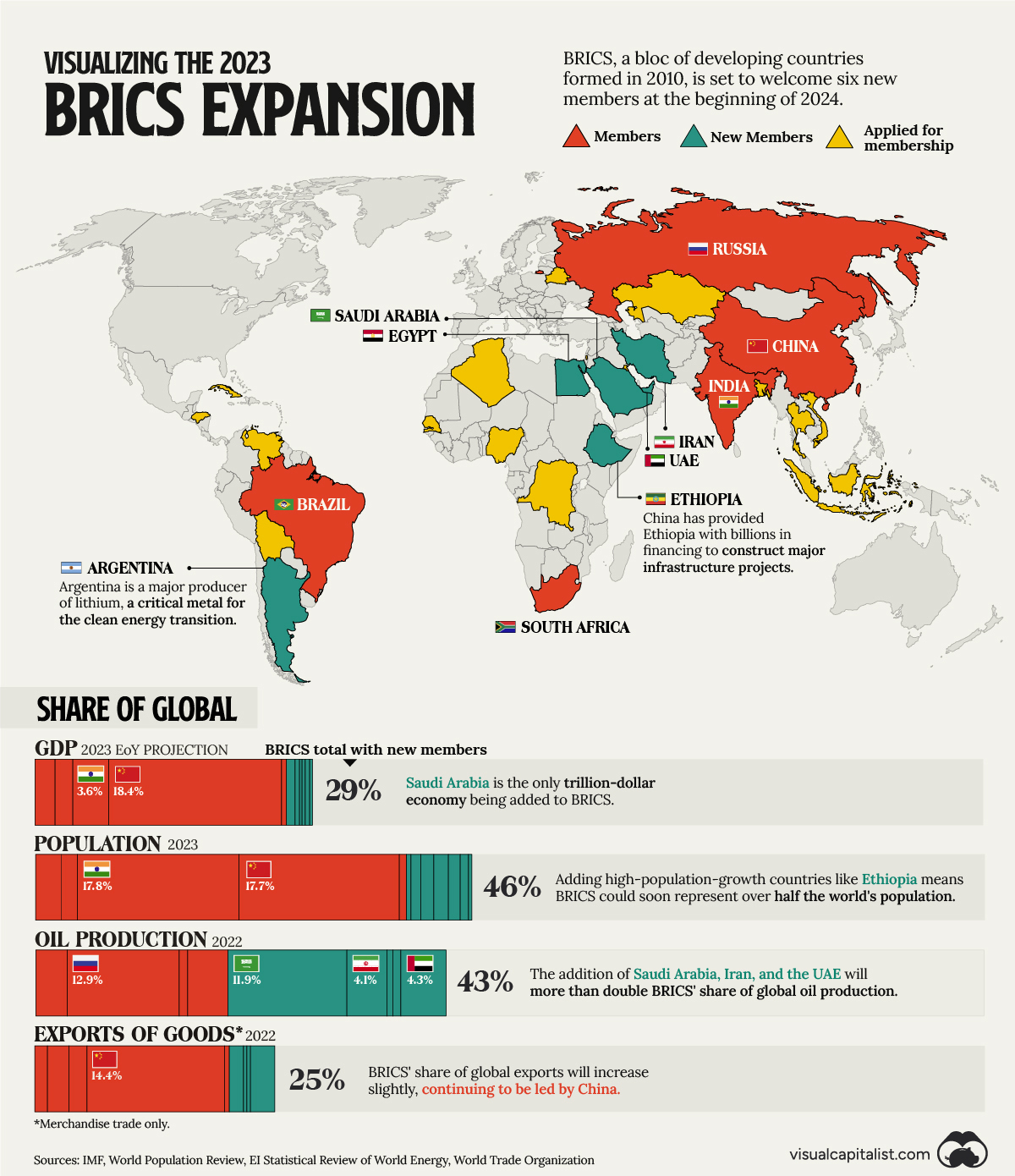
    Expansion of BRICS

    • First phase of expansion: The countries including Argentina, Egypt, Ethiopia, Iran, Saudi Arabia, and the UAE have received invitations to join BRICS. This new membership is set to take effect from January 1, 2024.

    Reasons for the BRICS expansion:

    • China’s strategic move for global influence.
    • FOMO: Fear of missing out on a visible club.
    • Limited options in other groups.
    • Anti-western sentiment and Global South unity

    Challenges faced by BRICS

    • Divergent National Interests: BRICS members have diverse economic and political priorities, which can sometimes lead to conflicting interests. Example: China’s emphasis on export-led growth might conflict with India’s efforts to reduce its trade deficit with China, creating economic tensions within the group.
    • Economic Inequalities: Challenge: Economic disparities among BRICS countries can hinder equitable distribution of benefits from cooperation. Example: South Africa, with a smaller economy compared to China and India, might find it challenging to compete for investment and trade opportunities within the group.
    • Geopolitical Competition: Geopolitical rivalries and regional conflicts among BRICS members can strain cooperation. Example: China’s territorial disputes in the South China Sea have led to tensions with other BRICS countries like India, which has concerns over freedom of navigation.
    • Differing Political Systems: BRICS countries have different political systems and levels of political freedom, impacting their approaches to governance and international relations. Example: Russia’s political landscape differs significantly from the democratic systems in Brazil, India, and South Africa, potentially affecting consensus on certain issues.
    • Infrastructure and Connectivity Gaps:  Inadequate infrastructure and connectivity gaps within BRICS countries can hinder trade and collaboration. Example: Insufficient transport and logistics infrastructure in some member countries can hinder smooth movement of goods and services.
    • Institutional Limitations: The institutional structure of BRICS, including the New Development Bank, might face limitations in terms of resources, decision-making processes, and lending capacity. The NDB might struggle to finance large-scale projects without relying on external resources beyond the BRICS nations.
    • Economic Volatility: Economic fluctuations and market vulnerabilities can impact the stability of BRICS economies. Example: The global economic recession triggered by the COVID-19 pandemic affected BRICS nations differently, leading to varying levels of economic contraction and recovery.
    • Regional and Bilateral Disputes: Regional and bilateral disputes among BRICS members can strain the group’s unity and shared objectives. Example: The Doklam standoff between India and China in 2017 created tensions and highlighted potential areas of conflict within BRICS.
    • Leadership Rotation and Priorities: Each BRICS member country holds the rotating presidency for a year, which can impact the continuity of the group’s priorities. Example: Each new presidency might emphasize different areas of cooperation based on its national interests and foreign policy goals.

    Reforms needed in BRICS

    • Inclusion of Civil Society and Private Sector: Involve civil society organizations and the private sector in discussions and initiatives to broaden perspectives and encourage innovation.
    • Promotion of Sustainable Development Goals (SDGs): Align BRICS activities more explicitly with the United Nations’ SDGs to foster sustainable and inclusive development across member countries.Launch joint projects on renewable energy deployment across member countries, addressing SDG 7 (Affordable and Clean Energy).
    • Humanitarian and Disaster Response Collaboration: Establish a BRICS Disaster Response Task Force to coordinate resources and expertise during natural disasters.
    • Expanding Membership or Partnerships: Consider the possibility of expanding the membership or establishing strategic partnerships with other emerging economies that share similar interests and values.
    • Promotion of Digital Connectivity: Foster digital connectivity and technological collaboration among BRICS members to capitalize on the benefits of the digital economy.
    • Regular Assessment of Goals and Progress: Periodically evaluate the achievements, challenges, and relevance of BRICS objectives to ensure they remain aligned with member countries’ evolving interests.
    • Climate Change and Environmental Cooperation: Establish a BRICS Environmental Fund to finance joint environmental protection and conservation projects.

    Way Forward for India

    • BRICS’ Role: BRICS can serve as an alternative platform to address global governance deficiencies, despite its imperfections. It could initiate discussions on more inclusive global governance.
    • Navigating Complexity: India’s geopolitical choices are complex due to its affiliations in various forums. India’s participation in non-Western platforms reflects a response to historical inequities.
    • Balancing Geopolitical Shifts: As competing blocs emerge, India must balance affiliations between a China-centric and a West-centric world order. Striking this balance is crucial to India’s global positioning.
    • Managing China’s Rise: India needs to consider whether its actions inadvertently support China’s ascent. While India must moderate China’s influence, it should avoid alienating other global South nations.
    • Safeguarding National Interests: India’s active participation in global forums must align with promoting equitable global governance while ensuring its national interests are safeguarded.

    Conclusion

    • Amid global uncertainties, India’s role in the BRICS summit gains prominence. Balancing between non-Western forums and Western ties, India aims for equitable global governance while managing China’s ascendancy. These decisions could mold India’s path and impact the evolving international landscape.
  • India launches Global Initiative on Digital Health (GIDH)

    Central Idea

    • In a significant stride towards global healthcare innovation, the World Health Organization (WHO) and India’s G20 presidency have jointly unveiled the ‘Global Initiative on Digital Health’ (GIDH).
    • The announcement was made at the Health Minister’s Meeting during the G20 Summit, hosted by the Indian Government.

    What is GIDH?

    • WHO and G20 Partnership: The WHO and India’s G20 presidency collaboratively introduced the ‘Global Initiative on Digital Health’ (GIDH).
    • Strategy Implementation: GIDH functions as a WHO-managed platform, supporting the implementation of the ‘Global Strategy on Digital Health 2020–2025.’
    • Transformation Acceleration: The WHO, as the strategy’s Secretariat, facilitates the global convergence of standards, best practices, and resources for expediting digital health system transformation.

    Objectives of the GIDH Initiative

    • Measurable Outcomes: GIDH aspires to unite nations and partners, aiming to achieve tangible results through concerted efforts.
    • Prioritizing Investment Plans: The initiative seeks to establish focused investment plans for the transformation of digital health, driven by clear priorities.
    • Enhancing Resource Transparency: GIDH works towards greater transparency in reporting digital health resources, ensuring effective resource allocation.
    • Facilitating Global Collaboration: The initiative fosters the exchange of knowledge and collaboration among regions and countries to expedite progress.
    • Comprehensive Governance: GIDH supports holistic government approaches to digital health governance within countries.
    • Boosting Support: The initiative aims to enhance both technical and financial support for the implementation of the ‘Global Strategy on Digital Health 2020–2025’ and its forthcoming phase.

    India’s Role and Vision

    • Digital Health Innovation: India’s G-20 Health Minister emphasized India’s role in digital health innovation at the G-20 Health Ministers’ Meeting.
    • National Digital Health Architecture: India’s efforts for a comprehensive digital health ecosystem, exemplified by the Ayushman Bharat Digital Mission (ABDM), were highlighted.
  • Places in news: Murmansk Port

    murmansk

    Central Idea

    • India’s engagement with Russia’s Arctic region has been strengthening with India-bound goods constituting the maximum share of cargo handled this year by Murmansk, located about 2,000 km northwest of Moscow.

    About Murmansk Port

    • Murmask Port is a major seaport located in northwestern Russia, specifically in the city of Murmansk.
    • The port was established in 1916 as a supply point for the Russian military during World War I.
    • It is situated in the city of Murmansk, which is the largest city north of the Arctic Circle in Russia.
    • It is located on the Kola Peninsula on the shores of the Barents Sea.
    • The port serves as a crucial gateway to the Arctic region.
    • The port is an important node along the Northern Sea Route, a shipping route that connects Europe and Asia via the Arctic Ocean.
    • Its ice-free waters enable year-round maritime activities, making it an important hub for shipping and trade in the Arctic.

    Significance of the Port

    • Murmansk Port is strategically located near rich natural resources, including minerals, oil, and gas in the Arctic region.
    • It plays a role in facilitating the export of these resources.
    • The port is well-connected to various transportation networks, including railroads, pipelines, and roads.
    • It serves as a hub for moving goods to and from the Arctic and the rest of Russia.
  • Switzerland ambassador writes: A time-tested friendship with India

    Switzerland

    What’s the news?

    • On the 75th anniversary of the Treaty of Friendship, Switzerland and India commemorate a historic alliance that has fostered achievements in diverse sectors and look forward to deepening collaboration in areas like innovation, sustainable development, and healthcare.

    Central idea

    • In the annals of diplomatic history, the Treaty of Friendship and Establishment signed between Switzerland and India in 1948 stands as a testament to the enduring bond that has flourished for 75 years. As we commemorate this significant milestone, it is both opportune and prudent to reflect on the accomplishments achieved and envision the promising avenues that lie ahead.

    What is The Treaty of Friendship and Establishment?

    • The Treaty of Friendship and Establishment between Switzerland and India, signed in 1948, holds historical significance as one of India’s earliest diplomatic agreements after gaining independence.
    • It marked the establishment of formal diplomatic ties between the two nations and set the tone for their subsequent bilateral relationship.
    • This treaty emphasized mutual respect and cooperation, laying the groundwork for collaborations across various sectors such as vocational training, economic investments, technological exchange, and sustainable development.

    Historical Significance and Diverse Achievements

    • India’s Earliest Diplomatic Endeavors: The 1948 Treaty marked one of India’s earliest diplomatic endeavors and established a foundation of mutual respect. The ensuing decades witnessed fruitful cooperation in various sectors.
    • Investments in Skill Development: Switzerland’s investment in vocational training institutes and rail wagon factories aided India’s workforce development.
    • Milk Cooperatives: The establishment of milk farmer cooperatives in Kerala contributed to the dairy industry’s growth.
    • Technological Synergy: India’s IT expertise supported global undertakings, including Y2K bug resolution.
    • Climate-Friendly Innovation: Swiss-Indian collaboration led to Limestone Calcined Clay Cement (LC3), a low-carbon cement alternative.
    • Economic Partnership: Switzerland’s position as India’s 12th largest foreign investor fostered economic growth.

    Future Trajectory in the Swiss-Indian Partnership

    • Swiss-Indian Innovation Platform:
    • An upcoming milestone, the Swiss-Indian Innovation Platform, is a testament to the commitment of both nations towards fostering innovation.
    • By harnessing the strengths of India’s technological advancements and Switzerland’s innovation prowess, this platform aims to address pressing global challenges.
    • Notably, the focus on combating Antimicrobial Resistance (AMR) showcases the partnership’s practical relevance in tackling contemporary healthcare concerns.
    • Sustainable Development:
    • Both nations share a steadfast commitment to sustainable development.
    • Building on their historical collaboration, they are likely to channel their efforts towards joint initiatives that promote eco-friendly practices, address climate change, and ensure responsible resource utilization.
    • Healthcare Cooperation:
    • The partnership’s trajectory is expected to be marked by deeper collaboration in healthcare.
    • Drawing upon India’s technological prowess and Switzerland’s pharmaceutical innovations, joint ventures can pave the way for groundbreaking medical solutions, contributing to global health and well-being.
    • Investment and Trade:
    • Switzerland’s position as India’s 12th largest foreign investor underscores the depth of economic engagement.
    • With over 330 Swiss companies actively operating in India, this partnership has facilitated investment, job creation, and technology transfer, contributing to India’s economic growth.\
    • Free Trade Agreement:
    • Anticipating the horizon, discussions surrounding a Free Trade Agreement between the European Free Trade Association (EFTA) and India hold immense promise.
    • This agreement not only deepens trade ties but also catalyzes increased investments and innovation in both regions, boosting economic vitality.
    • Shared Values, Shared Growth:
    • Built upon the foundation of shared values, the economic relationship is characterized by mutual respect and common interests.
    • The economic collaborations not only boost trade figures but also underscore the friendship’s ability to drive prosperity for both nations.

    Conclusion

    • As we celebrate this milestone, the trajectory ahead appears promising, anchored in sustainable development, innovative solutions, and cooperative endeavors. It is a tryst with destiny that not only celebrates past achievements but anticipates an even brighter future for the intertwined destinies of Switzerland and India.

    Also read:

    India Switzerland Relations

  • PM mentions Katchatheevu Islands

    katchatheevu

    Central Idea

    • The island of Katchatheevu has emerged as a symbol of historical disputes, political contention, and a reminder of complex geopolitical decisions.
    • PM’s reference to Katchatheevu during a parliamentary debate added fuel to the ongoing discussions surrounding this small island, nestled between Tamil Nadu and Sri Lanka.

    Katchatheevu Island: Historical Background

    • Colonial Influence: Katchatheevu, a 285-acre island, has its origins in a 14-century volcanic eruption. It was historically under the control of the Jaffna kingdom in Sri Lanka and later the Ramnad Zamindari in India.
    • British-Era Claims: Both India and Sri Lanka claimed Katchatheevu in the early 20th century to establish fishing boundaries. The ownership dispute continued even during the British Raj.

    1974 Indo-Sri Lankan Maritime Agreement

    • Landmark Decision: Indira Gandhi’s government decided to cede Katchatheevu to Sri Lanka as part of the 1974 agreement, aiming to establish maritime borders.
    • Political Implications: The decision raised concerns in Tamil Nadu, where voices protested the lack of state assembly consultation and the impact on traditional fishing rights.
    • Fishing Ambiguity: The agreement allowed Indian fishermen access to Katchatheevu “hitherto,” but fishing rights remained ambiguous, leading to disputes.

    Sri Lankan Civil War and Beyond

    • Civil War Dynamics: The Sri Lankan civil war (1983-2009) shifted focus from the Katchatheevu issue as Sri Lanka’s naval forces grappled with internal strife.
    • Post-War Reality: Post the civil war, Sri Lanka reinforced maritime defense, leading to the arrest of Indian fishermen venturing into their waters, reigniting demands for Katchatheevu’s retrieval.

    Tamil Nadu’s Persistent Concerns

    • Political Backlash: Tamil Nadu politicians across parties raised objections against ceding Katchatheevu without state assembly consent, citing historical ties and livelihood impacts.
    • Legal Battles: Late J Jayalalitha’s AIADMK filed petitions challenging the 1974 agreement, arguing it affected traditional fishing rights. However, the Union government’s stance remained unaltered.
    • Modi Government’s Position: Despite vocal demands from Tamil politicians, the Modi government maintained that the island’s status was finalized in 1974 and reclaiming it would require drastic measures.

    Contemporary Implications

    • Symbol of Sovereignty: Katchatheevu symbolizes regional and sovereignty concerns, reflecting tensions between Tamil Nadu’s interests and central government decisions.
    • Geopolitical Dilemma: The case highlights the delicate balance between historical claims, political sentiments, and international agreements in the context of bilateral relations.

    Conclusion

    • The island of Katchatheevu continues to serve as a reminder of India’s historical intricacies, reflecting the delicate balancing act between state interests, national decisions, and regional aspirations.
    • While Tamil Nadu’s calls for retrieval echo in the political corridors, the longstanding 1974 agreement and subsequent geopolitical realities create a complex landscape.
    • As the island’s fate intertwines with broader diplomatic relations, Katchatheevu remains a testament to the complexities of national sovereignty and regional sentiment.
  • Raisina Dialogue and its Significance

    Central Idea

    • Foreign Secretary has told a Parliament committee that the Raisina Dialogue is now among the most significant global level think tank events in the world.

    What is Raisina Dialogue?

    • Flagship Geopolitical Conference: The Raisina Dialogue, founded in 2016, emerged as India’s flagship conference for discussions on global geopolitics and geo-economics.
    • Hosted by ORF: The Observer Research Foundation (ORF), an independent think tank, collaborates with the Ministry of External Affairs to host the Raisina Dialogue.

    Emergence of the Dialogue

    • Geopolitical and Geo-economic Discourse: The Raisina Dialogue is a significant global-level think tank event that fosters cross-sectoral discussions on geopolitics and geo-economics.
    • Global Participation: Raisina Dialogue serves as a platform for engagement among policymakers, heads of states, cabinet ministers, local officials, private sector executives, media representatives, and scholars.
    • Inspired by Shangri-La Dialogue: Modeled after Singapore’s Shangri-La Dialogue, Raisina Dialogue facilitates multi-stakeholder dialogues on crucial global issues.

    Political patronage to the dialogue

    • Participation: PM’s attendance and address at the 2016 Raisina Dialogue marked a turning point, elevating the event’s significance.
    • Shifting Paradigm: PM Modi’s presence elevated Raisina Dialogue from its modest beginnings in 2015 to a global focal point within a span of eight years.
    • Global Recognition: The conference gained international recognition and prominence, attracting participants of repute from across the world.

    Significance: Reflecting Indian Perspective

    • Strategic Vision: Raisina Dialogue embodies a deliberate strategy to reflect and project India’s point of view on global matters.
    • India-Centric Thinking: In alignment with the government’s focus on promoting India-centric thinking, the conference portrays India’s stance on global issues.
    • Diverse Representation: The event brings together international sponsors, co-sponsors, and participants, fostering diverse viewpoints and critical appraisal of foreign policies.

    Magnitude and Impact

    • Global Participation: The recent edition of the Raisina Dialogue held in March 2023 witnessed the presence of Italy’s Prime Minister and over 30 foreign ministers. Participants from more than 100 countries engaged in discussions.
    • Growing Influence: The conference’s stature and influence are evident through its widespread representation and discussions on a wide array of global issues.

    Conclusion

    • The Raisina Dialogue stands as a remarkable testament to India’s increasing role and influence in the global arena.
    • As the Dialogue continues to shape discussions on geopolitics and geo-economics, it reinforces India’s position as a significant player on the world stage.
  • ECOWAS and Niger Coup: Challenges and Potential Responses

    ecowas

    Central Idea

    • The recent coup in Niger has brought the Economic Community of West African States (ECOWAS) into the spotlight as it grapples with responding to the political crisis in the region.
    • As Niger faces economic hardships and military intervention by regional players looms, the role of ECOWAS is under scrutiny.

    Understanding ECOWAS

    • Formation and Membership: Established in 1975, ECOWAS aims to foster economic integration among its 15 member countries, including Benin, Burkina Faso, Ghana, Nigeria, and more.
    • Objective: The organization envisions a borderless region based on democratic principles and good governance.
    • Economic Goals: ECOWAS seeks to create a unified trading bloc, single currency, and enhanced cooperation in sectors such as industry, energy, and telecommunications.

    ECOWAS in Conflict Resolution

    • Regional Peacekeeping: ECOWAS has played a role in resolving conflicts by deploying peacekeeping missions. Notable examples include ECOMOG’s involvement in Liberia and Sierra Leone during the 1990s and early 2000s.
    • Gambia Crisis: In 2017, ECOWAS intervened in Gambia, ensuring the peaceful transfer of power after then-President Yahya Jammeh refused to step down following an election defeat.
    • Challenges and Successes: While ECOWAS has effectively resolved conflicts in some cases, it faces challenges due to differing interests among member countries and evolving security threats.

    ECOWAS’s Response to Niger Coup

    • Potential Military Intervention: ECOWAS has hinted at possible military intervention in Niger. However, regional challenges, including shared borders with other military-led nations, could complicate intervention plans.
    • Support for Coups: Some military coups in West Africa have been justified by leaders citing terrorism and security challenges, accusing civilian governments of inadequacy.
    • Security Situation: The ECOWAS Commission President reported a significant rise in terrorist attacks in the region, with a substantial death toll and refugees fleeing the violence.

    Economic Measures and Sanctions

    • Economic Sanctions: ECOWAS has previously imposed economic sanctions on countries undergoing political turmoil. However, the efficacy of these measures is questionable, especially when nations are grappling with economic difficulties.
    • France’s Role: France’s historical ties to Niger and the presence of foreign troops have fueled local sentiments against foreign involvement, creating complexities for potential interventions.

    Challenges and Dilemmas

    • Leadership Dynamics: The current chairman of ECOWAS, Nigerian President Bola Ahmed Tinubu, advocates for military intervention in Niger. However, internal opposition and conflicting interests within ECOWAS member states complicate decision-making.
    • Complexity of the Situation: The unique circumstances of each nation undergoing turmoil require tailored responses. The Niger coup’s leader, Gen. Abdourahmane Tchiani, has a history with ECOWAS peacekeeping missions.

    Conclusion

    • ECOWAS’s response to the Niger coup underscores the complexity of regional dynamics, the challenges of military intervention, and the delicate balance between security and democratic governance.
    • As the organization grapples with finding an effective solution, its role as a mediator and peacekeeping force in West Africa continues to evolve in response to the changing geopolitical landscape.
  • In news: Financial Action Task Force (FATF)

    fatf

    Central Idea

    • Pakistan’s Senate has approved a bill to establish a central authority to combat money laundering and terror financing by bringing all institutions related to the Financial Action Task Force (FATF) under one command.

    What is FATF?

    • The FATF is an intergovernmental organization established in 1989 to combat money laundering and financial crimes.
    • Pakistan’s efforts to address money laundering and terror financing led to its inclusion in the FATF grey list in 2018.
    • However, through comprehensive reforms and strategic measures, Pakistan successfully managed to exit the grey list.
    • The country’s progress in enhancing laws related to money laundering and terrorism financing played a crucial role in achieving this milestone.

    Role of FATF

    • Global Financial Crimes Combat: FATF develops policies to combat money laundering and terrorist financing in response to the rise of the global economy and international trade.
    • Regulatory Recommendations: The organization makes recommendations to combat financial crime, reviews members’ policies and procedures, and promotes the acceptance of anti-money laundering regulations worldwide.
    • Continuous Updates: To stay ahead of evolving financial crime techniques, FATF updates its recommendations regularly.

    Key initiatives: Grey and Black Lists

    • Grey List: Countries considered safe havens for supporting terror funding and money laundering are placed in the FATF grey list. Inclusion in this list serves as a warning for potential entry into the more severe blacklist.
    • Black List (Call for Action): The “Non-Cooperative Countries or Territories” (NCCTs) list, commonly known as the black list, identifies countries that are non-compliant with FATF’s recommendations.

    Impact of Being on FATF Grey List

    • Economic Sanctions and Reduced Trade: Countries on the grey list may face economic sanctions and reduced international trade opportunities.
    • Difficulty in Obtaining Loans: Access to loans from international financial institutions like IMF, World Bank, and ADB may be limited.
    • International Boycott: The country may face international boycotts affecting its global reputation.

    What has Pakistan initiated now?

    • Establishing the Authority: The bill seeks to create a National Anti-Money Laundering and Counter Financing of Terrorism Authority, which will be led by a chairman appointed by the Prime Minister.
    • Coordination and Cooperation: The authority will act as a focal point for the FATF and related organizations.
    • Unified Response: The proposed authority will function as a focal institution, enabling Pakistan to provide a unified response to money laundering and terror financing.
    • Institutionalization of Entities: The bill seeks to institutionalize different entities, leading to improved efficiency and coordination in dealing with financial threats.

    Challenges Addressed

    • 3 Arenas of Difficulty: The bill addresses difficulties related to anti-money laundering, countering the financing of terrorism, and targeted financial sanctions faced by Pakistan when on the FATF grey list.
    • Global Financial System Threats: Money laundering and terror financing were identified as severe threats to the global financial system when Pakistan was placed on the FATF grey list in 2018.

    FATF Review and India’s Position

    • Multifaceted Review: The FATF review assesses 40 parameters related to law, justice, revenue, banking, and insurance, along with nine parameters related to terror financing.
    • Review Timeframe: The review began early this year and is expected to conclude by the end of 2024, with India being a rare country to have postponed its review due to COVID-19.

    Conclusion

    • The FATF plays a crucial role in combating financial crimes, including money laundering and terror financing.
    • By taking significant steps to address deficiencies, Pakistan can manage to sustain its goal of exiting the grey list.
  • Saudi Arabia to mediate Russia-Ukraine Conflict

    russia

    Central Idea

    • Saudi Arabia is taking a significant step towards mediating the Russia-Ukraine conflict by hosting peace talks on August 5 and 6 in Jeddah.
    • The talks come amidst ongoing hostilities between Russia and Ukraine, with both sides unwilling to compromise on their respective visions for peace.

    Upcoming Peace Talks in Jeddah

    • Participants: The UK, EU, India, South Africa, Poland, and the US National Security Advisor have confirmed their attendance. Russia, having rejected Ukraine’s peace plan, has not been invited.
    • Goal: Ukraine aims to garner support for its 10-point peace plan and promote the restoration of lasting and just peace. The talks are seen as a constructive way to involve non-aligned countries and promote third-party mediation beyond the West.

    Current status of the war

    • Military Standoff: Ukraine is determined to fight back, supported by military aid from Europe and the US.
    • Unlikely Peace Talks: The United Nations Secretary-General expressed doubts about the possibility of peace negotiations at this stage, given both sides’ conviction of their ability to win on the battlefield.
    • Divergent Views: While both Russia and Ukraine express openness to talks, they vehemently disagree on the terms of peace. Ukraine insists on the withdrawal of Russian troops and the restoration of its territorial integrity, while Russia seeks recognition of redrawn borders, including annexed territories.

    Previous (Failed) Negotiations

    • Early Talks: In the initial stages of the conflict, talks for temporary ceasefires and humanitarian corridors took place.
    • War atrocities: However, direct peace negotiations have not occurred since May last year due to mounting evidence of war atrocities and attacks on civilians.

    China’s Peace Plan and African Efforts

    • China’s 12-Point Plan: Released in February, China’s plan called for the ceasing of hostilities, support for territorial integrity, and the abandonment of a cold war mentality. It was seen as skewed in favor of Russia and a diplomatic attempt by China to engage in the peace process.
    • African Proposal: Seven African countries led by South Africa proposed a 10-point plan for recognizing sovereignty, prisoner release, foodgrain exports, de-escalation, and prompt peace negotiations. The plan aimed to address the conflict’s impact on African nations’ food security.

    Status of the War

    • Kerch Bridge Incident: A terrorist attack on the Kerch Bridge led to Russia terminating the Black Sea Grain Initiative, further impacting grain shipments from Ukraine.
    • Ukraine’s Counter-Offensive: Ukraine continues its counter-offensive efforts, achieving advances in some regions but facing challenges in others.
    • US-Supplied Cluster Bombs: Ukraine’s use of US-supplied cluster bombs has been confirmed, effective against Russian defensive positions.
    • NATO Entry Denied: Ukraine’s last-ditch effort to secure an invitation for NATO membership was not successful.
    • Ukraine attacks Moscow: At least 3 different Ukrainian-made drones have been used in attacks inside Russia, including Moscow.

    Nature of the Conflict

    • Territorial Disputes: The conflict centers around territorial disputes and geopolitical interests, leading to extensive missile attacks and drone strikes.
    • Cold War Wounds: Historical contestations and ideological clashes contribute to the Ukraine crisis.
    • NATO Expansion: Ukraine’s bid for NATO membership and Russian interests in the Black Sea are key factors in the conflict.

    India’s Position in the Conflict

    • Exercising strategic autonomy: India practices strategic autonomy, maintaining a nuanced neutrality between the US-led West and Russia.
    • Favor for Russia: India abstains from supporting the US-led Western coalition, focusing on economic relationships with both parties.
    • Symbolic Criticisms: India emphasizes the importance of respecting territorial integrity while calling for an immediate end to violence and diplomatic solutions.
    • Condemnation: PM Modi openly appealed to Mr. Putin for peace, highlighting the pursuit of diplomatic solutions.

    Challenges to Ending the War

    • Proxy War: External players, including the US and NATO, complicate the conflict with their strategic interests.
    • Sovereignty Disputes: Unresolved territorial disputes fuel ongoing hostilities.
    • Ideological Divide: Clashes between Ukraine’s European aspirations and Russia’s sphere of influence add to tensions.
    • Military Support: Foreign military assistance to both parties sustains the conflict.
    • Economic Interests: Energy resources and Europe’s dependence on Russian gas play a role.
    • Lack of Trust: A deep lack of trust hinders lasting agreements.

    Conclusion

    • The Russia-Ukraine conflict remains a challenging and complex issue with no easy resolution in sight.
    • The upcoming peace talks in Jeddah represent a step towards international mediation, involving influential players from various regions.