💥Join UPSC 2027,2028 Mentorship (August Batch) + XFactor Notes & Microthemes PDF

GS Paper: Governance, Transparency & Accountability, Citizens Charters

  • Role of media in fair trial

    Context

    • In an ongoing case, the Peoples’ Union for Civil Liberties asked the Supreme Court to issue guidelines to regulate media briefings by the police to ensure fair trial.
    • This has left the judiciary with no choice but to deliberate on binding directives to the police.

    What is Media Trial?

    • Media Trial is when various newspapers, magazines, television channels, social media websites interpret facts of a particular case and present them in front of the general public.
    • In India, we have witnessed media trials in many cases where before the verdict of the Indian judiciary, the media channels frame an accused in such a manner that the general public believes him/her to be the person guilty of such offence.
    • Media Trial is not prohibited in India, but it influences the views and opinions of the general public as well as judges and lawyers.

    Issue of media trial

    [A] For Police

    (1) Investigation fouling

    • In criminal cases that attract the most sensationalist media coverage, media attention is often drawn toward investigation and early trial stages.
    • This makes the police a crucial source for the media and communication between the two institutions is often a starting point of the troubles of media trials.

    (2) Unregulated divulgence of case details

    • Leakage of information by police force and disproportionate reliance on this information by the media results in a public stripping of the rights that typically accompany a fair trial.

    (3) Blow to procedural justice

    • Most police departments do not have dedicated media cells, making officials of all levels authoritative sources of information and blurring the boundaries between an official and informal police account of events.
    • As a result, the evidence-based narrative of criminal cases presented by the police to a court varies significantly from the account provided to the news media.
    • This is detrimental for the persons involved in the case, and the justice system as a whole.

    [B] For Judiciary

    (1) Violation of the rights of litigants

    • Reportage of this nature violates the presumption of innocence and the right to dignity and the privacy of suspects, the accused, victims, witnesses and persons closely related to them.
    • They often face social ostracization and difficulties in retaining employment, making them vulnerable to crime and exploitation.

    (2) Disharmony

    • Police narratives are sometimes designed to achieve political goals, and the media’s ready acceptance of these narratives does little to prevent their insidious effects.
    • Given the media’s ability to shape political opinion, law enforcement agencies are sometimes under pressure to selectively reveal certain facets of the investigation or to mischaracterise incidents as communal or systemic.

    What should be the role of Media?

    • Contextualization: Problematic news coverage of criminal cases arises when reporters absolve themselves of any duty to contextualise information revealed by the police.
    • Verification of the facts: Media ethics extend beyond verification of facts to check its Authencity.
    • Create public awareness: Apart from making sure that police narratives are accurate before making them public, reporters bear the burden of translating the significance of police versions in a criminal trial.
    • Prevent mistrust in institutions: It is meant to protect, and contributes considerably to the public apprehension and mistrust in the system.

    Why is news media being hyperactive?

    • We should remember that the new media as an institution is NOT a not-for-profit organization.
    • The negligence can be attributed to the changing nature of the newsroom , responding to deadlines externally set by competing social media accounts that now qualify as news.

    Court directives and legal provisions

    Ans: The Romila Thapar vs Union of India, (2018) Case

    • Courts have repeatedly directed law enforcement authorities not to reveal details of their investigations, especially the personal details of the accused, before trial is complete.
    • It calls for states to enact their own laws based upon social construct.
    • The Ministry of Home Affairs issued office memorandum outlining a media policy over a decade ago, but this is of limited value given that ‘Police’ is an entry in the State List and thus falls primarily within the jurisdiction of State governments.

    Way forward

    • Uniform regulation: Government regulation is not uniform for print and television media and enforcement of these regulations, where it occurs, is slow.
    • Prevent overt regulation: In any event, Government regulation of the media is problematic and likely to increase politicization of the press.
    • Strengthening self-regulation: Self-regulation set-ups such as the National Broadcasting Standards Authority and Indian Broadcasting Foundation are membership-based and easily avoided by simply withdrawing from the group.
    • Reconcile the public faith: It is now in the immediate interest of the media and the general interest of free press, that media institutions look inward to find an answer to what is essentially an ethical crisis.

    Conclusion

    • The media’s immense power to shape narratives regarding public conceptions of justice makes it a close associate of the justice system, bringing with it a responsibility to uphold the basic principles of our justice system.
    • The media should feel subject to the obligation to do its part in aiding mechanisms that aim to preserve these principles.


    UPSC 2023 countdown has begun! Get your personal guidance plan now! (Click here)
  • Issue of withdrawal of Personal Data Protection Bill

    Context

    The Minister for the Ministry of Electronics and IT withdrew the Personal Data Protection Bill, 2019. The reasons for the withdrawal were circulated in a note to MPs, which stated that,“considering the report of the JPC (Joint Parliamentary Committee), a comprehensive legal framework is being worked upon…”.

    Background of Personal Data Protection Bill

    •  An expert committee headed by Justice (retd) A P Shah recommended in October, 2012,“a detailed framework that serves as the conceptual foundation for the Privacy Act”.
    • This did not come to fruition, with proposals buried by 2014 due to objections from the intelligence establishment on surveillance reforms.
    • While petitions on the constitutionality of Aadhaar and the right to privacy were pending before the Supreme Court, the Union government constituted an expert group headed by Justice (retd) B N Srikrishna in July, 2017.
    •  In August, a nine-judge bench unanimously pronounced the Puttaswamy judgment that reaffirmed the fundamental right to privacy for the autonomy, dignity and liberty for every Indian.
    • Justice D Y Chandrachud, who authored the majority opinion, noted the formation of the Srikrishna Committee as a positive obligation on the government to enact a law for informational privacy.
    • In December 2019, government introduced the Personal Data Protection Bill, 2019 in Parliament.
    • The draft law was referred to a JPC of 30 MPs that submitted a report after two years.
    • With the withdrawal in Parliament on August 3, it almost seems institutional processes, in which all three branches of government worked for years, are being jettisoned in favour of “a comprehensive legal framework”.

    Issues with reasons given for withdrawal of the Bill

    • The JPC has nowhere suggested a withdrawal in favour of a “comprehensive legal framework”.
    • The proper course was to consider the JPC’s recommendations including the dissent notes and expert analysis, redraft and introduce a new Data Protection Bill.
    • Compliance burden concern of government: With the government setting the goal of a one trillion dollar digital economy, fears of a compliance burden can impede innovation and growth.
    • Date protection is needed for innovation: Here, detailed reasoning is available in the Srikrishna Committee’s report as well as a growing international consensus suggesting that next-generation innovation in technology needs data protection.
    • Regulatory intervention will improve business practices requiring engineering decisions that focus on user trust.
    • Imperfections in law argument: With the imperfections within the Personal Data Protection Bill, 2019 and even the JPC report, there exists a reasonable argument that if passed into law, it may institutionalise bad privacy practices.
    •  Such a line of reasoning fails to recognise that institutional memory develops through reasonable due diligence and experience.
    • Legislative foresight is limited and no law is perfect, which is why there exist parliamentary amendments and judicial review.

    Conclusion

    Today, there is a relentless pace of digitisation that relies on gathering personal data in all spheres of our lives. All of this is done in a legal vacuum without any oversight or remedy. This underscores the urgent need for data protection law.

    UPSC 2023 countdown has begun! Get your personal guidance plan now! (Click here)

  • RTI Act

    Context

    Amidst renewed concern over its functioning across states, the Right to Information Act (RTI) is set to complete 17 years this October.

    Issues facing RTI

    • Backlog of appeals: Issues include a huge backlog of second appeals, lengthy wait time for hearings, hesitancy in posting penalties and increasing opacity in the working of the commissions.
    •  As on June 30, 2021, 2.56 lakh appeals were pending with 26 information commissions in the country.
    • CICs downgraded rank: Any serious RTI query or one which concerns more than one government department requires intervention by higher officials, but it is the PIOs from junior ranks who attend hearings and are often clueless.
    • Often, it requires a notice to higher authorities, in some cases, the secretary of the department, to elicit the right answer.
    •  With CICs downgraded in rank, there will be fewer and fewer notices served to the heads of departments and senior officers to appear and answer queries.
    • Vacancies: The commissions have been plagued with vacancies, poor choice of commissioners, untrained staff and a non-cooperative set of public information officers (PIOs).
    • Threat to some RTI activists: Apart from the PIOs’ general inexperience and unprofessionalism, comes the threat to some RTI activists who seek information to expose corruption.
    • According to the Commonwealth Human Rights Initiative (CHRI), across India, 99 RTI activists have lost their lives, 180 assaulted and 187 were threatened since 2006.
    • Political proclivity: The attitude of a few commissioners going public with their political proclivities is another cause for concern.

    Way forward

    • Training of officials: The Indian information law, rated as one of the strongest in the world, needs to be bolstered by raising awareness amongst the people and organising rigorous training of government officials.
    • Code of conduct: A code of conduct must be evolved for the central and state information commissioners.
    • It is imperative for the commissioners to keep a strict distance from government heads and officialdom.
    •  A strong political system is a must for the RTI regime to flourish.
    • It is imperative to ensure freedom of the press and democratic institutions, punish errant officials and maintain complete autonomy of the information commissions, in the interest of the people and the nation at large.

    Conclusion

    As India emerges as a global power, the implementation of legislation like the RTI Act will be under the constant scrutiny of the comity of nations.

    UPSC 2022 countdown has begun! Get your personal guidance plan now! (Click here)

  • SC upholds powers of arrest raid under PMLA for ED

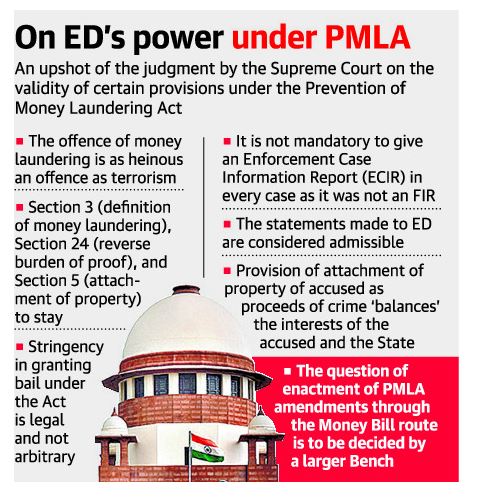
    The Supreme Court upheld the core amendments made to the Prevention of Money Laundering Act (PMLA), which gives the government and the Enforcement Directorate (ED) virtually unbridled powers of summons, arrest, and raids, and makes bail nearly impossible while shifting the burden of proof of innocence on to the accused rather than the prosecution.

    Did the judgement say?

    • The Supreme Court called the PMLA a law against the “scourge of money laundering” and not a hatchet wielded against rival politicians and dissenters.
    • Money laundering is an offence against the sovereignty and integrity of the country. It is no less a heinous offence than the offence of terrorism, the court noted.

    Why in news?

    • The verdict came on an extensive challenge raised against the amendments introduced in 2002 Act by way of Finance Acts.
    • The three-judge Bench said the method of introduction of the amendments through Money Bills would be separately examined by a larger Bench of the top court.

    What were the petitions?

    • Petitions were filed against the amendments, which the challengers claimed would violate personal liberty, procedures of law and the constitutional mandate.
    • The petitioners included many veteran politicians who all claimed that the “process itself was the punishment”.
    • There were submissions that the accused’s right against self-incrimination suffered when the ED summoned them and made them sign statements on threats of arrest.
    • But the court said these statements were recorded as part of an “inquiry” into the proceeds of crime.
    • A person cannot claim right against self-incrimination at a summons stage.

    About Enforcement Directorate (ED)

    • It goes back to May 1, 1956, when an ‘Enforcement Unit was formed in the Department of Economic Affairs.
    • It then aimed for handling Exchange Control Laws violations under the Foreign Exchange Regulation Act (FERA).
    • The ED today is a multi-dimensional organisation investigating economic offences under the Prevention of Money Laundering Act (PMLA), Fugitive Economic Offenders Act, Foreign Exchange Management Act and FERA.

    From where does the ED get its powers?

    • When proceeds of crime (property/money) are generated, the best way to save that money is by parking it somewhere, so one is not answerable to anyone in the country.
    • Therefore, there was a need to control and prevent the laundering of money.
    • The PMLA was brought in for this exact reason in 2002, but was enacted only in 2005.
    • The objective was to prevent parking of the money outside India and to trace out the layering and the trail of money.
    • So as per the Act, the ED got its power to investigate under Sections 48 (authorities under act) and 49 (appointment and powers of authorities and other officers).

    At what stage does the ED step in when a crime is committed?

    • Whenever any offence is registered by a local police station, which has generated proceeds of crime over and above ₹1 crore, the investigating police officer forwards the details to the ED.
    • Alternately, if the offence comes under the knowledge of the Central agency, they can then call for the First Information Report (FIR) or the chargesheet if it has been filed directly by police officials.
    • This will be done to find out if any laundering has taken place.

    What differentiates the probe between the local police and officers of the ED?

    Case study:

    • If a theft has been committed in a nationalised bank, the local police station will first investigate the crime.
    • If it is learnt that the founder of the bank took all the money and kept it in his house, without being spent or used, then the crime is only theft and the ED won’t interfere because the amount has already been seized.
    • But if the amount which has been stolen is used after four years to purchase some properties, then the ill-gotten money is brought back in the market.
    • Or if the money is given to someone else to buy properties in different parts of the country, then there is ‘laundering’ of money.
    • Hence the ED will need to step in and look into the layering and attachment of properties to recover the money.
    • If jewellery costing ₹1 crore is stolen, police officers will investigate the theft. The ED, however, will attach assets of the accused to recover the amount of ₹1 crore.

    What are the other roles and functions of the ED?

    • The ED carries out search (property) and seizure (money/documents) after it has decided that the money has been laundered, under Section 16 (power of survey) and Section 17 (search and seizure) of the PMLA.
    • On the basis of that, the authorities will decide if arrest is needed as per Section 19 (power of arrest).
    • Under Section 50, the ED can also directly carry out search and seizure without calling the person for questioning.
    • It is not necessary to summon the person first and then start with the search and seizure.
    • If the person is arrested, the ED gets 60 days to file the prosecution complaint (chargesheet) as the punishment under PMLA doesn’t go beyond seven years.
    • If no one is arrested and only the property is attached, then the prosecution complaint along with attachment order is to be submitted before the adjudicating authority within 60 days.

    Can the ED investigate cases of money laundering retrospectively?

    • If an ill-gotten property is acquired before the year 2005 (when the law was brought in) and disposed off, then there is no case under PMLA.
    • But if proceeds of the crime were possessed before 2005, kept in storage, and used after 2005 by buying properties, the colour of the money is still black and the person is liable to be prosecuted under PMLA.

    Under Section 3 of PMLA, a person shall be guilty of money-laundering, if such person is found to have directly or indirectly attempted to indulge or knowingly assist a party involved in one or more of the following activities:

    • Concealment; possession; acquisition; use; or projecting as untainted property; or claiming as untainted property in any manner etc.


    Also read:

    [Burning Issue] Enforcement Directorate (ED): Dreaded nightmare of Indian Politicians & Businessmen

    UPSC 2023 countdown has begun! Get your personal guidance plan now! (Click here)

  • Municipal finances

    Context

    Recently, the Indian Institute for Human Settlements (IIHS) analysed data from 80 urban local bodies (ULBs) across 24 States between 2012-13 and 2016-17 to understand ULB finance and spending, and found some key trends.

    Health of municipal finances

    • The 74th Constitution Amendment Act was passed in 1992 mandating the setting up and devolution of powers to urban local bodies (ULBs) as the lowest unit of governance in cities and towns.
    • Constitutional provisions were made for ULBs’ fiscal empowerment.
    • Challenges in fiscal empowerment: Three decades since, growing fiscal deficits, constraints in tax base expansion, and weakening of institutional mechanisms that enable resource mobilisation remain challenges.
    • Revenue losses after implementation of the Goods and Services Tax (GST) and the pandemic have exacerbated the situation.

    Analysing the trends in municipal finances

    Recently, the Indian Institute for Human Settlements (IIHS) analysed data from 80 ULBs across 24 States between 2012-13 and 2016-17 to understand ULB finance and spending, and found some key trends.

    1] Own sources of revenue less than half of total revenue

    •  Key sources of revenue: The ULBs’ key revenue sources are taxes, fees, fines and charges, and transfers from Central and State governments, which are known as inter-governmental transfers (IGTs).
    • Important indicator of financial health: The share of own revenue (including revenue from taxes on property and advertisements, and non-tax revenue from user charges and fees from building permissions and trade licencing) to total revenue is an important indicator of ULBs’ fiscal health and autonomy.
    • The study found that the ULBs’s own revenue was 47% of their total revenue.
    • Of this, tax revenue was the largest component: around 29% of the total.
    • Property tax, the single largest contributor to ULBs’ own revenue, accounted for only about 0.15% of the GDP.
    • Figures for developing countries: The corresponding figures for developing and developed countries were significantly higher (about 0.6% and 1%, respectively) indicating that this is not being harnessed to potential in India.

    2] High dependence on IGTs

    • Most ULBs were highly dependent on external grants — between 2012-13 and 2016-17, IGTs accounted for about 40% of the ULBs’ total revenue.
    •  Transfers from the Central government are as stipulated by the Central Finance Commissions and through grants towards specific reforms, while State government transfers are as grants-in-aid and devolution of State’s collection of local taxes.

    3] Tax revenue is largest revenue for larger cities, while smaller cities are more dependent on grants

    • here are considerable differences in the composition of revenue sources across cities of different sizes.
    • Class I-A cities (population of over 50 lakh) primarily depend on their own tax revenue, while Class I-B cities and Class I-C cities (population of 10 lakh-50 lakh and 1 lakh-10 lakh, respectively) rely more on IGTs.
    • Own revenue mobilisation in Class I-A cities increased substantially.
    • It was primarily driven by increases in non-tax revenue

    4] Increasing operations and maintenance (O&M) expenses

    • Operations and maintenance (O&M) expenses are on the increase but still inadequate.
    • While the expenses were on the rise, studies (such as ICRIER, 2019 and Bandyopadhyay, 2014) indicate that they remained inadequate.
    • For instance, O&M expenses incurred in 2016-17 covered only around a fifth of the requirement forecast by the High-Powered Expert Committee for estimating the investment requirements for urban infrastructure services.
    • O&M expenses should ideally be covered through user charges, but total non-tax revenues, of which user charges are a part, are insufficient to meet current O&M expenses.
    • The non-tax revenues were short of the O&M expenditure by around 20%, and this shortfall contributed to the increasing revenue deficit in ULBs.

    Way forward

    • Improving own revenue: It is essential that ULBs leverage their own revenue-raising powers to be fiscally sustainable and empowered and have better amenities and quality of service delivery.
    • Stability in IGT: Stable and predictable IGTs are particularly important since ULBs’ own revenue collection is inadequate.
    • O&M expenses: Increasing cost recovery levels through improved user charge regimes would not only improve services but also contribute to the financial vitality of ULBs.
    • Measures need to be made to also cover O&M expenses of a ULB for better infrastructure and service.
    • Tapping into property taxes, other land-based resources and user charges are all ways to improve the revenue of a ULB.

    Conclusion

    The health of municipal finances is a critical element of municipal governance which will determine whether India realises her economic and developmental promise.

    UPSC 2023 countdown has begun! Get your personal guidance plan now! (Click here)

  • Assessing Juvenility a ‘Delicate Task’: SC

    The Supreme Court has given some guidelines for the delicate task of deciding whether juveniles aged between 16 and 18, accused of heinous offences such as murder can be tried like adults as per the JJ Act, 2005.

    Juvenile Justice Act, 2015

    • The JJ Act, 2015 replaced the Indian juvenile delinquency law, Juvenile Justice (Care and Protection of Children) Act, 2000.
    • It allows for juveniles in conflict with Law in the age group of 16–18, involved in Heinous Offences, to be tried as adults.
    • The Act also sought to create a universally accessible adoption law for India.
    • The Act came into force from 15 January 2016.

    Key features

    • Change in nomenclature from ‘juvenile’ to ‘child’ or ‘child in conflict with law’, across the Act to remove the negative connotation associated with the word “juvenile”
    • Inclusion of several new definitions such as orphaned, abandoned and surrendered children; and petty, serious and heinous offences committed by children;
    • Setting up Juvenile Justice Boards and Child Welfare Committees in every district. Both must have at least one woman member each.
    • Special provisions for heinous offences committed by children above the age of 16 years: This was in response to the juvenile convict in Nirbhaya Case.
    • Inclusion of new offences committed against children:  Sale and procurement of children for any purpose including illegal adoption, corporal punishment in child care institutions, use of child by militant groups, offences against disabled children and, kidnapping and abduction of children.
    • Penalties for cruelty against a child: Offering a narcotic substance to a child, and abduction or selling a child has been prescribed.

    What is the recent Supreme Court assessment?

    • The “delicate task” of deciding whether juveniles aged between 16 and 18, accused of heinous offences such as murder, can be tried like adults should be based on meticulous psychological investigation.
    • They should not left to the discretion and perfunctory “wisdom” of juvenile justice boards and children’s courts across the country, the Court held.

    What delicate tasks does the apex court is referring to?

    (1) Preliminary Assessment

    • Section 15 of the JJ Act requires a “preliminary assessment” to be done of the mental and physical capacity of juveniles, aged between 16 and 18, who are involved in serious crimes.
    • The assessment is meant to gauge a child’s ability to understand the consequences of the offence and the circumstances in which he or she allegedly committed the offence.
    • If the Juvenile Justice Board is of the opinion that the juvenile should not be treated as an adult, it would not pass on the case to the children’s court and hear the case itself.
    • If the Board decides to refer the case to the children’s court for trial as an adult, the juvenile, if guilty, would even face life imprisonment.

    (2) Mental capacity

    • The evaluation of ‘mental capacity and ability to understand the consequences’ of the child in conflict with law can should not be relegated as a routine task.
    • The process of taking a decision on which the fate of the child in conflict with law precariously rests, should not be taken without conducting a meticulous psychological evaluation.
    • The court said the Board which conducts the assessment of the child should have at least one child psychologist.

    Way forward

    • The court discovered that there were neither guidelines nor a specific framework in place for conduct of the preliminary assessment.
    • The court left it open for the Centre and the National Commission for Protection of Child Rights to consider issuing guidelines or directions in this regard.
    • It should further take the assistance of experienced psychologists or psychosocial workers.


    UPSC 2023 countdown has begun! Get your personal guidance plan now! (Click here)

  • The road to productivity

    Context

    The commute time for the labour force to the workplace plays a very important role in determining their productivity in cities.

    Issue of long travel time to work

    • Labour market: Cities are labour markets where the labour force exchanges their labour and creates knowledge spillovers.
    • Relation between commute time and productivity: The commute time for the labour force to the workplace plays a very important role in determining their productivity in cities.
    •  The longer the commute time in a city, the smaller is its effective labour market and vice-versa.
    • Difference between nominal and effective labour market: While the nominal labour market of the city refers to all jobs created in the metropolitan area, the effective labour market refers to the jobs accessible within a certain commute.
    • Importance of effective labour market: The larger a city’s effective labour market, the greater its agglomeration economies and knowledge spillovers will be.
    • From the viewpoint of enlarging a city’s effective labour market and economic output, it is therefore very important to keep the commute time short and commuting cost cheap within a city as it keeps growing in population.

    Way forward

    • One way in which urban local bodies (ULBs) directly impact the city’s economic output is through their infrastructure.
    • Increase in tax base: Road length has a positive effect on the city’s tax base.
    • Motivation to pay texes: This is because roads lead to easy access to jobs and increased economic activity; that also gives the public more confidence and motivation to pay taxes.
    • Cities should not view investment in road networks as expenditure; rather, roads add to the city’s revenue base which the city can use to improve infrastructure and public services.

    Conclusion

    Investing in roads not only reduces travel time and enlarges effective labour markets of cities and their economic output, but also improves access to schooling for children as well as healthcare, thereby upgrading human development. This is indeed the road to the $5 trillion economy along with improvement in human well-being.

    UPSC 2023 countdown has begun! Get your personal guidance plan now! (Click here)

  • New Rules to keep Advertisements in Check

    The Central Consumer Protection Authority (CCPA) recently issued guidelines to prevent false or misleading advertisements.

    Guidelines on Prevention of Misleading Advertisements and Endorsements for Misleading Advertisements, 2022: Key takeaways

    (1) Conditions for non-misleading and valid advertisement

    An advertisement shall be considered to be valid and not misleading:

    • If it contains truthful and honest representation;
    • Does not mislead consumers by exaggerating the accuracy,
    • Scientific validity or practical usefulness or capability or performance or service of the goods or product;
    • Does not present rights conferred on consumers by any law as a distinctive feature of advertiser’s offer.

     (2) Bait Advertisement

    • A bait advertisement shall not seek to entice consumers to purchase goods, products or services without a reasonable prospect of selling such advertised goods, products or services at the price offered.
    • The advertiser shall ensure that there is an adequate supply of goods, products or services to meet foreseeable demand generated by such advertisement.

    (3) Prohibition of surrogate advertising

    • No surrogate advertisement or indirect advertisement shall be made for goods or services whose advertising is otherwise prohibited or restricted by law.
    • No circumventing of such prohibition or restriction and portraying it to be an advertisement for other goods or services shall be allowed.

    (4) Free claims advertisements

    • A free claims advertisement shall not describe any goods, product or service to be ‘free’, ‘without charge’ or use such other terms if the consumer has to pay anything other than the unavoidable costs.
    • Seller must make clear the extent of commitment that a consumer shall make to take advantage of a free offer.

    (5) Children targeted advertisements

    • An advertisement that addresses or targets or uses children shall not condone, encourage, inspire or unreasonably emulate behaviour that could be dangerous for children or take advantage of children’s inexperience, credulity or sense of loyalty.

    (6) Limitations on Celebrity Endorsers

    • The government has tightened norms for endorsers, including celebrities and sportspersons.
    • They are now required to make material connection disclosures and undertake due diligence while doing advertisements.
    • Endorsements must reflect the honest opinions, belief or experience of the endorsers.
    • The endorsers have to make material connection disclosures and failing to do so will attract penalty under the Consumer Protection Act (CPA).
    • Material disclosures mean any relationship that materially affects the weight or credibility of any endorsement which a reasonable consumer would not expect.
    • Violation of these guidelines will attract a penalty of ₹10 lakh for the first offence and ₹50 lakh for the subsequent offence, under the CPA.

    (7) ASCI rules

    • The latest guidelines will also apply to government advertisements.
    • Moreover, the advertising guidelines for self-regulation issued by the Advertising Standards Council of India (ASCI) will also be in place in a parallel manner.

    Back2Basics:

    Explained: Central Consumer Protection Authority (CCPA)


    UPSC 2023 countdown has begun! Get your personal guidance plan now! (Click here)

  • Custodial deaths

    Context

    The recent spate of custodial deaths in Tamil Nadu has yet again highlighted the methods used by the police during interrogation.

    Custodial deaths in India

    • It is not uncommon knowledge that the police, when they grow increasingly frustrated with the trajectory of their interrogation, sometimes resort to torture and violence which could lead to the death of the suspect.
    • Custodial deaths are common despite enormous time and money being spent on training police personnel to embrace scientific methods of investigation.
    • This is because police personnel are humans from different backgrounds and with different perspectives.

    Use of technology by law enforcement agencies

    • There is no doubt that technology can help avert police custodial deaths. For example, body cameras could hold officers liable.
    • Deception detection tests (DDTs), which deploy technologies such as polygraph, narco-analysis and brain mapping, could be valuable in learning information that is known only to a criminal regarding a crime.
    • Among the DDTs, the Brain Fingerprinting System (BFS) is an innovative technology that several police forces contemplate adding to their investigative tools.
    • The technique helps investigative agencies uncover clues in complicated cases.
    • With informed consent, however, any information or material discovered during the BFS tests can be part of the evidence.
    • Police departments are increasingly using robots for surveillance and bomb detection.
    • Many departments now want robotic interrogators for interrogating suspects.
    • Use of robots: Police departments are increasingly using robots for surveillance and bomb detection.
    • Use of robots for interrogation: Many departments now want robotic interrogators for interrogating suspects.
    • Many experts today believe that robots can meet or exceed the capabilities of the human interrogator, partially because humans are inclined to respond to robots in ways that they do to humans.
    • Robots equipped with AI and sensor technology can build a rapport with the suspects, utilise persuasive techniques like flattery, shame and coercion, and strategically use body language.
    • Use of AI/ML: Artificial Intelligence (AI) and Machine Learning (ML) are emerging as tool of interrogations. AI can detect human emotions and predict behaviour.
    • Therefore, these are also options.
    • ML can in real-time alert superiors when police are meting out inhumane treatment to suspects.

    Issues with the use of technologies

    • Informed consent: In 2010, the Supreme Court, in Selvi v. State of Karnataka, rendered the BFS evidence inadmissible.
    • The court observed that the state could not perform narco analysis, polygraph, and brain-mapping tests on any individual without their consent.
    • High cost of technology: As the BFS is high-end technology, it is expensive and unavailable in several States.
    • There is a lot of concern about AI or robot interrogations, both legally and ethically.
    • Risk of bias: There exists the risk of bias, the peril of automated interrogation tactics, the threat of ML algorithms targeting individuals and communities, and the hazard of its misuse for surveillance.

    Way forward

    • Multi-pronged strategy: What we need is the formulation of a multi-pronged strategy by the decision-makers encompassing legal enactments, technology, accountability, training and community relations.
    • Onus of proof on police: The Law Commission of India’s proposition in 2003 to change the Evidence Act to place the onus of proof on the police for not having tortured suspects is important in this regard.
    • Strict implementation of D.K. Basu case guidelines: Besides, stringent action must be taken against personnel who breach the commandments issued by the apex court in D.K. Basu v. State of West Bengal (1997).
    • Law against custodial torture: The draft bill on the Prevention of Torture, 2017, which has not seen the day, needs to be revived.

    Conclusion

    While the technology available to the police and law-enforcement agencies is constantly improving, it is a restricted tool that can’t eradicate custodial deaths. While it might provide comfort and transparency, it can never address the underlying issues that lead to these situations.

    UPSC 2023 countdown has begun! Get your personal guidance plan now! (Click here)


    Back2Basics:  Supreme Court judgement in DK Basu case

    • The DK Basu judgment since 1987 is crucial in dealing with issue of custodial deaths.
    • The judgement has origin from a letter complaint in 1986, which was converted into PIL.
    • 4 crucial and comprehensive judgments — in 1996, twice in 2001 and in 2015 — lay down over 20 commandments, forming the complete structure of this judgement.

    Details of judgment:

    First 11 commandments in 1996, focused on vital processual safeguards:

    • All officials must carry name tags and full identification, arrest memo must be prepared, containing all details regarding time and place of arrest, attested by one family member or respectable member of the locality.
    • The location of arrest must be intimated to one family or next friend, details notified to the nearest legal aid organisation and arrestee must be made known of DK Basu judgement.
    • All such compliances must be recorded in the police register, arrestee must get periodical medical examination, inspection memo must be signed by arrestee also and all such information must be centralised in a central police control room.
    • Breach to be culpable with severe departmental action and additionally contempt also, and this would all be in addition to, not substitution of, any existing remedy.
    • All of the above preventive and punitive measures could go with, and were not alternatives to, full civil monetary damage claims for constitutional tort.

    8 other intermediate orders till 2015:

    • Precise detailed compliance reports of above orders to be submitted by all states and UT and any delayed responses to be  looked into by special sub-committees appointed by state human rights body.
    • Also where no SHRC existed, the chief justice of the high courts to monitor it administratively.
    • It emphasised that existing powers for magisterial inquiries under the CrPC were lackadaisical and must be completed in four months, unless sessions court judges recorded reasons for extension.
    • It also directed SHRCs to be set up expeditiously in each part of India.

    The third and last phase of judgment ended in 2015:

    • Stern directions were given to set up SHRCs and also fill up large vacancies in existing bodies.
    • The power of setting up human rights courts under Section 30 of the NHRC Act was directed to be operationalised.
    • All prisons had to have CCTVs within one year.
    • Non-official visitors would do surprise checks on prisons and police stations.
    • Prosecutions and departmental action to be made unhesitatingly mandated.
  • The job puzzle

    Context

    The government has assured the creation of one million jobs over the next one-and-a-half years. This may be optimistic, but if it does materialise, the employment landscape will change dramatically.

    Background

    • What is the unemployment rate? Expressed in percentage, the unemployment rate is defined as the share of people who are without any job.
    • Joblessness in the country essentially relates to educated young adults seeking jobs in the formal economy.
    • The government recently announced it would recruit 10 lakh people in “mission mode” over the next one-and-a-half years.
    • The announcement came at a time when the unemployment rate for youth (aged 15-29 years) in urban areas has been hovering at over 20 per cent for the last several quarters.

    What is the employment situation in India today?

    • If jobs are being created on a progressive basis, there will be an increase in income generation, which in turn, should spur consumption.
    • Therefore, if consumption picks up – this can be indicated by the growth in the consumer goods segments — then one can be confident of jobs being created.
    • What is the situation in India? Consumer durable goods have been registering negative or slightly positive growth for the last five years or so — this is a reflection of the purchasing power of the people that ultimately can be linked to job creation.
    • There have been talks of start-up economy in the country and their achievements.
    • Interestingly, it is a well-known fact that, globally, 80-85 per cent of start-ups fold up in the first couple of years mainly due to non-viable models that fail the scaling-up challenge.
    • Therefore, while start-ups sound exciting, job creation at scale cannot be part of these experiments, unless there is an assured flow of funds.

    Challenge in recruiting 10 lakh people

    • It will be a really big task given that presently the central government offices house around 3.45 million personnel as per the budget for 2022-23.
    • Short time frame: The first challenge is in recruiting such a large number in this short period of time considering that there are fairly lengthy processes involved in hiring people to government departments.
    • Finding meaningful role: Hiring such a number is good for the country, but finding meaningful roles for them in various departments needs to be seriously examined.
    • Quite clearly, plans need to be in place to provide work to this set of new employees.
    • Increase in cost for the government: The third issue that would have to be kept in mind is the increase in cost for the government.
    • As per the budget for 2022-23, the average outgo per employee was around Rs 12.20 lakh.
    • Assuming the new set earns half of the existing average, the additional cost would be at least Rs 60,000 crore.
    • The salary outlay for the year was Rs 4.22 lakh crore.
    • These provisions would have to be made in subsequent budgets.

    Conclusion

    The overall unemployment picture looks complex today. While the government’s intent to add over a million jobs in the next 18 months is laudable, the task is audacious and challenging from both an administrative and financial point of view.

    UPSC 2023 countdown has begun! Get your personal guidance plan now! (Click here)