💥Join UPSC 2027,2028 Mentorship (August Batch) + XFactor Notes & Microthemes PDF

GS Paper: Governance, Transparency & Accountability, Citizens Charters

  • Back in news: Non-Resident Indians (NRIs)

    A national helpline for women deserted in Non-Resident Indian (NRI) marriages and the need for a dedicated fund to provide assistance to them are among the recommendations made at a consultation organized by the National Commission for Women (NCW).

    What are the issues faced by NRI wives?

    • Abandon after marriage
    • Inconclusive divorces filed abroad
    • Child custody disputes

    Classification of Overseas Indians

    Overseas Indians, officially known as Non-resident Indians (NRIs) or Persons of Indian Origin (PIOs), are people of Indian birth, descent or origin who live outside the Republic of India:

    (A) Non-Resident Indian (NRI)

    • Strictly asserting non-resident refers only to the tax status of a person who, as per section 6 of the Income-tax Act of 1961, has not resided in India for a specified period for the purposes of the Act.
    • The rates of income tax are different for persons who are “resident in India” and for NRIs.

    (B) Person of Indian Origin (PIO)

    Person of Indian Origin (PIO) means a foreign citizen (except a national of Pakistan, Afghanistan, Bangladesh, China, Iran, Bhutan, Sri Lanka and/or Nepal), who:

    • at any time held an Indian passport OR
    • either of their parents/grandparents/great-grandparents were born and permanently resident in India as defined in GoI Act, 1935 and other territories that became part of India thereafter provided neither was at any time a citizen of any of the aforesaid countries OR
    • is a spouse of a citizen of India or a PIO.

    (C) Overseas Citizenship of India (OCI)

    • After multiple efforts by leaders across the Indian political spectrum, a pseudo-citizenship scheme was established, the “Overseas Citizenship of India”, commonly referred to as the OCI card.
    • The Constitution of India does not permit full dual citizenship.
    • The OCI card is effectively a long-term visa, with restrictions on voting rights and government jobs.


    UPSC 2023 countdown has begun! Get your personal guidance plan now! (Click here)
  • AKRUTI Program to start in Kudankulam

    The Nuclear Power Corporation of India Limited is all set to launch AKRUTI programme in the villages surrounding Kudankulam Nuclear Power Project (KKNPP).

    AKRUTI Program

    • The Nuclear Power Corporation of India Limited is assisting unemployed youth living near the Tarapur Atomic Power Station (TAPS) through AKRUTI.
    • AKRUTI stands for Advanced Knowledge and Rural Technology Implementation (AKRUTI) program.
    • Areas of water, food processing, agriculture and waste management in rural areas are covered under the AKRUTI program.
    • The scheme aims at empowering villages through implementing different technologies for usage.
    • This scheme will lead to sustainable growth of the rural sector across the country.

    What is the objective?

    • To provide information and mechanism for implementation of BARC technologies in rural areas thereby aiming at overall rural development.


    UPSC 2023 countdown has begun! Get your personal guidance plan now! (Click here)

  • Structural interventions by state governments that can create higher-wage jobs

    Context

    The recent decision to deduct off-budget borrowings from state borrowing limits reminds chief ministers to be good policy ancestors.

    Financing welfare state

    • In A Brief History of Equality, economist Thomas Piketty suggests that “the world of the early 2020s, no matter how unjust it may seem, is more egalitarian than that of 1950 or 1900, which were… more egalitarian than those of 1850 or 1780”.
    • But how the welfare state is financed matters.
    • Changes in state borrowing limits: Adjusting state borrowing limits for their off-budget borrowings leads to transparency because they are routinely breached through vehicles for schemes whose bill comes due far in the future.
    • The confiscation of future spending — interest payments crowd out expenditure and revenue expenditure crowd out capex — matters because our prosperity problem is productivity, wages, not jobs.

    5 Structural interventions that can create high wage jobs

    1] Reduce regulatory hurdles

    • States control 80 per cent of India’s employers’ compliance ecosystem of 67,000+ compliances, 6,500+ filings and 26,000+ criminal provisions.
    • State governments that rationalise, decriminalise, and digitise their compliance ecosystem will reap lower corruption and higher formality.

    2] Fix government schools

    • The most powerful tool for social mobility and employability is free and quality school education.
    • State governments that undertake a significant overhaul of school performance management (the fear of falling and hope of rising for teachers) and governance (the allocation of decision rights around resources and hiring) will create an unfair advantage in human capital.

    3] Converge education and employability

    • States should set up skill universities that create qualification modularity (between certificates, diplomas, advanced diplomas, and degrees), delivery flexibility (equate online, apprenticeships, on-site and on-campus classrooms), and pray to the one god of employers.
    • Degree apprentices innovate at the intersection of employment, employability and education.
    • State governments that remove barriers in their path will see their population of employed learners exceed full-time learners.

    4] Devolution of money and power

    • Cities drive productive job creation — New York City’s GDP is higher than Russia’s.
    •  It took 70 years after 1947 for the budget of 28 states to cross the central government’s budget.
    • The combined budget of state governments now exceeds Rs 45 lakh crore, but 2.5 lakh municipalities and panchayats have a budget of only Rs 3.7 lakh crore.
    • Governments that devolve money and power from state capitals to their towns will avoid the curse of megacities and create the competition that drove China’s growth (they have 375 cities with more than a million people versus our 52).

    5] Civil service reforms

    • State governments must sell their 1,500+ loss-making public sector units, cut civil service compensation to less than 40 per cent of budget spending, and replace expenditure with capex.
    • Moving from outlays to outcomes needs a new human capital regime for civil servants via seven interventions; structure, staffing, training, performance management, compensation, culture, and HR capabilities.

    Shifting resources to protective and productive  version of states

    • Nobel Laureate James Buchanan said any state had three versions — the protective state (police, rule of law, defence, courts), the productive state (common goods like roads, power, health, education, etc.), and the redistributive state.
    • Too many state governments accept the status quo in the first two and “innovate” in the third version.
    • It’s time to shift resources to the first two.

    Conclusion

    Chief Ministers ought to create high wage jobs, and not borrow money future generations will have to repay.

    UPSC 2023 countdown has begun! Get your personal guidance plan now! (Click here)

  • Delimitation fallouts

    Context

    Four years from now, when the delimitation of the constituencies will take place, India’s electoral democracy will stand on an existential crossroads.

    Historical background of North-South tension

    • There was a time, not all that long ago, when English speakers in the south of India routinely referred to our north as ‘Upper India’.
    • The Imperial Legislative Council, with its Central Legislative Assembly as the Lower House and the Council of State as the Upper House, being located in Delhi pushed that upperness further up.
    •  Later, the Constituent Assembly continued the ‘India’s north as India’s peak’ image.
    • Role of Congress: The Indian National Congress was from the very start, aware of the need for India’s regions to be seen as equal, bereft of any asymmetry.
    • Its very third session after Bombay (1885) and Calcutta (1886) was held in Madras (1887, and many times later).
    • The All India Kisan Sabha, the peasant wing of the Communist Party of India, likewise, which had first met in a ‘founder-conference’ in Lucknow in 1936, met at its fifth session in 1940 in Palasa, Srikakulam.
    • These considered arrangements embody the opening Article 1 of our Constitution: India, that is Bharat.

    What would be the Impact of delimitation

    • A delimitation of the constituencies that will elect Members of the Lok Sabha, following the population figures returned by the next decennial Census, is to take place in 2026.
    • Need to increase number of members: We cannot have, should not have, the same number of Members of Parliament — 543 — representing a vastly increased population in the Lok Sabha.
    • Mathematically speaking, the higher the number of people per constituency, the lower the impact each voter has on parliamentary representation — clearly an undesirable situation.
    • Reduced representation to States that stabilised their population: Re-arranging and standardising the number of people per constituency through the scheduled delimitation exercise will inevitably lead to a reduced representation for States that have managed to stabilise their populations, and to a higher representation for States that have not stabilised their populations.
    • Considering the Census data for 2011, almost half (48.6%) of our population (of approximately 1.38 billion) is contributed by the States of Uttar Pradesh, Maharashtra, Bihar, West Bengal and Madhya Pradesh.
    • Issues with population-based marking: A population-based marking out or re-arrangement of constituencies, as envisaged in Article 82 of the Constitution, will have the effect of giving more MPs to the States and Union Territories that have let their numbers grow, and will give markedly less MPs to those that have held their numbers in some check.
    • Realising the anomaly that a delimitation based on Census data would cause, a delimitation freeze was put in position by Prime Minister Indira Gandhi through the 42nd Amendment of the Constitution in 1976. 
    •  This was extended by Prime Minister Atal Bihari Vajpayee through the 84th Amendment.
    • It is this extension that is to end in 2026, placing us at a crossroads.

    Way forward

    • There are two alternatives before us:
    • 1] Onother freeze: One, we go in for another freeze, this time not for any specific period but for until all States have achieved population stabilisation.
    • 2] Mathematically equitable formula: Two, we request demographic and statistical experts to devise a mathematical model along the lines of the ‘Cambridge Compromise’ based on a mathematically equitable “formula” for the apportionment of the seats of the European Parliament between the member-states.

    Conclusion

    The population-stabilising States of India that is Bharat, which include all the southern States, must continue to enrich our legislative and parliamentary processes as they have been doing since the time of the Imperial Legislative Council, with no penalties having to be paid for their sense of responsibility. We need to limit population, not representation.

    UPSC 2023 countdown has begun! Get your personal guidance plan now! (Click here)

  • With delimitation over, a look at the slate for J&K

    Context

    Fresh delimitation was necessary for Jammu and Kashmir since the State had been divided into two Union Territories and elections could only be held under the Jammu and Kashmir Reorganisation Act, 2019.

    Issues with the report of the Delimitation Commission

    • The central question of why Jammu has gained six Assembly seats and the Valley only one has been brushed under general remarks on methodology with no explanation of how that methodology was applied.
    • Nor does it explain why Jammu’s Muslim-majority seats now comprise less than a quarter of the province’s total seats, though Muslims comprise over a third of the province’s population.
    • The commission’s recommendations further complicate the issue.
    • They propose that the President nominate Pandit migrants to two Assembly seats — why is there no reference to Pandits who remain in the Valley?
    • Indeed, the only overarching guideline which the report does describe in some detail is the commission’s desire to match the boundaries of Assembly and parliamentary constituencies.
    • Most of these questions were addressed to the commission during its consultation phase.
    •  By choosing not to do so they lost a valuable opportunity to display transparency and dispel suspicion of bias.

    Way forward

    • The only hope for a peace process in Jammu and Kashmir is if there is a clean election, statehood is speedily restored, and the new Assembly determines whether or in which form special status is required. 
    • The better option is to hold elections for existing constituencies and let the new assembly approve or query the delimitation report.
    • In fact, the commission itself proposed that the report be placed before the legislative assembly, a recommendation that makes sense only if new delimitation comes into force after and not before elections.
    • Urgent as elections are, attention to fundamental freedoms is even more important.

    Conclusion

    The peace process in Jammu and Kashmir needs to address the concerns of the people related to the restoration of statehood, and clean elections.

    UPSC 2023 countdown has begun! Get your personal guidance plan now! (Click here)

  • Sedition law

    Context

    On May 11, the Supreme Court directed the Union government and the states to refrain from using the law of sedition and keep all previous cases under 124A in abeyance till the matter is reconsidered in a comprehensive way.

    Data on Section 124A and UAPA about pendency and conviction rates

    • The data on draconian laws like 124A or UAPA exposes their untenability.
    • According to the National Crime Records Bureau data, a total of 156 cases of sedition were pending in 2017.
    • In that year, only 27 cases could be disposed of at the police level by withdrawing the case or submitting a chargesheet.
    • In courts, out of the 58 cases on trial, only one conviction could be obtained and the pendency rate for the cases of sedition was close to 90 per cent.
    • The number of cases increased in 2020, the year for which the latest NCRB data is available, but with the same results.
    • Of the total 230 cases registered, only 23 were chargesheeted.
    • Pendency in court reached close to 95 per cent for the sedition cases in 2020.
    • The abysmally low rate of conviction and disposal of these cases make it clear that these charges are slapped with very flimsy or no evidence to intimidate or harass those who question the government’s fiat.
    • The picture is no different for the UAPA.
    • Cases under it have increased by about 75 per cent between 2017-2020.
    • A total of 4,827 UAPA cases were pending in 2020 —of them, only 398 could be chargesheeted in that year.
    • The pendency rate in court remained 95 per cent, indicating harassment and violation of the right to life and liberty for a great number of people who are suffering because of the diabolical prison conditions in India.

    Recommendations and measures

    • A consultation paper on sedition circulated by the Law Commission of India on August 30, 2018, found many issues that need addressing around the working of Section 124A.
    • Most recently, on May 11, the Supreme Court directed the Union government and the states to refrain from using the law of sedition.

    Conclusion

    Dissent, criticism and differences of opinion are vital for the functioning of any democracy. The witch-hunting of those who question the government of the day reminds us of medieval times and totalitarian rulers. It is time we usher in an era of free speech. For that, the sedition law must go.

    UPSC 2023 countdown has begun! Get your personal guidance plan now! (Click here)

  • MTP Act 2021

    Context

    The issue of abortion is in the news again, internationally.

    Criminal law provisions related to termination of pregnancy

    • Under the general criminal law of the country, i.e. the Indian Penal Code, voluntarily causing a woman with child to miscarry is an offence attracting a jail term of up to three years or fine or both, unless it was done in good faith where the purpose was to save the life of the pregnant woman.
    • A pregnant woman causing herself to miscarry is also an offender under this provision apart from the person causing the miscarriage, which in most cases would be a medical practitioner.

    Background of the MTP Act

    • In 1971, after a lot of deliberation, the Medical Termination of Pregnancy (MTP) Act was enacted.
    • This law is an exception to the IPC provisions above.
    • Who, when, where, why and by whom? The law sets out the rules — of when, who, where, why and by whom — for accessing an MTP.
    •  This law has been amended twice since, the most recent set of amendments being in the year 2021 which has, to some extent, expanded the scope of the law.
    • The law does not recognise and/or acknowledge the right of a pregnant person to decide on the discontinuation of a pregnancy.
    • The law provides for a set of reasons based on which an MTP can be accessed.

    Reasons allowed for MTP

    • Reasons: The continuation of the pregnancy would involve a risk to the life of the pregnant woman or result in grave injury to her physical or mental health.
    • The law explains that if the pregnancy is as a result of rape or failure of contraceptive used by the pregnant woman or her partner to limit the number of children or to prevent a pregnancy, the anguish caused by the continuation of such a pregnancy would be considered to be a grave injury to the mental health of the pregnant woman.
    • The other reason for seeking an MTP is the substantial risk that if the child was born, it would suffer from any serious physical or mental abnormality.
    •  A pregnant person cannot ask for a termination of pregnancy without fitting in one of the reasons set out in the law.
    • Gestational age of pregnancy: The other set of limitations that the law provides is the gestational age of the pregnancy.
    • The pregnancy can be terminated for any of the above reasons, on the opinion of a single registered medical practitioner up to 20 weeks of the gestational age.
    • From 20 weeks up to 24 weeks, the opinion of two registered medical practitioners is required.
    • Any decision for termination of pregnancy beyond 24 weeks gestational age, only on the ground of foetal abnormalities can be taken by a Medical Board as set up in each State, as per the law.
    • The law, as an exception to all that is stated above, also provides that where it is immediately necessary to save the life of the pregnant woman, the pregnancy can be terminated at any time by a single registered medical practitioner.

    Issues with the MTP Act provisions

    • While India legalised access to abortion in certain circumstances much before most of the world did the same, unfortunately, even in 2020 we decided to remain in the logic of 1971.
    • Right to health and right to life: By the time the amendments to the MTP Act were tabled before the Lok Sabha in 2020, a number of cases came before the courts.
    • In these cases, the courts had articulated the right of a pregnant woman to decide on the continuation of her pregnancy as a part of her right to health and right to life, and therefore non-negotiable.
    • Violation of right to privacy: In right to privacy judgment of the Supreme Court of India it was held that the decision making by a pregnant person on whether to continue a pregnancy or not is part of such a person’s right to privacy as well and, therefore, the right to life.
    • The standards set out in this judgment were also not incorporated in the amendments being drafted.
    • Not in sync with central laws: The new law is not in sync with other central laws such as the laws on persons with disabilities, on mental health and on transgender persons, to name a few.
    • In conflict with other laws: The amendments also did not make any attempts to iron out the conflations between the MTP Act and the Protection of Children from Sexual Offences (POCSO) Act or the Drugs and Cosmetics Act, to name a few.

    Conclusion

    While access to abortion has been available under the legal regime in the country, there is a long road ahead before it is recognised as a right of a person having the capacity to become pregnant to decide, unconditionally, whether a pregnancy is to be continued or not.

    UPSC 2023 countdown has begun! Get your personal guidance plan now! (Click here)

  • Extreme Poverty down in India

    Context

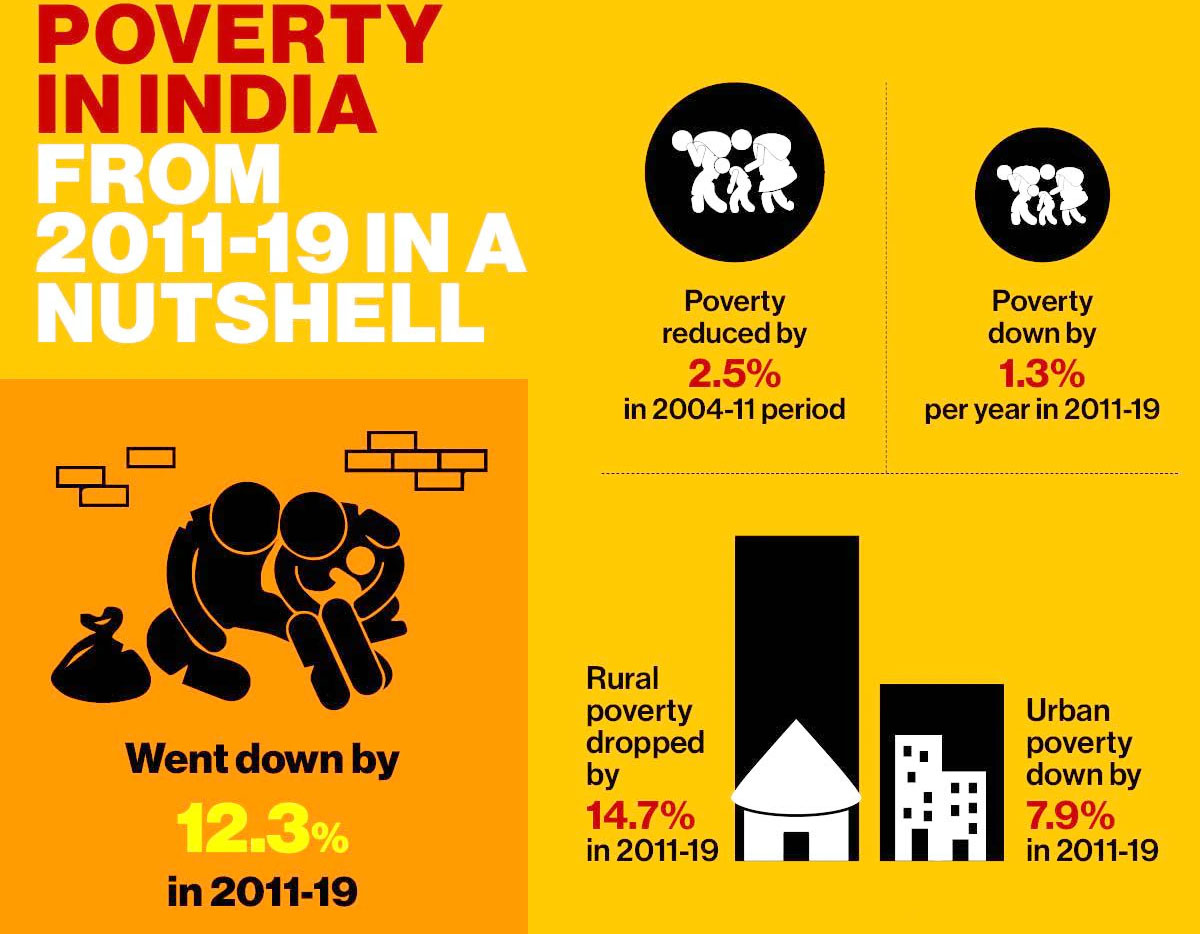
    A recent World Bank Report has shown that extreme poverty in India more than halved between 2011 and 2019 – from 22.5 per cent to 10.2 per cent.  The reduction was higher in rural areas, from 26.3 per cent to 11.6 per cent.

    What explains the reduction in poverty?

    • Poverty has reduced significantly because of the government’s thrust on improving the ease of living of ordinary Indians through schemes.
    • These schemes include the Ujjwala Yojana, PM Awas Yojana, Swachh Bharat Mission, Jan Dhan and Mission Indradhanush in addition to the Deendayal Antyodaya Yojana-National Rural Livelihood Mission and improved coverage under the National Food Security Act.
    • It is important to understand how poverty in rural areas was reduced at a faster pace.
    • Much of the success can be credited to all government departments, especially their janbhagidari-based thrust on pro-poor public welfare.

    Contributing factors

    1] Identification of beneficiaries through SECC 2011

    • The identification of deprived households on the basis of the Socioeconomic and Caste Census (SECC) 2011 across welfare programmes helped in creating a constituency for the well-being of the poor, irrespective of caste, creed or religion.
    • Deprivation criterion: Since deprivation was the key criterion in identifying beneficiaries, SC and ST communities got higher coverage and the erstwhile backward regions in Bihar, Madhya Pradesh, Rajasthan, Uttar Pradesh, Jharkhand, Odisha, Chhattisgarh, Assam, Rajasthan and rural Maharashtra got a larger share of the benefits.
    • Gram Sabha Validation: Social groups that often used to be left out of government programmes were included and gram sabha validation was taken to ensure that the project reached these groups.

    2] Widened coverage of women

    • The coverage of women under the Deendayal Antyodaya Yojana and Self Help Groups (SHG) increased from 2.5 crore in 2014 to over 8 crore in 2018 as a result of more than 75 lakh SHGs working closely with over 31 lakh elected panchayati raj representatives, 40 per cent of whom are women.
    • This provided a robust framework to connect with communities and created a social capital that helped every programme.
    • The PRI-SHG partnership catalysed changes that increased the pace of poverty reduction and the use of Aadhaar cleaned up corruption at several levels and ensured that the funds reached those whom it was meant for.

    3] Creation of basic infrastructure

    • Finance Commission transfers were made directly to gram panchayats leading to the creation of basic infrastructure like pucca village roads and drains at a much faster pace in rural areas.
    • The high speed of road construction under the Pradhan Mantri Gram Sadhak Yojana created greater opportunities for employment in nearby larger villages/census towns/kasbas by improving connectivity and enhancing mobility.

    4] Availability of credit through SHGs

    • The social capital of SHGs ensured the availability of credit through banks, micro-finance institutions and MUDRA loans.
    • Livelihood diversification: The NRLM prioritised livelihood diversification and implemented detailed plans for credit disbursement.

    5]  Implementation of social sector schemes

    • In the two phases of the Gram Swaraj Abhiyan in 2018, benefits such as gas and electricity connections, LED bulbs, accident insurance, life insurance, bank accounts and immunisation were provided to 63974 villages that were selected because of their high SC and ST populations.
    • The performance of line departments went up manifold due to community-led action.
    • The gains are reflected in the findings of the National Family Health Survey V, 2019-2021.

    6] Universal coverage schemes

    • The thrust on universal coverage for individual household latrines, LPG connections and pucca houses for those who lived in kuccha houses ensured that no one was left behind. This created the Labarthi Varg.

    7] Increase in fund transfer to rural area

    • Seventh, this was also a period in which a high amount of public funds were transferred to rural areas, including from the share of states and, in some programmes, through extra-budgetary resources.

    8] Community participation

    • The thrust on a people’s plan campaign, “Sabki Yojana Sabka Vikas” for preparing the Gram Panchayat Development Plans and for ranking villages and panchayats on human development, economic activity and infrastructure, from 2017-18 onwards, laid the foundation for robust community participation involving panchayats and SHGs, especially in ensuring accountability.

    9] Social and concurrent audit

    • Through processes like social and concurrent audits, efforts were made to ensure that resources were fully utilised.
    • Several changes were brought about in programmes like the MGNREGS to create durable and productive assets.

    10] Focus of states on improving livelihood diversification

    • The competition among states to improve performance on rural development helped.
    • Irrespective of the party in power, nearly all states and UTs focussed on improving livelihood diversification in rural areas and on improving infrastructure significantly.

    Conclusion

    All these factors contributed to improved ease of living of deprived households and improving their asset base. A lot has been achieved, much remains to be done.

    UPSC 2023 countdown has begun! Get your personal guidance plan now! (Click here)

  • Loudspeaker Crackdown: Court orders and Govt directives

    Illegal and unauthorized loudspeakers had been taken down across the Uttar Pradesh and their loudness had been capped, under “an existing government order of 2018, and set rules for sound decibel limits and court directions”.

    What is the news?

    • The UP state authorities have taken action since the loudspeaker crackdown began in our country.
    • Notices were served to alleged violators by local police stations citing the order of Allahabad High Court of 2017, and centre’s the Noise Pollution Rules, 2000.
    • The recent UP order asked officials to remove illegal loudspeakers after dialogue and coordination with religious leaders, and to ensure that decibel levels are kept within laid down limits.

    Legal basis of loudspeaker crackdowns

    (a) Orders of 2022, 2018

    • The April 23 order said that two earlier orders passed by the government in 2018 were not being followed, and the situation needed to be rectified.
    • Those earlier orders had been passed to ensure implementation of The Noise Pollution (Regulation and Control) Rules, 2000.
    • However, it had come to knowledge that many religious institutions are violating the standard decibel norms and are using loudspeakers in large numbers.

    (b) The Noise Pollution Rules, 2000

    • The 2000 Rules define “Ambient Air Quality Standards in Respect of Noise”, i.e., Industrial, Commercial, Residential, and Silence Zones.
    • It asked officials to demarcate these areas and to ensure that the correct norms were followed.
    • Each police station has been asked to prepare a list of religious institutions using loudspeakers under their jurisdiction.

    What is noise pollution?

    • Noise is defined as unwanted sound. A sound might be unwanted because it is loud, distracting, or annoying.
    • Noise pollution is manmade sound in the environment that may be harmful to humans or animals.

    Objective of the NPR, 2000: To regulate and control noise producing and generating sources with the objective of maintaining the ambient air quality standards in respect of noise

    Important compliance’s under NPR, 2000

    • What are the restrictions on using loud speaker or musical system at night?
      : A person cannot play a loud speaker, public address system, sound producing instrument, musical instrument or a sound amplifier at night time except in closed premises like auditorium, conference rooms, community halls or banquet halls.
    • What is the noise level for using loudspeakers or the public address?
      : The persons using loudspeakers or public address shall maintain the noise level and restrain it from exceeding 10 dB (A) above the ambient noise standards for the area specified or 75 dB (A) whichever is lower.
    • What is the Noise level for a private sound system?
      : The persons owning a private sound system or a sound producing instrument shall not, exceed the noise above 5 dB (A) the noise standards specified for the area in which it is used.
    • What are the prohibitions on violating the silence zone areas?
      A person shall not do the following acts in silence zone

      1. Playing any music or uses any sound amplifiers,
      2. A drum or tom-tom or blows a horn either musical or pressure, or trumpet or beats or sounds  any instrument, or
      3. Playing any musical or other performance of a to attract crowd
      4. Bursting sound-emitting firecrackers
      5. Using a loudspeaker or a public address system.


    UPSC 2023 countdown has begun! Get your personal guidance plan now! (Click here)

  • Death Penalty

    Context

    On April 22, a Bench of the Supreme Court of India, led by Justice U.U. Lalit, decided to critically examine the routine and abrupt way in which trial judges often impose the death penalty on convicts.

    Individualistic approach

    • The challenge before the Court in the instant case of Irfan vs State of Madhya Pradesh was to identify the mitigating circumstances and to ensure a convict-centric approach so that the imposition of capital punishment becomes rarer, fairer, and principled.
    • According to the Court, “a ‘one size fit for all’ approach while considering mitigating factors during sentencing should end”.
    • Mitigation expert: The Bench indicated the need for mitigation experts to assist trial courts in reaching a correct conclusion on whether one should be sent to the gallows or not.
    • The Court seemed to think that an individualistic approach that examines the social, economic, emotional, and genetic components that constituted the offender rather than the offence, would go a long way in evolving a just and judicious sentencing policy.
    • An analysis of the possible reasons to avert the death penalty is reflected in a series of recent verdicts such as Lochan Shrivas vs State of Chhattisgarh (2021) and Bhagchandra vs State of Madhya Pradesh (2021).
    • These reasons might include socio-economic backwardness, mental health, heredity, parenting, socialisation, education, etc.

    Background of the humane and reformist framework

    • The special reason: According to Section 354(3) in the Code of Criminal Procedure, while imposing the capital punishment, the judge should specify “the special reasons” for doing so.
    • It was in Bachan Singh vs State of Punjab (1980) that the Constitution Bench suggested a humane and reformist framework in the matter.
    • Bachan Singh requires the trial courts not only to examine the gravity of the offence but also the condition and the ‘reformability’ of the accused. 
    • Not unconstitutional: The Court, in Bachan Singh, refused to declare the death penalty as unconstitutional. 
    • It abundantly implied that no person is indubitably ‘irreformable’.
    • It had the effect of practically undoing the death penalty provision, if taken in its letter and spirit.
    • Person-centric approach: This person-centric approach, for its materialisation, needs a different judicial acumen that recognises the convict in her multitudes.

    Is the Bachan Singh doctrine followed?

    • The Bachan Singh principle was followed more in its breach than in compliance even by the Supreme Court.
    • In Ravji vs State of Rajasthan (1995), the Supreme Court said that it is the nature of the crime and not the criminal which is germane for deciding the punishment.
    • Several other cases also were decided by ignoring the Bachan Singh doctrine, as noted by the Supreme Court itself in Santhosh Kumar Satishbhushan Bariyar vs State of Maharashtra (2009) and Rajesh Kumar vs State (2011).
    • This egregious judicial error will have to be kept in mind while the Court revisits the issues related to mitigating factors and individual-centered sentencing policy in the Irfan case.
    • Shortcomings of Bachan Sing: Bachan Singh did not, in concrete terms, elaborate on the mitigating factors and the methods to gather them to avert the death penalty.
    • Nor did it explain the issues such as burden of proof and standard of proof in detail.

    Issue of misuse and overuse

    • Misuse of sedition provision: The Indian experience shows that whenever the Court tries to dilute the harshness of penal provisions by a balancing approach, instead of striking down the provision, the instrumentalities of the state (including the police, the prosecution and the court) continue to overuse or misuse the provisions.
    • The Supreme Court endorsed the validity of the sedition law (Section 124A of the Indian Penal Code) with a rider that it could be invoked only when there is an incitement to violence.
    • But the state seldom acts based on interpretation of the law. 
    •  Many were booked for the charge of sedition since then for mere words, innocent tweets or harmless jokes.

    Social implications

    • Disproportionate effect on the poor: In India, as elsewhere, the poor, rather than the rich, are sent to the gallows.
    • Ineffectiveness of legal assistance: In Williams vs Taylor (2000), the U.S. Supreme Court said that failure of the defence lawyer in highlighting the mitigating factors that could lead to avoidance of capital punishment makes the legal assistance ineffective. 
    • Therefore, it infringes constitutionally guaranteed rights.
    • In the Indian scenario, the legal assistance received by the poor facing serious charges is far from satisfactory.
    • Mitigating factors not placed: And in the matter of sentencing too, the mitigating factors are either not placed before the trial court or not persuaded adequately to convince the trial judge to avoid the death penalty.

    Way forward

    • Taking empirical lessons from the fate of Bachan Singh, the Supreme Court may have to now ask the more fundamental question posed and negatived in Bachan Singh — the question of the constitutional validity of death penalty.
    • Comprehensive report: The Court, in the instant case, will have to evolve a legal device for procurement of a comprehensive report dealing with the socio-economic and hereditary backgrounds of the accused from experts in the fields of social work, psychiatry, psychology, anthropology, etc.
    • Violation of Article 21: The Court may have to revisit Bachan Singh itself in so far as it refused to declare the death penalty as violative of the right to life envisaged under Article 21 of the Constitution.
    • Across the world, 108 nations have abolished death penalty in law and 144 countries have done so in law or practice, according to the Amnesty Report of 2021.
    • Judicial errors: In the Indian context, where judgmental error is quite frequent and the quality of adjudication is not ensured, what is required is a judicial abolition of death penalty. 

    Conclusion

    The present matter will have to be referred to a larger Bench, with a view to rectify the foundational omission in Bachan Singh — of not explicitly declaring capital punishment as unconstitutional.

    UPSC 2023 countdown has begun! Get your personal guidance plan now! (Click here)