💥Join UPSC 2027,2028 Mentorship (July Batch) + XFactor Notes & Microthemes PDF

GS Paper: GS1-02.Modern Indian History- Mid-18th century – Present (significant events, personalities, issues);

  • Throw light on the significance of the thoughts of Mahatma Gandhi in the present times.

    Mahatma Gandhi (Father of the nation) combined ethics, politics, and social reform, offering a timeless framework for resolving modern challenges.

    Significance of Gandhian thoughts in present times

    The philosophy of Ahimsa is relevant for addressing internal conflicts, protests, and global tensions. Eg- Russia-Ukraine war

    His emphasis on village self-rule promotes grassroots democracy and empowers citizens beyond electoral participation.

    Gandhi’s fight against untouchability underlines social justice. It is relevant in addressing caste discrimination and social exclusion. Eg- Mob Lynching of Dalits

    His emphasis on simple living and need-based consumption address ecological crises and is in line with Mission LiFE.

    Swadeshi supports local production and employment. It also resonates with Atmanirbhar Bharat and counters exploitative globalisation. Eg- weaponisation of supply chains by China

    Satyagraha empowers citizens to challenge injustice non-violently. It prevents descent into anarchy or authoritarianism.

    Nai Talim stressed holistic education integrating ethics and skills. It is in line with value-based and vocational education suggested in NEP,2020.

    His emphasis on self-discipline and moral courage bridges gap between rights and duties and promotes responsible citizenry and builds social capital

    Trusteeship principle

    Encourages corporate social responsibility (CSR) and ethical capitalism.

    Reduces wealth inequality (1% HOLDING 40% WEALTH)

    Gandhi’s concept of Sarvodaya (progress for all) and Antyodaya (upliftment of the last person) are relevant for forming social welfare policies. Eg- MGNREGA

    Mahatma Gandhi’s thoughts represent a living philosophy. By prioritizing the planet over profit and humanity over hegemony, Gandhian principles provide a compass for navigating the complexities of the 21st century.
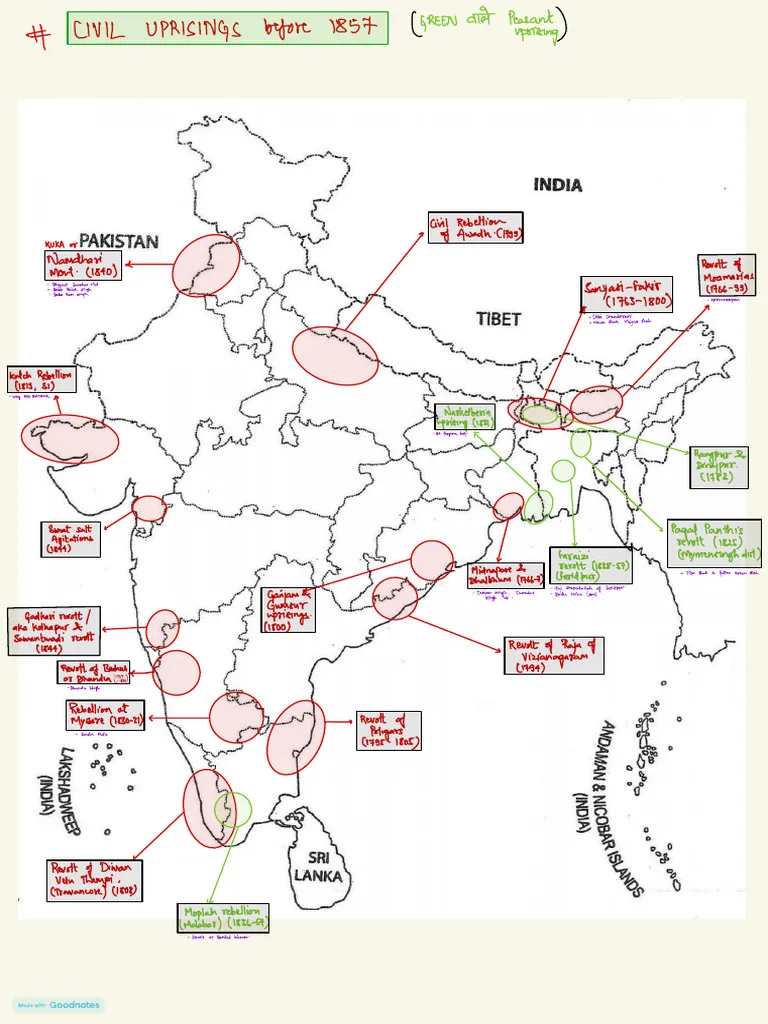
  • The 1857 Uprising was the culmination the recurrent big and small local rebellions that had occurred in the preceding hundred years of British rule. Elucidate. (1857 का विप्लव ब्रिटिश शासन के पुर्ववर्ती सौ वर्षों में बार-बार घटित छोटे एवं बड़े स्थानीय विद्रोहों का चरमोत्कर्ष था | सुस्पष्ट कीजिए | ) (10m,150 words)

    While the events at Meerut provided the immediate spark, the 1857 Revolt was the historical result of a century-old tradition of resistance.

    1857 revolt as a culmination of past rebellions

    Poligars’ Revolt (1799-1805) in South India against the Company’s demand for high tribute.

    Paika Rebellion (1817)- landed militia of Odisha rose under Bakshi Jagabandhu against the British land revenue policies and the loss of their rent-free lands.

    Kittur Chennamma’s Revolt (1824) against the British refusal to recognize an adopted heir.

    Ramosi Uprising (1822-1829) led by Chittur Singh in Maharashtra as a reaction to the annexation of the Maratha territories.

    Tribal Uprisings

    Chuar Uprising (1766-1772) in Bengal against the enhanced land revenue demands of the Company.

    Kol Mutiny (1831) in Chhotanagpur against the transfer of their lands to outsiders and moneylenders

    Santhal Rebellion (1855-1856) under sidhu and kanhu just one year before 1857.

    Khasis’ Revolt (1833) under Tirut Singh in the Meghalaya hills against the British attempt to build a road through their ancestral lands using forced labor.

    Peasant Movements

    Sanyasi-Fakir Rebellion (1763-1800) in Bengal as a reaction to restrictive pilgrim taxes and the devastating famine of 1770.

    Faraizi Movement (1838-1857) in East Bengal against the excesses of indigo planters and landlords

    Paglapanthis Revolt (1825-1835)- Led by Tipu Shah in Bengal, targeting Zamindars.

    Mappila revolt in Kerala against zamindars

    Sepoy Mutinies

    Vellore Mutiny (1806) against a new dress code that forbade religious marks and required the use of leather cockades.

    Barrackpore Mutiny (1824)- Sepoys refused to cross the “Black Water” (ocean) to Burma.

    Afghan War Mutinies (1839-1842) due to the hardships of the campaign and the psychological strain of fighting outside India.

    Mutiny of 1844 (Bengal Army) against the withdrawal of Bhatta (foreign service allowance) after the annexation of Sindh.

    These movements culminated in the first large-scale, multi-class challenge to British colonial rule in India in 1857.

  • Evaluate the policies of Lord Curzon and their long term implications on the national movement. (लार्ड कर्जन की नीतियों एवं राष्ट्रीय आंदोलन पर उनके दूरगामी प्रभावों का मूल्यांकन कीजिए l)

    Lord Curzon, serving as Viceroy from 1899 to 1905, epitomized imperial paternalism. Driven by an explicit belief in “White Man’s Supremacy,” his policies unintentionally converted India’s moderate elitist protest into an aggressive mass-based nationalist movement.

    Evaluation of Curzon’s Key Policies

    Bengal Partition (1905): Divided the province on religious lines to fracture nationalist unity under the guise of administrative convenience.

    Universities Act (1904): Placed higher education under strict state control to suppress anti-colonial political activism among students.

    Calcutta Corporation Act (1899): Drastically reduced elected Indian members, explicitly undermining local self-governance.

    Economic & Strategic Reforms: Created the Cooperative Credit Societies Act (1904) to help peasants and pursued expansionist moves in Tibet.

    Official Secrets Act (1904): Extended the definition of “sedition” to restrict freedom of the press and curb public criticism against official high-handedness.

    Established the Central Criminal Intelligence Department (CID) to keep tight political surveillance on emerging nationalist leaders.

    Long-Term Implications on the National Movement

    Catalyzed Extremism: His blatant disregard for public opinion discredited moderate constitutional methods, bringing radical leaders like Lal-Bal-Pal to the forefront.

    Sparked the Swadeshi Movement: The partition triggered India’s first major mass struggle, introducing indigenous economic boycott tactics and fostering Atmasakti (self-reliance).

    Institutionalized Communalism: Splitting Bengal along religious fault lines deliberately deepened political communalism, eventually leading to the creation of the Muslim League (1906).

    Cultural Renaissance: His high-handedness backfired into a revival of national pride, inspiring patriotic art, vernacular literature, and historical preservation.

    Enlarged the Social Base: The anti-partition agitations successfully brought women, students, and urban workers into active street politics for the first time.

    Curzon’s aggressive imperialism accelerated the absolute collapse of British rule in India.

  • Why was there a sudden spurt in famines in colonial India since the mid-eighteenth century ? Give reasons.

    Under British rule, India experienced an unprecedented frequency of famines (31 major famines) leading to over 60 million deaths.

    Reasons for sudden spurt in famines in colonial India

    Commercialisation of agriculture – Shift from food crops to cash crops reduced local food availability. Eg- Expansion of indigo, cotton, and opium cultivation under Company pressure.

    Rigid land revenue systems with fixed and high revenue demands forced peasants to sell grain during scarcity.

    Collapse of handicrafts increased dependence on agriculture and reduced household resilience during crop failure.

    Disruption of traditional famine-coping mechanisms like community grain banks due to British policies.

    Free trade ideology (laissez-faire attitude) prioritised exports over local needs. Eg- Continued grain exports during famines like the Great Famine of 1876-78.

    Neglect of agricultural investment heightened vulnerability to monsoon failure. Eg- Limited irrigation outside canal colonies.

    Diversion of foodgrains for British soldiers during world war II led to over 3 million deaths during Bengal famine of 1943

    Role of Viceroys – Lord Lytton exported 320,000 tons of wheat to England during the Great Famine of 1876-1878

    Thus, spurt in famines was an “administrative and man-made” phenomenon. It underscores the critical role of the state in ensuring food security at present.

  • Why did the armies of the British East India Company – mostly comprising of Indian soldiers-win consistently against the more numerous and better equipped armies of the then Indian rulers ? Give reasons.

    The expansion of the British East India Company was a triumph of institutional organization over feudalism.

    Major wins of the British East India Company army

    Battle of Plassey (1757)

    Battle of Buxar (1764)

    Anglo-Mysore Wars (1767-1799)

    Anglo-Maratha Wars (1775-1818)

    Anglo-Sikh Wars (1845-1849)

    Reasons behind consistent wins of British East India company army

    Political Factors

    Fragmented Indian polity – Eg- Marathas, Nizam, and Awadh failed to form a sustained anti-British alliance.

    Diplomacy – Company isolated enemies before military confrontation. Eg- Wellesley’s Subsidiary Alliance system neutralised Indian rulers politically.

    Economic Factors

    Superior financial resources – Eg- Diwani rights (1765) funded continuous military expansion.

    Commercial-military synergy – Trade profits sustained long wars without fiscal collapse.

    Technological Factors

    Standardised firearms and artillery – Eg- Effective use of field artillery at Buxar overwhelmed numerically superior forces of Awadh, Mughal, and Bengal Nawab.

    Military innovations – Better logistics, military engineering, and disciplined infantry formations.

    Leadership and Organisation

    Professional military leadership – Officers trained in European warfare doctrines. Eg- Clive and Eyre Coote employed coordinated infantry-artillery tactics.

    Unified command structure – Clear hierarchy ensured swift decision-making unlike feudal Indian armies.

    Social Divisions within Indian Armies

    Feudal composition of Indian forces – Loyalty based on personal allegiance, not the state. Eg- Defection of Mir Jafar at Plassey.

    Caste and regional divisions – Eg- Mahar regiment fighting against Peshwa army in Anglo-Maratha wars

    Ideological and Psychological Factors

    Absence of nationalism – Indian soldiers fought for rulers, not a national cause.

    Company’s corporate discipline – Soldiers motivated by regular pay, promotion, and military professionalism.

    The European conquest of India was not just a conquest of territory but a conquest of the Indian soul, changing the very ethos of Indian society.” – Rabindranath Tagore

    Section Specific

  • What was the difference between Mahatma Gandhi and Rabindranath Tagore in their approach towards education and nationalism?

    Mahatma Gandhi and Rabindranath Tagore were towering thinkers of modern India who shared a commitment to freedom, yet differed significantly in their visions of India’s engagement with modernity.

    Difference between Gandhi and Tagore on EDUCATION

    Difference Between Gandhi and Tagore on NATIONALISM

    Similarities

    Commitment to India’s Freedom – Eg- Tagore renounced his British knighthood (1919)

    Both believed politics must be guided by moral values. Eg- Gandhi’s satya and ahimsa and Tagore’s humanist ethics.

    Critique of Blind Westernisation

    Both saw education as central to societal transformation.

    Both valued India’s spiritual and cultural heritage. Eg- Use of Indian symbols by Gandhi and revival of Indian art, music, and literature by Tagore.

    Opposition to Violence and Militarism

    Concern for Social Harmony – Both sought unity across caste, religion, and region.

    Despite differences in method, Gandhi and Tagore converged in their ethical vision, making them complementary architects of modern Indian thought.

  • How did the colonial rule affect the tribals in India and what was the tribal response to the colonial oppression?

    Colonial rule profoundly altered tribal life by disrupting their autonomy, economy, culture, and customary institutions, leading to sustained resistance across India.

    Impact of colonial rule on tribals

    Political Impact

    Loss of political autonomyExpansion of colonial authority into previously autonomous regions. Eg- Displacement of Munda chiefs in Chotanagpur.

    Undermining of tribal leadership – Authority of headmen replaced by colonial officials. Eg- Appointment of British-appointed diwans in tribal tracts.

    Criminal Tribes Act (1871)- Many nomadic and forest tribes were branded as “hereditary criminals” by birth, leading to their police harassment and forced settlement.

    Economic Impact

    Land alienation – Introduction of private property eroded communal ownership. Eg- Transfer of tribal land to moneylenders in Chotanagpur.

    Exploitative forest policies – Restrictions on grazing, shifting cultivation, and forest produce
    under Indian Forest Acts of 1865 and 1878.

    Indebtedness and exploitation by traders and mahajans. Eg- dikus in Santhal regions

    Forced labour in plantations and mines. Eg- in Assam tea plantations.

    Social Impact

    Disruption of traditional social structures – Breakdown of clan-based systems.

    Imposition of alien legal systems – Customary law replaced by British civil and criminal law.

    Suppression of customary practices linked to forests and land. Eg- Criminalisation of shifting cultivation.

    Missionary activities and forced conversions among tribals Eg- Resistance to Christian missionaries among Mundas and Oraons.

    Tribal response to colonial oppression

    Legal and Institutional Response

    Petitions and Memorandums- Some tribes initially sought redress through official channels. Eg- early phases of the Kol Mutiny.

    Demand for separate administration – Eg- Creation of Santhal Parganas as a separate district.

    Revolutionary and Armed Resistance

    Mass armed uprisings – Violent resistance against colonial rule and intermediaries. Eg- Santhal Rebellion (1855-56).

    Leader-centric movements – Mobilisation under charismatic leaders. Eg- Birsa Munda’s Ulgulan (1899-1900).

    Resistance to revenue and forest laws – Attacks on symbols of colonial authority. Eg- Kol Uprising (1831-32).

    Rampa Rebellion (1922-24)- Alluri Sitarama Raju led a guerrilla war in the Eastern Ghats against the Madras Forest Act.

    Participation in National Movement (Non-Violent Response)

    Tana Bhagat Movement (1914)- Jatra Bhagat used “satyagraha” against British and zamindars

    During the Civil Disobedience Movement, tribes in Central Provinces and Karnataka organized “Forest Satyagrahas” to defy grazing and timber laws.

    Quit India Movement- Tribal leaders like Lakshman Nayak in Odisha mobilized their communities.

    Zeliangrong Movement- Under Rani Gaidinliu in the Northeast, the movement transitioned from a socio-religious reform to a political struggle for Indian independence.

    The colonial experience of exploitation shaped post-independence tribal policy, reflected in Nehru’s Tribal Panchsheel

    Respect for tribal culture,

    Protection of land rights

    Minimal administrative interference

    Development without cultural destruction

    Movement Specific

  • Mahatma Jotirao Phule’s writings and efforts of social reforms touched issues of almost all subaltern classes. Discuss.

    Mahatma Jyotirao Phule (1827-1890) is regarded as the “Father of the Indian Social Revolution.” His radical approach sought social transformation through education and rationalism.

    Mahatma Phule’s writings

    Gulamgiri: drew parallels between the plight of lower castes in India and Black slaves in America.

    Shetkaryacha Asud : critique of the exploitation of farmers by the “Shetji-Bhatji” (moneylender-priest) alliance and the colonial bureaucracy.

    Tritiya Ratna : A play highlighting how education serves as the “third eye” that allows the oppressed to see through religious and social deception.

    Brahmananche Kasab: Exposed the various ways in which Brahmin priests exploited the ignorant masses through complex rituals and superstitions.

    Sarvajanik Satya Dharma Pustak: Published posthumously, it outlined a universal religion based on truth, social equality, and a single creator (Nirmika), rejecting idol worship and caste.

    Satsar (The Essence of Truth): defended Pandita Ramabai’s conversion and attacked Brahminical societal norms.

    In his poems and ballads (Powadas), he reinterpreted myths like the Aryan Invasion Theory to present Shudras as the “Bhumiputras” (sons of the soil) who were wrongly subjugated.

    Efforts of Social Reform

    Pioneering Women’s Education: In 1848, he opened the first indigenous school for girls at Bhide Wada, Pune.

    Education for Dalits: He established the first schools specifically for Mahar and Mang children (Ati-Shudras) in 1852.

    Satyashodhak Samaj (1873): Founded the “Society of Truth Seekers” to liberate the lower castes from priestly control. It promoted rituals conducted by non-Brahmins.

    He opened his own private water tank in Pune for Dalits to use, directly challenging untouchability.

    Balhatya Pratibandhak Griha (1863): He provided refuge to pregnant widows (often upper-caste) to deliver babies safely and secretly, even adopting one child, Yashwant.

    He campaigned vigorously against the forced tonsuring of widows and organized a strike of barbers in Pune to refuse shaving widows’ heads.

    Agrarian Reforms: He demanded irrigation facilities, animal breeding programs, and scientific farming to uplift the subaltern peasantry.

    Working Class Support: Along with his associate N.M. Lokhande, he supported the early mill worker movements in Bombay.

    Established night schools for those belonging to the working class who could not attend school during the day due to their labor.

    In his testimony to the Hunter Commission (1882), he demanded free and compulsory primary education and proportional representation for lower castes in government jobs.

    Critical Assessment

    His movement was regionally concentrated in western India.

    Limited mobilisation among industrial labour due to the early time period.

    He laid the foundation for later non-Brahmin and Dalit movements and contributed significantly to the idea of social justice and equality in modern India.

    Policy Specific