💥Join UPSC 2027,2028 Mentorship (July Batch) + XFactor Notes & Microthemes PDF

GS Paper: GS1-02.Modern Indian History- Mid-18th century – Present (significant events, personalities, issues);

  • Young Bengal Movement and Henry Derozio 

    Why in the News?

    This newscard is an excerpt from the article originally published in The Hindu.

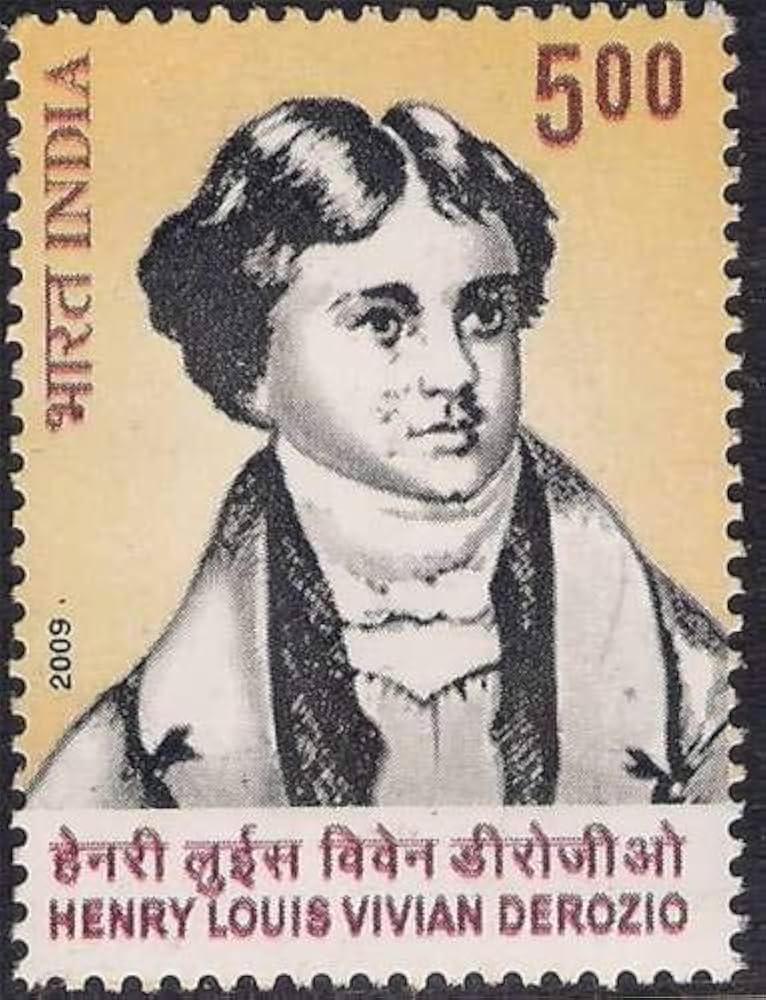
    Young Bengal Movement and Henry Derozio 

    Who was Henry Vivian Louis Derozio?

    • Birth–Death: Born 1809, died- 22 in 1831; Indo-Portuguese origin.
    • Identity: Radical thinker, poet, and educator in British India.
    • Recognition: Called the first national poet of modern India; pioneer of Anglo-Indian poetry.
    • Influences: Inspired by Enlightenment ideals and the French Revolution.
    • Career: Became lecturer at Hindu College, Calcutta in 1826 at just 17.
    • Role: Inspired students with rationalism, liberty, and free thought.
    • Writings: Poems (1827), The Fakeer of Jungheera (1828), and To India – My Native Land (first modern patriotic poem in English).
    • Themes: Expressed India’s decline with images of a caged eagle and a broken instrument; advocated freedom and abolition of slavery.
    • Dismissal: Removed from Hindu College in 1831 on charges of spreading atheism.

    The Young Bengal Movement: 

    • Formation: Radical group of his students, also called Derozians.
    • Association: Founded the Academic Association, debating social and political reform.
    • Ideals: Advocated rationalism, women’s rights, freedom of thought; opposed caste, superstition, idolatry.
    • Political Role: In 1843, with George Thompson, formed India’s first political partyBengal British India Society.
    • Notable Member: Radhanath Sikdar, mathematician who first calculated Mount Everest’s height and openly resisted colonial injustices.
    • Perception: Described by missionary Alexander Duff as a “new race of men”; historian Rosinka Chaudhuri called them India’s “first radicals.”
    • Legacy and Intellectual Impact:
      • Awakening: Though short-lived, the movement sparked Bengal’s intellectual revolution.
      • Seeds of Reform: Laid foundation for later reformist and nationalist currents.
      • Independence of Mind: Marked a sharp break from Macaulay’s vision of Anglicised Indians — Derozians were assertive and original.
    [UPSC 2021] Who among the following was associated as Secretary with Hindu Female School which later came to be known as Bethune Female School?

    Options: (a) Annie Besant (b) Debendranath Tagore (c) Ishwar Chandra Vidyasagar * (d) Sarojini Naidu


  • In news: British Conquest of Sindh

    Why in the News?

    The British conquest of Sindh in the 1840s was a key step in colonial expansion, reminding us that regions like Sindh, Punjab, and Bengal came under British rule long before the 1947 partition of India and Pakistan.

    British Conquest of Sindh:

    • Sindh was annexed by the British in 1843 after the battles of Miani and Dubbo.
    • The resistance was led by Hosh Muhammad Sheedi, a general of the Talpur army and member of the African-origin Siddi community.
    • His defiance symbolised the first major armed resistance to British expansion in northwest India.

    Political Background in Sindh:

    • Kalhora Dynasty (1701–1779): Founded by Mian Yar Muhammad Kalhoro, recognised by Mughals; ruled northern and central Sindh. Prosperous period but weakened by internal disputes.
    • Talpur Dynasty (1779–1843): Baloch Talpurs overthrew Kalhoras; consolidated Sindh under clan rule at Hyderabad and Khairpur.
    • Geopolitical Context: Sindh lay at the crossroads of British–French–Russian rivalry (The Great Game). Britain feared Russian advances through Iran and Afghanistan.
    • British Entry: East India Company forced treaties on Talpurs; captured Karachi (1839) after bombarding Manora fort.

    British Advance and the Fall of Sindh:

    • Battle of Miani (17 Feb 1843): British under Sir Charles Napier defeated Mir Nasir Khan Talpur near Hyderabad.
    • Battle of Dubbo (24 Mar 1843): Hosh Muhammad Sheedi allied with Mir Sher Muhammad Talpur of Mirpur Khas. Sheedi raised the war cry “Marvesoon par Sindh na desoon” (I may die but will not give up Sindh). He was killed in action.
    • British Annexation: After Dubbo, Sindh was annexed into the Bombay Presidency. Talpur rule ended.
    • Aftermath: Within a decade, Punjab too was annexed (1849), bringing all of northwest India under British rule.

    Legacy of Hosh Muhammad Sheedi:

    • Born into the household of Talpur rulers; of African-Siddi descent.
    • Valour acknowledged by both Indian and British chroniclers.
    • Became a folk hero of Sindh, remembered by Hindus and Muslims alike.
    • His legacy is central to the cultural memory of Sindh and highlights the role of the Siddi community in resisting colonialism.
    [UPSC 2007] The ruler of which one of the following States was removed from power by the British on the pretext of misgovernance?

    Options: (a) Awadh* (b) Jhansi (c) French (d) Satara


  • Red Fort as the Venue for Independence Day

    Why in the News?

    On August 15, 2025, Prime Minister delivered the longest Independence Day speech (103 minutes) from the Red Fort, continuing a tradition started by Jawaharlal Nehru in 1947.

    The fort’s choice as the venue reflects its historic role as Delhi’s seat of power and symbol of sovereignty.

    About the Red Fort:

    • Construction: Built in 1648 by Mughal Emperor Shah Jahan as the palace fort of Shahjahanabad, his new capital.
    • Material: Enclosed by massive red sandstone walls with royal pavilions and apartments.
    • Water Feature: Contained the Nahr-i-Behisht (“Stream of Paradise”), a continuous water channel.
    • Architectural Value: Prime example of Mughal architecture, blending Islamic traditions with Indian craftsmanship.
    • Recognition: Declared a UNESCO World Heritage Site in 2007.

    Historical Significance of Delhi and Red Fort:

    • Delhi’s Role: Seat of power for nearly a thousand years, regarded as “capital of all Hindustan” by Babur.
    • Shahjahanabad: Inaugurated in 1648 with the Red Fort at its centre.
    • Symbol of Sovereignty: Even after Mughal decline, Delhi remained central; East India Company minted coins in the emperor’s name.

    1857 Revolt and British Authority:

    • Revolt Centre: Bahadur Shah Zafar was declared leader by sepoys in Delhi.
    • Aftermath: Fall of Delhi ended Mughal rule; Zafar was exiled.
    • Fort Damage: British converted Red Fort into a military garrison, destroying ~80% of interiors.
    • Imperial Authority: Delhi Durbars (1877, 1903, 1911) asserted British control before capital shifted from Calcutta to Delhi in 1911.

    Significance of Red Fort for Independence Day:

    • INA Trials: Held in Red Fort in 1946, igniting nationalist fervour.
    • 1947 Ceremony: Jawaharlal Nehru hoisted the national flag on 15 August 1947 and gave the first Independence Day address.
    • Tradition: Since then, every Prime Minister hoists the flag and addresses the nation from its ramparts.
    • Symbolism: Site once stamped with colonial dominance, now reclaimed as a symbol of India’s sovereignty.
    [UPSC 2021] What was the exact constitutional status of India on 26th January, 1950?

    Options: (a) A democratic Republic (b) A Sovereign Democratic Republic* (c) A Sovereign Secular Democratic Republic (d) A Sovereign Socialist Secular Democratic Republic


  • Paika Rebellion references omitted from NCERT books

    Why in the News?

    Former Odisha CM expressed concern over the omission of the Paika Rebellion from NCERT’s latest Class VIII history textbook, calling it a “huge dishonour” to the brave Paikas.

    Localized Revolts in Odisha Region:

    • The Paika Rebellion was part of a broader pattern of regional uprisings triggered by colonial encroachments:
      • Paralakhemundi Rebellion (1799–1814)
      • Ghumusar Revolt (1835–36)
      • Angul Uprising (1846–47)
      • Kondh and Sabara Rebellions (1855–1857)
    • These revolts were often led by dispossessed elites and tribal communities, reacting to land loss, economic distress, and erosion of traditional authority.

    About Paika Rebellion:

    • Who Were the Paikas: Traditional militia of Odisha who served local kings in exchange for rent-free land (nish-kar jagirs) and social standing.
    • Role: Functioned as hereditary foot soldiers and police for the Khurda kingdom.
    • Decline: British annexation of Odisha in 1803 ended their privileges through land revenue reforms and colonial restructuring.
    • Leader: Led by Bakshi Jagabandhu Bidyadhar, the military chief under King Mukunda Dev II of Khurda.
    • Causes of Rebellion: Loss of land rights, oppressive taxation, and marginalization of both the elite and peasantry under British rule.
    • Key Events:
      • 2 April 1817: Bakshi Jagabandhu led the Paikas, joined by tribal Kondhs and others, in open rebellion.
      • Rebel Actions: British offices at Banapur were torched, the treasury looted, and colonial officers killed.
      • British Response: Regained control by mid-1817, but rebels resorted to guerrilla tactics.
      • Bakshi’s Death: Captured in 1825, died in custody in 1829.

    Outcomes:

    • British Concessions: Temporary tax remissions, Lowered assessments, Suspended forced estate sales and fixed-land-tenures.
    • Administrative Impact: These measures showed the British were forced to reconsider exploitative policies.
    • Aftermath and Significance:
      • Historical Role: An early example of organized resistance against British colonial rule—decades before 1857.
      • Freedom Struggle Legacy: Viewed as a precursor to India’s independence movement.
      • Current Demand: Odisha leaders advocate its recognition as India’s “first war of independence.”
    [UPSC 2018] After the Santhal Uprising subsided, what was/were the measure/measures taken by the colonial government?

    1. The territories called `Santhal Paraganas’ were created. 2. It became illegal for a Santhal to transfer land to a non-Santhal.

    Select the correct answer using the code given below:

    Options: (a) 1 only (b) 2 only (c) Both 1 and 2* (d) Neither 1 nor 2


  • In news: Mangal Pandey (1827-1857)

    Why in the News?

    The Prime Minister paid tribute to the great freedom fighter Mangal Pandey on his birth anniversary.

    Who was Mangal Pandey?

    • Birth: Born on 19 July 1827 in Nagwa village, Ballia district, Uttar Pradesh.
    • Military Service: Joined the British East India Company’s army in 1849 as a sepoy in the 34th Bengal Native Infantry at Barrackpore.
    • Trigger of Revolt: Opposed the use of Enfield rifle cartridges greased with cow and pig fat, offensive to religious beliefs.
    • Rebellion: On 29 March 1857, attacked British officers and encouraged sepoys to rise in revolt.
    • Punishment: Arrested, tried, and executed by hanging on 8 April 1857.
    • Legacy: Regarded as the “Hero of the First War of Indian Independence” and a symbol of resistance.

    Back2Basics: 1857 War of Independence

    • Overview: The First War of Indian Independence or the Great Rebellion of 1857.
    • Sepoy Composition: Indians made up over 87% of the British Indian Army but faced severe discrimination.
    • Root Causes:
      • Military Discontent: Unequal pay, poor promotion prospects, denial of allowances.
      • Religious Insensitivity: Use of animal fat-greased cartridges insulted Hindu and Muslim beliefs.
      • Economic Hardship: Heavy land taxes, decline in traditional crafts, and rising unemployment.
      • Political Grievances: Annexation of Indian states and enforcement of oppressive laws.
    • Outbreak:
      • Barrackpore: Mangal Pandey’s defiance on 29 March 1857 marked the beginning.
      • Meerut: On 10 May 1857, sepoys rebelled after refusing cartridges and were imprisoned.
      • Delhi: Rebels marched to Delhi and declared Bahadur Shah II as Emperor.
    • Spread of Revolt: Uprising expanded to Kanpur, Lucknow, Jhansi, Bihar, Bareilly, Faizabad, and beyond.
    • Mass Participation: Involved sepoys, peasants, landlords, and regional rulers.

    Suppression and Its Aftermath:

    • Brutal Suppression: Rebellion was crushed by 1859; Delhi was recaptured in September 1857.
    • Administrative Shift: British East India Company was dissolved; India came under direct British Crown rule, initiating the British Raj.
    • Military Reorganization: Indian representation in the army was reduced and reorganized to prevent future revolts.
    • Increased Repression: Racial discrimination and harsh policies intensified post-revolt.


    [UPSC 2006] Who was the Governor-general of India during the Sepoy Mutiny?

    Options: (a) Lord Canning* (b) Lord Dalhousie (c) Lord Hardinge (d) Lord Lytton


  • Tipu Sultan and Anglo-Mysore Wars (1767-1799)

    Why in the News?

    The new NCERT Class 8 Social Science textbook omits Tipu Sultan, Haidar Ali, and the Anglo-Mysore Wars from its chapter on India’s colonial era.

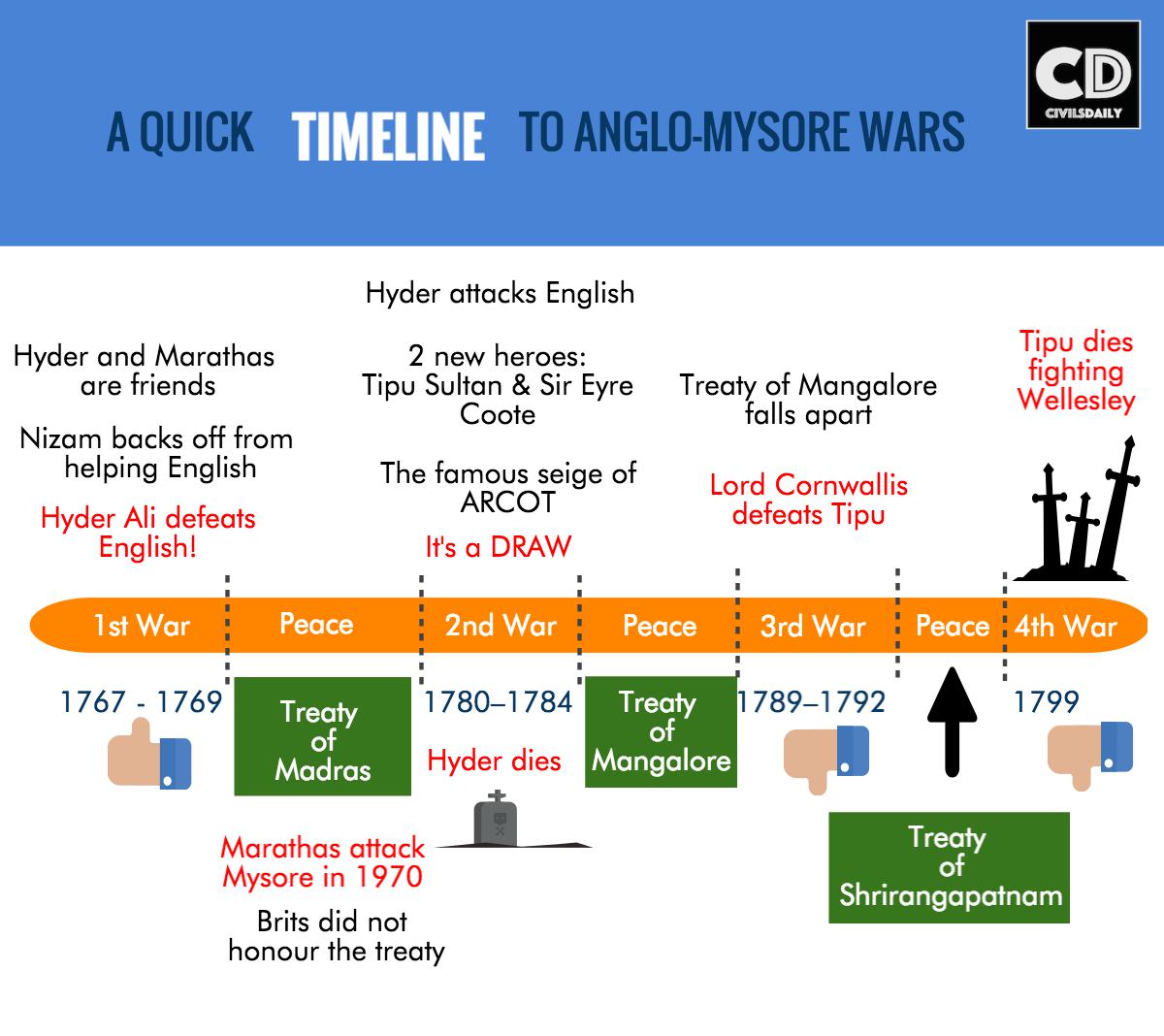
    Tipu Sultan and Anglo-Mysore Wars (1767-1799)

    Legend of Tipu Sultan and Haidar Ali:

    • Rise of Haidar Ali: Started as a horseman in the Mysore army and became de facto ruler by 1761 through military skill.
    • Military Reforms: Introduced Western training, built arms factories with French help, and strengthened cavalry and artillery.
    • Tipu Sultan: Born in 1751, trained by French officers and well-versed in Islamic law, Persian, Arabic, and science.
    • Administrative Innovations: Introduced a new calendar, land revenue reforms, and coins in gold, silver, and copper with Persian inscriptions.
    • Governance and Industry: Created seven departments, promoted silk industry, and envisioned the future Kannambadi Dam.
    • French Alliance: Maintained strong ties with France, alarming the British amid global Anglo-French rivalry.
    • Technological Advancement: Deployed iron-cased Mysorean rockets, which inspired British Congreve rockets.
    • Moral Governance: Banned liquor, gambling, and prostitution to enforce discipline.
    • Religious Policy: Though devoutly Islamic, he patronized temples and mathas, but faced criticism for intolerance in annexed regions.

    About the Anglo-Mysore Wars:

    First Anglo-Mysore War (1767–69)

    • Alliance Against Mysore: British, Marathas, and Nizam formed a coalition against Haidar Ali.
    • Diplomatic Victory: Haidar neutralized the Marathas and secured Nizam’s support.
    • Outcome: Treaty of Madras (1769) restored the status quo and mutual restitution of territories.

    Second Anglo-Mysore War (1780–84)

    • Trigger: British violation of the Treaty of Madras and occupation of French port Mahe.
    • Coalition Formation: Haidar allied with Marathas and Nizam against the British.
    • Major Battle: Captured Arcot and defeated Col. Baillie; Haidar died in 1782.
    • Conclusion: Tipu continued the fight; Treaty of Mangalore (1784) was the last time an Indian power dictated terms to the British.

    Third Anglo-Mysore War (1790–92)

    • Cause: Tipu’s attack on Travancore, a British ally.
    • British Response: Cornwallis led a coordinated campaign with Maratha and Nizam support.
    • Result: Tipu ceded half his territory and paid ₹3 crore under the Treaty of Seringapatam (1792).

    Fourth Anglo-Mysore War (1799)

    • British Strategy: Wellesley isolated Tipu diplomatically over his French ties.
    • Final Battle: Tipu was killed defending Seringapatam on May 4, 1799, ending native resistance in South India.

    Aftermath of the Wars:

    • Fall of Resistance: Tipu’s death marked the end of organized native military opposition in the South.
    • British Control: Wodeyars reinstated as puppet rulers under Subsidiary Alliance; key territories annexed by the British.
    • Territorial Division: Nizam received Gooty and Gurramkonda; Marathas declined British land offer.
    • Administrative Changes: Mysore came under direct British rule in 1831 due to alleged misrule; restored to Wodeyars in 1881 by Lord Ripon under a constitutional monarchy.
    • Legacy: Anglo-Mysore Wars showed how native resistance could challenge colonial power through modernization, alliances, and tactical innovation.
    • Rocketry Influence: Tipu’s military rocketry was studied and adapted by the British into European warfare.
    [UPSC 2014] With reference to the Anglo-Mysore Wars, consider the following statements:

    1. In the Third Battle of Panipat, Ahmed Shah Abdali defeated Ibrahim Lodi.

    2. Tipu Sultan was killed in the Third Anglo-Mysore War.

    3. Mir Jafar entered in a conspiracy with the English for the defeat of Nawab Siraj-ud-daulah in the Battle of Plassey.

    Which of the statements given above is/are correct?

    (a) 1, 2 and 3 (b) 3 only* (c) 2 and 3 (d) None


  • In news: Nagari Pracharini Sabha

    Why in the News?

    As language debates rise in Maharashtra and Tamil Nadu, the historic Nagari Pracharini Sabha, key to promoting Hindi and Devanagari, quietly resumed its work after decades.

    Hindi Under the British: A Language in Waiting

    • Until the late 19th century, Persian remained the court language in much of India. Even by 1861, courts in North-Western Provinces and Oudh still used English, Persian, and Urdu.
    • Hindi struggled to assert itself due to a lack of standardised vocabulary and administrative acceptance.
    • British official Antony MacDonnell began promoting Devanagari over Persian script in the 1890s.
    • On July 14, 1888, Maharaja Lakshmeshwar Singh of Darbhanga adopted Hindi as the official language in his region, influenced by the slogan “Hindi, Hindu, Hindustan.”

    About Nagari Pracharini Sabha:

    • Establishment: The Nagari Pracharini Sabha was founded on 16 July 1893 at Queen’s College, Varanasi by Shyamsundar Das, Pandit Ramnarayan Mishra, and Shivkumar Singh.
    • Early Patronage: The Sabha received initial support from Babu Radhakrishna Das, a cousin of Bharatendu Harishchandra, a leading figure in modern Hindi literature.
    • Organizational Presence: Its headquarters are located in Varanasi, with additional branches in New Delhi and Haridwar.
    • Primary Mission: The Sabha aimed to promote the Hindi language and Devanagari script in education, administration, and literature during a period dominated by Persian, Urdu, and English.
    • Library Establishment: In 1896, it established the Arya Bhasha Pustakalaya, which became the largest Hindi library in India.
    • Research Journal Launch: Also in 1896, it began publishing the Nagari Pracharini Patrika, now recognized as India’s oldest and most authoritative Hindi research journal.
    • Cultural Contributions: It managed the Bharat Kala Bhavan museum, until it was eventually transferred to Banaras Hindu University.
    • Modern Revival: After years of inactivity and disputes, it was revived in 2023 under Vyomesh Shukla’s leadership, following a court order from the Allahabad High Court.

    Its Role in Hindi Promotion:

    • Linguistic Standardization: It conducted surveys in rural and urban areas to collect regional vocabulary, laying the groundwork for a standardized Hindi language.
    • Lexicographic Landmark: This effort led to the publication of Shabd Sagar in 1929, a monumental 11-volume Hindi dictionary and a major lexicographical achievement.
    • Literary Influence: It published Saraswati magazine from 1900, edited by Mahavir Prasad Dwivedi, which played a transformative role in shaping modern Hindi literature.
    • Preservation of Classics: It produced critical editions of works by poets like Surdas, Tulsidas, Kabirdas, Bihari, and Bhushan, ensuring the preservation of Hindi literary heritage.
    • Official Language Recognition: The Sabha’s advocacy led to the recognition of Hindi in Devanagari script for official use in the North-Western Provinces and Oudh by the early 20th century.
    • Civil Service Policy Impact: It was instrumental in making Hindi and Urdu proficiency a requirement for government jobs in the United Provinces.
    • National Literary Conferences: In 1910, it helped organise the first Akhil Bharatiya Hindi Sahitya Sammelan, giving Hindi a pan-Indian literary platform.
    • Support from National Leaders: The Sabha’s mission was endorsed by Mahatma Gandhi, Bal Gangadhar Tilak, Madan Mohan Malaviya, Lala Lajpat Rai, and Motilal Nehru, indicating its central role in the Hindi movement.
    [UPSC 2021] Consider the following statements:

    1. 21st February is declared to be the International Mother Language Day by UNICEF.

    2. The demand that Bangla be one of the national languages was raised in the Constituent Assembly of Pakistan.

    Which of the above statements is/are correct?

    Options: (a) 1 only (b) 2 only* (c) Both 1 and 2 (d) Neither 1 nor 2


  • Who are the Girmitiyas?

    Why in the News?

    PM Narendra Modi, while speaking in Trinidad and Tobago, paid tribute to the Girmitiyas—19th-century indentured Indian labourers who helped shape Indo-Caribbean culture.

    About Girmitiyas:

    • Overview: The word “Girmitiya” comes from “agreement,” which was pronounced as “girmit” by Indian labourers who signed contracts to work abroad.
    • Origin of the Labourers: Most Girmitiyas were recruited from eastern Uttar Pradesh and Bihar, especially from areas suffering poverty or famine.
    • Language and Community: These workers primarily spoke Bhojpuri, Awadhi, or Hindi and came from agricultural castes and communities.
    • Role of Recruitment Agents: Agents known as arkatis enticed labourers with promises of good wages while hiding the reality of harsh plantation conditions.
    • Scale and Scope of Migration: Between 1834 and 1920, over 1.2 million Indians were sent to British colonies like Mauritius, Fiji, Trinidad & Tobago, Guyana, South Africa, and Suriname.
    • Cultural Continuity Abroad: Despite minimal belongings, Girmitiyas preserved Indian languages, religious practices, and cultural expressions like Ramleela in the Caribbean.

    Indentured Labour System: A New Form of Slavery:

    • Post-Abolition Labour Need: After slavery ended in 1834, the British created the Indian Indentured Labour System to meet the demand for plantation workers.
    • Contract Terms and Reality: Although the agreement lasted five years, labourers were often deceived, worked in poor conditions, and could not change employers.
    • Criminalisation of Movement: If a labourer was found outside the plantation without documentation, they could be arrested for vagrancy.
    • Punitive Wage Deductions: Tactics like the “double-cut” system—cutting two days’ pay for one day’s absence—made the system exploitative.
    • Wage Withholding: Employers often withheld wages to delay repatriation and trap labourers in economic dependence.
    • Gender Exploitation: Women were underrepresented, often brought for demographic balance, and suffered wage discrimination and sexual abuse, as documented by scholars like Kamala Kempadoo.
    • Critique by Historians: While colonial rulers called it a “Great Experiment,” historian Hugh Tinker famously termed it “a new system of slavery” in his 1974 book.

    Who are the Girmitiyas?

    Gandhiji’s Campaign Against Indenture:

    • Early Opposition: Mahatma Gandhi opposed the system after witnessing its abuse during his legal work in South Africa.
    • Malaviya’s Blocked Attempt: In 1917, Pandit Madan Mohan Malaviya tried to introduce a bill for abolition but was denied by the British colonial government.
    • Protest Strategy: Gandhi launched an all-India movement, using the press, public meetings, and moral advocacy to gather support.
    • Engagement with British: Gandhi met with Viceroy Lord Chelmsford and united national leaders in opposition to the practice.
    • Finally, Abolition: The mounting public pressure led to the official abolition of indentured labour on July 31, 1917.
    • Moral Significance: Gandhi later wrote in My Experiments with Truth that the victory represented India’s moral and spiritual awakening under nonviolent protest.


    [UPSC 2019] With reference to the British colonial rule in India, consider the following statements:

    1. Mahatma Gandhi was instrumental in the abolition of the system of ‘indentured labour’.

    2. In Lord Chelmsford’s ‘War Conference’, Mahatma Gandhi did not support the resolution on recruiting Indians for World War.

    3. Consequent to the breaking of the Salt Law by the Indian people, the INC was declared illegal by the colonial rulers.

    Which of the statements given above are correct?

    Options: (a) 1 and 2 only (b) 1 and 3 only* (c) 2 and 3 only (d) 1, 2 and 3


  • 170th Anniversary of Santhal Revolt 

    Why in the News?

    Jharkhand on observed ‘Hul’ Diwas to commemorate the rebellion’s 170th anniversary of Santhal Revolt which was held on June 30, 1855.

    santhal

    About the Santhal Revolt:

    • Overview: The Santhal Hul (Revolt) began on June 30, 1855, in present-day Jharkhand, and is observed annually as Hul Diwas.
    • The ‘Hul’: It means revolution, symbolising one of India’s earliest organized uprisings against British colonialism, even before the 1857 Revolt.
    • Leaders Associated: It was led by Sidho, Kanho, Chand, Bhairav Murmu, and sisters Phulo and Jhano, and gathered support from 32 different tribal and non-tribal communities.
    • Nature of the Revolt: The Santhal Hul was marked by tribal unity, guerrilla warfare, and was primarily an agrarian uprising, not driven by religion or elite politics.
    • Causes:
      • Exploitation by Landlords: It opposed the British East India Company, the Zamindari system, and moneylenders who exploited tribal communities.
      • Damin-i-Koh Policy: In 1832, the British created Damin-i-Koh in the Rajmahal Hills to resettle Santhals from Bengal and Jharkhand to clear forests and take up agriculture.
      • Alienation: Santhals were subjected to land alienation, forced labor (like kamioti and harwahi), usurious debt traps, and Zamindari-court-police nexus oppression.
    • Suppression measures: The British imposed Martial Law on November 10, 1855, and crushed the uprising by January 3, 1856, using modern firearms and war elephants; Sidho and Kanho were killed in action.
    • Continued resistance: Even after its suppression, tribal uprisings continued during the 1857 Sepoy Mutiny in areas like Hazaribagh and Manbhum (now Dhanbad and Purulia).

    Key Outcomes of the Revolt:

    • Santhal Pargana Tenancy Act (1876): This law banned land transfers to non-Adivasis, allowed inheritance under tribal customs, and protected Santhal self-governance.
    • Chhotanagpur Tenancy Act (1908): Inspired by later tribal movements, it restricted sale of tribal and Dalit land, and required Collector’s approval for land transfer within caste and locality.
    • Impact on Tribal Identity: The revolt helped shape tribal consciousness, legal land safeguards, and anti-colonial resistance legacies.
    • Modern Legacy: The Santhals are now India’s third-largest tribal group, living in Jharkhand, Bihar, Odisha, and West Bengal, and they use the ‘Ol Chiki’ script to preserve the Santhali language.
    [UPSC 2018] After the Santhal Uprising subsided, what was/were the measure/measures taken by the colonial government?

    1. The territories called `Santhal Parganas’ were created.
    2. It became illegal for a Santhal to transfer land to a non-Santhal.

    Select the correct answer using the code given below:

    Options: (a) 1 only (b) 2 only (c) Both 1 and 2 (d) Neither 1 nor 2


  • Who was Sree Narayan Guru (1856–1928)?

    Why in the news?

    The Prime Minister recently addressed a commemorative event marking 100 years of the historic conversation between Sree Narayana Guru and Mahatma Gandhi.

    About Sree Narayana Guru:

    • Early Life: Sree Narayana Guru was born on 22 August 1856 in Chempazhanthy, Kerala, into the Ezhava community, considered the so-called ‘avarna’ or outside the caste system.
    • Social Reform: He led a peaceful revolution against caste discrimination and promoted social equality and spiritual upliftment in Kerala.
    • Famous Slogan: Guru gave the powerful message — “One Caste, One Religion, One God for All”, calling for unity beyond caste or creed.
    • Spiritual Philosophy: A follower of Advaita Vedanta, he reinterpreted it to assert that divinity exists in every individual, regardless of caste.
    • Death and Legacy: He passed away on 20 September 1928, and his birth and death anniversaries are now observed as public holidays in Kerala and other states.

    His Contributions:

    • Temple Reform: In 1888, he consecrated a Shiva idol at Aruvippuram, challenging Brahminical control over temples.
    • Organisational Impact: He founded the Sree Narayana Dharma Paripalana (SNDP) Yogam in 1903, with Kumaran Asan as its first general secretary.
    • Social Movements: He supported the Vaikom Satyagraha (1924–25) against untouchability in public spaces.
    • Spiritual Centres: Guru established the Sivagiri Mutt (1904), which became the heart of the Sivagiri Pilgrimage (Theerthadanam).
    • Writings: His works, like Advaitha Deepika, Atmavilasam, Daiva Dasakam, and Brahmavidya Panchakam, reflect a spiritual and reformist vision.
    • Holistic Upliftment: He promoted education, cleanliness, agriculture, and handicrafts for self-reliance.
    • Against Conversions: Guru opposed religious conversion as a caste solution, favouring internal reform within Hindu society.

    His Conversations with Gandhiji (1925):

    • Historic Meeting: Mahatma Gandhi met Guru on 13 March 1925 at Sivagiri Mutt during the Vaikom Satyagraha.
    • On Scriptures: Guru clarified that Hindu texts do not support untouchability and backed the Vaikom movement fully.
    • On Salvation: He believed that all religions lead to moksha but stressed that material freedom is key to dignity.
    • Inclusive Ashrams: He shared that his ashrams welcomed all castes, with children studying and praying together.
    • View on Caste: While Gandhi defended varna in principle, Guru critiqued caste as rigid, anti-freedom, and regressive.
    • Mutual Respect: Gandhi was deeply moved and later praised Guru as a “holy soul”, calling Sivagiri a model of harmony.
    • Enduring Legacy: The meeting symbolised a blend of spiritual wisdom and social reform, with lasting national impact.
    [UPSC 2019] Consider the following pairs:

    Movement/Organization Leader

    1. All India Anti-Untouchability League Mahatma Gandhi 2. All India Kisan Sabha Swami Sahajanand Saraswati 3. Self-Respect Movement E. V. Ramaswami Naicker

    Which of the pairs given above is/are correctly matched?

    Options: (a) 1 only* (b) 1 and 2 only (c) 2 and 3 only (d) 1, 2 and 3