Mains Ready By December. Smash Mains & Smash PYQ Admissions Open

GS Paper: GS1-04.Post-Independence- Consolidation and reorganisation within country

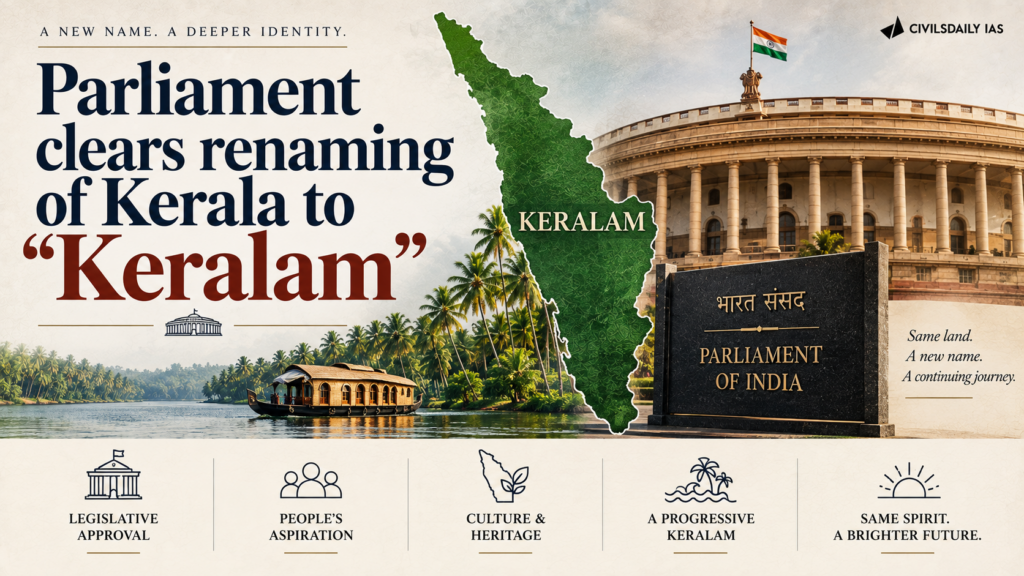
  • Parliament clears renaming of Kerala to “Keralam”

    Why in the News

    Both Houses passed a Bill to rename Kerala as “Keralam”, its name in Malayalam. The change follows two resolutions of the Kerala Assembly and routes through the constitutional process for altering a state’s name.

    How is a state renamed under the Constitution?

    1. Parliament’s power: Under Article 3, Parliament can alter the name of a state by law.
    2. Presidential referral: Such a Bill needs the President’s recommendation and the views of the affected state legislature.
    3. Simple majority: The change is passed by ordinary legislative majority, not a constitutional amendment.

    Why “Keralam”?

    1. Linguistic identity: “Keralam” is the state’s name in Malayalam, and the change aligns official usage with local usage.
    2. Assembly resolutions: The Kerala Assembly twice sought the change unanimously.

    Why does the process matter?

    1. Union primacy: Only Parliament, not the state, can effect the legal renaming.
    2. Federal courtesy: The state legislature’s view is sought, but its resolution is not binding.

    Back2Basics: Article 3 of the Constitution

    1. Scope: Formation of new states and alteration of areas, boundaries, or names of existing states.
    2. Initiation: Only on the President’s recommendation, after seeking the state legislature’s views.
    3. Nature: Treated as an ordinary law, reflecting the “indestructible states” feature of Indian federalism.

    “[2022, GS1, 15] The political and administrative reorganization of states and territories has been a continuous ongoing process since the mid-nineteenth century. Discuss with examples.”

    [2025] Consider the following pairs :
    State:Description

    1. Arunachal Pradesh: The capital is named after a fort, and the state has two National Parks
    2. Nagaland: The State came into Existence on the basis of a Constitutional Amendment Act.
    3. Tripura: Initially a Part ‘C’ State, it became a centrally administered territory with the reorganization of State in 1956 and later attained the status of a full-fledged State
    How many of the above pairs are correctly matched?

    [A] Only one

    [B] Only two

    [C] All the three

    [D] None

  • Discuss whether the formation of new states in recent times is beneficial or not for the economy of India.

    Formation of Chhattisgarh, Jharkhand, Uttarakhand in 2000, Telangana in 2014, and the reorganization of Jammu and Kashmir in 2019 were driven by demands for administrative efficiency, regional development, identity recognition, and better governance.

    Benefits of new state formation for the economy of India

    Higher growth rate – Eg- Uttarakhand’s economy has grown over 20 times in size in 23 years

    Balanced regional development – Addresses neglect of backward regions within larger states. Eg- Uttarakhand focused on hill infrastructure and tourism-led growth.

    Improved capital expenditure prioritization – Eg- Telangana increased irrigation spending through projects like Kaleshwaram.

    Fiscal focus on local needs – Eg- Hill-area connectivity in Uttarakhand vs plains-focused spending earlier.

    Better resource utilization –

    Telangana focused on IT and Pharma, leading to a GSDP share increase from 4.1% in 2014 to nearly 5% of national GDP by 2024-25.

    Jharkhand (40% of India’s mineral wealth) and Chhattisgarh significantly improved their mining and steel output post-formation.

    Employment generation – Eg- New state secretariats, universities, and agencies creating jobs.

    Competitive federalism gains – States innovate to attract investment. Eg- Telangana’s TS-iPASS single-window clearance system.

    Urban growth engines – New capitals stimulate construction and services. Eg- Development of Amravati in Andhra Pradesh.

    Administrative efficiency – reduced the “distance” between the government and the governed lead to faster and efficient decision-making. Eg- improved PDS coverage in Chhattisgarh.

    Counter-arguments – drawbacks for the economy of India

    Revenue dependence – New states rely heavily on central transfers.

    Uneven development within new states – Eg- Tribal belts in Chhattisgarh remain underdeveloped.

    Fragmentation of the national market – Eg- Different state-level compliances increasing transaction costs.

    Inter-state disputes over resources – Water, power, and assets become contentious. Eg- Krishna-Godavari water disputes between Telangana and Andhra Pradesh.

    High administrative costs –

    Creation of capitals, assemblies, and cadres strains finances. Eg- creation of Amravati

    Increase in per-unit costs of administration due to duplication of departments.

    Over-Administration also fuels corruption. Eg- Pooja Singhal case

    Weak institutional capacity – New administrations take time to mature. Eg- Staffing shortages and governance gaps in Uttarakhand.

    No automatic growth guarantee – Outcomes depend on governance quality. Eg- political instability in states like Jharkhand and Chhattisgarh deter long-term foreign investment.

    Environmental Degradation- Eg- industrialization and urbanization has led to disasters like the 2013 Kedarnath floods and 2023 Joshimath subsidence – High economic losses

    Way Forward

    Formation 2nd state reorganisation commission as suggested by Sudha Pai

    Strengthening cooperative federalism through Inter-state council – mandatory meetings and enforcement powers

    Strengthening fiscal federalism – Eg- state representation in Finance commission

    New state formation should be guided by objective economic criteria and robust transition planning to ensure that political reorganization strengthens economic growth.

  • Assess the main administrative issues and socio-cultural problems in the integration process of Indian Princely States. (150 words)

    The integration of 565 princely states into the Indian Union was one of the most complex administrative and socio-cultural challenges faced by independent India.

    Main Administrative Issues

    Proliferation of Small Principalities: Managing hundreds of fragmented, tiny states made coordinating a uniform consensus for accession exceptionally difficult.

    With British departure, paramountcy lapsed, giving princely states theoretical independence or choice to join India or Pakistan. Eg- Hyderabad, Junagadh, and Kashmir posed major challenges.

    Resistance of Rulers – Many rulers were reluctant to surrender sovereignty and merge with India

    Nizam of Hyderabad declared independence; required Operation Polo (1948) for integration.

    Nawab of Junagadh acceded to Pakistan despite Hindu-majority population, requiring Indian military intervention.

    Administrative Reorganisation

    Diverse administrative systems, revenue codes, and legal frameworks had to be unified.

    Some states were merged into provinces, others into unions (Eg- Rajasthan formed by merging 19 states).

    Privy Purse and Privileges created a long-term financial burden and was abolished only in 1971 by Indira Gandhi.

    Disbanding or absorbing irregular princely state armies into the unified Indian Armed Forces presented severe logistical and ranking issues.

    Socio-Cultural Problems

    Demographic and Religious Mismatches: Severe tensions emerged in regions where the ruler’s personal faith differed completely from the majority population. Eg- J&K

    Feudal social structures – entrenched landlordism, bonded labour, and caste hierarchies in princely territories.

    Low levels of education and modern administration in many princely states.

    Regional and linguistic identities complicated integration. Eg- Demand for linguistic reorganisation (SRC, 1956).

    Tribal and ethnic tensions in areas like Northeast India and Bastar.

    Deep-Rooted Feudal Allegiances: Decades of monarchical rule left local populations culturally more loyal to traditional princes than to a distant democratic federation.

    Communal Violence: The trauma of Partition ignited communal polarization in several states, making peaceful, secular integration harder to enforce.

    Sardar Patel‘s monumental efforts successfully overcame these multi-layered fractures, forging a unified, democratic, and geographically cohesive Indian nation.