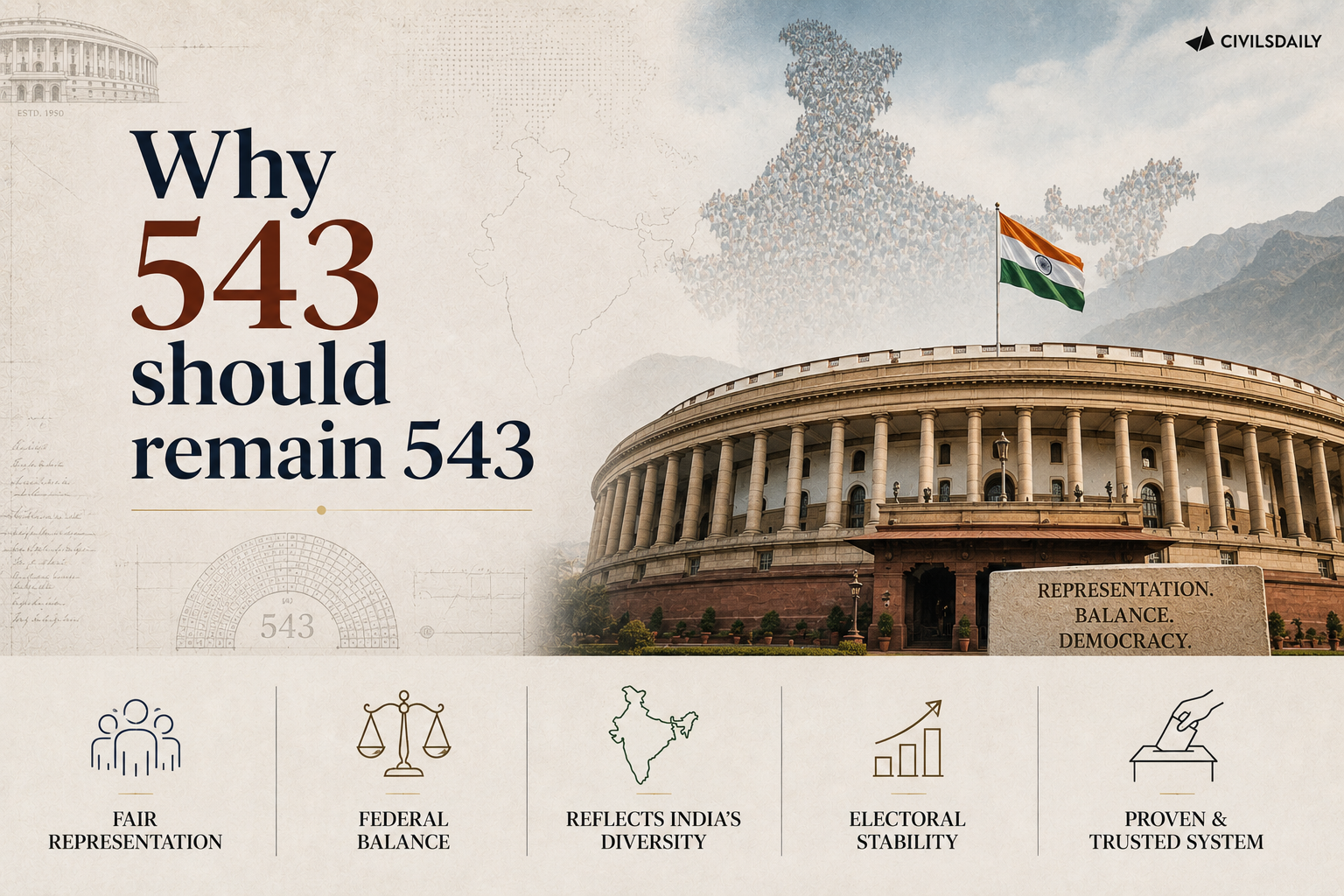
After both Houses of Parliament were adjourned sine die, the monsoon session has yet to be formally prorogued, prompting speculation that Parliament could be reconvened for another attempt at the constitutional amendment linked to delimitation and women’s reservation. That uncertainty sharpens a question Parliament must confront: whether delimitation, the redrawing of constituency boundaries to reflect population change, must necessarily mean enlarging the Lok Sabha beyond its present 543 seats. The government has reportedly suggested increasing every State’s representation by roughly 50 percent so each keeps its current proportion of seats, a formula that leaves the proportional balance between States unchanged even as it widens the absolute gap in their voting strength.
What is the constitutional basis linking delimitation to the Lok Sabha’s size?
The representation principle: Article 81 requires that representation broadly correspond to population “so far as practicable,” while Article 82 provides for a fresh delimitation exercise after every Census.
The 1976 freeze: The 42nd Constitutional Amendment, 1976 froze the inter State allocation of Lok Sabha seats on the basis of the 1971 Census, so States that succeeded in family planning were not politically penalised for slowing population growth.
The extension: The freeze was extended by the 84th Constitutional Amendment, 2001 until the first Census conducted after 2026 is published.
Why does a proportional expansion still favour larger States?
Proportions stay the same: A roughly 50 percent increase in every State’s seats would keep each State’s share of the Lok Sabha unchanged from today.
But the absolute gap widens: If Uttar Pradesh’s seats rose from 80 to 120 and Tamil Nadu’s from 39 to about 59, the proportional relationship would hold, yet the absolute gap in voting strength would widen from 41 Members of Parliament to around 61.
Why the gap matters: Parliament votes in absolute numbers rather than proportions, so governments, confidence motions and constitutional amendments would all turn on a wider numerical gap than exists today.
Can delimitation happen without enlarging the House?
A precedent already exists: The delimitation exercise after the 2001 Census reorganised constituencies within States while leaving the existing inter State seat allocation untouched.
The same principle can apply again: The Census expected in 2027 could provide the basis for redrawing constituencies within each State to reflect demographic movement and urbanisation, without increasing the Lok Sabha beyond 543 seats.
What do other democracies show about legislature size and population growth?
United States: The House of Representatives has remained at 435 voting members for more than a century, despite the country’s population growing many times over.
Switzerland: The National Council has stayed at 200 members since 1963.
Hungary: Parliament was reduced from 386 members to 199.
Italy: The Chamber of Deputies was cut from 630 members to 400.
What would a larger Lok Sabha do to Parliament’s own functioning?
Fixed parliamentary time: Parliamentary time does not expand with the number of Members of Parliament, so even with 543 members, many already get few opportunities to speak, ask questions or raise matters of public importance.
A larger House would worsen this: A Lok Sabha enlarged to more than 800 members would reduce those opportunities further even as numerical representation rises.
Already outsized constituencies: Indian Members of Parliament already represent the largest average constituencies among the world’s major democracies, several times the size of a United States congressional district or a United Kingdom constituency.
Where should the accessibility pressure from population growth be absorbed instead?
No federal arithmetic constraint at the State level: A larger Vidhan Sabha, or State Legislative Assembly, shifts no balance between States, since each Assembly answers only to its own State’s population.
The proposed shift: Strengthening representation through more Members of the Legislative Assembly and smaller Assembly constituencies can bring representatives closer to citizens without enlarging the national legislature, since most citizens approach elected representatives over matters substantially within the State sphere, such as roads, schools and hospitals.
How does women’s reservation fit within a frozen 543 seat House?
The existing House can absorb it: One third of the present Lok Sabha is approximately 181 seats, and women’s constitutionally promised representation can be delivered within the existing House of 543 rather than through additional seats.
What reservation is meant to do: The purpose of reservation is to alter who occupies parliamentary seats, not to create hundreds of additional ones.
The risk of combining it with enlargement: An expansion on the proposed scale could raise the number of women Members of Parliament while also deepening the numerical dominance of the already larger States, so a reform addressing one imbalance could deepen another.
Challenges to keeping the Lok Sabha frozen at 543
Political resistance from faster growing States: States whose population has grown fastest since 1971 may resist a freeze that keeps their Lok Sabha strength unchanged relative to their current population share. Eg. States with higher population growth could press for the government’s enlargement proposal precisely because it raises their absolute seat count. Fix. Pair the freeze with strengthened State level representation, so faster growing States gain proportionate voice through larger Assemblies rather than through the Lok Sabha.
Redrawing constituencies within States is itself contentious: Internal redelimitation shifts constituency boundaries and can alter the political weight of specific regions or social groups within a State, so it invites dispute even where a State’s total seat count is untouched. Eg. The Jammu and Kashmir Delimitation Commission’s 2022 exercise was contested by opposition parties as tilting the balance toward one region over another. Fix. Anchor any internal redelimitation in updated, transparent 2027 Census data, with a public objection and hearing process before boundaries are finalised.
A prolonged freeze delays updated representation: Continuing the freeze until the first post 2026 Census pushes any change in the Lok Sabha’s internal distribution well into the future, leaving current population shifts unreflected for years. Eg. The freeze first imposed in 1976 has already run for close to half a century without a fresh count of inter State seat shares. Fix. Commit to a fixed timeline for the post 2026 Census based delimitation, so the freeze does not become indefinite by default.
Conclusion
Delimitation and the size of the Lok Sabha are separable questions, and preserving the House at 543 seats while redrawing constituencies within States and absorbing accessibility pressure through larger State Assemblies would deliver updated representation, women’s reservation and federal fairness without disturbing the balance between larger and smaller States. Whether Parliament chooses this route or an across the board enlargement that widens the absolute gap between States even as it keeps their proportions unchanged will shape the federal balance of the Republic for decades, a question that stays open as long as the constitutional amendment remains pending.
Back2Basics: What is a Delimitation Commission?
What it is: A Delimitation Commission is a body constituted under a Delimitation Act to redraw the boundaries of parliamentary and Assembly constituencies based on the latest Census.
How many: Delimitation Commissions have been constituted four times in independent India, in 1952, 1963, 1973 and 2002.
Legal basis: Its orders have the force of law and cannot be challenged in a court.
Latest exercise: The most recent Commission, based on the 2001 Census, redrew constituency boundaries within States without altering the inter State allocation of Lok Sabha seats frozen since 1976.
[2024] How many Delimitation Commissions have been constituted by the Government of India till December 2023?
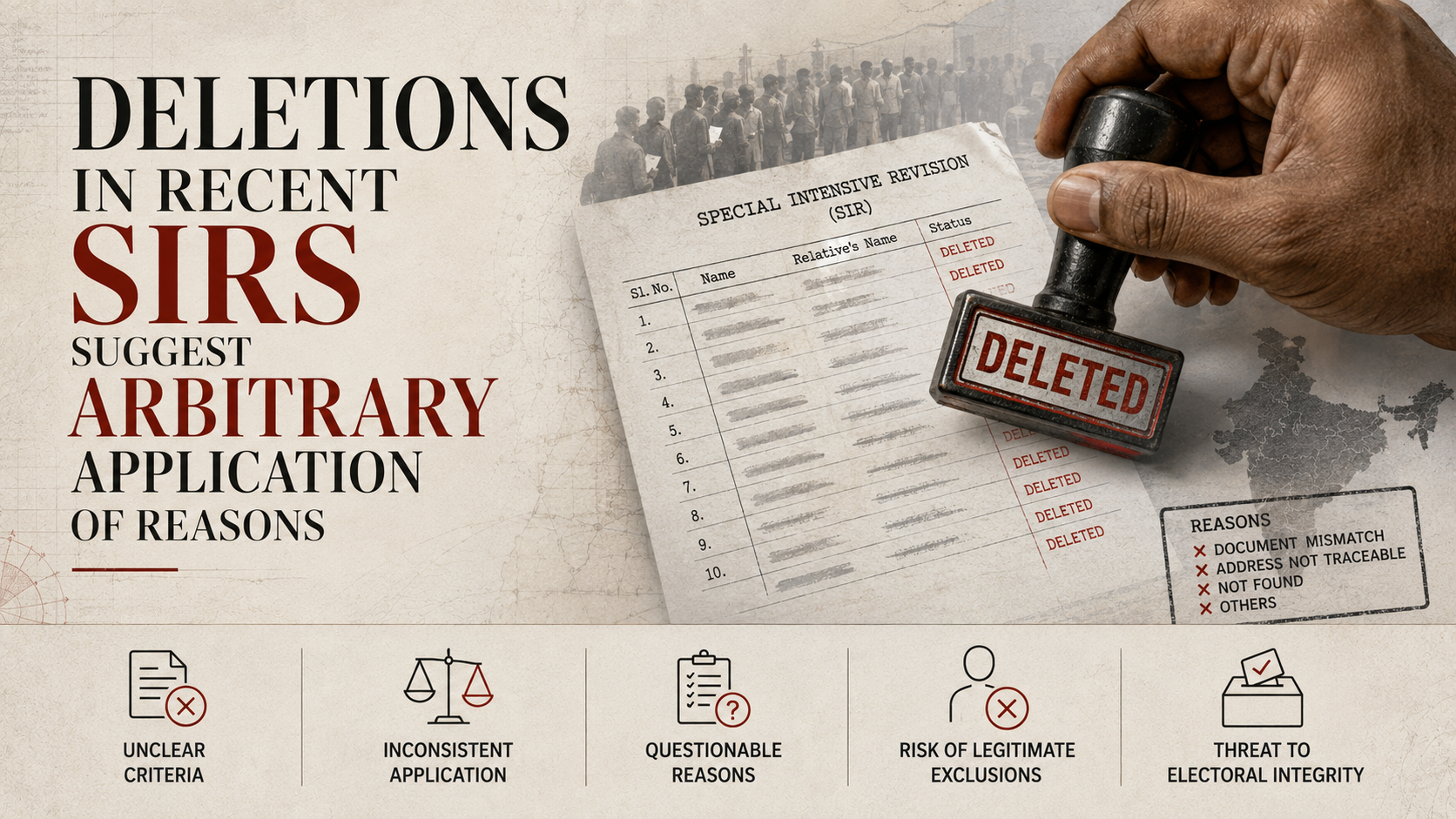
Draft electoral rolls released after the enumeration phase of the Special Intensive Revision (SIR), an exercise conducted by the Election Commission to verify every elector afresh rather than only updating additions and deletions, show wide variation in the reasons recorded for deleting names in Karnataka and Telangana. Both states saw roughly one-fifth of their electors deleted, the highest share among major states. A reason-wise breakdown of the deletions shows extreme, inconsistent use of the two largest deletion categories, “Shifted” and “Absent”, across constituencies of comparable size. The Election Commission has not defined when a Booth-level Officer (BLO) should mark an elector “Shifted” rather than “Absent”, and has never published the break-up between the two categories.
What do the numbers show?
No defined threshold between categories: The Election Commission’s Manual on Electoral Rolls, 2023 states that a person absent temporarily from their ordinary residence does not, by law, cease to be ordinarily resident there, which raises the question of whether an elector found “Absent” during enumeration should be deleted at all. The manual gives BLOs no rule for choosing between “Shifted” and “Absent”.
Wide swings between similar constituencies in Telangana: Of 1,79,510 deletions in Jubilee Hills, 83% were marked “Shifted” and only 15,000 “Absent”. In the comparably sized Nizamabad (Urban), 50,307 of 83,282 deletions were marked “Absent”. In Nakrekal (SC), all 20,169 deletions were marked as reasons other than “Absent”, with not a single elector recorded as absent.
Wide swings in Karnataka: In Hebbal, 87% of 1.3 lakh deletions were marked “Shifted” and only 287 “Absent”. In Hubli-Dharwad-East, roughly 25,000 of 47,000 deletions were marked “Absent”. In Bommanahalli, 2.65 lakh electors, 54.8% of the roll, were deleted, with only about 9,700 marked deceased.
Aggregated official reporting hides the pattern: The Election Commission has only ever published a combined figure for “Shifted” and “Absent” deletions in every state where the SIR has run. The category-wise breakdown used in this analysis was derived independently by processing thousands of constituency-level deletion lists.
Conclusion
The scale of variation in reason-coding for deletions, without a defined rule separating “Shifted” from “Absent”, points to inconsistent application rather than a uniformly applied enumeration standard. The Election Commission has not made public a category-wise breakdown for any SIR state, leaving independent verification as the only route to auditing how deletions are being classified.
Back2Basics: Special Intensive Revision (SIR)
SIR is a full re-verification of the electoral roll, requiring every elector to be freshly enumerated, unlike the routine annual “Summary Revision” that only processes additions, deletions and corrections against the existing roll.
Deletions during SIR are coded under four broad reasons: Shifted (or Permanently Shifted), Absent, Deceased and Duplicate.
“[2024, GS2, 10 marks] Examine the need for electoral reforms as suggested by various committees with particular reference to “one nation-one election” principle.”
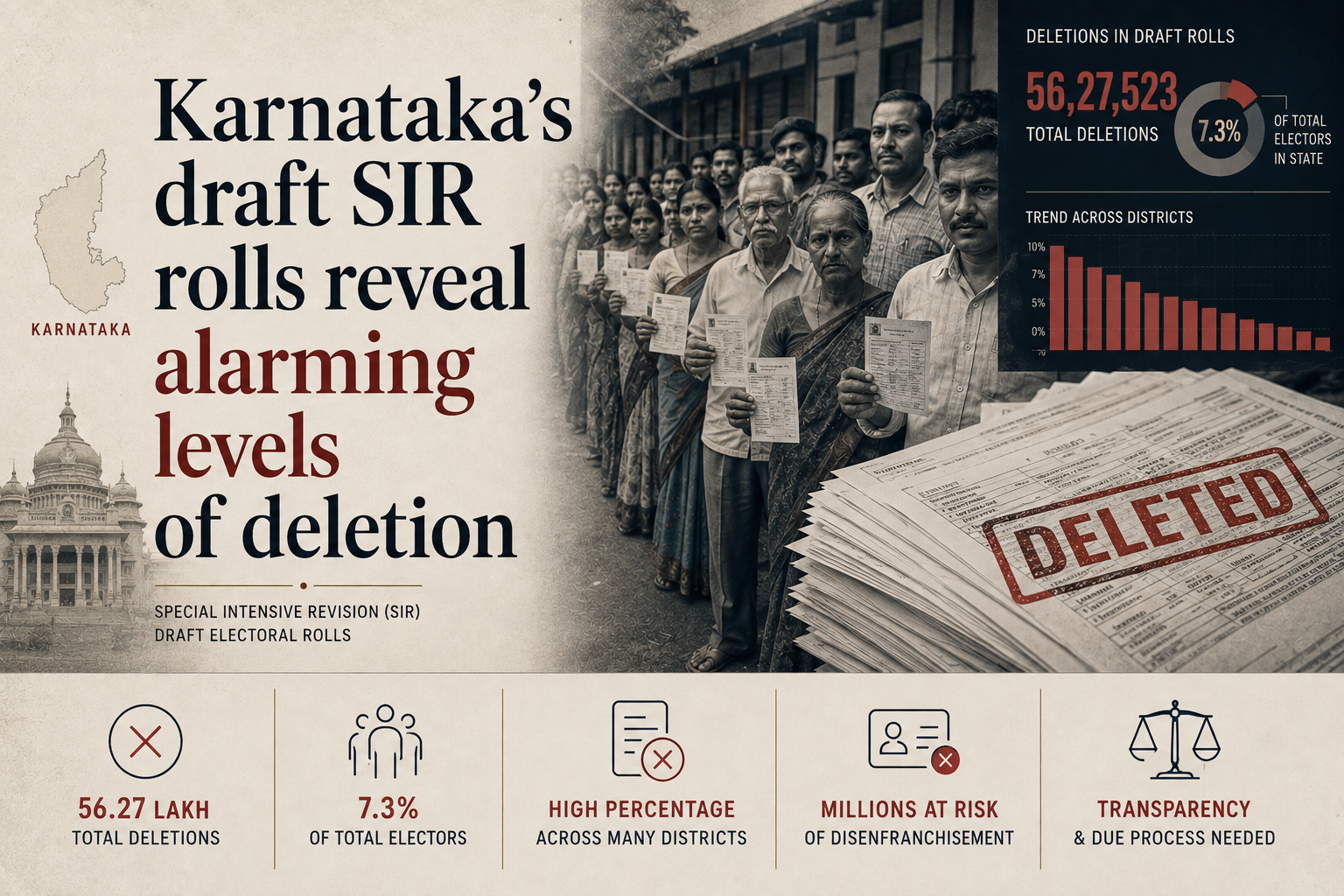
The draft electoral rolls released after the enumeration phase of the Special Intensive Revision (SIR) show Karnataka’s rolls shrinking by 19.5%, a deletion of 1.08 crore names, the second-highest deletion rate among major States after Telangana. Constituency-level analysis shows the deletions concentrated overwhelmingly in Bengaluru’s urban core, and the Election Commission’s continuing refusal to release the electors-to-population ratio, combined with Karnataka’s own opaque disclosure practices, has deepened concerns about whether the exercise can be independently verified.
What do the numbers show about how the deletions are distributed?
Five constituencies lost more than half their electors: Bommanahalli (54.8%), Dasarahalli (52.1%), B.T.M. Layout (51.6%), Vijayanagar (51.1%), and C.V. Raman Nagar (51.1%) each saw over 50% of their rolls deleted, the first time any major State has recorded constituencies crossing that threshold during SIR enumeration, and all five sit in the core Bengaluru area.
The deletions are heavily concentrated in a small number of seats: Half of the 1.08 crore deletions came from just 36 of Karnataka’s 224 Assembly Constituencies, of which 28 were in the core Bengaluru area.
A structural gap against the eligible population persists: Karnataka’s draft SIR roll is at least 67 lakh short of the population eligible to vote as estimated by the Union government’s Technical Group on Population Projections, the largest shortfall among the major States compared in the underlying data.
The “Shifted” category is unusually high even in rural constituencies: Unlike the urban-concentration pattern seen in other States, Karnataka recorded a high share of deletions marked “Shifted” even in predominantly rural constituencies.
Why is the process itself under scrutiny, independent of the deletion numbers?
The Election Commission has not released the electors-to-population ratio for any State during this SIR round: This ratio, mandatory during every roll revision, is the standard check on under- or over-enrolment, and its absence is attributed by the Commission to the lack of Census data.
Karnataka’s disclosure practice is the weakest among major States: Unlike other States that host a searchable deletion list, Karnataka’s Chief Electoral Officer has hosted the deleted-voters list only as booth-wise documents on scattered Google Drive links, in English only, without old booth numbers, making verification difficult for affected voters.
Gender-disaggregated data on deletions is missing: Karnataka has not released gender-wise deletion data, unlike other States, and the Chief Electoral Officer’s office has stated it does not hold this data.
Conclusion
The scale and concentration of Karnataka’s SIR deletions, combined with the Election Commission’s continuing non-disclosure of the electors-to-population ratio and Karnataka’s own weak search and disclosure infrastructure, leave roughly 44 lakh voters in the draft rolls facing discrepancy notices with no independently verifiable baseline against which the exercise’s accuracy can be tested.
Back2Basics
Special Intensive Revision (SIR): An intensive, house-to-house revision of electoral rolls carried out under the Representation of the People Act, 1950, distinct from the routine annual summary revision, undertaken to re-verify enrolment through fresh enumeration.
Electors-to-Population (EP) ratio: The proportion of the population eligible to vote (18 years and above) that is actually enrolled on the electoral rolls; a low EP ratio indicates under-enrolment and a high one can indicate over-enrolment or padding.
An editorial criticises the Election Commission of India for allowing large-scale, allegedly fraudulent Form 7 deletion applications to be filed during the Special Intensive Revision (SIR) in Rajasthan, Gujarat, Uttar Pradesh, and Uttarakhand. Form 7 is the prescribed form under electoral roll rules for objecting to another person’s inclusion on the roll or seeking their deletion. Large volumes of such applications, filed in bulk and allegedly by parties with no direct connection to the individual voters concerned, raise the concern that a mechanism meant for genuine, individual objections is instead being used as a tool to strike names off the roll at scale, without the safeguards a genuine objection process would apply.
Why is bulk filing of Form 7 applications a concern?
Form 7 was designed for individual, evidence-backed objections: The form allows any registered elector to object to another entry on the roll, but the process assumes each objection is filed on a specific, documented ground by someone with knowledge of that particular voter’s circumstances.
Bulk filing bypasses the individual-knowledge assumption: Reports of large batches of Form 7 applications filed together, in Rajasthan, Gujarat, Uttar Pradesh, and Uttarakhand, suggest a coordinated filing exercise rather than genuine, case-by-case objections raised by people with actual knowledge of each voter.
No standard operating procedure to screen bulk filings: The Election Commission has not published a standard operating procedure specifying how a Booth Level Officer or Electoral Registration Officer should treat an unusually large batch of objections filed from a single source or in a short window, leaving field-level officials to process each one individually regardless of the pattern.
Risk of disenfranchisement without adequate verification: A voter whose name is objected to through a bulk-filed Form 7 may be removed from the roll on a ground that was never actually verified against that specific individual’s circumstances, if the volume of filings overwhelms the verification capacity at the local level.
What safeguard does the editorial call for?
A standard operating procedure for anomalous filing patterns: The editorial’s central demand is a documented, uniform procedure specifying how Electoral Registration Officers must treat Form 7 applications filed in unusually large batches or from a common source, rather than processing every filing as an ordinary individual objection.
Verification against the objected voter, not just the objector’s paperwork: A functioning safeguard would require direct verification with the individual whose name is objected to before any deletion is finalised, rather than relying solely on the documentation the objecting party submits.
Conclusion
The editorial’s concern is that the Special Intensive Revision, meant to correct genuine errors in the electoral roll, is vulnerable to being used to strike voters off the roll at scale through a bulk-filed, individually-framed objection form that field officials are not equipped to screen. A published standard operating procedure for anomalous Form 7 filing patterns is the specific safeguard the editorial says is missing.
Back2Basics: Form 7
The prescribed form under the Registration of Electors Rules, 1960 for objecting to the inclusion of a name in the electoral roll, or seeking the deletion of an entry on stated grounds such as death or shift of residence.
Can be filed by any registered elector against another entry on the same roll, not only by the individual whose own entry is in question.
Processed by the local Electoral Registration Officer, who is required to give the affected voter an opportunity to be heard before a name is deleted.
Became a point of controversy during the 2026 Special Intensive Revision after reports of large-volume, bulk filings in several States.
Matching Previous Year Question
“[2024, GS2, 10 marks] Examine the need for electoral reforms as suggested by various committees with particular reference to “one nation-one election” principle.”
A data analysis of the Special Intensive Revision (SIR) draft rolls shows Telangana recorded the highest deletion rate of any State, at 21.7 percent, concentrated heavily in Hyderabad’s urban assembly constituencies. The analysis also flags a shift in the gender ratio of the deleted rolls, a pattern that raises the question of whether urban migration and residential churn, rather than uniform electoral-roll error, is driving Telangana’s outlier deletion rate.
What does the deletion pattern in Telangana show?
Telangana’s 21.7 percent deletion rate is the national outlier: No other State’s SIR draft rolls recorded as high a share of entries deleted as Telangana’s 21.7 percent, making it the sharpest single data point to emerge from the SIR exercise so far.
Deletions cluster in Hyderabad’s urban assembly constituencies: The deletion rate is not evenly spread across Telangana; it concentrates disproportionately in the assembly constituencies that make up Hyderabad and its adjoining urban belt.
Gender ratio shifts within the deleted rolls: The analysis flags a change in the male-to-female ratio among deleted entries compared with the surviving roll, suggesting the deletions are not gender-neutral in their incidence.
Why would an urban belt like Hyderabad see such a high deletion rate?
High residential churn in a metro labour market: Hyderabad’s urban constituencies see high rates of migration for work, with residents frequently changing addresses within the city or moving in and out of it, a pattern the SIR’s Shifted category is specifically designed to capture.
Rental housing turnover complicates address verification: A large share of Hyderabad’s urban population lives in rented accommodation with shorter tenancies than owner-occupied housing, making door-to-door verification more likely to find an address where the previously registered voter no longer lives.
Duplicate registration risk from repeated internal migration: Voters who moved within Hyderabad, or into it from elsewhere in Telangana, without formally updating their electoral roll entry each time, are more likely to end up registered more than once, feeding the Duplicate category of the ASDDO framework.
Conclusion
Telangana’s 21.7 percent deletion rate, concentrated in Hyderabad’s urban constituencies, is consistent with the residential churn that a fast-growing metro labour market produces, though the gender-ratio shift in the deleted rolls is a pattern that needs its own explanation before the deletion rate can be read as a purely administrative correction. The final roll, after the objection window closes, will show how much of the 21.7 percent survives scrutiny.
Back2Basics: ASDDO categorisation
The five-category framework, Additional, Shifted, Duplicate, Dead, and Objected, the Election Commission uses to classify every entry removed during a Special Intensive Revision.
“Shifted” covers voters found to have moved residence since their last registration, the category most directly linked to urban migration patterns.
“Duplicate” covers voters registered more than once, often from repeated, unrecorded address changes.
The categorisation is meant to make each deletion auditable against a specific, stated ground rather than an unexplained removal.
Matching Previous Year Question
“[2024, GS2, 10 marks] Examine the need for electoral reforms as suggested by various committees with particular reference to “one nation-one election” principle.”
The Election Commission of India’s draft electoral rolls under the ongoing Special Intensive Revision (SIR) show 1.07 crore names removed from Karnataka’s electoral rolls, shrinking the State’s registered electorate to 4.46 crore. Discrepancy notices have been issued to affected voters, and the deletions have been categorised under the ASDDO framework: Additional, Shifted, Duplicate, Dead, and Objected entries. Opposition parties have flagged the ASDDO categorisation as opaque, arguing that voters cannot easily determine which specific ground led to their own name being struck off.
What is the Special Intensive Revision, and what has it found in Karnataka?
A door-to-door re-verification of the electoral roll: The Special Intensive Revision (SIR) is the Election Commission’s mechanism for a fresh, ground-level re-verification of every entry on a State’s electoral roll, distinct from the routine annual summary revision.
1.07 crore names deleted from Karnataka’s rolls: The draft rolls published under the SIR remove 1.07 crore entries from Karnataka’s electoral list, a reduction large enough to shrink the State’s registered electorate to 4.46 crore.
Deletions grouped under five ASDDO categories: Every deleted entry is classified as Additional (a duplicate registration elsewhere), Shifted (moved residence), Duplicate (registered more than once), Dead (deceased), or Objected (formally objected to by another party), the ASDDO framework the Election Commission uses to justify each deletion.
Discrepancy notices issued to affected voters: Voters whose names were flagged for possible deletion have been sent discrepancy notices, intended to give them a chance to respond before the final roll is published.
Why is the ASDDO categorisation being called opaque?
No voter-level breakdown published against each category: Opposition parties argue that the aggregate 1.07 crore figure is not accompanied by a transparent, checkable breakdown showing how many entries fall under each of the five ASDDO categories, making it difficult to assess whether deletions are concentrated in a particular category prone to error.
Individual voters cannot easily verify their own category: A voter who finds their name removed has limited means to determine which of the five categories was applied to their specific entry, or to see the evidence behind that categorisation, before the final roll is locked in.
Scale of deletion invites scrutiny of the underlying process: A reduction of over a crore names is large enough, relative to Karnataka’s total electorate, that opposition parties are asking whether the field verification exercise behind the SIR was itself uniformly rigorous or prone to erroneous deletions in specific segments.
Conclusion
Karnataka’s SIR draft rolls have removed 1.07 crore names and issued discrepancy notices to affected voters, but the opacity around the ASDDO breakdown leaves the accuracy of that large a deletion unverifiable from outside the Election Commission’s own process. The final electoral roll, after voters respond to the discrepancy notices, will determine how many of the 1.07 crore deletions are contested and reversed before the list is locked.
Back2Basics: Special Intensive Revision (SIR)
A ground-level, door-to-door re-verification of a State’s entire electoral roll conducted by the Election Commission of India under its powers over roll preparation under the Representation of the People Act, 1950.
Distinct from the routine annual Summary Revision, which updates the existing roll rather than re-verifying every entry from scratch.
Uses Booth Level Officers to physically verify voter details house by house before publishing a draft roll for public objections.
Has drawn political controversy in multiple States over the scale of deletions and the transparency of the verification process behind them.
Matching Previous Year Question
“[2024, GS2, 10 marks] Examine the need for electoral reforms as suggested by various committees with particular reference to “one nation-one election” principle.”
Former diplomat Navdeep Suri has raised concerns over the process of establishing citizenship during the ongoing Special Intensive Revision (SIR) of electoral rolls in Punjab. He was issued a notice by the Election Commission of India (ECI) and asked to produce documents after discrepancies were flagged between his current details and his details in the 2003 electoral roll. Suri stated that he was not in India in 2003 and was posted at the Indian High Commission in London, so he did not participate in the SIR of that year, and that officials have therefore asked for his passport as proof. The Punjab Chief Electoral Officer has stated that his name was never removed and is part of the draft electoral roll published on 13 August 2026. The case turns on whether an elector absent from the 2003 roll can be required to establish citizenship afresh, and on what documents satisfy that requirement.
What is the Special Intensive Revision of electoral rolls?
The exercise itself: A Special Intensive Revision is a house-to-house verification of every entry in an electoral roll, conducted against a stated earlier roll used as the reference base. It differs from a summary revision, which only processes fresh claims and objections.
The reference roll in this round: The 2003 electoral roll is being used as the base against which current entries are mapped in Punjab. An elector mapped to a 2003 entry is carried forward without further documentation.
What happens when mapping fails: An elector not mapped in the 2003 SIR receives a notice from the Electoral Registration Officer and is asked to submit documents. The Booth Level Officer, the field official who maintains a polling station’s roll, delivers the notice and collects the response.
The stated purpose: The revision is intended to remove deceased electors, duplicate entries and shifted electors from the roll. The 2025 round covered 12 States and over 51 crore electors.
Why did a former ambassador receive a notice?
The 2003 mapping gap: His current details did not match his details in the 2003 electoral roll. The mismatch, not any allegation against him, generated the notice.
The reason for the gap: He was not in India in 2003 and was serving at the Indian High Commission in London at the time. He did not participate in the SIR conducted in that year.
The document then demanded: Officials asked for his passport as proof once he explained his absence. Documents he had uploaded in 2026 did not match his 2003 details.
The procedural sequence he described: He was told to come and collect the notice from the Booth Level Officer. He was then to return with documents establishing that he is an Indian citizen, and the documents required were not specified at the point of the first instruction.
His stated position: He holds documents other than a voter identity card and an Aadhaar card. He asked what the position of a common citizen would be where a person who represented India in three countries had trouble establishing citizenship.
What did the Election Commission say in response?
On removal: The Punjab Chief Electoral Officer stated that his name was never removed from the roll. It is part of the draft electoral roll published on 13 August 2026.
On his registration: His vote was registered in Amritsar and continues to be registered there. No change of constituency was involved at any stage.
On why the notice issued: He received a notice and was asked to submit documents because he was not mapped in the 2003 SIR. The trigger was the mapping gap rather than a challenge to his entry.
On the outcome: His name was published as part of the electoral roll after the documents were received. The process concluded in his favour.
On the standing of the draft roll: Publication in the draft roll on 13 August 2026 preserved his entry throughout the notice period. A notice under the revision does not by itself delete an entry.
What does the case suggest about the burden on ordinary electors?
Documentary burden falls on the elector: The revision places the obligation to produce proof on the person whose entry failed to map, not on the officer who flagged the mismatch. An elector without a document trail from 2003 has no way to discharge it.
Absence abroad becomes a defect in the record: A person outside India in 2003 could not have been enumerated in that year’s roll. The design treats that absence as a discrepancy requiring citizenship proof rather than as an expected gap.
The document list was not specified upfront: The elector was asked to return with unspecified documents showing Indian citizenship. Discretion over which document satisfies the requirement sits with the field officer.
Uploaded records did not close the gap: Documents uploaded in 2026 did not match the 2003 details and did not resolve the flag. Digital submission therefore did not substitute for the passport eventually demanded.
The professional case is the favourable case: A former ambassador holds a passport, service records and multiple identity documents. An elector whose only records are a voter identity card and an Aadhaar card, both of which the revision does not accept as proof of citizenship, faces the same demand with fewer means to meet it.
Challenges to the Special Intensive Revision
Citizenship determination sits outside the electoral machinery’s competence: The ECI registers electors under the Representation of the People Act, 1950 and does not adjudicate citizenship, which the Citizenship Act, 1955 governs. Eg. Field officers are asking electors to produce documents that show they are Indian citizens. Fix. Confine the revision to residence and identity verification and refer genuine citizenship doubts to the competent authority under the Citizenship Act, 1955.
The reference roll excludes a whole class of electors: Anyone absent from the 2003 roll for legitimate reasons carries the documentary burden of the entire exercise. Eg. An elector posted abroad in diplomatic service in 2003 was flagged and asked for a passport. Fix. Publish an exhaustive and binding list of alternative documents in advance, with a stated procedure for electors with no 2003 entry.
Selective disenfranchisement allegations follow the exercise: Concentrated deletions in particular areas invite the charge that the revision falls unevenly across communities. Eg. Opposition parties have alleged selective disenfranchisement in the States covered by the 2025 revision. Fix. Publish constituency-wise deletion and addition data with stated reasons, on a fixed schedule, so the pattern is auditable.
Booth level capacity is the binding constraint: A house-to-house verification at the coverage the 2025 round reached rests on field officers holding other full-time posts. Eg. Booth Level Officers are drawn from teaching and revenue staff and handle notice delivery alongside their regular duties. Fix. Create a dedicated cadre of full-time roll verification staff for the duration of each revision, with a fixed elector-to-officer ratio.
The appeal window is short relative to the burden: An elector must locate decades-old documents inside the claims and objections period fixed for the draft roll. Eg. In the Bihar revision of 2025 the draft roll was published on 1 August with claims and objections closing on 1 September, a single month in which an elector had to trace decades-old records. Fix. Extend the objection period where an elector has been served a notice, and require a written speaking order before any deletion.
Conclusion
An intensive revision that uses the 2003 electoral roll as its reference base converts the absence of a 2003 entry into a demand for proof of citizenship, and that demand fell on a former ambassador who was posted abroad in that year. The Election Commission’s response, recorded above, disputes the fact of removal rather than the documentary burden the process places on the elector. The unresolved question is what an elector with no 2003 entry and no passport is expected to produce. The next milestone is the disposal of claims and objections against the draft roll and the publication of the final Punjab roll.
“[2024, GS2, 10 marks] Examine the need for electoral reforms as suggested by various committees with particular reference to “one nation-one election” principle.”
Tribunals in West Bengal are struggling to handle the caseload thrown up by the ongoing Special Intensive Revision (SIR) of electoral rolls, and every State running the exercise is reporting rising numbers of electors marked “absent”, “shifted”, “dead” and “duplicate”. The Supreme Court settled the legal question in Association for Democratic Reforms and Others v. Election Commission of India and Others (May 2026). That ruling upheld the Election Commission of India’s power to conduct the revision. It also recorded the Court’s satisfaction with the procedure the Commission adopted, holding the deletions to be within the parameters of that procedure. The contest is now over whether a constitutional court that declines to scrutinise an electoral authority is protecting institutional autonomy or removing the only check available to an elector who has been struck off.
What is the Special Intensive Revision of electoral rolls?
A house to house verification, not a paper update: SIR is a time bound enumeration of the whole roll. Booth Level Officers physically visit every household to verify each entry on it.
It differs from the routine revision: The annual Summary Revision works off claims and objections filed by electors. SIR re-verifies every single existing entry.
Its stated objects: It removes deceased, duplicate and permanently shifted entries, registers newly eligible electors, and extends high security Electors Photo Identity Cards to full coverage.
It is periodic, not novel: Intensive revisions were first run between 1952 and 1956, and India has conducted roughly fourteen such exercises, including those of 1983, 1995, 2002 and 2004.
What did the Court actually hold in the SIR case?
The power was affirmed: The judgment upholds the Commission’s authority to conduct an intensive revision of the rolls.
The procedure was endorsed: The Court recorded its satisfaction with the procedure the Commission adopted, rather than testing that procedure against outcomes.
The deletions were validated collectively: Deletions were held to fall within the parameters of the approved procedure, which forecloses an individual challenge on the ground that the procedure itself is defective.
Which of the two available approaches did the Court choose?
The first option was structured suspicion: The Court could have adopted scepticism towards the Commission’s claims of authority, on the view that judicial vigilance is needed to hold the balance between asserted state power and citizens’ rights.
The second option was institutional trust: It could instead repose trust in another constitutional authority, on the assumption that constitutional institutions are themselves sufficiently committed to protecting citizens’ rights, making intensive scrutiny unnecessary.
It took the second: The judgment rests on the premise that a constitutional body does not need to be watched, which is precisely the premise a rights challenge exists to test.
Rights are lost by practice, not only by intent: An authority can undermine citizens’ rights without any explicit intention to do so, simply through unreasonable practices applied at scale.
Trust tests motive, scrutiny tests effect: A court satisfied that a body means well never reaches the question of what the body’s method actually produces on the ground.
The error is not isolated: It sits inside a broader contemporary judicial tendency that increasingly privileges “authority” over the citizen asserting a right against it.
How does the ruling fail the principle of representation?
Representation was the missing anchor: The judgment is not anchored in the foundational principle underlying the controversy, which is representation, so the logic of representation did not inform how the Commission’s authority was read.
Inclusion is now a defining requirement of citizenship: As democracy has evolved and the idea of citizenship has expanded, full inclusion has become one of its central requirements.
The requirement runs in two directions: Citizenship must not be denied or diminished on grounds such as sex, religion, race, caste or class, and political representation is not meaningful if citizens are effectively disabled from participating in elections as voters.
The arithmetic follows: Leaving eligible electors out of an election inevitably produces flawed representation, whatever the quality of the procedure that excluded them.
Can a power to purify the rolls be exercised without becoming a power to exclude?
The power was accepted without its limit: Having accepted that the Commission may prepare rolls and examine whether a person is genuinely entitled to be on them, the Court did not ensure that this power of scrutiny stops short of excluding or harassing eligible voters.
The default duty runs the other way: In a democratic election the Commission’s first responsibility is to include, not to exclude, and a verification drive inverts that default by design.
The Commission was not seized of inclusion: Nothing in the record shows the Commission asking whether its verification drive keeps eligible electors on the roll.
The instrument turns on its purpose: Without a stated inclusion duty, the revision becomes a hatchet rather than a purifying procedure.
Who bears the cost of a documentation based test of eligibility?
Exclusion is not random in practice: The state’s exclusion operates randomly as a general rule, but a documentation regime used as evidence of citizenship does not fall evenly.
The exposed groups are identifiable in advance: Vast numbers of women, the poor and the marginalised are particularly vulnerable to being trapped by such regimes, both as a matter of theory and as an empirical reality.
The democratic cost is the endpoint: A disproportionate exclusion of these groups undermines democratic representation itself, not merely the individual entitlements of those removed.
What happens to a citizen after the name is deleted?
The verdict routes deletions to the executive: It directs the Commission to report to the Home Ministry the names of persons whose entries have been deleted, for further adjudication of their claims.
The exercise acquires a second use: That direction allows the Commission and the government to weaponise the revision, pushing individuals into a zone of doubt, suspicion and harassment.
A cautious judgment produced an expansive institution: A ruling anxious not to enter the Commission’s domain has obliquely enabled the Commission to transcend that domain and become enmeshed with executive authority.
The consequences run past the vote: The exercise may end by creating a class of shifted, absent and duplicate persons pushed to the margins of formal existence, with passports and claims to welfare schemes also cast into doubt.
Challenges to the Special Intensive Revision
Booth level staff are set impossible targets: Verification of every entry within a compressed window is loaded onto officers who already hold full time teaching or clerical posts. Eg. Booth Level Officers in West Bengal reported acute duty stress during the current cycle, including cases of suicide. Fix. Cap the number of entries assigned per officer per day and pay a separate verification honorarium tied to that cap.
Legacy document requirements exclude the undocumented: Asking for a birth certificate or an ancestral roll entry disqualifies people whose births were never registered. Eg. Civil registration of births was far from universal in the birth cohorts now in their fifties and sixties. Fix. Accept a widened evidence set including electricity bills, ration cards and community certificates, with a declaration by the Booth Level Officer as a residual proof.
Grievance redress does not keep pace with deletions: Claims and objections pile up faster than hearing officers can dispose of them, so the roll freezes with the disputes unresolved. Eg. Only a fraction of the roughly six million claims filed in West Bengal were disposed of before the poll freeze. Fix. Constitute standing appellate tribunals for electoral rolls that sit year round rather than temporary benches raised at revision time.
Field marking is subjective: A single officer decides on one visit whether an elector is “shifted” or “absent”, with no second visit and no corroboration requirement. Eg. Households locked at the time of a daytime visit are routinely marked absent. Fix. Mandate geotagged evidence of at least two visits at different times of day before any absence marking is recorded.
Manual capture introduces avoidable error: Offline field data is later keyed into the database by hand, so transcription mistakes enter the roll after verification has finished. Eg. Name and age mismatches between the field form and the uploaded entry are a recurring source of objections. Fix. Issue tablets with offline forms that sync directly, removing the separate data entry step.
Fear of a citizenship screen suppresses cooperation: Residents who read the exercise as a covert citizenship test refuse to produce documents, which raises the very deletion risk they fear. Eg. Households in border districts have declined to hand over papers during roll verification. Fix. Print on the enumeration form itself that the exercise determines electoral registration only and creates no finding on nationality.
Conclusion
The exclusions now surfacing across States are not an administrative accident sitting downstream of a sound legal position. They follow from the judicial choice set out above, and from the direction routing deleted names to the executive for further adjudication. What remains unresolved is whether a court will accept that a power to verify carries a matching duty to include, because until it does, the elector who is struck off has a procedure to follow and no forum that will ask whether the procedure was reasonable.
“[2024, GS2, 10 marks] Examine the need for electoral reforms as suggested by various committees with particular reference to “one nation-one election” principle.”
The United States President’s appreciation of India’s election mechanism, and his social media post citing India’s Chief Election Commissioner on how the United States conducts elections without a valid photo identity, has put election integrity in both democracies under simultaneous scrutiny. Both political systems agree that rolls should be clean and voting should be verified, and disagree completely on who the requirement is meant to exclude.
What is the Special Intensive Revision (SIR) of electoral rolls?
Definition:Special Intensive Revision (SIR) is a comprehensive, time bound house to house verification drive involving fresh enumeration forms for all voters, door to door verification by Booth Level Officers, document verification of citizenship, deletion of ineligible entries and inclusion of omitted voters.
How it differs from the routine exercise:Summary Revision is the routine annual update of additions, deletions and corrections carried out before general, Assembly and bye elections, with a qualifying date typically of 1 January.
When it is triggered: SIR is exceptional and is triggered only when rolls have remained largely unchanged for years or when large scale irregularities are suspected.
Statutory basis: Electoral rolls are prepared and maintained by the Election Commission of India under Article 324 of the Constitution and Section 21 of the Representation of the People Act, 1950, with intensive revision mandated under Sections 22 and 23 of that Act.
What is the current status of electoral roll revision in India?
Frequency in history: Intensive revisions have been carried out only 13 times in India’s history, in 1952, 1957, 1961, 1965, 1966, 1983-84, 1987-89, 1992, 1993, 1995, 2002, 2003 and 2004.
The current exercise: The Election Commission launched a nationwide SIR 2.0 from 4 November 2025, the first in 21 years, covering 9 States and 3 Union Territories and targeting approximately 51 crore voter records.
Method used: The exercise uses artificial intelligence driven duplicate detection and facial and identity match algorithms alongside field verification.
The officer chain: The Chief Electoral Officer at State level, the District Election Officer at district level, the Electoral Registration Officer at constituency level and Booth Level Officers at polling booth level carry out the work.
The immediately preceding exercise: The January 2025 Special Summary Revision was completed with no issues raised before the Bihar SIR was announced.
The presumption cutoff: The exercise uses 2003 as the citizenship presumption cutoff, which effectively re verifies every voter added between 2003 and 2025.
Constitutional Provisions Related to Elections and Electoral Rolls
Article 324: Establishes the Election Commission of India and vests in it the superintendence, direction and control of elections to Parliament, State Legislatures and the offices of President and Vice President.
Article 325: Guarantees that no person shall be ineligible for inclusion in, or claim to be included in, a special electoral roll on grounds of religion, race, caste or sex.
Article 326: Provides that elections to the House of the People and State Legislative Assemblies shall be on the basis of adult suffrage, so every citizen not disqualified by a specific legal exception may vote.
Articles 327 and 328: Authorise Parliament and State Legislatures respectively to make laws on all election related matters, including electoral rolls and delimitation of constituencies.
Article 329: Bars courts from questioning laws relating to delimitation of constituencies, making Delimitation Commission orders final and non justiciable.
Part XV: Articles 324 to 329 together constitute the electoral provisions of the Constitution, and they are the source of the Election Commission’s status as a constitutional body.
Why has election integrity become contested in both democracies at the same time?
Partisan mistrust as the common driver: Partisan politics in both countries has fostered political mistrust, which leads election losers to repeatedly question electoral integrity.
Both sides want purification, in opposite directions: The liberal and progressive strands and the conservative and nativist strands in both countries want to purify and streamline electoral rolls and processes, in different and often contradictory ways.
The ruling side’s claim: Ruling dispensations in both countries hold that the election process is too permissive and allows foreigners to obtain voting rights.
The opposition’s claim: Their opponents point to systematic and premeditated efforts to target social groups in the name of election integrity.
The point of agreement is narrow: No one disagrees that the process should be fair and transparent, and the agreement ends there.
The shared opportunity: India and the United States could lead a shared democratic agenda on election rules, but only after restoring trust and integrity in their own electoral processes.
How do the American and Indian election administration systems differ?
United States, a decentralised and federalised process: The American electoral process is highly federalised and governed by fragmented rules and politics that resist the idea of a nationwide SIR type exercise.
United States, the constitutional allocation: The Constitution grants each State its own methods, subject to the qualification that Congress may at any time by law make or alter such regulations.
United States, the pending federal law: The expanded Safeguard American Voter Eligibility (SAVE) Act was passed in February and is pending in the Senate, and would require proof of citizenship for voter registration and photo identity for voting.
United States, the gap identified: The decentralised system leaves too many loopholes in the process of enrolment and voting, and could benefit from a more robust national framework of the kind the Election Commission of India provides.
India, a constitutional election authority: The Indian Constitution establishes the Election Commission as a constitutional body, unlike the American arrangement of State by State methods.
India, a nationalised administration under strain: India’s nationalised election administration system has largely worked well and now faces a crisis of legitimacy.
The common legal position: There is no ambiguity in existing law in either country that only citizens may register and vote, and the controversy is entirely about the process of ensuring this.
Why can a legitimate requirement of clean rolls still damage trust?
The requirement itself is elementary: Clean electoral rolls of citizens, and voting with photo identity, are elementary requirements of a fair process, and neither is objectionable in principle.
The manner of introduction is the objection: In India the SIR is introducing the citizenship proof requirement without transparency, adequate consultation or sufficient time.
Frequency argues for care, not speed: SIR is meant to be conducted only once in 20 years, which is precisely why it should be carried out carefully and inclusively.
The same rule can serve two purposes: A requirement designed to exclude non citizens can equally be used to exclude citizens who lack the documents, and the two outcomes are indistinguishable in the roll.
The standard both countries must meet: In both countries the state must not selectively weaponise these requirements against those not in power.
Major debates surrounding electoral roll revision in India
Bihar, the scale of deletion: A 47 lakh net reduction in the final roll, with 3.66 lakh removed in the last phase after draft publication, and allegations of large scale deletions in four border districts ahead of State elections.
Bihar, the process failure: Booth Level Officers collected forms without acknowledgement slips, and contradictory deadlines of 25 July and 31 August caused mass confusion.
West Bengal, the notice requirement: Large scale deletions were alleged, with Rule 18 of the Registration of Electors Rules, 1960, which requires individual notice before deletion, alleged to have been violated, and petitions filed in the Calcutta High Court against a contesting Commission affidavit.
Uttar Pradesh, the quality of verification: Concerns were raised over disproportionate deletions in minority heavy constituencies, with field verification by Booth Level Officers reported as cursory and forms collected in bulk.
Migrant voters: Multiple States including Jharkhand, Rajasthan and Assam reported that migrant workers away from their registered constituencies were deleted without notice.
Timing without a stated trigger: The SIR was announced within six months of a clean January 2025 summary revision with no new justification offered.
Feasibility of the timeline: The Commission’s own Assam National Register of Citizens experience shows that verification of this kind cannot be completed within the 90 days allotted.
Challenges to a credible electoral roll revision
Burden of proof falls on the voter: An intensive revision requires the voter to establish eligibility rather than requiring the state to establish ineligibility. e.g. the 2003 presumption cutoff placing the documentary burden on everyone enrolled between 2003 and 2025.
Migrant and mobile populations are structurally exposed: Voters absent from their registered address during door to door verification are recorded as untraceable and deleted. e.g. migrant workers in Jharkhand, Rajasthan and Assam reported as deleted without notice.
Notice requirements are unevenly observed: Deletion without individual notice removes the only opportunity to contest an error before publication. e.g. the alleged violation of Rule 18 of the Registration of Electors Rules, 1960 in West Bengal.
Field capacity does not match the timeline: Booth Level Officers carry the entire verification load within a compressed window, and shortcuts follow. e.g. forms collected in bulk without acknowledgement slips in Bihar and cursory verification reported in Uttar Pradesh.
Algorithmic deduplication carries error: Facial and identity match algorithms produce false positives that are removed before any human confirms the match. e.g. SIR 2.0 applying artificial intelligence driven duplicate detection across approximately 51 crore records.
Contradictory administrative communication: Multiple deadlines and changing instructions destroy the voter’s ability to comply. e.g. the 25 July and 31 August deadlines issued in Bihar.
Verification errors survive to the draft roll: Voters who submitted forms still appear in the deleted category, which shifts the burden to a post publication correction process. e.g. voters in Telangana finding their names listed under permanently shifted or dead in the recently released draft roll despite having filed forms.
Conclusion
Clean electoral rolls of citizens and voting with photo identity are elementary requirements of a fair process, and the disagreement in both India and the United States is about who the requirement is applied to and how. India’s nationalised system offers the national framework the American process lacks, and it is that system that now faces a crisis of legitimacy. An exercise conducted once in 20 years, over approximately 51 crore records, has to be carried out carefully and inclusively or it converts a legitimate purification into a selective exclusion. The obligation on the state in both countries is the same, not to weaponise these requirements against those not in power.
About: Election integrity is the condition in which every stage of an election, from enrolment to the declaration of results, is conducted according to law and is accepted as such by winners and losers alike.
Rationale: Democratic legitimacy rests on the losing side accepting the result, so integrity is measured by trust in the process rather than by the accuracy of the count alone.
Pre poll phase: Covers electoral roll preparation and revision, delimitation and representation, candidate scrutiny and disqualification, and the registration and recognition of political parties.
During poll phase: Covers the Model Code of Conduct, the voting mechanism including electronic voting machines and the Voter Verifiable Paper Audit Trail, and corrupt practices under Section 123 of the Representation of the People Act, 1951.
Post poll phase: Covers exit and opinion poll regulation under Sections 126A and 126(1)(b) of the Representation of the People Act, 1951, and election disputes through election petitions before High Courts.
The statutory division: The Representation of the People Act, 1950 governs the preparatory side including rolls and delimitation, and the Representation of the People Act, 1951 governs the conduct of elections including candidates, offences and disputes.
Laws and Rules Governing Electoral Rolls and Elections
Representation of the People Act, 1950: Provides for allocation of seats in Parliament and State Legislatures, delimitation of constituencies, and the preparation and maintenance of electoral rolls, and defines the machinery of electoral officers.
Section 21: The provision under which electoral rolls are prepared and maintained.
Sections 22 and 23: The provisions mandating correction, deletion and inclusion of entries, under which intensive revision is conducted.
Representation of the People Act, 1951: Governs the conduct of elections, qualifications and disqualifications of candidates, nomination and scrutiny, corrupt practices, election offences, expenditure limits and election petitions.
Section 8: Provides for disqualification on conviction, with immediate disqualification of a sitting legislator convicted and sentenced to two years or more, continuing for six years after release.
Section 29A: Provides for registration of political parties with the Election Commission.
Section 29C: Requires parties to disclose all donations above twenty thousand rupees annually to the Commission.
Section 100: Sets out the grounds on which an election may be declared void.
Registration of Electors Rules, 1960: Prescribe the procedure for preparation and revision of rolls, with Rule 18 requiring individual notice before deletion of an entry.
Election Symbols (Reservation and Allotment) Order, 1968: Governs recognition of parties as State or National parties and the allotment of reserved and free symbols.
Chief Election Commissioner and Other Election Commissioners (Service Conditions) Act, 2023: Governs the appointment and service conditions of the Chief Election Commissioner and Election Commissioners.
Conduct of Elections Rules, 1961 (supplemented, not drawn from the Backgrounder): Prescribe the detailed procedure for nomination, polling, counting and declaration of results under the Representation of the People Act, 1951.
Election Commission Initiatives to Strengthen the Electoral Process
Electronic Voting Machines: Deployed across India since 2004, replacing the ballot box system used from 1952.
Voter Verifiable Paper Audit Trail: Deployed at all polling stations from the 2019 elections, printing a slip visible to the voter for seven seconds before it falls into a sealed compartment.
National Voters Services Portal: Allows voters to register, modify and confirm their electoral details online.
cVIGIL mobile application: Introduced for the 2019 elections, enabling over 20,000 complaints of electoral malpractice to be reported directly to the Commission, with complaints attended within 100 minutes in Bihar.
Systematic Voters Education and Electoral Participation: Targeted voter education campaigns that contributed to a turnout of approximately 67 percent in 2019, among the highest in Indian electoral history.
Photo electoral rolls: All voter lists carried photographs by the 2019 elections, reducing impersonation risk.
Election Seizure Management System: Provides real time reporting of interceptions of cash, liquor and other inducements, alongside 824 flying squads deployed in Bihar and static surveillance teams.
Biometric identification: Piloted in select constituencies during State elections to verify voter identity more accurately.
Key Facts about Elections and Electoral Rolls in India
Voter access commitments: No polling station is to have more than 1,200 voters, and polling stations are to be located within 2 km of voters’ residences.
Urban apathy measures: Polling stations are set up inside high rise buildings and residential colonies, with basic amenities guaranteed at every polling station.
Seat freeze: The Lok Sabha seat count has been frozen at 543 on the basis of 1971 Census figures, and average voters per constituency has grown from roughly 10 lakh in 1971 to 18 lakh today.
Delimitation Commissions: Four have been constituted so far, in 1952, 1963, 1973 and 2002.
Expenditure ceiling: The official Lok Sabha election expenditure limit is now 95 lakh rupees, up from 25,000 rupees in 1951-52.
Verification record of the machines: Over 4 crore Voter Verifiable Paper Audit Trail slips have been tallied with the electronic counts of their control units without a single mismatch recorded.
Criminalisation of politics: A record 251 of the 543 members elected to the 18th Lok Sabha in 2024, or 46 percent, have criminal cases registered against them, and the proportion with serious charges rose from 24 percent in 2004. e.g. the conviction rate for politicians involved in crimes standing at only 6 percent, so most accused legislators complete full terms.
Money power and unaccounted funding: Over 60 percent of party income often comes from unknown sources, and registered political parties now exceed 2,800. e.g. cash, liquor and drugs worth over 100 crore rupees seized in Bihar in 2025 and 733.43 crore rupees in Karnataka in 2023.
Seizures that do not convert into convictions: The burden of proving that seized cash was meant to influence votes defeats most cases. e.g. 303.86 crore rupees seized in the 2014 Lok Sabha election released after income assessment, with criminal cases filed in only three of hundreds of instances.
Frozen representation: Seats fixed on 1971 population data leave voters in high growth States under represented, and any correction risks penalising States that reduced fertility. e.g. five southern States together standing to lose approximately 24 seats under a straight redistribution of the existing 543.
Women’s under representation: Women form 49 percent of the population and held approximately 11 percent of Lok Sabha seats as of 2021. e.g. the Women’s Reservation Bill, first introduced in 1996, having failed multiple times, and state laws eroding the grassroots gains secured by the 73rd and 74th Amendments through retrograde eligibility criteria.
Model Code of Conduct without statutory backing: The Code lacks statutory force and is enforced indirectly through existing law. e.g. the Supreme Court in Union of India versus Harbans Singh Jalal (2001) holding that the Code comes into force on the day the election date is announced, and opining that legalising the Code may not be suitable.
Trust deficit in the Commission: Repeated controversies over electronic voting machines, SIR and turnout data have eroded the Commission’s moral authority. e.g. the demand that the Commission release detailed verification data and establish mechanisms for public scrutiny.
Exit and opinion poll regulation gaps: Parliament limited only exit poll publication until the final phase, leaving opinion polls comparatively unrestricted. e.g. exit polls after the 2024 general elections significantly missing the actual result.
Constitutional status: A constitutional body established on 25 January 1950 under Article 324, governed by Articles 324 to 329 in Part XV of the Constitution.
Jurisdiction: Conducts and supervises elections to Parliament, State Legislatures and the offices of President and Vice President.
Composition: A multi member body comprising one Chief Election Commissioner and up to two Election Commissioners.
Status of the Chief Election Commissioner: Holds the same status, salary and perquisites as a judge of the Supreme Court, and can be removed only by a parliamentary address in the manner of a Supreme Court judge.
Removal of Election Commissioners: An Election Commissioner can be removed by the President only on the recommendation of the Chief Election Commissioner.
Appointment: Governed by the Chief Election Commissioner and Other Election Commissioners (Service Conditions) Act, 2023, under which a Selection Committee comprising the Prime Minister, a Union Cabinet Minister nominated by the Prime Minister and the Leader of the Opposition in the Lok Sabha recommends candidates.
The appointment dispute: The Supreme Court in Anoop Baranwal versus Union of India (2023) had directed that the selection panel include the Chief Justice of India until Parliament enacted a law, and the 2023 Act omitted the Chief Justice, which is under challenge.
Administrative functions: Preparation and revision of electoral rolls, notification of election dates, scrutiny of nomination papers, recognition of political parties and allotment of symbols.
Advisory and quasi judicial functions: Advises the President on disqualification of members of Parliament and Governors on State legislature disqualifications, cancels and reschedules polls for rigging or violence, and acts as a court for disputes on party recognition and symbols.
Way Forward
Publish the verification trail: Release booth level data on forms received, entries deleted and the reason recorded for each deletion, so that a claimed clean up is auditable rather than asserted.
Enforce the individual notice requirement: Make compliance with Rule 18 of the Registration of Electors Rules, 1960 a precondition for deletion, with a recorded acknowledgement for every form collected.
Match the timeline to the task: Set the revision period from the verification workload of the largest States rather than a uniform 90 day window, given the Assam experience.
Provide a portable enrolment route for migrants: Enable remote or transferable enrolment so that absence from the registered address during verification does not by itself trigger deletion.
Require human confirmation of algorithmic matches: Treat artificial intelligence generated duplicate and identity matches as flags for field verification rather than as grounds for deletion.
Publish a single calendar: Issue one set of deadlines for each State at the outset, so that contradictory dates of the kind issued in Bihar do not recur.
Restore the appointment safeguard: Settle the composition of the Selection Committee for Election Commissioners, since the Commission’s perceived independence is the foundation of any acceptance of its roll revision.
Build a bilateral democratic agenda on rules, not on claims: Convert the shared interest of India and the United States in citizen only rolls and verified voting into a technical exchange on enrolment standards, after each restores trust in its own process.
“[2018, GS2, 10 marks] In the light of recent controversy regarding the use of Electronic Voting Machines (EVM), what are the challenges before the Election Commission of India to ensure the trustworthiness of elections in India?”
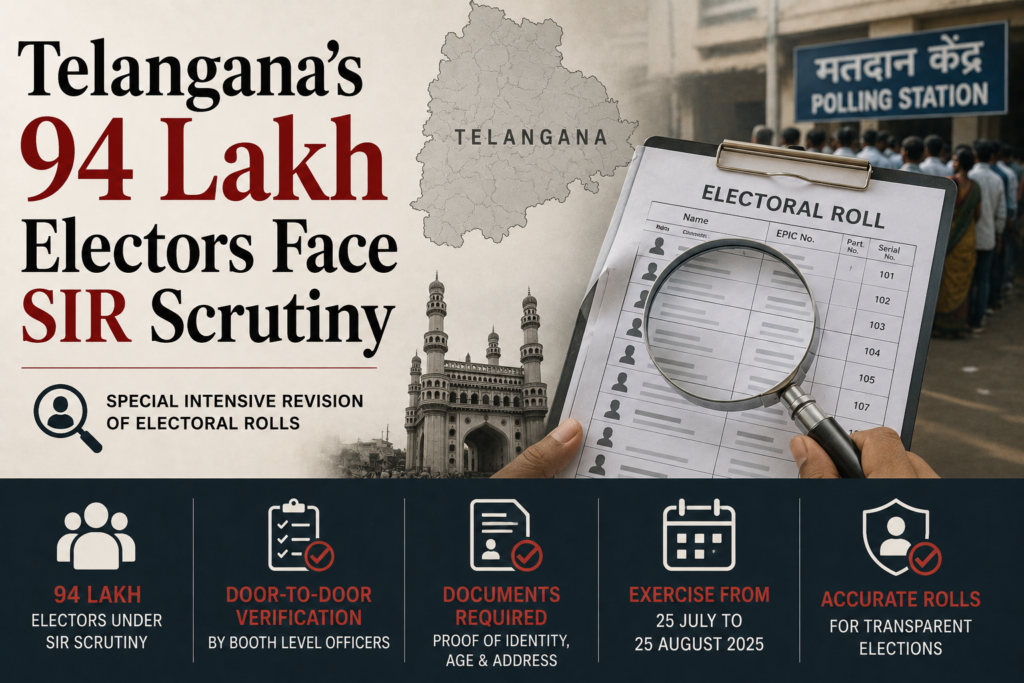
The Telangana Chief Electoral Officer’s office records that only 78.3 percent of enumeration forms in the ongoing Special Intensive Revision (SIR) of electoral rolls have been digitised, with the remaining 21.7 percent classified as uncollectable. Together with nearly 20 lakh technically inconsistent or unmapped entries, close to 94 lakh electors now face scrutiny, exposing a conflict between the Election Commission’s duty to purify the roll and the elector’s burden of proving continued existence at a particular address.
What is the Special Intensive Revision (SIR) of electoral rolls?
Nature of the exercise: SIR is a house to house re-verification of the entire electoral roll ordered by the Election Commission of India, distinct from the routine annual summary revision that only adds and deletes at the margin.
Core method: Every existing elector is served an enumeration form and must return it with supporting particulars, so continued enrolment depends on a fresh positive response rather than on the presumption of an existing entry.
Statutory anchor: The revision is conducted under the Representation of the People Act, 1950, read with the Registration of Electors Rules, 1960, which govern preparation and revision of rolls.
Output of the exercise: The Commission publishes a draft roll, invites claims and objections, disposes of them, and then publishes the final roll that governs the next election.
Stated purpose: The exercise removes deceased, shifted, duplicate and ineligible entries and is intended to produce a roll free of multiple enrolment across constituencies.
What is a Booth Level Officer (BLO)?
Who they are: A Booth Level Officer is a local government functionary, usually a schoolteacher, anganwadi worker or panchayat employee, appointed by the Electoral Registration Officer for one polling station area.
Core duty: The BLO conducts door to door verification, distributes and collects enumeration forms and reports additions, deletions and corrections for that booth.
What is a Booth Level Agent (BLA)?
Who they are: A Booth Level Agent is a party appointed representative attached to a polling station, authorised to submit claims and objections in bulk on behalf of a recognised political party.
Function in a revision: The BLA is the party’s only institutional means of tracking who is being added to or removed from the roll while the revision is still under way.
What is the claims and objections phase?
What it is: After the draft roll is published, any person may file a claim for inclusion or correction, and any elector may file an objection to another person’s entry, within a notified window.
Why it matters here: An elector whose form is missing, uncollected or found to contain discrepancies must use this window to restore the entry, which shifts the burden of proof onto the individual.
What is the current status of the right to vote in India?
Who holds the right: Every citizen of India not less than 18 years of age on the qualifying date, ordinarily resident in a constituency and not otherwise disqualified, is entitled to be registered as an elector.
Nature of the right: The right to vote is a statutory right conferred by the Representation of the People Act, 1950 and 1951, not a fundamental right, though the Supreme Court has treated the act of voting as an expression of choice touching Article 19(1)(a).
Age threshold: The voting age was lowered from 21 to 18 years by the Sixty first Constitutional Amendment Act, 1988.
Bar on discrimination: No person may be excluded from a roll on grounds only of religion, race, caste or sex, and separate electorates stand abolished.
Grounds of disqualification: Non citizenship, unsoundness of mind declared by a competent court, and corrupt practices or electoral offences under the Representation of the People Act, 1951 disqualify a person from registration.
Practical precondition: Enrolment requires ordinary residence in the constituency, which is the exact test that a migration heavy electorate such as Telangana’s strains.
Which constitutional provisions govern electoral rolls and the franchise?
Article 324: Vests superintendence, direction and control of the preparation of the electoral rolls and the conduct of all elections to Parliament, State legislatures, the office of President and the office of Vice President in the Election Commission of India.
Article 325: Provides for a single general electoral roll for every territorial constituency and bars exclusion on grounds only of religion, race, caste or sex.
Article 326: Establishes adult suffrage as the basis of elections to the Lok Sabha and State Legislative Assemblies, with non residence, unsoundness of mind, crime, corrupt practice or illegal practice as the only permitted disqualifications.
Article 327: Empowers Parliament to make law on all matters relating to elections, including the preparation of electoral rolls.
Article 328: Empowers a State legislature to legislate on election matters for that State where Parliament has not occupied the field.
Article 329: Bars courts from questioning the delimitation of constituencies and confines challenges to an election to an election petition filed under law.
What does the Telangana revision’s own arithmetic show?
Total electorate: The Chief Electoral Officer’s office records a total electorate of 3,38,26,448 in Telangana.
Forms digitised:2,64,86,214 enumeration forms have been digitised, a completion rate of 78.3 percent.
Forms uncollectable: The remaining 21.7 percent stand classified as uncollectable, the category at the centre of the dispute.
Additional problem entries: Nearly 20 lakh entries have been identified as technically inconsistent or unmapped, which is separate from the uncollectable set.
Aggregate exposure: The two categories together account for nearly 94 lakh electors who may face scrutiny during the revision.
Political reading of the figure: The State’s Chief Minister has warned party colleagues that a potential reduction of 21 percent in voter numbers would carry serious consequences.
What exactly does the uncollectable category contain?
Deceased:9,22,230 electors are recorded as deceased.
Absent or untraceable:11,25,546 electors are marked absent or untraceable.
Permanently shifted:45,18,961 electors are listed as permanently shifted, the single largest component of the set.
Enrolled elsewhere:6,70,203 electors are shown as enrolled elsewhere.
Other categories:1,02,294 electors fall under residual other categories.
Why has the uncollectable count risen so far?
Verification substituted, not performed: Overburdened Booth Level Officers allegedly skipped mandatory door to door verification in several areas and worked instead from centralised collection points.
Consequence of that substitution: Persons who could not travel to those collection centres were marked unavailable, so an administrative shortcut is recorded as an elector’s absence.
Geographic concentration: The problem is concentrated in districts around Hyderabad, specifically the erstwhile districts of Ranga Reddy, Medak, Mahabubnagar and Nalgonda, which have seen substantial migration to the capital region.
The dual voter imbalance: People who moved to Hyderabad retained their votes in their native places, producing low local enrolment across the 28 Assembly segments falling under the Hyderabad, Secunderabad, Chevella and Malkajgiri Lok Sabha constituencies.
Interstate migration: Migrant workers from Bihar, Chhattisgarh and other States also vote in their home States rather than registering locally, which leaves them unavailable at the Telangana address on record.
Absence of party level checks: The ruling party did not deploy adequate Booth Level Agents during field verification, so lapses in the revision went unchallenged while opposition parties monitored enrolment patterns closely.
Why does a roll cleaning exercise carry a disenfranchisement risk?
Both claims are legitimate: A roll carrying deceased and duplicate entries is a genuine integrity problem, and a revision that deletes a living elector is a genuine rights problem, and the same exercise produces both outcomes.
The burden inverts: Once an entry is classed uncollectable, the elector must affirmatively reclaim it during claims and objections, so the cost of an official’s failure falls on the individual.
Incidence is not neutral: Deletions concentrate among minorities, low income households and socio economically weaker groups, precisely the electors least able to navigate a documentary appeal.
Loss extends beyond the vote: Losing an entry can also affect access to welfare linked identity systems and government benefits, since the roll functions as a residence proof in practice.
Scale defeats remedy: A claims window designed for marginal correction cannot realistically process nearly 94 lakh contested entries within a normal revision calendar.
Comparative anxiety: The concern is framed against roll controversies in other States where large scale deletions are alleged to have altered electoral outcomes.
What are the major debates surrounding electoral roll revision?
Purity versus inclusion: One position treats a bloated roll as the primary threat to a fair election, the other treats wrongful deletion as the graver harm, and the Commission has no settled test for choosing between them.
Ordinary residence versus migration: The ordinary residence requirement of the Representation of the People Act, 1950 assumes a settled population, which sits badly with an economy built on circular and long distance internal migration.
Burden of proof: Whether the State must prove ineligibility before deletion, or the elector must prove eligibility to retain an entry, remains the central unresolved question of every intensive revision.
Documentary thresholds: Any documentary requirement beyond the existing roll risks excluding electors who lack birth records, which raises a question of proportionality under Article 14.
Aadhaar linkage: The voluntary linking of Aadhaar with the elector photo identity card, permitted after 2021, is contested on the ground that a residence and identity database is being used to test citizenship linked entitlement.
Data and audit gap: No independent audit of deletion accuracy is published, so the actual error rate of any revision is unknown to both parties in the dispute.
Migrant voting rights: The absence of a working remote voting mechanism means an internal migrant must choose between a vote at origin and residence at destination.
Challenges to the Special Intensive Revision
Field capacity deficit: A single Booth Level Officer handling more than a thousand electors alongside a regular government job cannot complete genuine door to door verification within a compressed calendar, e.g. Telangana’s revision saw officers operating from centralised collection points instead of visiting households.
Migration blindness of the roll: The roll’s design assumes a fixed address, so circular migrants appear as absent rather than as electors resident elsewhere, e.g. 45,18,961 Telangana entries classed as permanently shifted with no corresponding transfer of registration.
Asymmetric political capacity: Parties with dense booth level networks can protect their electors during verification while weaker parties cannot, e.g. Telangana’s ruling party admitted it failed to deploy adequate Booth Level Agents during field verification.
Documentary exclusion of the poorest: Reclaiming a deleted entry requires paperwork that landless, informal and displaced households frequently lack, e.g. the 46 lakh distinct caste strings thrown up by the 2011 Socio Economic and Caste Census illustrate how weakly self reported records map onto official categories.
Compressed appeal window: The claims and objections period is calibrated for marginal correction, not for mass restoration, e.g. nearly 94 lakh Telangana entries now require individual disposal inside a single revision cycle.
Absence of a deletion audit: No independent verification of deletion accuracy is published before the final roll, e.g. neither the 11,25,546 absent or untraceable entries nor the nearly 20 lakh unmapped entries in Telangana have been sample audited.
Federal friction over process: State governments read a centrally ordered intensive revision as an intrusion into a politically sensitive process, e.g. the Telangana Cabinet was alerted that a 21 percent reduction in voter numbers would carry serious consequences.
Conclusion
The Telangana revision has converted an administrative failure of verification into a question of individual entitlement, because an elector missed at the doorstep is recorded as an elector who does not exist. Nearly 94 lakh entries now stand exposed at the claims and objections phase, and the burden of correcting an officer’s shortcut has passed to the elector. The revision will only be defensible if field verification is genuinely completed and deletions are audited before the final roll is published.