Mains Ready By December. Smash Mains & Smash PYQ Admissions Open

GS Paper: GS2-08.Salient features of the Representation of People’s Act.

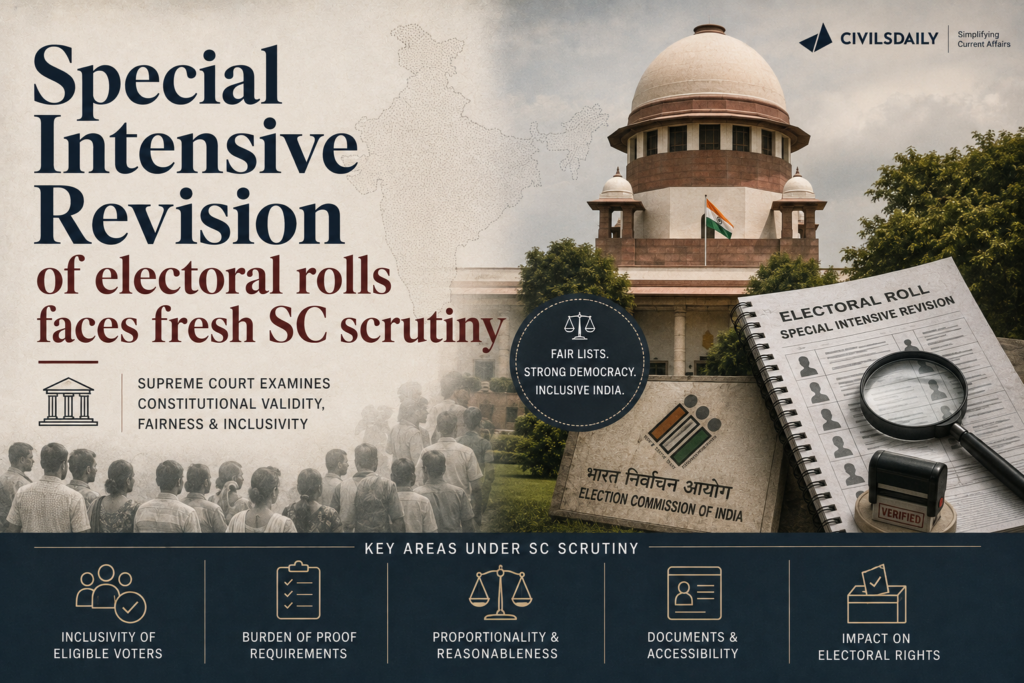
  • Special Intensive Revision of electoral rolls faces fresh SC scrutiny

    Why in the News

    The Supreme Court agreed to consider a plea alleging misuse of Form 7 during Uttar Pradesh’s Special Intensive Revision of electoral rolls. In Karnataka, nearly half of Bengaluru’s voters are flagged for possible deletion ahead of the draft roll. The draft roll is due on 17 August 2026.

    What is the Special Intensive Revision of electoral rolls?

    1. Definition: the Special Intensive Revision (SIR) is a house to house exercise by the Election Commission to update and verify electoral rolls.
    2. Enumeration: electors are mapped and verified, and doubtful entries are flagged for review.
    3. Draft stage: a draft roll is published, followed by a claims and objections phase before finalisation.

    What is Form 7 and how is it alleged to be misused?

    1. Form 7: a statutory mechanism under the Registration of Electors Rules, 1960, for limited and bona fide objections to inclusion, or deletion on narrow grounds.
    2. Allegation: a Congress Member of Parliament cited documented evidence of bulk, fraudulent and targeted deletion attempts.
    3. Targeting: the plea says objections hit minority and marginalised electors, including those already verified during the revision.
    4. Mechanical filing: Booth Level Officers reportedly received pre filled Form 7 applications with identical grounds and no credible basis.
    5. Respondents: the Election Commission and the Chief Electoral Officer of Uttar Pradesh are named respondents.

    What is the ASDDO flag in Karnataka?

    1. Full form: Absent, Shifted, Dead, Duplicate or Other.
    2. Scale: of Bengaluru’s 1.03 crore voters, 49.42 lakh are flagged under this category.
    3. State total: across Karnataka, 1.11 crore voters, one fifth of the 5.54 crore mapped, are flagged.
    4. Hotspots: ten Bengaluru constituencies show flagged deletions above 50 percent, led by Bommanahalli at 57.08 percent.

    [2017] For election to the Lok Sabha, a nomination paper can be filed by
    (a) Anyone residing in India.
    (b) A resident of the constituency from which the election is to be contested.
    (c) Any citizen of India whose name appears in the electoral roll of a constituency.
    (d) Any citizen of India.
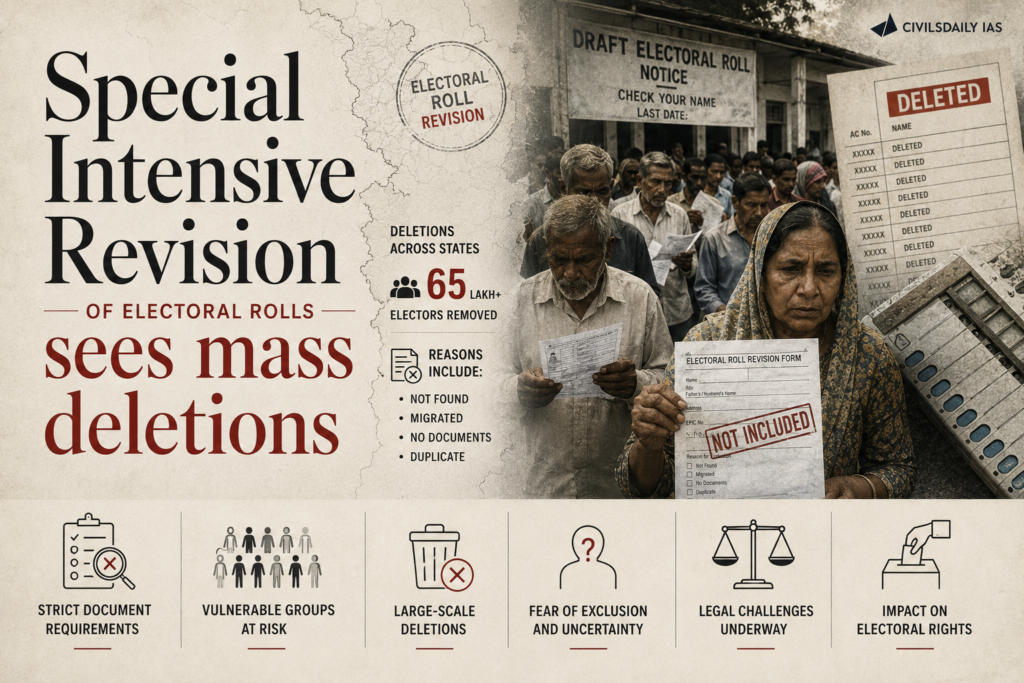
  • Special Intensive Revision of electoral rolls sees mass deletions

    Why in the News

    A large intensive revision of electoral rolls has removed millions of names across States, with objection windows now open. The tension is between cleaning the rolls of ineligible entries and the risk of wrongful deletion of genuine voters.

    What is the Special Intensive Revision (SIR)?

    1. Roll revision: The Special Intensive Revision (SIR) is a house to house re verification of electoral rolls by the Election Commission of India.
    2. ASDD categories: Names are marked under absent, shifted, duplicate, and dead (ASDD) categories for deletion.
    3. Claims window: Deletions are provisional until the claims and objections period closes.

    What is the scale of deletion?

    1. Jharkhand: About 43.6 lakh names, or 16.5%, were removed from the draft roll.
    2. Karnataka: The State projects deletions of about 20% of electors.
    3. Correction route: Voters can seek restoration through Booth Level Officers and Form 6.

    Why is the revision contested?

    1. Wrongful removal: Genuine voters risk deletion through data errors.
    2. Compressed timeline: The claims and objections window runs only to 4 September 2026.
    3. Legal challenge: The revision faces litigation over its process and scale.

    “[2017] Consider the following statements:
    1. The Election Commission of India is a ‘ five-member body.
    2. Union Ministry of Home Affairs decides the election schedule for the conduct of both general elections and bye-elections.
    3. Election Commission resolves the disputes relating to splits/mergers of recognized political parties.
    Which of the statements given above is/are correct ?
    (a) 1 and 2 only
    (b) 2 only
    (c) 2 and 3 only
    (d) 3 only

  • In the light of recent controversy regarding the use of Electronic Voting Machines (EVM), what are the challenges before the Election Commission of India to ensure the trustworthiness of elections in India?

    In Abhiram Singh vs UoI, SC has held that elections are the biggest secular and democratic event. EVMs were introduced to improve transparency and efficiency of the electoral process.

    Challenges before the Election Commission of India (ECI)

    Technical and Operational Challenges

    Allegations of EVM tampering and demand for Postal Ballot system.

    EVMs are produced by PSU’s BEL and ECIL– concerns about source code security and potential government misuse.

    Large-scale deployment increases risk of technical failure, power supply issues, and storage vulnerability.

    Institutional and Procedural Challenges

    Political polarisation has led to accusations of bias against ECI decisions (timing of elections, model code enforcement).

    Lack of transparency- Limited access for political parties and civil society to audit or inspect EVM functioning.

    Opposition parties demand 100% VVPAT verification or return to ballot papers, which the ECI has resisted citing impracticality.

    Legal and Regulatory Challenges

    Use of EVMs is governed by Conduct of Elections Rules, 1961, not by a specific EVM legislation.

    Judicial scrutiny and legal disputes- Repeated petitions challenge credibility of EVMs and VVPAT counting procedures.

    Despite SC directives (2024) to improve VVPAT counting transparency and preserve paper trail records – compliance remains partial.

    Public Perception and Political Trust Deficit

    Decline in citizen confidence- Lack of understanding of EVM functioning leads to misinformation and conspiracy theories.

    Political blame culture- Losing parties often question EVM integrity, politicising the institution’s credibility.

    Social media misinformation- Viral false claims about EVM manipulation erode voter trust. Eg- “Black Box” Allegations (2024)

    ECI’s Stand

    EVMs are standalone, non-networked machines; cannot be hacked remotely.

    Rigorous mock polling, sealing, randomisation, and observer monitoring prevent manipulation.

    Technical Expert Committee (TEC) from IITs and DRDO regularly reviews EVM integrity.

    Way Forward

    Conduct independent third-party audits (IITs, NIC) of EVM software and random samples.

    VVPAT Verification – Increase sample size or audit entire constituency in disputed cases.

    Launch voter education campaigns explaining EVM and VVPAT mechanisms

    Enact a dedicated “Electronic Voting Regulation Act” ensuring independent oversight

    Free and fair elections are the cornerstone of democracy (Art. 324). Enhancing the transparency in use of EVM’s is thus essential.

  • On what grounds a people’s representative can be disqualified under the Representation of People Act, 1951? Also mention the remedies available to such person against his disqualification.

    The RPA, 1951 provides the statutory framework for conducting elections and maintaining the integrity of India’s democratic process.

    Grounds for Disqualification under RPA, 1951

    Disqualification on Conviction for Certain Offences – Section 8

    bribery, undue influence, promoting enmity (IPC 153A, 295A), or corruption.

    If the sentence is two years or more, the disqualification is immediate and lasts six years after release.

    Lily Thomas v. Union of India (2013) – Section 8(4) was struck down, making disqualification automatic on conviction.

    Disqualification for Dismissal from Government Service – Section 9 – Disqualification for five years if dismissed for corruption or disloyalty to the State.

    Disqualification for Office of Profit – Section 10 – Holding an office of profit under the government (not exempted by law)

    Disqualification for Government Contracts – Section 9A

    Disqualification for Failure to Lodge Election Expenses – Section 10A

    Remedies Available Against Disqualification

    Judicial Appeal – If conviction is stayed, disqualification ceases to operate (Lok Prahari v. Union of India, 2018).

    Under Articles 103 & 192, President or Governor’s Decision acts on the advice of the Election Commission.

    Election Petition (Section 80, RPA, 1951) in the High Court within 45 days of result declaration.

    Analysis

    Thus, the disqualification provisions ensure the trinity of Ethics, Accountability and Fairness of electoral process.

  • “There is a need for simplification of procedure for disqualification of persons found guilty of corrupt practices under the Representation of Peoples Act”. Comment.

    The RPA, 1951 provides the statutory framework for conducting elections and maintaining the integrity of India’s democratic process.

    Procedure of Disqualification

    Under Articles 103 & 192, President or Governor’s Decision acts on the advice of the Election Commission.

    Election Petition (Section 80, RPA, 1951) in the High Court within 45 days of result declaration. Appeal to SC within 30 Days

    Positive Impacts of Simplification

    Enhances Public Trust

    Improves Integrity of the Electoral Process

    Strengthens Rule of Law

    Promotes Ethical Politics

    Upholds Constitutional Morality

    Thus, simplification of disqualification provisions are needed to ensure the trinity of Ethics, Accountability and Fairness of electoral process.

  • Discuss the role of the Election Commission of India in the light of the evolution of the Model Code of Conduct.

    Model Code of Conduct is the guidelines set by Election Commission of India for political entities during campaigns to ensure decorum. Though not legally enforceable, it has become an indispensable moral instrument for ensuring free, fair, and level-playing elections in India.

    Evolution of the Model Code of Conduct (MCC)

    1960 – First voluntary code introduced during the Kerala Assembly elections.

    1962 – First Nationwide Use in the Lok Sabha elections

    1991 – ECI under T.N. Seshan formalised and reissued MCC with 7 comprehensive parts

    2013 – Supreme Court Recognition in S. Subramaniam Balaji v. Tamil Nadu

    2018-Present – MCC expanded to cover social media, fake news, and online campaigning.

    Role of the Election Commission of India in MCC Implementation

    Acts under Constitutional Authority (Art. 324)- Exercises residual powers to enforce MCC even in the absence of explicit statutory provisions.

    Ensures Free and Fair Elections- ECI enforces MCC to maintain a level playing field among all political parties.

    Restricts the ruling party from announcing new schemes, transferring officials, or using public resources for campaigns.

    Monitors Campaign Conduct- Prohibits hate speech, communal appeals, caste-based propaganda, and personal attacks in campaigns.

    Acts Against MCC Violations- Issues warnings, censures, derecognition, or suspension of political leaders and parties for violations.

    Uses Media Certification and Monitoring Committees (MCMC) to monitor paid news and political advertisements.

    Controls Government Communication- Prohibits use of official media or public funds for election-related publicity.

    Deploys observers and flying squads to detect and address MCC violations promptly.

    Engages Citizens in Monitoring- Introduced the cVIGIL mobile app allowing citizens to report MCC violations in real time.

    Coordinates with Law Enforcement- Works with district magistrates, police, and election observers to ensure compliance on the ground.

    Challenges before the Election Commission in Enforcing MCC

    Legal and Institutional Challenges

    Lack of Statutory Backing- enforcement depends on moral authority, not legal sanction.

    Delay in Judicial Remedies on MCC violations, reduce deterrent effect.

    Administrative Challenges

    Monitoring compliance across 10+ lakh polling stations and multiple states is logistically difficult.

    Limited Human Resources- reliance on district officials who are part of state bureaucracy reduces independence.

    Political Challenges

    Allegations of Bias, especially against opposition leaders.

    Non-cooperation by Political Parties- ignore advisories or delay compliance with MCC orders.

    Freebies and Populism- Lack of clear guidelines to differentiate welfare schemes from electoral freebies (as seen in Tamil Nadu & Telangana cases).

    Technological and Media Challenges – Difficulty tracking fake news, hate campaigns, and paid promotions on digital platforms.

    Way Forward

    Give Statutory Backing to MCC under Representation of the People Act, 1951

    Regulate Freebies and Populism – Implement Supreme Court’s advice in S. Subramaniam Balaji (2013)

    Establish a digital MCC framework in collaboration with social media platforms to tackle misinformation, hate speech, and paid content.

    Enhance Transparency and Accountability – Publish all MCC violations, ECI actions, and outcomes on a public dashboard.

    Set time limits for inquiry and punishment in MCC violation cases.

    Electoral reforms is considered as ‘Mother of all Reforms’. Giving statutory backing to MCC can ensure the trinity of Ethics, Accountability and Fairness of electoral process.

  • While the national political parties in India favour centralisation, the regional parties are in favour of State autonomy. Comment.

    According to Edmund Burke, “Political parties are a group of people sharing common ideology and coming together for the pursuit of common interest.” In India’s quasi-federal system, political orientation of parties influences the federal balance.

    National Political Parties – Tilt Towards Centralisation

    Political Reasons

    Ideological focus on unity and integrity – Eg- Emphasis on “One Nation” narrative

    National security concerns – Strong Centre seen as vital for sovereignty. Eg- AFSPA

    High-command party culture – Central leaders dominate over state units.

    Uniform electoral strategy – Centralised messaging ensures consistency.

    Institutional Reasons

    Constitutional centralism – Support for Centre’s powers under Articles 249, 356, and 352.

    Governor’s role – Used as a central instrument in state politics.

    Economic Reasons

    Fiscal centralisation – Centre controls major taxes and revenue flows.

    Centralised planning legacy – Planning Commission model favoured top-down control.

    Centrally Sponsored Schemes (CSS) – Used for visibility and control (e.g., PM-KISAN).

    Uniform economic policy – Eg- GST.

    Social & Cultural Reasons

    Nation-building agenda – Eg- Ek Bharat, Sreshtha Bharat

    Integration of diversity – Central schemes for social cohesion and inclusion. Eg- One Nation, One Ration Card

    Promotion of national language/symbols – Eg- Three Language Formula

    Regional Political Parties – Favour State Autonomy

    Political Reasons

    Rooted in regional identity movements- Eg – DMK (Tamil identity), TMC (Bengal pride).

    Opposition to central interference- Resist misuse of Article 356 and Governor’s powers.

    Institutional Reasons

    Representation in central bodies- Seek stronger role for states in institutions like Finance Commission and NITI Aayog.

    Push for cooperative federalism- Eg- Anandpur Sahib Resolution on centre-state relations

    Economic Reasons

    Fiscal autonomy- Demand greater tax devolution and freedom in fund usage.

    Resource control- Want more authority over natural resources and industries.

    Discontent over CSS- Oppose Centrally Sponsored Schemes that restrict flexibility.

    Social & Cultural Reasons

    Language and cultural protection- Eg – DMK’s anti-Hindi protests.

    Address local inequalities- Focus on state-specific social justice and caste realities.

    “Federalism is not a monolith; it is a dialogue between self-rule and shared rule.” It must rest on the principles of autonomy, adequacy, and elasticity.

    Constitutional and Statutory Bodies