Why in the News
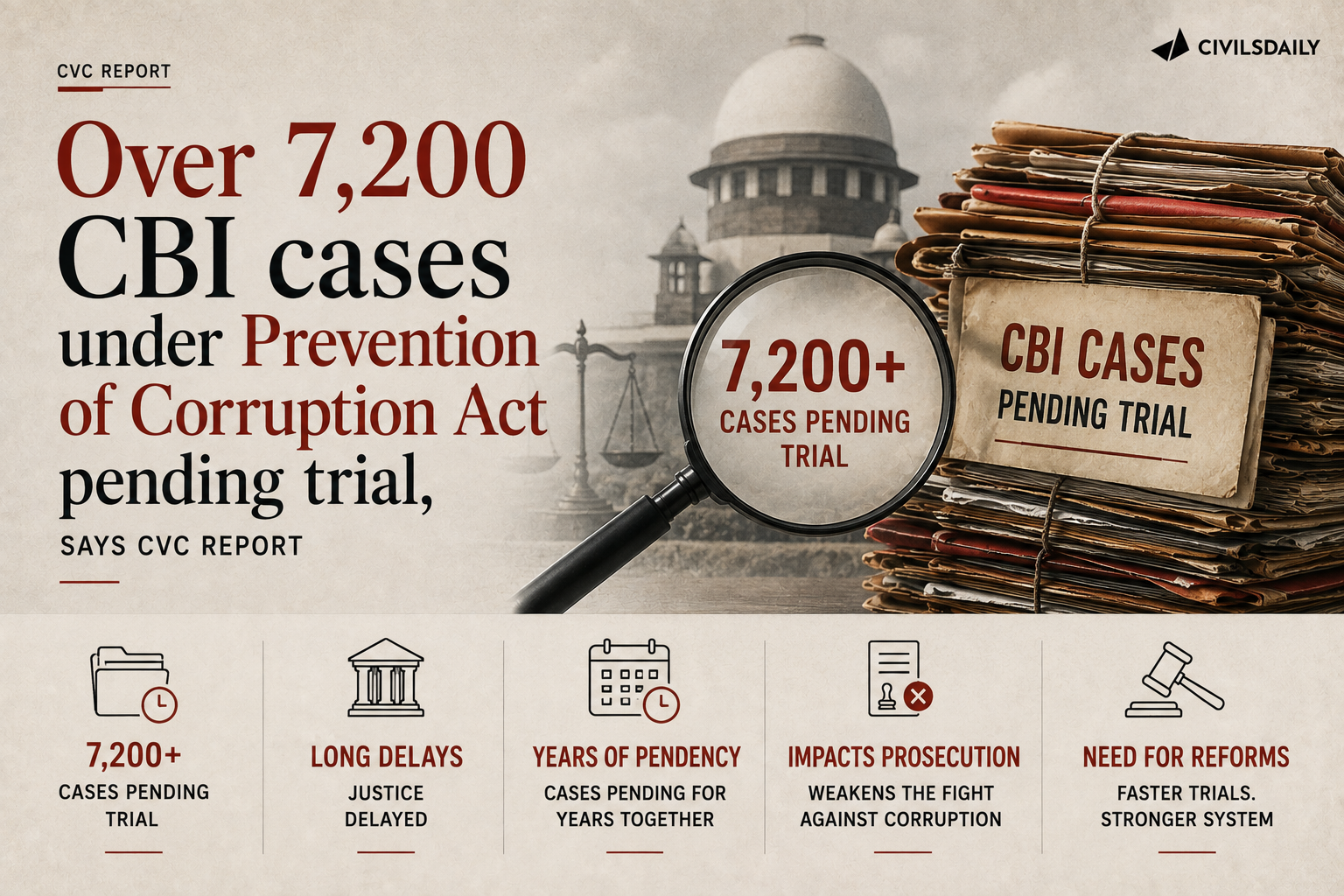
The Central Vigilance Commission (CVC) has reported in its annual report that over 7,200 cases investigated by the Central Bureau of Investigation (CBI) under the Prevention of Corruption Act, 1988 were awaiting completion of trial at the end of 2025.
Where does the anti-corruption pipeline stall?
- Trials run past two decades: More than 400 of the 7,229 pending Prevention of Corruption Act trials have been open for over 20 years.
- Appeals add a second backlog: 14,083 appeals, revisions and writ petitions under the Act were pending in the High Courts and the Supreme Court.
- Over a third of those are more than a decade old: 3,161 were 10 to 15 years old, 1,347 were 15 to 20 years old and 739 were over 20 years old.
- The wider trial load is larger still: Counting cases outside the Act, 11,510 CBI court cases were pending trial at the end of the year.
What do the investigation and conviction figures show?
- Convictions improved: The conviction rate in CBI cases was 71.71 percent in 2025 against 69.14 percent in 2024.
- Investigation pendency is small by comparison: 755 corruption related cases were pending investigation, made up of 679 regular cases, 63 preliminary enquiries and 13 Lokpal references (cases the Lokpal has referred to the CBI for investigation).
- A year is the usual limit, and 274 cases crossed it: Of the 679 regular cases, 274 had been pending for over one year.
- The intake in 2025: The CBI registered 797 regular cases, 177 preliminary enquiries and recorded 31 Lokpal references during the year.
What capacity does the vigilance system have?
- One in seven CBI posts is vacant: Against a sanctioned strength of 7,300, 1,088 posts were vacant, with the largest gap of 672 in the executive ranks.
- Departmental inquiries under the Commission: For officers under CVC jurisdiction, 1,460 departmental inquiries were in process during 2025 and 731 were completed.
- Inquiries outside its purview: For employees outside its jurisdiction, 9,883 inquiries were in process and 5,561 were completed.
- Complaint disposal kept pace: The Commission received 34,153 complaints in 2025 in addition to 1,260 carried forward from 2024, and disposed of 35,193.
Challenges to prosecuting corruption under the Prevention of Corruption Act
- Sanction is a gate the executive controls: Section 19 requires the government’s sanction before a court can take cognisance against a public servant, and Section 17A, added by the Prevention of Corruption (Amendment) Act, 2018, requires prior approval even to begin an inquiry into a decision taken in official capacity. Eg. In Vineet Narain v Union of India (1997) the Supreme Court fixed a three month limit for sanction decisions, and the 2018 amendment wrote that limit, extendable by one month, into Section 19 itself.
The Fix: Treat sanction as deemed granted when the statutory period lapses without a decision. - Special courts are too few for the load: Section 3 of the Act requires trials before special judges, and the same judges carry other criminal work, so a corruption trial waits behind the general docket. Eg. In Ashwini Kumar Upadhyay v Union of India the Supreme Court in 2021 recorded 4,984 pending criminal cases against legislators and directed special courts to prioritise them.
The Fix: Designate exclusive special judges for Prevention of Corruption Act trials in every district with a CBI court, with a monthly disposal target monitored by the High Court. - State consent limits where the CBI can act: Under Section 6 of the Delhi Special Police Establishment Act, 1946 the CBI needs a State’s consent to investigate within it, and a growing list of States has withdrawn general consent so every case needs a fresh order. Eg. West Bengal withdrew general consent in November 2018, and in 2024 the Supreme Court allowed the State’s suit against the Union over CBI investigations to proceed to trial.
The Fix: Enact a standalone CBI statute defining its jurisdiction, as the Parliamentary Standing Committee on Personnel, Public Grievances, Law and Justice recommended in 2023. - Deputation, not a cadre, staffs the agency: The CBI fills most executive posts by deputation from State police and central forces, so vacancies persist when States decline to release officers. Eg. In May 2013, during the coal block allocation hearing, the Supreme Court described the CBI as a “caged parrot” after the agency’s status report had been shared with the Law Minister.
The Fix: Expand direct recruitment at the sub inspector and deputy superintendent levels and offer fixed tenure with cadre security to reduce reliance on deputation.
Conclusion
The Commission’s numbers show the agency’s work improving at the stages it controls and stalling at the stages it does not. The pendency now sits with the courts and the sanctioning authorities rather than with the investigators. The marker to watch is whether the next annual report shows the oldest trials closing rather than the backlog growing.
Back2Basics: Central Vigilance Commission (CVC)
- Origin: Set up in 1964 on the recommendation of the Santhanam Committee on Prevention of Corruption, and made a statutory body by the Central Vigilance Commission Act, 2003.
- Composition: A Central Vigilance Commissioner and up to two Vigilance Commissioners, appointed by the President on the recommendation of a committee of the Prime Minister, the Union Home Minister and the Leader of the Opposition in the Lok Sabha.
- Powers over the CBI: It exercises superintendence over the CBI’s investigations of offences under the Prevention of Corruption Act by virtue of Section 4 of the Delhi Special Police Establishment Act, 1946, and reviews the progress of those investigations.
- Reporting: It submits an annual report to the President, and the report is laid before both Houses of Parliament.
[2026, GS2, 15 marks] “Transparency and accountability in governance are not about controlling corruption but about creating the trust of stakeholders in the policy process by following the Rule of Law and Participatory Governance.” Comment.”
