💥Join UPSC 2027,2028 Mentorship (August Batch) + XFactor Notes & Microthemes PDF

GS Paper: India & Its Neighborhood – Relations

  • Regional bonding: On Ranil Wickremesinghe’s prescription for peace

    Context

    Former Sri Lankan Prime Minister Ranil Wickremesinghe’s push for regional economic integration and for India-Pakistan dialogue should be studied carefully by New Delhi.

    What are the issues with SAARC?

    • Recent moves by India: India has more or less shut down all conversations on the South Asian Association for Regional Cooperation (SAARC).
      • India also walked away from the ASEAN-led Regional Comprehensive Economic Partnership (RCEP).
    •  Mr Wickremesinghe set out a number of suggestions:
    • The original purpose of SAARC-Regional growth: India-Pakistan tensions have brought economic integration within the SAARC region to a “standstill”.
      • That the original purpose of the South Asian group was to build a platform where bilateral issues could be set aside in the interest of regional growth.
    • Start at the sub-grouping levels: To engender more intra-regional trade, an even smaller sub-grouping of four countries with complementary economies: India, Sri Lanka, Bangladesh and Thailand, can start the process of reducing tariffs and demolishing non-tariff barrier regimes.
      • When it comes to the intra-regional share of total trade, SAARC and BIMSTEC languish behind groupings such as ASEAN, EU and MERCOSUR.
    • Economic Integration Road Map: The Sri Lankan leader also suggested that with India’s leadership, a more integrated South Asian region would be better equipped to negotiate for better terms with RCEP so as not to be cut out of the “productivity network” in Asia, and envisioned an Economic Integration Road Map to speed up the process.

    Governments stand

    • Talks with Pakistan off the table: The government has made it clear that talks with Pakistan are strictly off the table, and that a SAARC summit, which has not been held since 2014, is unlikely to be convened anytime soon.
    • More reliance on bilateral deals: The government, which has taken a protectionist turn on multilateral trade pacts, is relying more on direct bilateral deals with countries rather than overarching ones that might expose Indian markets to flooding by Chinese goods.
    • India’s trade deficit with the neighbours: For any regional sub-grouping in South Asia to flourish, it is India that will have to make the most concessions given the vast trade deficits India’s neighbours have at present, which it may not wish to do.

    Conclusion

    • The overall projection that India’s global reach will be severely constrained unless it is integrated with its neighbours, and tensions with Pakistan are resolved, cannot be refuted. India needs to be more accommodative for the realisation of its ambitions.


  • Putting neighbours first

    Context

    India has promoted regional cooperation in South Asia in a spirit of generosity, without insisting on reciprocity.

    Relations with Sri Lanka

    • Beginning of new chapter in ties: The visit of Sri Lankan Prime Minister Mahinda Rajapaksa to India in February marked the beginning of a new chapter in ties with a friendly neighbour.
      • The neighbour with which India has close historical bonds straddling culture, religion, spirituality, art and language.
    • Growing convergence against terrorism: More relevantly, there is a growing convergence against terrorism following the Easter attacks in Sri Lanka last April.
    • There is deep appreciation in Sri Lanka for the free emergency services provided through 280 ambulances gifted by India, now operational in eight of the country’s nine provinces.
    • Prospects for tri-lateral cooperation: There are much better prospects today for tri-lateral cooperation between India, Japan and Sri Lanka in the development of the East Container Terminal at Colombo port and the proposed joint development of the Trincomalee oil storage tanks.
    • Indicators of a new warmth in relations:
      • Several infrastructure projects.
      • Direct flights between Chennai and Jaffna.
      • Resumption of ferry services.
      • India’s new lines of credit and construction of houses for the internally displaced.
      • Homeless and landless people are indicative of a new warmth in relations.
    • First visit to India: That both Mahinda Rajapaksa and his brother President Gotabaya chose India as the destination for their first overseas visits after assuming office bodes well.

    Relations with Maldives

    • First visit by PM Modi: After the general elections last year, PM Modi’s first foreign visit was to the Maldives in June 2019.
      • India first: The visit was to establish warm and friendly relations with President Ibrahim Solih, who has done much to promote closer relations with India through his “India First Policy”.
    • First visit to India: India was the first country that Solih had visited in December 2018, a far cry from his predecessor’s brazen anti-India slant.
      • Soon after assuming office, Solih’s government annulled a controversial 2015 law that was meant to allow foreigners, particularly from China, to arbitrarily own islands.
    • Projects worth 180 crores inaugurated: The inauguration during Modi’s visit of two projects worth Rs 180 crore-the Coastal Surveillance Radar System and the Composite Training Center of the Maldivian National Defence Forces-has deep significance for the success of India’s neighbourhood policy.
    • $800 million worth lines of credit: India’s offer of lines of credit worth about $800 million and other capacity-building projects for water supply and sewerage are strong planks in our economic ties.
    • Terrorism and radicalisation are subjects of common concern.
    • DOSTI exercise: The agreement to restart the tri-lateral DOSTI naval exercise as also the tri-lateral NSA-level dialogue between India, Maldives and Sri Lanka lay the ghost of the Yameen era to rest.

    Relations with Nepal

    • Inauguration of first cross-border petroleum pipeline: In September last year, India and Nepal jointly inaugurated South Asia’s first cross-border petroleum products pipeline from Motihari in India to Amlekhgunj in Nepal.
    • Prioritising the rebuilding of houses: India is also prioritising the rebuilding of houses in Gorkha and Nuwakot districts, with “Build Back Better” as the guiding principle in keeping with Modi’s clarion call for a Coalition for Disaster Resilient Infrastructure (CDRI).
    • Role played by geography: Geography plays a determining role in creating inter-dependence.
      • Even as Nepal, like other South Asian countries, seeks closer ties with China, there is a much better appreciation today that India’s role as a key economic and developmental partner is unique and indispensable.

    Relations with Bangladesh

    • Model partnership: India’s relations with Bangladesh under Modi and Sheikh Hasina have evolved into a model partnership, consolidated by-
      • High-level exchanges.
      • Mutual trust and-
      • Enhanced cooperation on security matters.
    • Border firing incidents: Incidents of border firing, though rare, have an adverse fall-out on public perception and need to be handled with sensitivity.

    Relations with Bhutan

    • The India-Bhutan friendship runs deep, with growing cooperation in the vital hydro-power sector providing it a fresh impetus.
      • Notably, the centrepiece Mangdechhu project (750 MW) was completed on schedule last year.
    • RuPay card in Bhutan: The introduction of the RuPay card in Bhutan and elsewhere in the neighbourhood will further cement economic and people-to-people ties.

    Relations with Myanmar

    • Security cooperation: When India shortly hands over to Myanmar the INS Sindhuvir, a Kilo Class submarine, it will propel security cooperation to a higher pedestal.
      • Cross-border strike in Myanmar: Close coordination with Myanmar was evident earlier in the cross-border strike on insurgents by Indian forces in 2015.

    Unrealised potential of South Asia

    • South Asiasome figures: has 1.8 billion people and a combined GDP of nearly $3.47 trillion, with India’s economy the largest by far.
    • South Asia has great potential but has been held back by Pakistan.
      • Hindrance for cooperation with Afghanistan: Pakistan has not only denied India and Afghanistan the overland transit route for trade, but has also thwarted Modi’s efforts to place at centre stage the common struggle against poverty, illiteracy and natural disasters.

    Cooperation within SAARC: Pakistan has held to ransom cooperation within SAARC by raising extraneous matters, perpetuating terrorism and rejecting the ineluctable logic of intra-South Asian trade, which remains abysmally poor.

    • Pakistan opt-out of satellite project: Islamabad decided to opt-out of the SAARC satellite project proposed by India, and it was finally launched in 2017 without Pakistan’s participation.
    • Motor Vehicle Agreement: Pakistan also played the role of a spoiler at the 18th SAARC Summit in November 2014, preventing progress on the proposed Motor Vehicle Agreement for the regulation of passenger and cargo vehicular traffic amongst SAARC member states.
    • Implications for Afghanistan: Pakistan’s intransigence on connectivity impairs Afghanistan’s ability to link up with other countries in South Asia.
      • The air corridor between India and Afghanistan cannot cater to the full potential of trade ties.
      • Sustainability of Chabahar port: Recent tensions between the US and Iran have cast a shadow on the sustainability of Chabahar port as an alternative maritime supply route to Afghanistan at a crucial juncture in its history.
      • India’s role in Afghanistan: India’s proactive role in recent years in building much-needed infrastructure and capacities in Afghanistan is widely recognised.
      • Deepened defence cooperation: Defence cooperation too has deepened under Modi, with India dropping its traditional coyness in such matters.
      • Much more may have to be done, though, to help Afghanistan achieve stability through economic prosperity.
      • Afghanistan’s true destiny lies with South Asia.

    Key aspects of Neighbourhood First Policy

    • Response to security challenges: Neighbourhood First involves India’s willingness to respond to security challenges with new grit.
    • Humanitarian assistance: It also involves for India to be an enthusiastic responder in providing humanitarian assistance and conducting disaster relief operations in Nepal, Sri Lanka, the Maldives and the extended neighbourhood.
    • Developmental assistance: Even more important is the steady progress made by India to expand developmental assistance and improve project execution based on collaborative partnerships.
      • India’s developmental assistance to six South Asian countries was over Rs 21,100 crore. 

    Progress on BIMSTEC

    • BIMSTEC, the other regional grouping, has done well.
    • Participation in disaster Management Exercise: In February this year, delegates and rescue teams from India, Bangladesh, Nepal, Sri Lanka and Myanmar enthusiastically participated in disaster management exercises conducted at Ramachandi Beach at Puri in Odisha.
    • Cross-border electricity grid: The signing of the MoU on BIMSTEC Grid Interconnection at the fourth BIMSTEC Summit, attended by all seven nations in Kathmandu in August 2018, provides a fillip to cross-border electricity trade.
    • India’s focus on BIMSTEC and its Act East Policy have served to highlight India’s key role in promoting cooperative growth and development in several parts of South Asia.

    Conclusion

    In a world increasingly characterised by a “my country first” approach, India has endeavoured to harness the impulse for regional cooperation in a spirit of generosity, without insisting on reciprocity, to realise the motto of Security And Growth For All In The Region (SAGAR).


  • The missing piece in India’s defence jigsaw puzzle

    Context

    The country needs a clearly articulated white paper on its defence needs which sets out its strategic concerns.

    India’s defence deals in the pipeline

    • The first lot of Rafale fighter jets are expected shortly.
    • The final deal on the 200 Kamov Ka-226 light utility helicopters from Russia is in advanced stages and expected to be signed soon.
    • In October 2018, India and Russia had signed a $5.4-billion mega-deal for the S-400 Triumf Air Defence System.
    • Under contemplation today are yet another set of high-value U.S. defence deals, including additional purchases of P-8I Maritime Reconnaissance Aircraft and Apache Attack Helicopters.
    • NASAMS-II: Speculation is rife that India and the U.S. would sign a deal for the National Advanced Surface to Air Missile System (NASAMS-II).
      • Which is intended as part of a multi-layered missile shield to protect Delhi.
    • The U.S. side is also hoping for two more mega defence deals, worth $3.5-billion to be signed for 24 MH-60 Romeo Multi-Mission Helicopters for the Navy and an additional six AH-64E Apache Attack Helicopters for the Army.

    Need for the white paper

    • Given India’s rising global profile, and with two major adversaries on its borders, India needs to be fully prepared.
    • A missing piece: What is lacking in the defence jigsaw puzzle is a well-considered and clearly articulated white paper on India’s defence needs.
      • The white paper would deal with?
      • It sets out its strategic concerns.
      • How it is positioning itself to meet these challenges.
      • The putative costs of meeting the country’s defence needs.
    • Explain the Pakistan threat: In the case of Pakistan, the threat motif is, no doubt, obvious.
    • India’s political and defence establishment are on record that India can easily defeat Pakistan, even if a “weaker” Pakistan possesses “nuclear teeth”.
      • What is needed? A great deal of effort is called for to-
      • Explain to the public, the true nature of the threat posed by Pakistan.
      • And why India is so confident of beating back the Pakistani challenge.
    • Explaining the China threat: Meeting the military, strategic and economic challenge from China is an entirely different matter.
      • Understanding the nature of the threat: China is not Pakistan.
      • While China and Pakistan may have established an axis to keep India in check, explaining the nature of the threat posed by China to India is a complex task that needs to be undertaken with care and caution.

    The China threat

    • Is China an existential threat for India?: There are many experts who express doubts as to whether China intends today to pursue its 19th Century agenda, or revert to its belief in ‘Tian Xia’.
      • Undoubtedly China aims to be a great power and an assertive one at that.
      • India’s defence planners should, however, carefully assess whether there are degrees of “assertiveness” in China’s behavioural patterns.
      • There is little doubt that regarding its claim to areas falling within the ‘nine-dash lines’ (the first island chain), China is unwilling to make compromises.
      • Whether this applies to other regions of Asia and the Indo-Pacific, calls for an in-depth study.
    • The analysis is needed: It would be premature for India without undertaking such an analysis, to adhere to a common perception that China is intent on enforcing a Sino-centric world order in which India and other countries would necessarily have to play a secondary role.
    • What after analysis? If after undertaking such an “analysis”, it appears that China does not pose a direct threat to India’s existence, strategic and military planners need to come up with a different set of alternatives.
    • Western influence over thinking about China: In recent years, much of India’s strategic thinking regarding China’s aggressive behaviour has been coloured by that of the U.S. and the West.
      • Though it is a proven fact that China has not used lethal military force abroad since the 1980s.
    • Concerns over BRI: China’s Belt and Road Initiative (BRI) does convey an impression that China seeks to put itself at the centre of the world.
      • The speed with which many of the steps to progress the BRI are being taken again conveys an impression that China is intent on shrinking the physical and psychological distance between Europe and East Asia.
      • No intention of confrontation: This does not, however, necessarily mean that China is preparing to confront individual countries in Asia, such as India, which do not subscribe to the BRI.

    What would the white paper explain?

    • Answer to whether China is a threat to India? A defence white paper would provide a more definitive answer to such issues.
      • A detailed exercise to assess whether China is indeed a threat, rather than a challenge, to India should prove invaluable.
      • It is possible that a detailed study may indicate that China understands that there are limits to its strength and capabilities.
    • China’s weaknesses: Several instances of late have shown the frailties in China’s policies –Hong Kong, Taiwan, and even Xinjiang are instances that indicate that China has its own Achilles heel.
      • Consequently, China may not be ready, for quite some time at least, to seek a direct confrontation with India.
    • Conflict or furthering the influence? A defence white paper may also indicate that rather than a “conflict-prone” role, China is more intent on an “influence-peddling” one.
      • This is important from India’s point of view.
      • Converting economic heft into strategic influence: Already there is one school of thought that believes that Beijing is better at converting its economic heft into strategic influence, rather than employing force beyond certain prescribed areas.
    • Coming to understanding over the respective sphere of influence: If the above view is espoused by a defence white paper then, despite the vexed border dispute between India and China, the two countries could try and arrive at a subliminal understanding about respective spheres of influence.
      • What is India’s major concern? Today, one of India’s major concerns is that China is attempting to intrude into its sphere of influence in South Asia, and the first and second concentric circles of India’s interest areas, such as Afghanistan and parts of West Asia.
      • The peaceful co-existence: The defence white paper might well provide a strategic paradigm, in which India and China agree to peacefully co-exist in many areas, leaving aside conflict zones of critical importance to either, thus ensuring a more durable peace between them.
    • Is geo-economics is the primary arena of competition: One other outcome that the defence white paper could attempt is: whether China views geo-economics as the primary arena of competition today.
      • Avenue for cooperation: China has invested heavily in artificial intelligence, robotics and biotechnology, and perhaps, India needs to recognise that rather than blacklisting Chinese technology Tech firms, (which could prove counter-productive) there exist avenues for cooperation, paving the way for better state-to-state relations.

    Conclusion

    The defence white paper needs to underscore that a country’s domestic politics are an important pointer to a stable foreign policy. There could be different schools of thoughts within a nation, but equilibrium needs to be maintained if it is not to adversely impact a nation’s foreign policy imperatives. An impression that the country is facing internal strains could encourage an adversary, to exploit our weaknesses. This is a critical point that the defence white paper needs to lay stress on.

  • Explained: West Asia Peace Plan

    With West Asia Peace plan US plans to revive the stalled two-state talks between the Israelis and the Palestinians. Israeli PM Benjamin Netanyahu, who had earlier spoken against the two-state solution, has accepted the Trump plan.

    West Asia Peace Plan

    The West Asia peace plan unveiled by U.S. President Trump seeks to give the Israelis what they have long wanted — an expansive state with Jerusalem as its “undivided capital” and tight security control over a future Palestinian state.

    What’s the plan about?

    • The Trump plan seeks to address most of the contentious issues in the conflict such as the border of Israel, status of Palestinian refugees, Jewish settlements on the West Bank, land swap between Israel and Palestine, Israel’s security concerns and the status of the city of Jerusalem.
    • However US have proposed to almost all of these issues favour the Israeli positions.
    • For example, Israel would be allowed to annex the Jewish settlements on the West Bank as well as the Jordan Valley.
    • The Palestinian refugees, who were forced out from their homes during the 1948 Arab-Israeli war that followed the declaration of the state of Israel in the historic Palestine, would not be allowed to return.
    • They could move to the future Palestinian state, be integrated into the host countries or settled in other regional countries.

    Jerusalem: The undivided Capital

    • Jerusalem, perhaps the most contentious issue, would be “the undivided capital” of Israel, with Palestine gaining its capital in the east of the city — beyond the security border Israel has already built.
    • In return, Israel would freeze further settlement activities on the West Bank for four years — the time for negotiations.

    Land Swap

    • According to the Oslo Accords, the West Bank was divided into three areas and only one of them is under the direct control of the Palestinian Authority.
    • The plan proposes some land swap for the Israeli annexation of the West Bank Jewish settlements.
    • It seeks to enlarge Gaza and connect the strip with the West Bank through a tunnel.
    • The Arab towns in the southeast of Israel, which are close to Gaza, could become part of a future Palestinian state.

    Curb on Hamas

    • During this period, the Palestinian Authority should dismiss its current complaints at the International Criminal Court against Israel and refrain itself from taking further actions.
    • It should also crack down on “terrorist” groups such as Hamas and the Islamic Jihad.

    Investment Plans

    • US has also proposed $50 billion in investment over 10 years should Palestine accept the proposals.
    • In the final settlement, Palestine would get control over more land than what it currently controls.

    Implications for Palestine

    • The Palestine position is backed by most of the world powers is the formation of an independent, sovereign Palestinian state based on the 1967 border.
    • It means the whole of the West Bank and the Gaza Strip with East Jerusalem as its capital including the Old City that houses Haram esh-Sharif, also known as Temple Mount, a holy site for both Muslims and Jews.
    • Issues like the right of return of the Palestinian refugees are to be settled in final negotiations.
    • But US has effectively rejected the Palestinian claims outright and asked them to make more compromises.
    • He seeks to give Jerusalem and about 30% of the West Bank to the Israelis and has denied the right of return of the Palestinian refugees.
    • And for this, the Palestinians should take action against militant groups, stop supporting Palestinian families of those jailed or killed by Israel and refrain itself from questioning the occupation in international fora.
  • [op-ed snap] Same country, different script

    Context

    Pakistan is changing significantly, which is good for itself and its neighbour as well.

    Changing Pakistan

    • Major stakeholders in favour of peace: The civil society, the political parties, and even the military establishment of Pakistan have come to favour peaceful and cooperative relations with India.
    • Both the power-centre on the same page: Both Islamabad and Rawalpindi, Pakistan’s two centres of power, are now on the same page in seeking “honourable peace” with New Delhi on the basis of “sovereign equality”.
      • Heavy price paid by Pakistan: There is a broad consensus in Pakistani society and polity that their country has paid a very heavy price by supporting the forces of Islamist extremism and terrorism.
      • The futility of using terrorism as foreign policy: There is also consensus that using terrorism for achieving mistaken foreign policy ends in Afghanistan and India.

    Conducive conditions for dialogues

    • Four factors have influenced the welcome winds of change in Pakistan.
    • First-Realisation that Pakistan has suffered a lot:
      • Harm at home and to the global image: There is the across-the-board realisation that Pakistan has suffered a lot, both domestically and in terms of damage to its global image, by supporting religious extremism and terrorism.
      • A large number of casualties: Terrorists have killed a shockingly large number of civilians -certainly far many more than in India. Several thousand soldiers have lost their lives in the army’s “war on terror”-more than the number of casualties in all the wars with India.
      • The threat of FATF blacklisting: Furthermore, Islamabad is under relentless pressure from the Financial Action Task Force (FATF) to act decisively and irreversibly against terrorist organisations.
    • Second-Decrease in religious radicalisation in Pakistan
      • The decrease in the financial support to radicalism: What has contributed to the diminished importance of religious radicalism is also the shrinking inflow of petrodollars from Saudi Arabia and Gulf countries that promoted this agenda.
      • The ideological influence of religious radicalisation on Pakistan’s civil society is clearly declining.
      • Change in Saudi Government Policy: Export of Wahhabism is no longer a foreign policy priority of the Saudi Arabian government.
      • Changing policies in UAE: The United Arab Emirates has gone a step further, under the leadership of Abu Dhabi’s Crown Prince Mohammed bin Zayed Al Nahyan, it is pursuing inter-religious tolerance with a zeal that has surprised Muslims and non-Muslims alike.
    • Third-Interest of China
      • Rise of China as an economic and security partner: The third factor is China, which has emerged as Pakistan’s most important economic and security partner.
      • The China-Pakistan Economic Corridor (CPEC) and BRI: The flagship projects under Beijing’s BRI has begun to modernise Pakistan’s infrastructure spectacularly, but its security is which could be threatened by terrorism is also the concern for China.
      • Connection with China’s Xinjiang Province: China has urged Pakistan’s ruling establishment to take firm steps to curb the activities of Islamist groups because they can easily foment trouble in China’s Muslim-majority Xinjiang province.
      • India-China relation factor: Beijing is also engaged in a steady effort to improve relations with New Delhi, in recognition of India’s rising economic and geopolitical stature in Asia and globally.
      • Possibility of India-China-Pakistan cooperation: China’s President Xi Jinping even mooted cooperation among China, India and Pakistan at Mamallapuram summit.
    • Fourth-Military establishment in favour of peace.
      • The military establishment seems to be fully convinced of the need for normalisation of India-Pakistan
      • Opening of Kartarpur Sahib Corridor: The opening of the Kartarpur Sahib Corridor, perhaps the greatest confidence-building measure between the two countries since 1947, is almost entirely due to Gen. Bajwa’s personal commitment to the project.
      • The economic crisis in Pakistan: Bajwa’s is also said to be convinced of the need to open the doors for economic and trade cooperation between the two countries given a serious economic crisis Pakistan is going through.
      • Discussion on the Kashmir issue: The Pakistan Army may also be ready to discuss a solution to the Kashmir issue on the basis of a formula Gen. Pervez Musharraf had discussed with PMs Atal Bihari Vajpayee and Dr Manmohan Singh.

    Conclusion

    India needs to seize the opportunity to resume the talks with Pakistan on all the contentious issues and try to resolve the disputes so that the improved relations could help both the countries and the neighbouring countries.

  • India-Pakistan Trade

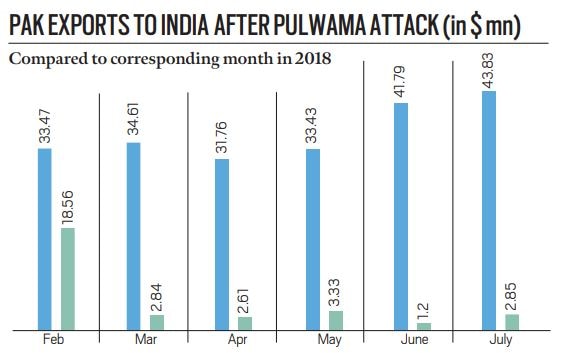
    Tensions between India and Pakistan in 2019 have reduced the already low volumes of trade between the two countries to near zero.

    India-Pakistan trade, in the beginning

    • In 1948-49, about 56% of Pakistan’s exports were to India, and 32% of its imports came from India.
    • From 1948-65, India and Pakistan used a number of land routes for bilateral trade; there were eight customs stations in Pakistan’s Punjab province and three customs checkpoints in Sindh.
    • India remained Pakistan’s largest trading partner until 1955-56. Between 1947 and 1965, the countries signed 14 bilateral agreements on trade, covering avoidance of double taxation, air services, and banking, etc.
    • In 1965, nine branches of six Indian banks were operating in Pakistan.

    Close to vanishing

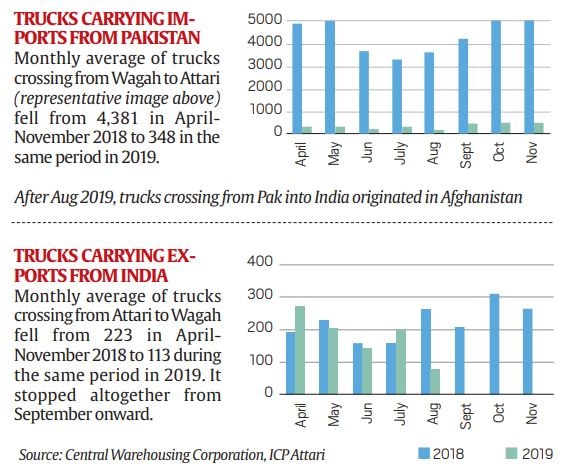
    • Following the terrorist attack on the CRPF convoy in Pulwama in February, India withdrew Most Favoured Nation (MFN) status for Pakistan and raised customs duty on Pakistani imports to 200% .
    • In April, India suspended cross-LoC trade to stop the misuse of this route by Pakistan-based elements.
    • Pakistan on its part closed its airspace to India for a prolonged period.
    • The decisions by both countries, while targeted at hurting the neighbour, have severely impacted the livelihoods of individuals and families involved in cross-border trading activities.
  • [op-ed snap] Seize the summit

    Context

    India announced that it will invite all heads of government of Shanghai Co-operation Organisation member countries, including Pakistan.

    Significance of the invitation

    • First since 2014: The summit will assume significance should Pakistan Prime Minister accept the invitation.
      • As it will be the first by a head of government or state of that country to India since former Prime Minister Nawaz Sharif attended the swearing-in ceremony of Prime Minister in 2014.
    • Hopes belied: Nothing came from that meeting and hopes created by the invitation were belied.
    • Failed attempts to engage: Attempts to engage after that failed, including at a previous SCO summit at Ufa in 2015.

    Latest events that further reduced the engagement

    • Pulwama attack: First, there was the February 2019 Pulwama attack, India’s Balakot response, and Pakistan’s counter-response.
    • Article 370: After India did away with Jammu & Kashmir’s special status, India and Pakistan have downgraded even their diplomatic presence in each other’s countries.
    • Both the countries withdrew their high commissioners after the Article 370 issue.
    • Trade stopped completely: Bilateral trade, which had managed to survive earlier shocks to relations, has stopped completely.

    Opportunities presented by SCO summit

    • “Inputs of all stakeholders”: In deciding whether to accept the invitation, the Pakistan PM will have to take into consideration “inputs of all stakeholders”.
    • A polite way of saying that the final yes or no will rest with the Pakistan Army.
    • A chance for a high-level meeting: Even if Imran Khan stays away and sends a minister instead, it would still be a chance for a high-level bilateral meeting.
    • The world wants India and Pakistan to engage: The world wants India and Pakistan to engage, and this was evident in the way the UNSC refused to take up the Kashmir issue, saying it was not the forum for it.
    • Opportunity for India to make a start: India has declared several times recently that it wants to peel away from historical foreign policy baggage.
      • India should make a start with Pakistan by making it possible for such a meeting to take place.
    • Making acceptance of invitation easier: India can make it easier for the Pakistan Prime Minister to accept the invitation.
    • Resuming trade: A start could be made by resuming trade, which has ground to a dead halt
    • Sending High Commissioner back: India can start by sending India’s High Commissioner back to his office in Islamabad.

     Conclusion

    The SCO summit presents an opportunity for both the countries to end the long hiatus in the relations which is essential for both the countries to resolve the long-standing issues and progress of both the countries.


  • Indian Origin Tamils and Sri Lanka’s Citizenship Law

    Recently an MHA spokesperson wrote on Twitter that about 4.61 lakh Tamils of Indian origin were given Indian citizenship during 1964-2008. The reference was to the Indian Origin Tamils (IOTs) of Sri Lanka, and the Lal Bahadur Shastri-Sirimavo Bandaranaike Pact of 1964.

    The Indian Origin Tamils

    • Different from Sri Lankan Tamils who live predominantly in the North and East, the IoTs are descendants of indentured Tamil workers.
    • The British had shipped them to the island in the mid 19th century to work on tea estates in the five hill districts of the Central and Uva provinces.
    • These people now call themselves Malayaha (hill country) Tamils — because of the historical stigma attached to being “Indian” Tamils.
    • At the time of Sri Lanka’s independence, the IOTs numbered around 800,000.
    • They were the backbone of the tea industry, politically active, and keen to ensure their rights in independent Sri Lanka through strategic alliances with unions and left parties.
    • Determined to blunt their political rights, the ruling parties described IOTs as “birds of passage” with no loyalty to the country, as India’s fifth column in Sri Lanka, and as people who stole the locals’ jobs.

    SL’s 1948 Citizenship Act

    • Sri Lanka’s Nov. 1948 Citizenship Act was the first in a series of divisive moves by the Sinhala rulers to consolidate their political base in the majority Sinhalese (Buddhist and Christian) community.
    • It was aimed at excluding IOTs — then as now, the predominant workforce in the upcountry tea estates — whose numbers and growing association with leftist parties were proving to be politically inconvenient.
    • The IOTs that India accepted through the 1964 agreement were not “fleeing” Sri Lanka.
    • Most were, in fact, reluctant to leave the country in which they had lived for three generations or longer.
    • Those that remained, were stateless in Sri Lanka for decades until their status as citizens was settled ironically because the ruling party now wanted their votes.

    What did the Act provide?

    • Under the Act, citizenship could be only by patrilineal descent or registration.
    • For citizenship by registration, umarried persons had to show 10 years of uninterrupted stay in Sri Lanka from the date of application; married persons had to show 7 years.
    • Most IOTs were unlettered and poor, with no documents. Effectively an entire community was rendered stateless.
    • Soon afterward came the Indian & Pakistani Residents’ Act of 1949, which opened a window for those above a certain income level.
    • Only 1,40,000 had been granted citizenship under the Indian & Pakistani Residents’ Act, and 2,50,000 were accepted by India as its citizens.
    • Finally, the 1949 Ceylon (Parliamentary Elections) Amendment was passed, under which only citizens could vote.
    • The IOTs were stripped of voting rights, and the fallout was immediate: in 1947, there were 7 Indian Tamils in the legislature; in 1952, there were none.

    Issues with the Act

    • This Act sharply delineated ethnic differences, and distorted the political system to weight it in favour the Sinhalese majority.
    • This created an intractable dynamic of ethnic outbidding between the two major Sinhalese-dominated parties to attract Sinhalese voters at the expense of the Sri Lankan Tamil minority.
    • This directly contributed to the latter’s alienation, support for secessionism, and the outbreak of ethnic violence and civil war in the 1970s and 1980s.

    India’s response

    • The treatment of Indian Tamils had cast a shadow on India-Sri Lanka relations even before independence; post-independence, the citizenship laws became a major irritant.
    • They were denounced in India, and the Madras legislature passed a resolution against them.
    • In 1947, PM Nehru had tried unsuccessfully to persuade Senanayake to give citizenship to all Indian Tamils who had lived in the country for 7 years prior to January 1, 1948.
    • The two countries corresponded on this issue until Nehru’s death in 1964.
    • Nehru rejected the Sri Lankan position that the “stateless” IOTs were automatically Indian citizens, and would have to be shipped to India.

    Repatriation of IOTs

    • After the 1962 war with China, PM Shastri was eager to mend fences with Sri Lanka. He gave in to Bandaranaike’s demands, and it was agreed that Sri Lanka would accept 3,00,000 IOTs and their natural increase, while India would accept 5,25,000 IOTs and their natural increase.
    • The status of the balance 1,50,000 IOTs was to be decided later.
    • Some 4,00,000 reluctantly applied for citizenship of India; 6,30,000 applied for Sri Lanka’s.
    • By the time the window agreed upon in 1964 closed, only 1,62,000 IOTs had been given Sri Lankan citizenship. In the same period, India gave citizenship to over 3,50,000.
  • Ethnic Unity Law in Tibet

    The People’s Congress of Tibet passed a law that makes ethnic unity in the region mandatory, reflecting the significant role that the autonomous Himalayan region plays in its economic and social development.

    About the Law

    • The law makes it clear that Tibet has been an inalienable part of China since ancient times.
    • It states that it is the common responsibility of the people of all ethnic groups to safeguard national reunification and take a clear stand against separatism.

    Ethnic Unity in China

    • This is not the first time that the phrase ethnic unity has been mentioned by China.
    • In October 2019 the Communist Party of China published a guideline for enhancing ethnic unity.
    • It stressed on efforts to improve the governance of ethnic affairs, guaranteeing the legal rights and interests of citizens of ethnic groups.
    • It called for cracking down on “criminal acts” that sabotage ethnic unity or cause ethnic separation.
    • Before this, in 2016, China began a campaign in the autonomous territory of Xinjiang to promote ethnic unity and called for people to respect the cultures of the minorities who call the region home.

    Why such Law?

    • There are more than 40 ethnic minorities in the region, which account for 95 per cent of Tibet’s population of over three million.
    • Like Tibet, Xinjiang is another region of China that houses multiple ethnic minorities.
    • A similar legislation was passed there four years ago and in recent times, China has faced criticism for detaining at least a million Uighur and other Muslims, along with some ethnic Kazakhs and Uzbeks.
    • China has began “re-education camps” in Xinjiang, a region that has been claimed by China since 1949.
    • China has denied these allegations and maintains that the facilities where the detainees are housed are vocational training centers.
  • Raisina Dialogue 2020


    India`s annual global conference on geopolitics and geo-economics, Raisina Dialogue 2020 has began with the participation of over 100 countries.

    Raisina Dialogue

    • The Raisina Dialogue is a multilateral conference committed to addressing the most challenging issues facing the global community.
    • It is jointly organised by the Ministry of External Affairs and the Observer Research Foundation.
    • Every year, global leaders in policy, business, media and civil society are hosted in New Delhi to discuss cooperation on a wide range of pertinent international policy matters.
    • The Dialogue is structured as a multi-stakeholder, cross-sectoral discussion, involving heads of state, cabinet ministers and local government officials, as well as major private sector executives, members of the media and academics.

    This years’ agenda

    • The fifth edition of the Dialogue 2020 has been India`s contribution to global efforts to discover solutions, identify opportunities and provide stability to a century that has witnessed an eventful two decades.
    • This year`s Dialogue titled `Navigating the Alpha Century` is structured as a multi-stakeholder, cross-sectoral discussion, involving heads of states, cabinet ministers and local government officials as well as major private sector executives, members of the media and academics.

    Significance of the dialogue

    • The Raisina Dialogue has acquired an enviable global profile uniting the best strategic thinkers of the world.
    • The synergies and collaborations in the Raisina Dialogue represent India`s deliberative ethos, as well as its international credibility and convening power.
    • The Dialogue has grown along with India`s diplomatic profile and will set the tone for its intensive diplomatic engagement this year.