Mains Ready By December. Smash Mains & Smash PYQ Admissions Open

GS Paper: GS2-01.Indian Constitution-Historical underpinnings & evolution; Features, amendments, significant provisions, basic structure of Constitution

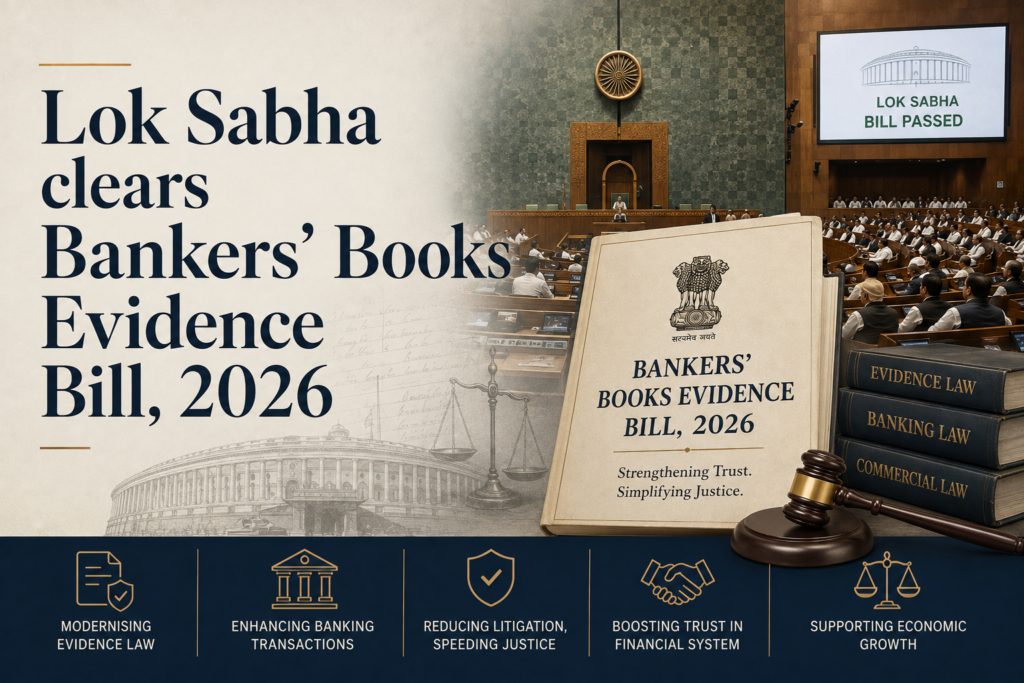
  • Lok Sabha clears Bankers’ Books Evidence Bill, 2026

    Why in the News

    The Lok Sabha has cleared the Bankers’ Books Evidence Bill, 2026, replacing the colonial Bankers’ Books Evidence Act, 1891. It modernises how bank records are admitted as evidence in court, amid data-privacy concerns.

    What does the Bill change?

    1. Digital records: It recognises electronic and digital bank records as admissible evidence, aligning with modern banking.
    2. Officer powers: It empowers a senior-rank officer to certify records and use hash values to verify integrity.

    Why do concerns remain?

    1. Data privacy: Wider access to digital bank records raises questions on safeguards for customer financial data.
    2. Certification standards: The reliability of hash-based verification depends on tamper-proof audit trails.
    3. Overlap with new codes: The Bill must sit consistently with the recently enacted evidence and criminal law framework.

    Conclusion

    The Bill updates a 19th-century evidence law for a digital banking era. The next milestone is Rajya Sabha clearance and rules on data safeguards.

  • Meta accused of stepping up takedowns of protest content

    Why in the News

    Meta is reported to be removing protest and political reels after routing takedown requests through the Ministry of Home Affairs Sahyog portal. The conflict is between the state’s power to order content removal and the citizen’s right to free speech online.

    What is Section 79(3)(b) of the Information Technology Act, 2000?

    1. Safe harbour condition: Section 79 gives intermediaries legal immunity for user content, conditional on acting on a government or court order.
    2. Takedown trigger: Under 79(3)(b), an intermediary must remove content on receiving actual knowledge through such an order.

    How does this differ from the Section 69A route?

    1. Procedural safeguards: Section 69A blocking requires a reasoned order and a review committee, with recorded justification.
    2. Weaker check: The 79(3)(b) route lacks the same documented safeguards, enabling faster and broader removals.
    3. Portal channel: Requests are routed through the MHA’s Sahyog portal, widening the volume of takedowns.

    Why does this raise a free speech concern?

    1. Political speech: Removal of protest reels targets expression at the core of Article 19(1)(a) protection.
    2. Opaque process: Users often receive no reasoned order they can challenge.

    What is the state’s justification?

    1. Public order: Removal is defended on grounds of preventing unrest and misinformation.

    Conclusion

    The dispute is over whether a fast track takedown route bypasses the procedural checks that protect online speech. The unresolved question is whether courts will require 69A style safeguards for 79(3)(b) removals.

    Back2Basics: Shreya Singhal Judgment (2015)

    1. Ruling: The Supreme Court struck down Section 66A of the IT Act for vagueness.
    2. Section 79: It read down Section 79(3)(b) to require a court or government order before takedown.

    Matching Previous Year Question

    “[2014, GS2, 12.5 marks] What do you understand by the concept ‘freedom of speech and expression’? Does it cover hate speech also? Why do the films in India stand on a slightly different plane from other forms of expression? Discuss.”

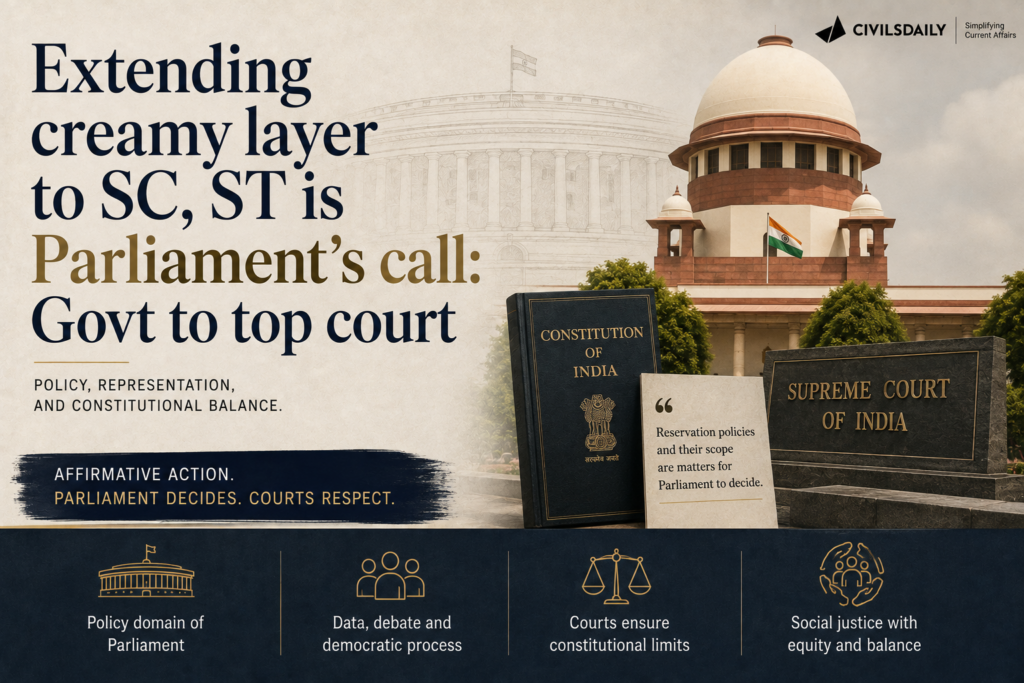
  • Extending creamy layer to SC, ST is Parliament’s call: Govt to top court

    Why in the News

    The Centre has told the Supreme Court that the creamy layer principle cannot be extended to Scheduled Castes (SCs) and Scheduled Tribes (STs) through judicial directions. It argued that any such change requires a decision by Parliament, as reservation for SCs and STs is based on historical and social discrimination rather than economic status.

    What is the Creamy Layer Principle?

    • Definition: Excludes the socially advanced and economically better off members of a reserved category from availing reservation benefits.
    • Origin: Introduced for Other Backward Classes (OBCs).
    • Current Position: The principle does not apply to SCs and STs, whose reservation is based on historical discrimination and social exclusion.

    What did the Centre argue before the Supreme Court?

    • Parliament’s Authority: Only Parliament can decide whether to extend the creamy layer principle to SCs and STs.
    • Constitutional Basis: Any exclusion must follow the procedure under Article 341(2) (and similarly Article 342 for STs).
    • Need for Evidence: Any income based classification should be preceded by a comprehensive empirical study.
    • Separation of Powers: Courts should not direct the executive to frame such a policy without legislative backing.
    • Reservation Basis: SC and ST identification depends on historical social disadvantage, not merely economic criteria.

    Key Judicial Precedents

    • State of Punjab v. Davinder Singh (2024): Held that sub classification within SCs and STs for equitable distribution of reservation benefits is constitutionally permissible.
    • E.V. Chinnaiah v. State of Andhra Pradesh (2005): Held that altering the SC list requires legislative action under Article 341.
    • Ashoka Kumar Thakur v. Union of India (2008): Clarified that the creamy layer principle does not apply to SCs and STs.

    What is the core issue?

    • Equitable Distribution: Petitioners seek greater benefits for the poorest sections within SCs and STs.
    • Social Justice vs Economic Criteria: The Centre maintains that SC/ST reservation addresses historical social stigma, not poverty alone.
    • Institutional Question: The case raises the issue of whether such reforms should come through judicial intervention or Parliamentary legislation.
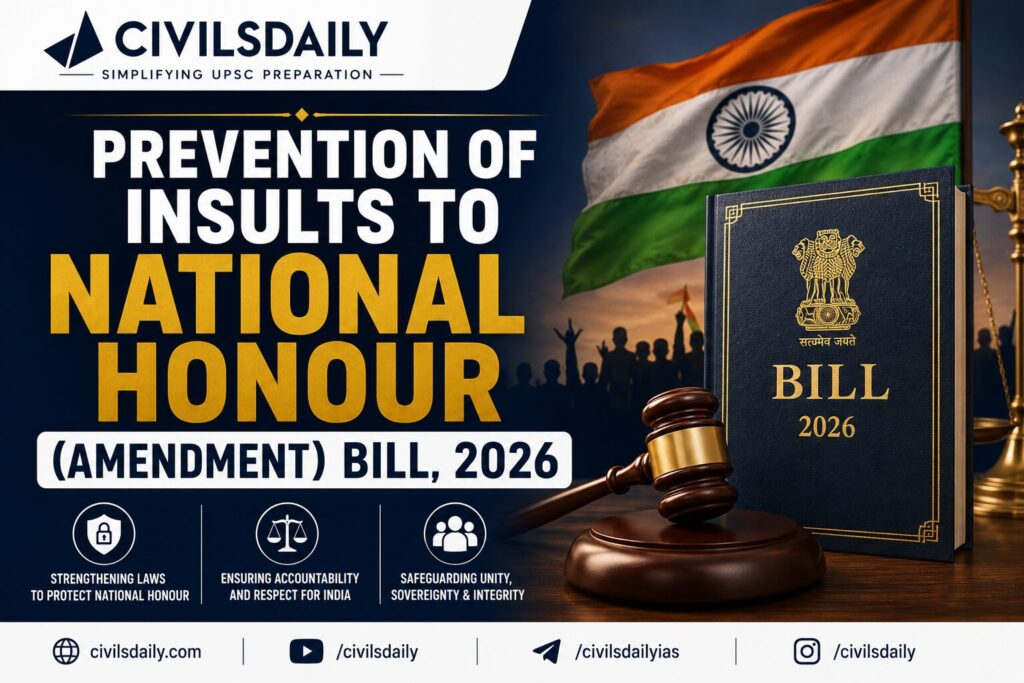
  • Prevention of Insults to National Honour (Amendment) Bill, 2026

    Why in News?

    The Rajya Sabha passed the Prevention of Insults to National Honour (Amendment) Bill, 2026, extending legal protection to Vande Mataram by making its intentional disruption or prevention a punishable offence.

    Key Highlights

    • Amends the Prevention of Insults to National Honour Act, 1971.
    • Makes intentional disruption or prevention of the singing of Vande Mataram punishable.
    • Punishment: Imprisonment up to 3 years, or fine, or both.
    • Seeks to accord the National Song legal protection similar to the National Anthem (Jana Gana Mana).
    • Passed by the Rajya Sabha through a voice vote.

    About the Prevention of Insults to National Honour Act, 1971

    • The Act penalises insults to: National Flag, Constitution of India, and National Anthem
    • The 2026 amendment adds protection for the National Song (Vande Mataram).

    Vande Mataram

    • Written by Bankim Chandra Chattopadhyay.
    • Originally appeared in the novel Anandamath (1882).
    • Adopted as the National Song on 24 January 1950.
    • Only the first two stanzas are accorded official status.

    Prelims Facts

    • National Anthem: Jana Gana Mana by Rabindranath Tagore.
    • National Song: Vande Mataram by Bankim Chandra Chattopadhyay.
    • 24 January 1950: Constituent Assembly adopted Jana Gana Mana as the National Anthem while according Vande Mataram equal honour as the National Song.

    [2025] Consider the following pairs:
    Provision in the Constitution of India State under
    I. Separation of Judiciary from the Executive in the Public services of the StateThe Directive principles of the State policy
    II. Valuing and preserving of the rich Heritage of our composite cultureThe Fundamental Duties
    III. Prohibition of employment of children below the age of 14 years in factoriesThe Fundamental Rights
    How many of the above pairs are correctly matched?

    [A] Only one

    [B] Only two

    [C] All the three

    [D] None

  • Protecting protest: on mass protests

    Why in the News?

    The Supreme Court is hearing petitions on alleged excessive police force during recent protests, while the CJI’s remarks on protests requiring due permission have sparked debate. The case has also revived the question of whether public inconvenience caused by peaceful protests should be conflated with violence, and the need for a national protocol on crowd-control measures.

    Why does conflating inconvenience with violence weaken the right to protest?

    1. Legal standard blurred: Treating traffic disruption or public inconvenience as equivalent to violence lowers the threshold at which force can be used against a peaceful gathering.
    2. Judicial remark’s weight: A “due permission” framing from the Chief Justice of India carries institutional weight that can shape how lower courts and police read the limits of Article 19(1)(b), the right to assemble peaceably.
    3. Precedent tension: Existing case law distinguishes disruptive but peaceful assembly from violent assembly, and collapsing that distinction narrows the constitutional space for protest.

    What does the absence of a national crowd control protocol expose?

    1. No uniform threshold: Without a national protocol, the force threshold used against protestors varies by state and by individual police commander’s judgment.
    2. Accountability gap: No standard mechanism currently holds police accountable for disproportionate force used to disperse a protest deemed merely inconvenient.
    3. Comparative absence: Other democracies operationalise proportionality standards for crowd control through documented use of force continuums, a structure India’s policing framework lacks in codified form.

    Conclusion

    Peaceful protests that cause public inconvenience should not be treated the same as violent acts. A national crowd-control protocol with clear rules on the use of force and strong accountability can help protect both the right to protest and public order.

    Back2Basics

    The right to protest in India is an implied fundamental right derived from Article 19(1)(a) (freedom of speech and expression) and Article 19(1)(b) (freedom to assemble peaceably and without arms) of the Constitution of India.

    Constitutional Basis and Rules

    1. No Absolute Right: Protests must remain completely peaceful and unarmed.
    2. Reasonable Restrictions: Under Articles 19(2) and 19(3), the state can limit protests to protect the sovereignty and integrity of India, security of the state, and public order.
    3. No Blocking Roads: The Supreme Court has ruled that public ways and spaces cannot be permanently blocked or occupied, balancing protester rights with public movement.

    Legal Obligations and Permissions

    1. Prior Permission: Organizers must generally seek local police or municipal permissions to hold public gatherings or marches.
    2. Designated Spaces: Authorities often restrict demonstrations to specific assigned areas (like designated grounds or parks) to prevent traffic and safety hazards.
    3. Police Action Limits: Courts maintain that mere assembly or peaceful agitation does not justify excessive police force or lathi-charges.

    PYQ Relevance

    [UPSC 2022] Right of movement and residence throughout the territory of India are freely available to the Indian citizens, but these rights are not absolute. Comment.

    Linkage: The PYQ tests the scope of Fundamental Rights under Article 19 and reasonable restrictions. The editorial examines the limits of the right to peaceful protest under Article 19, and whether restrictions on protests satisfy the test of proportionality.
  • The right to protest and the limits of police power

    Why in the News

    The Cockroach Janta Party’s (CJP) “Chalo Sansad” march at Jantar Mantar on July 20, demanding reforms in the National Testing Agency (NTA) and the Union Education Minister’s resignation, ended in tear gas and lathi charges after protesters attempted to march towards Parliament. The clashes reopened the question of how a democracy polices protest, testing where a constitutionally protected right to assemble ends and lawful police power to disperse begins.

    Is the right to protest absolute?

    1. Constitutional guarantee: Article 19(1)(b) of the Indian Constitution guarantees all citizens the Fundamental Right to assemble peaceably and without arms. This includes the right to hold public meetings, demonstrations, and take out processions, forming the constitutional basis for peaceful protests.
    2. Reasonable restrictions permitted: Article 19(3) allows reasonable restrictions on this right in the interests of public order and the sovereignty and integrity of India.
    3. Restrictions implemented through statute: These restrictions operate through laws governing public order and policing rather than through Article 19 directly.
    4. No single governing law: The legal authority to regulate protests is drawn from a range of statutes, not one dedicated law.

    Was the CJP march unlawful?

    1. Bharatiya Nyaya Sanhita (BNS) test for unlawful assembly: Under the Section 189 of the Bharatiya Nyaya Sanhita (BNS), 2023, an assembly of five or more persons becomes unlawful only if its common object involves using criminal force, resisting the execution of law, committing an offence, or compelling a person by force or threat.
    2. Lawful assemblies can turn unlawful: A gathering that begins lawfully can become unlawful if its conduct changes during the event.
    3. No permission sought: Delhi Police said the CJP had not sought permission for a procession to Parliament.
    4. Prohibitory order in force: Section 163 of the Bharatiya Nagarik Suraksha Sanhita (BNSS) barred protests, marches and demonstrations in the New Delhi district, except at the designated Jantar Mantar site with prior permission.
    5. Judicial scrutiny followed: The Delhi High Court has sought responses from the Centre and Delhi Police on petitions alleging police brutality and excessive force.

    What standards and limits govern police use of force?

    1. Democratic policing standard: The National Human Rights Commission (NHRC) Manual on Human Rights for Police Officers states that democratic policing treats police as protectors of citizens’ rights and the rule of law, while ensuring safety and security equally for all.
    2. Cost of violations: The manual notes that human rights violations by police erode public confidence, bring institutions into disrepute, and can escalate civil unrest.
    3. Global standard on force: These principles align with the United Nations (UN) Basic Principles on the Use of Force and Firearms, which require force to be lawful, necessary and proportionate.
    4. Statutory dispersal power: Under the BNSS, an Executive Magistrate or an authorised police officer may order an unlawful assembly, or one likely to disturb public peace, to disperse, and may use force if it does not comply.
    5. Minimum force standard: The Code of Conduct for the Police in India requires persuasion, advice and warning first, and only the irreducible minimum force once force becomes inevitable.
    6. Identification gap: The BNSS requires an arresting officer to bear accurate, visible identification but imposes no corresponding requirement on officers engaged in crowd control or dispersal, even as videos from the march showed personnel without name tags or with faces covered.

    How has the judiciary drawn the line, then and now?

    1. Anita Thakur v. State of Jammu & Kashmir (2016): The Supreme Court held that excessive force violates Fundamental Rights and awarded compensation to injured protesters, holding that police action must remain reasonable and accountable.
    2. Mazdoor Kisan Shakti Sangathan v. Union of India (2018): The Court held that authorities may regulate demonstrations to maintain public order but cannot extinguish the right to protest altogether.
    3. Amit Sahni v. Commissioner of Police (2020): Arising from the Shaheen Bagh protests, the Court affirmed that dissent is a constitutional right but cannot justify the indefinite occupation of public spaces.
    4. Present reluctance: Chief Justice of India Surya Kant orally declined a plea for suo motu cognisance of the alleged police excesses, saying the Court was “not interested in videos” and should not have its time wasted.

    Conclusion

    The right to assemble under Article 19(1)(b) is not absolute, and police may lawfully disperse an assembly that turns unlawful or defies a prohibitory order, but the force used must remain the minimum necessary and be accountable. The CJP crackdown exposed a specific accountability gap: the BNSS requires arresting officers to display identification but imposes no such requirement on personnel engaged in crowd control, a gap the courts’ existing case law on excessive force does not close, even as the Supreme Court itself declined to examine video evidence of the incident.

    PYQ Relevance

    [UPSC 2022] Right of movement and residence throughout the territory of India are freely available to the Indian citizens, but these rights are not absolute. Comment.

    Linkage: The PYQ highlights that Fundamental Rights are subject to reasonable restrictions. This is conceptually very close because the article explains that the right to assemble peacefully is also not absolute and may be reasonably restricted under Article 19(3) for public order.

  • What is the right to be forgotten? 

    Why in the News?

    The Delhi High Court, ruling on 29 May 2026 in Laksh Vir Singh Yadav v. Union of India, laid down India’s first structured proportionality test for the right to be forgotten. The ruling forces a direct reckoning between an individual’s right to informational privacy and the constitutional commitment to open justice and free speech.

    How did the right to be forgotten emerge, and why did Indian courts arrive at it inconsistently?

    1. Origin in EU jurisprudence: The right originated in 2014 when Mario Costeja González complained to the European Court of Justice that Google continued to display an old notice about the auction of his repossessed house even after the debt was settled.
    2. Codification in General Data Protection Regulation (GDPR): The European Court ruled in his favour. This laid the groundwork for the right to erasure, later incorporated into Article 17 of the EU’s General Data Protection Regulation.
    3. Constitutional anchor in India: The Supreme Court’s judgment in K.S. Puttaswamy v. Union of India (2017) held that privacy is a Fundamental Right under Article 21 of the Constitution of India. This includes the right to informational privacy.
    4. Divergent High Court practice: High Courts adopted inconsistent approaches after Puttaswamy. Some permitted anonymisation in limited cases, such as the Delhi High Court’s masking of names in certain matrimonial and criminal matters.
    5. The unresolved gap: Other courts rejected similar requests on grounds of open justice. No coherent framework existed to balance these competing interests before the May 2026 judgment.

    What test did the Delhi High Court lay down, and what does it require?

    1. The core issue: The Delhi High Court ruled on a batch of over 30 consolidated petitions. The central question was whether informational privacy could justify de-indexing or masking judicial records in a system committed to open justice.
    2. Constitutional source of the right: The court held that the right to be forgotten flows from Article 21’s guarantee of dignity and informational privacy.
    3. The proportionality test: Any restriction must have a legitimate purpose. The harm to privacy must be balanced against the public interest.
    4. Preference for the least intrusive means: Masking names should be preferred over deleting the entire judgment.
    5. Procedural direction: The court prescribed a two-week deadline for legal databases to comply. It clarified that only the parties’ names should be redacted, not the facts of the case.

    Why does the right to be forgotten sit in tension with open justice and free speech?

    1. Not a stand-alone right: The right to be forgotten frequently conflicts with freedom of speech and press under Article 19(1)(a), the principle of open justice, and the public’s right to know.
    2. A high threshold for privacy: A right to privacy must be sacrificed when the public interest is of a high order, particularly in serious cases of crime.
    3. The limiting principle: The digital presence of a case should not destroy a person’s life long after the trial ends.
    4. Selective, not absolute, restriction: Judgments remain publicly accessible by case number or keyword search. Only name-based searches are restricted.
    5. The unresolved concern: For an acquitted person, a name-based search can still surface the original accusation, described as the “shadow of crime,” as the first result a user sees.

    Why does enforcement remain the weakest link in this framework?

    1. Search engine design defeats masking: Search results are still generated at the search-engine level. Removing a court’s own copy does not remove all traces.
    2. Persistence beyond the primary source: Mirrors, archived copies, and social media sharing keep the original content accessible even after a court orders removal.
    3. No coordination mechanism: Effective technical compliance requires coordination among multiple platforms. No such mechanism currently exists.
    4. Consequence for the right’s value: Without platform-level compliance, the right to be forgotten remains largely symbolic rather than enforceable.

    What is the statutory basis for erasure under the Digital Personal Data Protection Act, 2023 (DPDP Act), and why is it inadequate for judicial records?

    1. Limited existing statutory right: The Digital Personal Data Protection Act, 2023 offers a limited right to erasure under Section 12.
    2. Consent-based design: This statutory right is primarily based on consent. It does not explicitly address judicial records.
    3. Scope gap: The Act does not cover public archives, where the need for a right to be forgotten is most acute.
    4. Non-operational status: The Act is deficient because its rules have not been notified.
    5. Missing institution: The data protection board contemplated under the Act has not been established.

    Who should decide erasure requests, and how should that authority be structured?

    1. The efficiency-accountability trade-off: Requiring every request to be decided by a court would create significant bottlenecks. Leaving decisions entirely to technology companies raises concerns about due process and transparency.
    2. A tiered proposal: A more sensible approach would use a tiered system.
    3. First tier: platforms: Straightforward cases could be heard directly by platforms.
    4. Second tier: data protection board: Contested cases would go to the data protection board.
    5. Third tier: courts: Judicial cases, including those with constitutional questions, would be reserved for courts.

    Conclusion

    The Delhi High Court’s ruling gives the right to be forgotten its most structured judicial articulation in India, subordinating deletion to name-masking to protect dignity without eroding open justice. This framework remains judge-made and non-statutory: the DPDP Act does not cover judicial records, the data protection board does not exist, and search engines retain wide discretion over technical compliance. Until the Supreme Court settles the doctrine nationally and a statutory institution is created to adjudicate erasure requests, the right to be forgotten in India will function more as a judicial aspiration than an enforceable entitlement.

    PYQ Relevance

    [UPSC 2024] Right to privacy is intrinsic to life and personal liberty and is inherently protected under Article 21 of the constitution. Explain. In this reference, discuss the law relating to D.N.A. testing of a child in the womb to establish its paternity.

    Linkage: The article similarly examines the Right to be Forgotten as an aspect of informational privacy under Article 21 and its balance with freedom of speech, the public’s right to know and the principle of open justice.

  • [7th July 2026] The Hindu OpED: In India, voting cannot remain merely a statutory right 

    [UPSC 2024] Examine the need for electoral reforms as suggested by various committees with particular reference to ‘one nation-one election’ principle.
    Linkage: The PYQ examines reforms required to strengthen India’s electoral democracy and democratic participation.The article argues that constitutional recognition of the right to vote is a foundational electoral reform that would strengthen free and fair elections and deepen democratic legitimacy

    Mentor’s Comment

    A Congress leader has revived the demand to recognise voting as a fundamental right, reopening a settled constitutional debate. The demand exposes a growing inconsistency between the Supreme Court’s insistence that voting remains a mere statutory right and its own decisions constitutionalising nearly every facet surrounding the vote.

    Why has the Supreme Court traditionally treated the right to vote as a statutory right rather than a fundamental right?

    1. Foundational ruling: N.P. Ponnuswami vs Returning Officer (1952) held that the right to vote is not a common law right. Parliament created this right through statute.
    2. Reaffirmation: Jyoti Basu vs Debi Ghosal (1982) held the right to elect is “purely a statutory right.” Justice O. Chinnappa Reddy denied it the status of a fundamental right.
    3. Constitution Bench position: Kuldip Nayar vs Union of India (2006) held that democracy forms part of the basic structure (basic structure doctrine: the principle that certain core features of the Constitution cannot be altered even by a constitutional amendment). It held that the individual right to vote flows from the Representation of the People Acts, not from the Constitution.
    4. Textual basis: Part III of the Constitution does not list the right to vote among the fundamental rights.
    5. Parliamentary latitude: This textual silence gives Parliament wide discretion. Parliament prescribes qualifications, disqualifications, and procedures for elections.

    How has judicial interpretation constitutionalised individual facets of voting, and what anomaly does this create?

    1. Right to know: Union of India vs Association for Democratic Reforms (2002) held that voters have a right to know the criminal antecedents, educational qualifications, and financial assets of candidates. The Court grounded this right in Article 19(1)(a).
    2. Freedom to choose: People’s Union of Civil Liberties vs Union of India (2003) held that the freedom to make an informed choice is a fundamental right under Article 19(1)(a). The Court retained the position that the right to vote itself is statutory.
    3. Right to reject: The 2013 NOTA judgment held that a voter’s decision to reject all candidates is political expression protected by Article 19(1)(a). The Court extended ballot secrecy to voters who choose not to vote for any candidate.
    4. Emerging judicial view: Justice Ajay Rastogi’s separate opinion in Anoop Baranwal vs Union of India (2023) favoured recognising voting as a fundamental right. This view did not command a majority on the Constitution Bench.
    5. Resulting anomaly: The Court has made the right to know, the freedom to choose, and the right to reject all candidates fundamental. The act of voting itself remains a mere statutory entitlement.
    6. Logical inconsistency: The Constitution protects the right to reject every candidate. Denying protection to the right to choose one is incongruous.

    Does recognising a Fundamental Right to vote require removing Parliament’s power to regulate elections?

    1. Limited scope of the claim: Constitutional recognition is not required for every procedural detail of voting. It is required only for the core right to participate in the democratic process.
    2. Regulatory power retained: Parliament continues to prescribe qualifications, disqualifications, and age requirements for elections. Electoral rolls and residency conditions also remain within Parliament’s domain.
    3. Corrupt practices regulation: Disqualification for corrupt practices remains a statutory matter. This regulation is necessary for orderly elections.
    4. Entitlement distinguished from mechanics: The mechanics of voting may remain statutory. The citizen’s underlying entitlement to be a voter need not.

    Why does the basic structure doctrine make the statutory classification of voting untenable?

    1. Democracy as basic structure: Kesavananda Bharati vs State of Kerala (1973) held that democracy forms part of the Constitution’s basic structure.
    2. Free elections as essential feature: Indira Nehru Gandhi vs Raj Narain (1975) held that free and fair elections are an essential feature of democracy.
    3. Source of legitimacy: Elections derive legitimacy from citizen participation through the ballot. The vote is the instrument through which popular sovereignty is exercised.
    4. Constitutional source of entitlement: Article 326 mandates elections on the basis of universal adult suffrage. Every citizen above 18 is constitutionally entitled to be registered as an elector, subject only to narrowly defined disqualifications.
    5. Statute merely operationalises: The Representation of the People Acts operationalise the command in Article 326. They do not create the underlying entitlement.
    6. Exclusion as constitutional harm: Exclusion from the electoral roll strikes at a constitutional guarantee. This holds except where exclusion follows constitutionally permissible limitations.

    Conclusion

    The Supreme Court has extended constitutional protection to the right to know, the freedom to choose, and the right to reject candidates, while continuing to classify the act of voting itself as merely statutory. This position is inconsistent with the Court’s own recognition that democracy and free and fair elections form part of the basic structure. The Court must revisit the Ponnuswami-Jyoti Basu-Kuldip Nayar line of doctrine. The citizen’s entitlement to be a registered elector flows from Article 326 of the Constitution, leaving only the mechanics of voting to statutory regulation.

  • [6th July 2026] The Hindu OpED: The right to belong beyond official documentation

    Mentor’s Comment

    On June 24, 2026, a Ministry of External Affairs (MEA) statement described the Indian passport as a “travel document” and not a “citizenship document.” The statement, coming amid the Election Commission’s Special Intensive Revision (SIR) of electoral rolls and recent Supreme Court rulings on citizenship, exposes a quiet shift in the burden of proving citizenship from the state to the individual.

    Why does the MEA’s “travel document” statement not settle the question of proof of citizenship?

    1. The Trigger: On June 24, 2026, an MEA statement described the Indian passport as a “travel document” and not a “citizenship document.”
    2. Statutory Exception: Passports are issued to non-citizens only when the government considers it necessary in “public interest.”
    3. Default Presumption: Outside this exception, passport issuance presumes citizenship. A passport is therefore conclusive proof of citizenship in the ordinary case.
    4. Available Remedy: The government can challenge a passport under law if it was obtained by concealing the true citizenship status of the holder.
    5. The Red Herring: The MEA’s framing does not change this legal position. It distracts from the real question: what standard of proof governs citizenship claims.

    Why did the Constituent Assembly’s rejection of the Deshmukh amendment establish an implied limitation on Parliament’s power over citizenship?

    1. The Plenary Power: Article 11 gives Parliament wide power to legislate on the acquisition and termination of citizenship.
    2. The Religious Test Proposal: P.S. Deshmukh moved an amendment to make Hindus and Sikhs automatically entitled to Indian citizenship.
    3. Nehru’s Rejection: Jawaharlal Nehru called the proposal “absurd on the face of it” and opposed it outright.
    4. Ayyar’s Secular Argument: Alladi Krishnaswami Ayyar argued India’s commitment to a secular state ruled out any distinction between persons on racial or religious grounds.
    5. The Implied Limitation: The defeat of the Deshmukh amendment and the adoption of Ambedkar’s neutral clause show that Parliament’s power under Article 11 is bounded by secularism, equality, and non-discrimination.
    6. Legal Boundary: Parliament can decide the modalities of citizenship. Parliament cannot make religion a condition for citizenship.

    How have legislative and judicial developments since 1985 shifted India’s citizenship regime away from jus soli towards near-unlimited parliamentary discretion?

    1. The Original Principle: The Citizenship Act, 1955 adopted jus soli, citizenship based on residence and birth. Jus soli: citizenship granted on the basis of birth or residence in a territory.
    2. First Amendment: Section 6A, introduced in 1985 to implement the Assam Accord, suspended citizenship conferment based on entry dates for people of “Indian origin.”
    3. Second Amendment: A 2003 amendment denied citizenship to persons born in India if even one parent was an “illegal migrant.”
    4. Judicial Endorsement: The Supreme Court’s October 2024 judgment upholding Section 6A found no implied limitation in Article 11 and treated Parliament’s power as virtually unlimited.
    5. Precedent Reinforced: The Court’s reasoning drew on Sarbananda Sonowal vs Union of India (2005), which had already characterised migration into Assam as “external aggression” against the State.
    6. Extension to SIR: Association for Democratic Reforms vs Union of India (May 2026) extended this rationale by upholding the ECI’s power to enquire into citizenship for the “limited” purpose of the electoral roll.

    Does the “principled distinction” between citizenship adjudication and electoral roll administration resolve the burden of proof problem, or does it merely relocate it into a zone of indefinite suspension?

    1. The Court’s Distinction: The Supreme Court distinguished between adjudicating citizenship and administratively verifying a name’s continuation on the electoral roll.
    2. The Referral Mechanism: Where the ECI is not satisfied with a claim of citizenship, it must refer the matter to the “competent authority” under the Citizenship Act.
    3. The Assam Precedent: An earlier revision in Assam sent voters marked “doubtful” to Foreigners Tribunals, trapping them in a prolonged bureaucratic process. Foreigners Tribunals: quasi-judicial bodies in Assam that adjudicate disputed citizenship status.
    4. The New Vacuum: Under the current machinery, a person need not be declared a foreigner to lose their basic rights. The person is instead left neither confirmed nor cleared.
    5. The Burden Shift: The burden of proving citizenship has moved from the state to the individual. No single document is now treated as conclusive.
    6. Documentary Erosion: The Aadhaar card is treated as proof only of residence. The voter ID is treated as proof only of prior registration. The passport is now treated as proof only of a right to travel.

    Why must citizenship rest on personhood rather than documentary proof, given the constitutional guarantees that flow from citizenship status?

    1. Universal Guarantees: Article 14 guarantees equality before the law to “any person.” Article 21 guarantees life and personal liberty to all persons.
    2. Citizenship-Specific Guarantees: Article 19 freedoms of speech, trade, and assembly, and the statutory right to vote, depend on citizenship status.
    3. The Stakes of Exclusion: To be excluded from citizenship is to forfeit what Hannah Arendt called the right to have rights.
    4. The Constitutional Test: Rules that determine citizenship must be built on equal dignity and equal protection of the law, not on documentary proof alone.

    Conclusion

    The MEA’s description of the passport as a mere travel document reflects a wider pattern. The burden of proving citizenship has shifted from the state to the individual. No document is now treated as conclusive proof. This produces a vacuum where persons are neither declared foreigners nor confirmed as citizens, and their rights remain in indefinite suspension. Citizenship is the foundation for personhood-based guarantees under Articles 14, 19, and 21. The rules determining citizenship must rest on equal dignity and equal protection, not on the accident of paperwork.

  • [3rd July 2026] The Hindu OpED: The right to a fair trial at the crossroads

    PYQ Relevance[UPSC 2023] The Constitution of India is a living instrument with capabilities of enormous dynamism. It is a constitution made for a progressive society. Illustrate with special reference to the expanding horizons of the right to life and personal liberty.
    Relevance: The PYQ directly covers the expansion of Article 21, including the right to speedy trial, fair procedure and personal liberty. The editorial argues that prolonged incarceration without trial violates the evolving constitutional guarantee under Article 21.

    Why in the News?

    The Supreme Court denied bail to Umar Khalid and Sharjeel Imam in the 2020 Delhi riots case earlier this year, though they have been in pre-trial detention for nearly six years. This has renewed the question of how long an accused can be held without trial, and exposed inconsistency in how courts weigh delay against the gravity of the offence under the Unlawful Activities (Prevention) Act (UAPA), 1967. At stake is whether pre-trial incarceration under anti-terror law is becoming punishment before conviction.

    Why does prolonged pre-trial detention under the UAPA raise a constitutional question of personal liberty?

    1. Delay triggers Article 21 right: The Supreme Court’s own prior judgments hold that an extended trial delay triggers the accused’s right to personal liberty under Article 21.
    2. Statutory conditions cannot override the Constitution: The UAPA’s strict bail conditions cannot override the constitutional right to personal liberty.
    3. Gravity of offence remains an allegation: At the bail stage, the gravity of the offence is only an allegation made by the state, not a proven fact.
    4. Sliding scale of detention: Allowing gravity to override delay creates a sliding scale that keeps certain individuals in jail for years simply because they are accused of grave offences.
    5. Precedent of prolonged wrongful detention: Individuals accused under the UAPA have been held in jail for over two decades before being acquitted, losing the most productive years of their lives.

    Does weighing the gravity of the offence against delay protect due process, or does it convert the trial into the punishment itself?

    1. Judge controls the pace of trial: The judge, not the accused, controls the courtroom and decides the pace of the trial.
    2. Responsibility for delay rests with the judiciary: The judge bears the ultimate responsibility to complete a trial within a reasonable timeframe, regardless of applications filed by either side.
    3. Internal Court criticism: A separate two-judge Bench of the Supreme Court openly criticised the Delhi riots bail rejection as contrary to established precedent.
    4. Reaffirmation of the rule of law: The Bench reiterated that individuals cannot be incarcerated indefinitely without trial under a Constitution committed to the rule of law.
    5. Delay used as a proxy for guilt: Treating an unproven allegation of gravity as sufficient ground to override delay effectively punishes the accused before the trial concludes.

    Why does inconsistency across and within courts on UAPA bail undermine the rule of law?

    1. Referral to a larger Bench: In a related case, the Delhi riots Bench referred the question of how long pre-trial detention can continue to the Chief Justice, for the constitution of a larger Bench.
    2. Unresolved apex court debate: The Supreme Court is now debating whether individuals who have spent over half a decade in jail without trial should be released, and the question remains open even as detention continues to lengthen.
    3. Contrasting High Court rulings: The Delhi High Court granted bail to Kashmiri human rights activist Khurram Parvez after more than four years without trial, weighing the length of detention heavily.
    4. Same judge, opposite outcomes: The judge who granted Khurram Parvez bail had earlier denied bail in the Delhi riots case, where the accused had already spent over four years in jail.
    5. Same facts, different verdicts a year apart: In the Delhi riots case itself, the same judge delivered opposing bail judgments on the same underlying facts within a year.

    What limited international references does the article draw upon to illustrate this concern? 

    1. France, Dreyfus comparison: The article compares the over-five-year detention of the Delhi riots accused to the imprisonment of Captain Alfred Dreyfus, a French political prisoner, without detailing the length or process of the Dreyfus case itself.
    2. United Kingdom and United States, dissent conflated with terrorism: The article cites recent actions in the UK and US against dissent linked to the Israel-Palestine conflict as examples of states blurring political dissent with terrorism, without naming a specific law or institutional mechanism.

    Why does the political character of laws like the UAPA make judicial consistency especially critical?

    1. Political character of anti-terror law: Laws such as the UAPA carry an undeniably political character because they criminalise activities that can also constitute legitimate dissent.
    2. Global pattern of blurring dissent and terrorism: States across the world have repeatedly interpreted anti-terror laws in ways that blur the line between political dissent and terrorism.
    3. Consequence of inconsistency: Repeated inconsistency across cases and courts on a basic issue like pre-trial incarceration damages the rule of law and the cause of fundamental rights.

    What must the judiciary ensure to prevent laws like the UAPA from being weaponised?

    1. Non-negotiable constitutional floor: The state cannot keep people behind bars for years without trial, regardless of how legal interpretation is otherwise contested.
    2. Process as punishment: Allowing incarceration without trial to continue makes a mockery of the rule of law and entrenches the pre-trial process itself as the punishment.
    3. Pending resolution: It remains unclear whether or when the Supreme Court’s larger Bench will resolve the underlying question.
    4. Continuing cost: Umar Khalid and Sharjeel Imam remain in custody as the last two accused student activists in the Delhi riots case, with five years in prison having turned into six.
    5. Rising stakes: The cost of continued detention falls both on the lives of the imprisoned individuals and on the credibility of the rule of law.

    Conclusion

    Judicial inconsistency in weighing delay against the gravity of offence is allowing pre-trial detention under laws like the UAPA to function as punishment before conviction. This threatens the constitutional right to personal liberty under Article 21 and creates space for anti-terror law to be used against political dissent. Until the Supreme Court’s larger Bench settles the doctrine, cases such as that of Umar Khalid and Sharjeel Imam will continue to test the gap between the rule of law and its practice.