💥Join UPSC 2027,2028 Mentorship (July Batch) + XFactor Notes & Microthemes PDF

GS Paper: Indian Economy

  • Making up for shortfalls in GST collection

    The article deals with the issue of shortfall in the GST compensation cess and the challenge Central government faces to pay the promised compensation to the states.

    Background of the cess

    • GST subsumed several taxes, including those which were the preserve of the States.
    • Therefore it required an amendment to the Constitution of India.
    • The amendment affected the Seventh Schedule, so it required ratification by the legislatures of half the States.
    • Before the GST, States exporting goods to other States collected a tax.
    • But the GST is a destination-based tax, i.e., the State where the goods are sold receive the tax.
    • This implies that manufacturing States would lose out while consuming States would benefit.
    • So, in order to convince manufacturing States to agree to GST, a compensation formula was created.
    • Under which States were promised compensation for loss of revenue for a period up to five years.
    • The Act for compensation to states assumed that the GST revenue of each State would grow at 14% every year, from the amount collected in 2015-16.
    • This scheme is valid for five years, i.e., till June 2022.

    Compensation cess fund

    • A compensation cess fund was created from which States would be paid for any shortfall.
    • An additional cess would be imposed on certain items and this cess would be used to pay compensation.
    • The Act states that the cess collected and “such other amounts as may be recommended by the [GST] Council” would be credited to the fund.
    • In the first two years of this scheme, the cess collected exceeded the shortfall of States.
    • In the third year, 2019-20, the fund fell significantly short of the requirement.

    The problem and its source

    •  A key source of the problem is that the 2017 Act guaranteed a tax growth rate of 14%, which is unachievable this year.
    • The 14% target was too ambitious to start with.
    • Given the government’s inflation target at 4%, this implied a real GDP growth plus tax buoyancy of 9%.
    • But, the Central government is constitutionally bound to compensate States for loss of revenue for five years.

    Solution to the problem

    1) The Constitution could be amended to reduce the period of guarantee to three years thus ending June 2020.

    • But most States would be reluctant to agree to this proposal.
    • It could also be seen as going back on the promise made to States.

    2) The Central government could fund this shortfall from its own revenue.

    •  The Centre’s finances are stretched due to shortfall in its own tax collection combined with extra expenditure to manage the health and economic crisis.

    3) The Centre could borrow on behalf of the cess fund.

    • The tenure of the cess could be extended beyond five years until the cess collected is sufficient to pay off this debt and interest on it.

    4) the Centre could convince States that the 14% growth target was always unrealistic.

    • If the Centre can negotiate with States through the GST Council to reset the assured tax level, it could then bring in a Bill in Parliament to amend the 2017 Act.

    Consider the question “What were the reasons for making provisions under GST for paying the states compensation for tax revenue shortfall? What are the implications of the provision for the Central government?”

    Conclusion

    The Constitution makes it obligatory for the Centre to make up for shortfall by the States. The cess collected will not be sufficient for this purpose. The GST Council, which is a constitutional body with representation of the Centre and all the States, should find a practical solution.

    B2BASICS

    Source: https://www.thehindu.com/opinion/op-ed/making-up-for-shortfalls-in-gst-collection/article32319744.ece

  • Increasing dependence on indirect taxes and issues with it

    India, with a tax-GDP ratio of 10.9 per cent in 2019 needs an overhaul of its tax system. This article analyses India’s growing dependence on indirect taxes and its implications for the poor.

    Important changes in direct taxes

    • The wealth tax was abolished in 2016.
    • Wealth tax was replaced by a 2 per cent surcharge on super-rich individuals with taxable income of over Rs 10 crore.
    • But the government rolled back the increase in surcharge in 2019.
    • Corporate taxes were slashed from 30 per cent to 22 per cent to attract foreign investors and induce Indian companies to invest.
    •  Cuts in corporate tax that have resulted in a revenue loss of Rs 1.5 lakh crore have contributed to making the state poor.

    Increasing indirect taxes and cess

    • The share of indirect taxes has increased by up to 50 per cent of the gross tax revenue in FY2019 from 43 per cent in FY2011.
    • The combined share of customs and excise duties and value-added tax reached an all-time high of 10.5 per cent of GDP.
    • This high was following a three-year-long steady increase in customs or excise duty on commonly used goods, such as petroleum products, metals and sugar, automobiles and consumer durables.
    • This is also when the service tax was hiked steadily to 18 per cent under GST from 12.4 per cent in 2014.
    • Swachh Bharat cess and Krishi Kalyan cesses were imposed in addition to GST.
    • The permanent nature of these cesses has been widely opposed by the states and criticised by the CAG.
    • CAG has pointed out the lack of transparency and incomplete reporting in accounts on the utilisation of amounts collected under cesses.
    • All of this is troubling because indirect taxes often penalise the poor and the middle class more than the rich.

    Case for the wealth tax

    • High tax rates on the wealthy in Europe have played a key role in ensuring a strong social security net for the poor.
    • This successful example should encourage India to consider the rationale for a wealth tax.
    • Higher taxes on the super-rich could be used for cash transfers and a fiscal stimulus, that, in India, at 1 per cent of GDP each, have been negligible so far.
    • A wealth tax, a COVID-19 cess on the super-rich and a surcharge on the super-rich for their income from listed equity shares are critical for mitigating the current situation.

    Issues with such policy

    • Cuts in corporate taxes, increased indirect tax revenues, decreased capital expenditure and practically no change in revenue expenditure on health and education show that India’s taxation policy is more business-friendly than pro-poor.
    • This is happening at a time when a supply-side oriented approach to the economy is counter-cyclical.
    • Faced with increased expenditure amid pandemic Centre increased the duty on fuel by a record Rs 10 per litre on petrol when global crude prices have been falling.
    • This speaks of the government’s increased dependency on indirect tax-based revenues.

    Examine the implications of India’s growing dependence on indirect tax revenue? Suggest the measures to reduce such dependence.

    Conclusion

    COVID-19 may be a blessing in disguise if it allows India to reform its tax system in order to make it work towards inclusive growth and sustainable development rather than targeting only investment-led economic growth.

    bACK 2 BASICS
    GO THROUGH THE ARTICLE BELOW FOR MORE INFORMATION ON TAXATION:

    Taxation in India: Classification, Types, Direct tax, Indirect tax

  • What is Balance of Payments?

    India’s balance of payments this year is going to be “very very strong” on the back of significant improvement in exports and a fall in imports said the Commerce and Industry Ministry.

    Try this PYQ:

    Q.In the context of India, which of the following factors is/are contributor/contributors to reducing the risk of a currency crisis? (CSP 2019)

    1. The foreign currency earnings of India’s IT sector
    2. Increasing the government expenditure
    3. Remittances from Indians abroad

    Select the correct answer using the code given below.

    (a) 1 only

    (b) 1 and 3 only

    (c) 2 only

    (d) 1, 2 and 3

    Balance of Payment

    • BOP is the oldest and the most important statistical statement for any country.
    • In a nutshell BOP of a country is “a systematic record of all economic transactions between the residents of one country with the residents of the other country in a financial year”.
    • Economic Transactions include all the foreign receipts and payments made by a country during a given financial year.
    • Foreign receipts include all the earnings and borrowings by a country from the other countries.

    Read the complete thread, here, at:

    India’s Balance of Payments: Current Account, Capital Account, Goods and Services Account

  • The new consumer

    The focus of this article is on the behavioural changes in the consumer post Covid. It also suggest the ways to deal with these changes.

    Context

    • The consumer during and post-COVID is showing remarkable flexibility, bringing about a paradigm shift in her consumption pattern.

    Issue of generating demand

    • Some state governments are busy demanding the opening up of the economy.
    • However, the issue is that the economy does not merely need opening up, but it requires urgent generation of basic demand.
    • That is why consumer behaviour needs to be closely watched.
    • Since the lockdown, the priorities of consumers have seen a drastic shift.

    Factors to consider to increase demand

    • 1) The decrease in the purchasing power to buy products needs to be addressed.
    • The government must look at ways like a reduction in taxes which will help the common man.
    • 2) The current scenario has also made all of us go back to the basic needs.
    • Luxury products hold little value. But renting will increase.
    • 3) The emphasis will be on saving for a rainy day, whether in the case of banks or households
    • 4) Aviation, tourism and hospitality sectors have been hit and continue to remain so even after the restrictions are lifted.
    • 5)  e-commerce has shown exponential growth and will continue to do so.
    • 6) With “Vocal for Local” gaining momentum, there’s a huge increase in local apps, local kirana stores, local artisans and brands.
    • 7) Schools and colleges have taken a hit as e-learning and online courses are being preferred.
    • 8) The entertainment industry has been drastically hit. The media and entertainment industry needs to pay heed to this and curate content accordingly.
    • 9) With a lot of people laying emphasis on their health and immunity, there’s been a substantial rise in the consumption of organic, ayurvedic, and immunity-boosting products.
    • Apart from the obvious products, financial and medical insurance will play an important role.
    • 10) Real estate will suffer as no long-term, high investment purchases will be favoured, but renting will increase.

    Role of the government

    • 1) People need to be provided with their daily needs — basic essentials such as food, water, housing, and electricity.
    • The government is already taking care of that, but money also needs to be given.
    • 2) Jobs need to be provided through development of infrastructure projects.
    • 3) Farmers need to have insurance for their crops and the infrastructure to sell at the right price.
    • 4) Migrant workers with their livelihoods being disrupted are looking for support,and many are focusing on agriculture as a means of income.

    Way forward

    • The government should focus on generating demand for products, and create jobs by improving infrastructure.
    • The government must incentivise spending by offering tax benefits on the amount spent.
    • Government must forget about fiscal prudence this year.
    • Consumers in rural areas are buying more than before.Companies should focus on tapping the rural demand

    Consider the question “Demand has been the driver of India’s growth. But the pandemic has dampened it with devastating effect. Agaist this backdrop suggest the measures to be taken by the government to revive the demand.”

    Conclusion

    With focus on these emerging trends and changing behaviour of the consumers, the government must take steps to bring the economy fast on the tracks.

  • Restructuring to cushion impact on the economy

    “The article analyses the present scenario of the economy and impact of the steps taken by the central bank and the government.” 

    Context

    • Monetary policy committee (MPC) members, through a unanimous vote, decided to keep policy rates unchanged.
    • MPC also maintained an accommodative stance.
    • This was the result of inflation hovering around 6% i.e. above the MPCs target of 4%.

    Restructuring package after moratorium ends

    • Moratorium on loans ends 31 August, RBI said the way forward is a restructuring package for businesses and households.
    • Recent data released by large banks indicate that there has been a sizeable reduction in moratorium in June from 50% in April for all scheduled commercial banks (SCBs).
    • As economic activity normalizes further, the need for restructuring will be even lower.

    What do the trends indicate

    • Most indicators—manufacturing and services Purchasing Managers’ Index(PMI’s) electricity output, vehicle sales, exports, imports—point to economic momentum settling at 10-15% below covid levels in the near-term.
    • The RBI’s consumer confidence survey—gauge of consumer spending—was at its lowest in May, and the one-year outlook is not promising.
    • This implies that consumption demand, especially discretionary demand, will be far lower.
    • With muted consumption, capacity utilization, which had fallen to 68.2% last December, has fallen further in the last few months.
    • Thus, investment demand is not likely to see upward momentum in the near term, even with lower interest rates.

    How RBI’s intervention made the difference

    • An economic slowdown of such proportions leads to an increase in risk premium.
    • Rating upgrade to downgrade ratio of the corporate sector had fallen to 0.05 as in May from a high of 1.11 in December 2018.
    • Spread between 3-year AAA corporate bonds and sovereign bonds rose to 276 basis points on 26 March.
    • But the spread has since fallen to 50bps.
    • This was possible because of the abundant liquidity made available by RBI and credit enhancement provided by the government.

    Way forward

    • RBI and the government will have to work together to revive demand.
    • Centre has already expanded its gross borrowing to ₹12 trillion.
    • Even with net tax collections at 53% of last year’s levels, the Centre has increased its spending by 13% over 2019-20.
    • The government better understand that this is the time to apply Keynesian economics.
    • Global central banks have become large buyers of sovereign debt to support the larger roles being played the governments.
    • In India, too, the Centre and states will have to spend to crowd-in private sector spending.
    • RBI’s role will be important not only as the lender of last resort but also as a buyer of government securities.
    • It has carried out its function as a central bank well, and brought a semblance of stability to financial markets.
    • It will have to do the same in the sovereign bond market.
    • More importantly, it will have to remain vigilant of impending risks to growth and inflation, and be ready to act.

    Consider the question “To what extent the steps taken by the RBI and the government to stabilise the economy battered by the covid pandemic were helpful? 

     Conclusion

    As India’s central bank comes towards the end of its interest rate reduction cycle, it will have to navigate the economy through financial and macroeconomic stability. The government will also have to act in tandem with the central bank in steering the economy through this storm.

    Original

    articles:https://www.livemint.com/opinion/columns/opinion-restructuring-to-cushion-impact-on-the-economy-11596758908360.html

  • Importance of increasing the income of those at the bottom of income pyramid

    India’s growth has been fuelled by demand which has dampened owing to various factors. One untapped source of demand could be the group which lies at the bottom of income pyramid. This article suggests the ways to increase the income of this group.

    Structural demand problem

    • India’s structural demand problem predates the COVID-19 shock.
    • This problem has been compounded after lockdown as jobs have been lost and incomes have collapsed.
    • Boosting domestic demand is critical for an economic revival as external demand is likely to remain muted.
    • It is argued that India’s growth story has been driven by demand generated by those who are at the top of India’s socio-economic pyramid
    • But the demand from that section has now plateaued.

    So, where the demand is going to come from?

    •  Turn to those at the bottom of the pyramid.
    • Those at the bottom of pyramid have a high marginal propensity to consume.
    • But realising the untapped demand potential of this group requires enhancing their incomes and earnings.

    Division of India’s workforce

    • Periodic Labour Force Survey (2018-19) tells us that less than 10 per cent of the workforce is engaged in regular formal jobs.
    • Another 14 per cent are engaged in regular informal jobs with average monthly earnings (Rs 9,500), which is roughly equivalent to or slightly below a minimum wage.
    • The self-employed and casual workers account for 50 per cent and 24 per cent of the workforce respectively and report average earnings that are considerably below a decent minimum amount.
    • Casual workers, who are unlikely to receive work on every day of the month, are at the bottom of the employment structure.

    How to increase the earning of those at the bottom of employment structure

    • Devising strategies that enhance productivity growth in the informal economy could increase their income.
    • Raising the minimum wages of the worst-off workers.
    • At present, under the Minimum Wage Act,  India has a complex set of minimum wages which offer different wages by occupation type and skill levels.
    • The Code on Wages (2019) seeks to universalise minimum wages and extend them to the unorganised sector.

    Way forward

    • 1) Ensuring a decent minimum wage for those who are the bottom of the distribution — the casual labour, would be helpful in this context.
    • This will help set a higher wage floor for others engaged in low-paid work, including regular informal workers.
    • 2) It is also important that minimum wages are paid in public workfare programmes too, in particular MGNREGA works.
    • At present, MGNREGA wages are not covered under the Minimum Wages Act.
    • 3) The minimum wage can be linked to the consumption expenditure of the relatively better-off group of workers.

    Consider the question “India’s growth story is scripted by demand which has been tapering off. The new source of demand could be those at the bottom of income structure. Suggest the strategies to increase the income of this group which could then translate into demand.”

    Conclusion

    The Indian employment challenge today cannot be seen independently of the problem of inadequate income. The above intervention will not only enable income enhancement of those in low-paid work but also add fuel to demand and growth, this time from those at the bottom of the distribution.

  • Balancing the interest of lenders and borrowers

    The article suggests the 5 point strategy to balance the interest of borrowers and lenders. Banks hold the special significance for the country and so require special and stricter regulation.

    Context

    •  COVID creates deep pain but we must resist consistently choosing borrowers over lenders.
    • We should persist with our multi-year five-pillar strategy to sustainably raise our Credit to GDP ratio from 50 per cent to 100 per cent.

    Issue of lending

    • A modern economy grows by lending.
    •  But fiscal constraints or natural disasters often create temptations to disguise spending as lending.
    • The last 20 years have given three lessons:
    • 1) Giving loans is easier than getting them back.
    • Corporate credit growing from Rs 18 lakh crore in 2008 to Rs 54 lakh crore in 2014 created a Rs 12 lakh crore bad loan problem.
    • 2) Accounting fudging and restructuring would not help.
    • 3) Government banks need more than capital.
    • Government banks’ risk-weighted assets are lower than two years ago despite a Rs 2 lakh crore capital infusion.

    History recommends patiently balancing financial inclusion and stability by persisting with our five-pillar strategy.

    1) Bank competition

    • Raising credit availability and lowering its price needs competition-driven innovation.
    • Capital should be chasing Indian banking given its high net interest margins, high market cap to book value ratios, and massive addressable market.
    • Yet, the RBI’s on-tap licencing has few applications pending.
    • We need many more banks.

    2) Private bank governance

    • Private banks are only 30 per cent of deposits but 80 per cent of bank market capitalisation.
    • Private banks are a special species with 20 times leverage, but this makes privatised gains and socialised losses possible.
    • Recent failures suggest problems with public shareholder collective action and the attention, skill, and courage of board directors.
    • Private bank governance must move from a perpetual private fiefdom to trustees that hand over in better condition to the next generation.

    3) Government bank governance

    • Over 10 years, government companies have sunk from 30 per cent of India’s market capitalisation to 6 per cent.
    • Government banks mirror this decline — their 70 per cent bank deposit share translates to only 20 per cent bank market capitalisation share.
    • Many have irrational employee costs to market capitalisation ratios ex- Bank of India with 58 per cent.
    • We need only four government banks with strong governance and no tax access for capital.

    4) RBI’s regulation and supervision

    • Recent failures in financial institutions reinforce the importance of statutory auditors, ethical conduct, shareholder self-interest, and risk management.
    • They also suggest a first-principles review that raises the RBI’s regulation and supervision.
    • Zero failure is impossible, but the RBI should boldly re-imagine its current mandate, structure and technology.

    5) Non-bank regulatory space

    • Regulatory differences traditionally existed between banks and non-banks.
    • But progress in payments, MSME lending, and consumer credit suggest that non-banks are as important for financial inclusion.
    • They need more regulatory space and supervision.

    Conclusion

    We won’t test the RBI’s COVID worst-case scenario of 14.7 per cent bad loans but handling the inevitable COVID bank pain needs resisting short-termism. In the long run, we are not all dead.

    Original article: https://indianexpress.com/article/opinion/columns/rbi-bank-and-the-covid-pain-india-gdp-6543101/

  • How are inflation rate and interest rate linked?

    The Monetary Policy Committee of the RBI has decided to keep the benchmark interest rates of the economy unchanged.

    Try this PYQ:

    Q.Which one of the following is not the most likely measures the Government/RBI takes to stop the slide of Indian rupee? (CSP 2019)

    (a) Curbing imports of non-essential goods and promoting exports

    (b) Encouraging Indian borrowers to issue rupee-denominated Masala Bonds

    (c) Easing conditions relating to external commercial borrowing

    (d) Following an expansionary monetary policy

    What is the link between growth, inflation and interest rates?

    • In a fast-growing economy, incomes go up quickly and more and more people have the money to buy the existing bunch of goods.
    • As more and more money chases the existing set of goods, prices of such goods rise.
    • In other words, inflation (which is nothing but the rate of increase in prices) spikes.

    How interest rates dominate?

    • To contain inflation, a country’s central bank typically increases the interest rates in the economy.
    • By doing so, it incentivizes people to spend less and save more because saving becomes more profitable as interest rates go up.
    • As more and more people choose to save, money is sucked out of the market and inflation rate moderates.

    What happens when growth rate decelerates or contracts?

    • When growth contracts or when its growth rate decelerates, people’s incomes also get hit.
    • As a result, less and less money is chasing the same quantity of goods.
    • These results in either the inflation rate decline.
    • In such situations, a central bank cuts down the interest rates so as to incentivise spending and by that route boost economic activity in the economy.
    • Lower interest rates imply that it is less profitable to keep one’s money in the bank or any similar saving instrument.
    • As a result, more and more money comes into the market, thus boosting growth and inflation.

    Why has RBI not raised interest rates this quarter?

    • RBI is facing an odd situation at present: GDP is contracting even as inflation is rising.
    • This is happening because the pandemic has reduced demand, on the one hand, and disrupted supply on the other.
    • As a result, both things are happening — falling growth and rising inflation.
    • It is true that for containing inflation, RBI should raise interest rates.
    • And under normal circumstances, it would have done just that. But raising interest rates at this stage would be catastrophic for India’s GDP growth.

    Risks of altering interest rates

    • If the RBI cuts the interest rate, it may be fuelling retail inflation further. It must be remembered that inflation hits the poor the hardest.
    • So, the RBI has chosen to do what many expected it to do: stay put and waits for another couple of months to figure out how growth and inflation are shaping up.

    Back2Basics: Monetary Policy Committee (MPC)

    • The RBI Act, 1934 (RBI Act) was amended by the Finance Act, 2016,  to provide for a statutory and institutionalized framework for an MPC, for maintaining price stability, while keeping in mind the objective of growth.
    • The MPC is entrusted with the task of fixing the benchmark policy rate (repo rate) required to contain inflation within the specified target level.
    • The meetings of the MPC are held at least 4 times a year and it publishes its decisions after each such meeting.
    • As per the provisions of the RBI Act, out of the six members of the committee, three members are from the RBI and the other three Members of MPC are appointed by the Central Government.
    • Governor of the RBI is ex officio Chairman of the committee.

    Economics | Monetary Policy Explained with Examples

  • How to pay for the stimulus package

    The article addresses the issue of apprehensions over money financing. It also compares the option of borrowing from international institutions.

    Issues with public spending

    • Greater public spending will increase the fiscal deficit and this expansion has to be financed.
    • Theoretically, it can be financed by higher taxes.
    • But when the economy is in a recession, this option cannot be explored even though the balanced-budget multiplier is one.
    • When the multiplier is one, output expands by exactly the same amount as the increase in government spending.

    So, what are the options?

    There are two options

    1) Issuing debt to the public (Debt financing)

    2) Borrowing from the RBI (Money financing)

    Borrowing from World Bank and IMF?

    This borrowing has 4 issues with it-

    • 1) This borrowing will have to be paid back in hard currency.
    • This would involve India having to earn hard currency by stepping up exports.
    • If a stimulus of approximately 10% of the GDP is envisaged, with exports at 25% of the GDP, it would imply stepping up exports by close to 50%.
    • This would be a herculean task under present circumstances.
    • 2) There is the issue of conditionalities.
    •  It is not obvious what conditionalities will come along with the loan.
    • 3) The loan is bound to take some time to be negotiated, taxing the energies of a government that ought to be engaged in the day to day battle with COVID-19.
    • 4) The external debt is truly national which, arguably, government bonds held by the country’s private sector are not.

    Issues with money financing

    • The standard economic argument against money financing is that it is inflationary.
    • However, whether a fiscal expansion is inflationary or not is related more to the state of the economy than the medium of its financing.
    • When resources are unemployed, output may be expected to expand without inflation.

    Consider the question “Examine the issues with the money financing of the fiscal deficit.”

    Conclusion

    There is no reasoned case for denying ourselves the option of money financing to take us back to pre-COVID-19 levels of output and employment.

  • The digital lifeline provided by UPI

    The UPI sets the template for India in its journey toward digitalisation. This article by WhatsApp head Will Cathcart explains the success story of UPI and the future scope to build on its success.

    The success story of UPI

    • The UPI system set a national open standard for all of India’s banks, more than 155 of which have adopted it.
    • UPI is open standard that technology companies can adopt on an equal and level-playing field.
    • This means that no one company, foreign or domestic, can write the rules for the other.
    • Since its launch, the UPI system has grown to manage a 100 million-strong user base.
    • NPCI has also set a goal to increase UPI’s user base to 500 million by 2022, which if achieved, would be a true game-changer for Digital India.

    What the success of UPI means

    •  UPI has set important new frameworks around security and efficiency.
    • Because of the strong rules that India has put in place, payment transaction information remains with the banks and within the country.
    • And as a platform built on Indian technology and governed by Indian rules, UPI benefits Indians now and holds great potential for further innovation and commerce.

    Future scope for UPI

    •  It is imperative more tech companies are able to leverage the power of UPI to expand the digital ecosystem to accelerate financial inclusion.
    • UPI can also anchor a broader suite of fintech applications like micro-pensions, digital insurance products, and flexible loans.
    • These are custom solutions created by Indian technology companies, on the public infrastructure of UPI.
    • These solutions will first solve large social, business and financial problems in India and then become templates for other countries to deploy.
    • COVID-19 has only underscored the importance of these tools that will serve as critical lifelines for small and micro-enterprises and individuals as they look to recover.

    Consider the question “Within a short period from its launch the UPI has transformed the payment landscape in India. Examine the factors that contributed to the success of UPI and elaborate on its future scope.”

    Conclusion

    With courage, ambition, and boundless potential, India can emerge from this pandemic stronger than ever before — a leading democratic digital powerhouse that will lead the world in the 21st century.

    B2BASICS

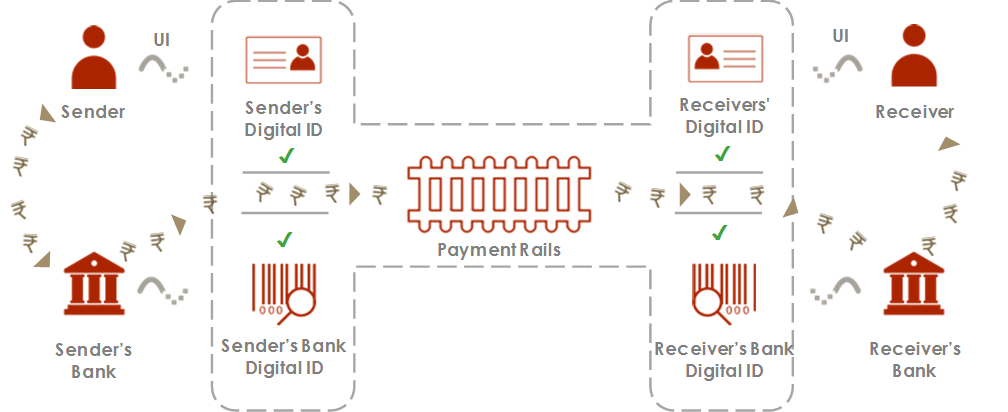
    What is Unified Payments Interface (UPI)?

    Image for post

    • It was launched in April 2016 and in the last two years, the platform has emerged as a popular choice among users for sending and receiving money.
    • UPI is a payment system that allows money transfer between any two bank accounts by using a smartphone.
    • UPI allows a customer to pay directly from a bank account to different merchants, both online and offline, without the hassle of typing credit card details, IFSC code, or net banking/wallet passwords.
    • It also caters to the “Peer to Peer” collect request which can be scheduled and paid as per requirement and convenience.

    Original article:

    https://indianexpress.com/article/opinion/columns/coronavirus-india-economy-poverty-digital-payment-bhim-upi-6533171/