💥Join UPSC 2027,2028 Mentorship (July Batch) + XFactor Notes & Microthemes PDF

GS Paper: Indian Economy

  • [op-ed snap] Reset and reform

    Context

    With the Indian economy caught in the middle of a socio-economic upheaval, the government needs to make its focus on the economy clear and pronounced.

    India in the middle of a socio-economic upheaval

    • Weakening economy: The economy has been weakening for a couple of years now.
    • Social upheaval: The social upheaval is new but its seeds have been fermenting for a while.
    • Consequences of the two: The social and economic sides of an economy are not divorced from each other.
      • Each influences the other and the current quagmire threatens to unleash the worst type of feedback between the two.

    Consequences for the employment

    • Most severe consequence due to the interaction between the social and economic sides is unemployment.
    • Rising unemployment disproportionately affects the young.
    • India’s job market: India whose median citizen is in the 30s and which is inducting 10 million new young people to the job market every year.
    • Demographic dividend turning into a curse: This dynamic, popularly hailed as India’s demographic dividend, can rapidly turn into a demographic curse if the employment situation doesn’t improve.

    Falling investment rate, increased risk perception

    • Where will the jobs come from? The job creators are entrepreneurs, conglomerates, and multinationals.
      • It is in their nature to take investment risks as long as the returns are high enough.
    • Investment rates below 30: In India, investment rate fell well below 30 per cent a while back.
      • Falling returns: The returns on investment were not compensating entrepreneurs for the risk.
      • The recent social upheaval is only adding to the perceived risk.
    • Wait and see approach: The more investors adopt a “wait-and-see” approach, the worse the job situation will become.

    Way forward

    • Structural reforms: The government needs to announce a clear plan and timeline for structural reforms.
    • Prioritising domain competence in staff: The government has to start staffing technical positions by prioritising domain competence and empowering these hires with policy relevance.
    • Maintaining the integrity of institutions: The government need to maintain the integrity of institutions tasked with the regulation of corporations and banks, monetary policy management, data collection/dissemination and law enforcement.
    • Accommodate dissent: The government also needs to desist from trying to drown out protesting voices with state muscle power.


  • [op-ed of the day] GST may not have been revenue-neutral

    Context

    In theory, the shift to GST made eminent sense, yet in practice, some of these expectations have been belied.

    Why have GST collections not measured up to expectations?

    • This could be due to a combination of three factors:
    • First:  The tax rates under GST are lower than in the earlier regime-GST was not revenue neutral, to begin with.
    • Second: There has been massive tax evasion due to under-reporting, input credit scams and fake invoices
    • Third: A slowing economy has impacted firm revenues, and thus tax collections.

    GST should have been revenue-neutral but it is not

    • Fitment exercises not carried out: The fitment exercise should have been undertaken in a manner so as to ensure that collections pre and post GST are the same.
      • But, this fundamental principle was not adhered to, and other considerations dominated.
      • Revenue neutrality Vs. Multiple objectives: The GST council began its deliberations not with the single objective of revenue neutrality, but with multiple objectives in mind.
      • Closeness to existing tax: Council wanted to ensure that rates were close to the existing tax incidence (accounting for cascading); to ensure minimal impact on inflation.
      • Not regressive: The council also wanted the proposed rate structure was not regressive in nature.
      • The council wanted that items of mass consumption were not taxed at a higher rate.
      • Achieving all these objectives simultaneously proved a difficult task.

    The issue of tax evasion

    • It is difficult to arrive at firm estimates of the scale of the problem but there are some indications of its size.
    • In West Bengal, it was estimated that the value of goods (July 2017 to March 2018) entering a state appeared to be under-reported by around Rs 50,000 crore.
    • Rs 60,000 crore in Madhya Pradesh, and Rs 1,50,000 crore in Maharashtra.
    • Numerous cases of tax fraud and fake invoice scams have also been detected since then

    Problems involve and possible solutions

    • Invoice matching:  It is argued that invoice matching will help if implemented it from the beginning.
      • It could have helped plug the loopholes.
    • Issue of under-reporting: It is debatable whether invoice matching can end under-reporting (collusion) and fake invoices.
    • Limit of state capacity in handling cases: The Central and state administrations can intervene in only about 3 lakh cases in a year.
      • Their capacity to track lakhs of transactions on a daily basis is questionable.
    • Slowing economy: Already existing structural issues have been compounded by the slowing economy.

    Way forward

    • There are certain options available to the government.
    • First: Either recalibrate the expectation or carry on the efforts to plug the loopholes and the shortcoming in the system.
    • Second: Lower the cut-off for composition scheme. A higher level simply encourages business “splitting”.
    • Third: Reduce exemptions.
    • Fourth: The council must deliberate on the rate structure, bringing it in line with pre-GST levels.
  • [op-ed snap] A rough patch

    Context

    High inflation has reduced the fiscal space available for a rate cut.

    RBI target of 6% breached.

    • CPI at 7.35 %: Retail inflation, as measured by the consumer price index (CPI), has surged to 7.35 per cent in December 2019.
    • Latest inflation data seems to corroborate fears articulated by the Monetary Policy Committee (MPC) in its December meeting.
    • In the meeting, MPC refrained from cutting the benchmark repo rate.

    Consequences for the economy

    • Reduced scope for fiscal slippage: High inflation reduced the space for further easing of policy rates.
      • Even after clarity over the extent of the Centre’s fiscal slippage emerged.
    • Rise in yield for 10-year securities: The 10-year G-sec yields have reacted sharply to these developments, rising to 6.67 on Tuesday.
      • Offsetting operation twist: Rise in yield resulted in offsetting the impact of the RBI’s recent open market operations.
    • Inflation targeting under stress: The combination of weak economic activity and higher than expected supply-side inflationary pressures has put the inflation-targeting regime under test.

    Reasons for the inflation rise and chances of easing

    • Food prices rise: Much of the rise in the headline inflation number can be traced to higher food prices.
      • Food inflation has risen to a near six-year high of 14.12 per cent in December 2019, up from 10.01 per cent in the previous month.
      • Vegetable prices have surged to 60.5 per cent in December, contributing nearly 3.7 percentage points to the headline numbers.
    • Chances of ease in coming months: While vegetable crop cycles tend to be short, and supply-side pressures may ease in the coming months.
      • The stickiness in prices of protein items is likely to provide a floor for food inflation.

    Bleak outlook for inflation easing

    • No short-term return to normal level: Food inflation is unlikely to revert to previous levels in the short term.
    • Household inflation expectations, a key metric in the MPC’s assessment, are more responsive to food inflation, this will further exert upward pressure on MPC.
    • A factor of hostilities in the Middle East: The uncertainty over oil prices on account of hostilities in the Middle East, adds to the bleak outlook for inflation.

    Conclusion

    With limited fiscal space for a meaningful stimulus, the government intends to support the economy during this rough patch, and return growth to a higher trajectory.


  • [op-ed of the day] Economic reforms are best done brick by boring brick

    Context

    Rather than big bang measures or a stealthy agenda, India can count on small but significant improvements.

    Reforms only in crisis or by stealth

    • The accepted conventional wisdom is that economic reforms in India happen only in a crisis or by stealth.
    • Reforms in the crisis
      • Reforms of 1991 : The big example of the former are the 1991 reforms.
      • In 1991 the country faced a huge foreign exchange crisis, resulting partly from the fiscal profligacy of the previous decade.
      • 1999 telecom sector reforms: Another example is from 1999 when the telecom sector was in near bankruptcy, and that crisis led to the shift away from fixed fee for spectrum to revenue sharing.
      • The situation of no other choice: In both cases, there was considerable opposition to those reforms, but they were pushed through because the crisis left no other choice.
    • Reform by stealth: Other than a crisis, more often than not, it has been economic reform by stealth.
      • In the form of executive orders: These reforms are often in the form of an executive decision rather than legislation. Following are the examples of it-
      • Expansion of the list under licence: The expansion of the list of items under the Open General Licence for imports, which is a reform of protectionism, or the reduction in the set of industries reserved for small-scale businesses.
      • Electoral bond introduction: A more recent example of stealth reform was the insertion of an electoral bond scheme in the Finance Bill of 2018.
      • Advantages of going stealth: Reform by stealth offers the advantage of going in either direction.
      • In 2013, faced with a potential currency crisis, the Reserve Bank of India (RBI) quietly retracted the limits on the liberalized remittance scheme (LRS).
      • Problem with stealth reforms: Stealth reforms are introduced stealthily but when they do not yield the desired result they are rolled back unpredictably, increasing uncertainty in policies of the government.

    Persistent, encompassing, creative incrementalism in reforms

    • The Economic Survey of 2015 pretty much ruled out Big Bang reforms in India, calling instead for “persistent, encompassing, creative incrementalism” on them.
    • This is the right mantra.
    • What incrementalism means: It implies continuity, not slowness, a sustainable speed that gives reforms predictability and stability. Following are its examples of it-
    • Reform in food subsidy: Example of incrementalism could be reforms that are being carried out in food subsidies.
      • First: Reduce the leakages of the subsidy to non-farmers.
      • Thus, when procurement is done, payments go directly to their Aadhaar-linked accounts.
      • This will lead to non-farmers getting eliminated,
      • Second-Pay subsidy only to the poor: It will lead to subsidy savings, allowing us to limit the subsidy only to poor farmers.
    • Sovereign gold bond scheme: The use of paper gold greatly reduces imports of the physical metal and outgoes of foreign exchange.
      • The sale of these bonds is being expanded, and they would eventually be everywhere, even at post offices.
    • Aggregate licence by RBI: The next example is from a new category called account aggregators licensed by RBI.
      • It allows users’ control over the digital data trail that their transactions generate, and they can monetize it or use it to enhance their creditworthiness.
      • This is an incremental reform with huge ramifications.

    Conclusion

    • The reforms cited above are incremental, not a big bang, persistent but not slow, open and not by stealth, and finally, imaginative too, since they respond to real needs.
    • Effective reforms are those that are done brick by brick, the boring measures that chip away at everything that constrains high, inclusive and sustainable growth.


  • [op-ed of the day] Revisiting the NBFC Crisis

    Context

    While India was trying to deal with the problems arising out of the large NPA accumulated by the commercial banks, the Indian financial sector was dealt with another blow in the form of the NBFC crisis.

    Effects of IL&FS and DHFL collapse:

    • Balance sheets affected: The collapse of these two big entities affected the balance sheets of banks and mutual fund companies.
    • Credit crunch: It also resulted in a credit crunch that dampened demand and pushed a slowing economy towards recession.
    • Tarnished image of NBFCs: Being leaders in the industry, their failure has tarnished the image of the NBFC sector as a whole.

    Types of NBFCs and their numbers

    • Total number: As of September 2019 there were a total 9,642 NBFCs in India.
    • Deposit-taking NBFC (NBFCs-D): Only 82 of India’s NBFCs were deposit-taking institutions (NBFCs-D) permitted to mobilise and hold deposits.
    • Non-deposit taking NBFCs (NBFCs-ND): The rest of the NBFCs which are not deposit-taking, are categorised as non-deposit taking NBFCs.
      • They did not have access to the savings of ordinary households.
      • For this reason, the majority of these institutions were not considered to be entities that needed strict regulation
    • Systematically important (NBFCs-ND-SI): Of a large number of non-deposit taking NBFCs (NBFCs-ND), only 274 were identified as being systematically important (NBFCs-ND-SI), by virtue of having an asset size of ₹500 crores or more.

    Significance of NBFCs as expressed by assets holdings

    • A significant player in the financial markets: As at the end of March 2019, these two sets-NBFCs-D and NBFC-ND-SI- held assets that amounted to almost a fifth of that held by the scheduled commercial banks.
      • This made them significant players in the web of credit, as well as large enough as a group to affect the health of the financial sector.
    • Non-deposit taking NBFCs must rely on resources garnered from the “market,” including the banking system, besides the market for bonds, debentures, and short-term paper.
    • Extension of financial entities: Individual investors would only be marginally involved in direct investment in these instruments.
      • So, the NBFCs are essentially extensions of the activity of other financial entities such as banks, insurance companies, and mutual funds.

    Concentrated lending by NBFCs

    • Industry getting lion’s share: Industry accounted for the biggest chunk of lending, amounting to 57% of gross advances in September 2019.
      • Much of this lending to industry went to the infrastructural sector.
    • At second place-retail sector: A second major target for lending by the NBFCs was the retail sector, with retail loans accounting for 20% of gross advances.
      • Within the retail sector, vehicle/auto loans accounted for as much as 44% of loans.

    What went wrong?

    • Diversification by commercial banks: Following a surge in capital flows into India which began in 2004, banks were flush with liquidity.
      • Under pressure to lend and invest to cover the costs of capital and intermediation and earn a profit, banks were looking for new areas into which they could move
      • Increase in retail lending by banks: The pressure resulted in a significant increase in retail lending, with lending for housing, automobiles and consumer durables.
      • There was also a substantial increase in lending to the infrastructural sector and commercial real estate.
    • Why NBFCs flourished even in the face of competition by banks? What the growth of the NBFCs indicates is that banks were unable to exhaust the liquidity at their disposal.
      • Banks were also unable to satisfy the potential for lending to these sectors, providing a space for NBFCs to flourish.
    • The willingness of NBFCs suited the banks: The willingness of the NBFCs to enter these areas suited the banks in two ways.
      • First, it permitted the banks to use their liquidity even when they themselves were stretched and could not discover, scrutinise and monitor new borrowers.
      • Banks could lend to the NBFCs, which could then take on the tasks associated with expanding the universe of borrowers to match the increased access to liquid funds.
      • The second was that it helped the banks to move risks out of their own books.
    • Short term lending to NBFCs, and long-term lending by NBFCs: Banks accepts short term deposits, so there is limit in their ability to lend that short term deposits as a long term debt.
      • On the other hand, these were the sectors to which additional credit could be easily pushed.
      • Lending to NBFCs that in turn lent to these sectors, appeared to be a solution to the problem.
      • Bank lending to the NBFCs was short term, and the latter used these short-term funds to provide long-maturity loans
      • NBFCs expected that they would be able to roll over much of these loans so that they were not capital short.
      • Role of rating agencies: What they needed for the purpose were ratings that ranked their instruments as safe.
      • The ratings companies were more than willing to provide such ranks.
    • The two risks involved in this model: The NBFC-credit build-up was an edifice that was burdened with two kinds of risks.
      • First risk: A possible default on the part of borrowers.
      • The probability of which only increases as the universe of borrowers is expanded rapidly to exhaust the liquidity at hand.
      • The second risk: The second was the possibility that developments in the banking sector and other segments of the financial sector would reduce the appetite of these investors for the debentures, bonds and commercial paper issued by the NBFCs
      • Since the NBFCs banked on being able to roll-over short-term debt to sustain long-term lending.
      • A slowdown in or halt to the flow of funds would lead to a liquidity crunch that can damage the balance sheet of these institutions.
    • Which of the two risks is involved in the present crisis? The crisis that affected the NBFCs was a result of both kinds of setbacks.
      • First setback: Loans to areas like infrastructure, commercial real estate and housing went bad.
      • Second setback: With the non-performing assets problem in the commercial banking sector curtailing their access to bank lending.
    • Why the problem turned systemic? Given the importance of ratings and “image” in ensuring access to capital, some firms with the requisite image were able to mobilise large sums of capital and expand their business.
      • When entities like that go bust, the response of lenders and investors to the event tends to be drastic, with systemic effects on the sector as a whole.

    Conclusion

    The episode was a shadow banking crisis that has had far-reaching consequences for the economy as a whole. Therefore, its high time that measures are taken to avoid the occurrence of such a crisis in the future.

  • Explained: The fundamentals of the Indian Economy

    PM Modi highlighted the strong absorbent capacity of the Indian economy while referring to certain fundamentals. He emphasized the strength of these basic fundamentals in absorbing the shocks of ongoing economic slowdown.

    What are the ‘fundamentals of an economy’?

    • The PM has reiterated a phrase of reassurance — underscoring the strong fundamentals of the Indian economy — that has been often used by policymakers in the past when the economy is seen to be faltering.
    • When one talks about the fundamentals of an economy, one wants to look at economy-wide variables such as the overall GDP growth, the overall unemployment rate, the level of fiscal deficit, the valuation of a country’s currency against the US dollar, the savings and investment rates in an economy, the rate of inflation, the current account balance, the trade balance etc.
    • There is intuitive wisdom in looking at these “fundamentals” of an economy when it goes through a tough phase.
    • Such an analysis, when done honestly, can give a sense of how deep the strain in an economy run.
    • It can answer the question whether the current crisis just an exaggerated response to a sectoral problem or is there something more “fundamentally” wrong with the economy that needs urgent attention and “structural” reform.
    • To be sure about the broader health of the economy, one looks at the broader variables. That way, one reduces the chances of getting the diagnosis wrong.

    Their relevance

    • The first advance estimates of national income for the current financial year, released earlier in the week, found that nominal GDP was expected to grow at just 7.5% in 2019-20.
    • This is the lowest since 1978. Real GDP is calculated after deducting the rate of inflation from the nominal GDP growth rate.
    • So, if for argument sake, the inflation for this financial year is 4%, then the real GDP growth would be just 3.5%.
    • Just for perspective, the Union Budget presented in July 2019 expected a real GDP growth of 8% to 8.5% and a nominal GDP growth of 12% to 12.5%, with a 4% inflation level.

    So, what is the current state of the fundamentals?

    The data on most variables that one may call as fundamentals of the Indian economy are struggling.

    • Growth rate — both nominal and real — has decelerated sharply; now trending at multi-decade lows. Gross Value Added, which maps economic growth by looking at the incomes-generated is even lower; and its weakness in across most of the sectors that traditionally generated high levels of employment.
    • Inflation is up but the consolation is that the spike is largely due to transient factors.
    • However, a US-Iran type of conflagration could result is a sharp hike in oil prices and, as such, domestic inflation may rise in the medium term.
    • Unemployment is also at the highest in several decades.According to some calculations, between 2012 and 2018, India witnessed a decline in the absolute number of employed people — the first instance in India’s history.
    • Fiscal deficit, which is proxy for the health of government finances, is on paper within reasonable bounds but over the years, the credibility of this number has come into question. Many, including the CAG, has opined that the actual fiscal deficit is much higher than what is officially accepted.
    • Bucking the trend, the current account deficit, is in a much better state but trade weakness continues as do the weakness of the rupee against the dollar; although on the rupee-dollar issue, a case can be made that the rupee is still overvalued and thus hurting India’s exports.
    • Similarly, while the benchmark stock indices have run up, and grabbed all attention, the broader stock indices like the BSE500 have struggled.
  • [op-ed snap] Limited scope for sharp recovery

    Context

    In order to revive the economy, the Government must choose between tax reductions and increasing rural spending.

    The Current Status of the Indian Economy

    • 5 % in 2019-20: The first advance estimate pegs India’s economic growth at 5 per cent in 2019-20.
    • Cause of the slowdown: The slowdown can be attributed largely to a structural demand problem in the economy along with some cyclical
    • Stagnant income and stagnant incomes: Despite largely stagnant incomes, private consumption has been financed over the past few years through lower savings, easy credit, and certain one-offs such as the Seventh Pay Commission led pay-outs.
    • Private consumption is the largest driver of growth.
    • Depleting savings: The household savings rate has dipped to 17.2 per cent of GDP in FY18, from 22.5 per cent in FY13.
    • Depleting credit in the system: Overall credit in the system has dried up.

     Rural economy

    • Low wages and stagnant incomes: Rural wage growth has averaged around 4.5 per cent over the past five years, but adjusting for inflation it has been only 0.6 per cent.
    • Weak real estate sector: The rural population, which was dependent on urban real estate/construction has faced headwinds in the recent past.
    • The sector is experiencing lower private sector investments recently.

    Limited scope for a sharp recovery

    • The following factors render the scope for sharp recovery limited.
    • Consumption issue is structural:  The slowdown in private consumption is a structural issue linked to low household income growth.
    • Low job creation: Low consumption is in turn, linked to the basic problems of low job creation.
    • Low Income: Low consumption is also linked with stagnant farm incomes.
    • None of the above factors is likely to change suddenly, limiting the scope of recovery.
    • Low Investments: Investment is unlikely to rebound sharply given the challenges on both income and balance sheet of the government, private sector, and households.
    • Stressed Government consumption: Which has been supporting growth over the past few years, remains under stress.
    • The combined Centre and states’ fiscal deficit is close to 6.5 per cent of GDP.
    • The public sector is already weighing on the limited domestic financial resources, ruling out space for an aggressive fiscal stimulus.
    • NBFC’s role: Recovery will also depend on the health of the financial sector, especially that of NBFCs.

     Use of the fiscal space

    • Supply-side: The government has shown a clear preference to rely on supply-side measures (like corporate tax cut) to support growth.
    • Need to address demand-side: Expectations will be high that the upcoming Union budget addresses the demand side concerns as well.
    • Spending on rural infrastructure and employment (MGNREGA, PM-KISAN, PMGSY) can decrease pain in rural areas.
    • Given the narrow income tax base, any sacrifice of the fiscal room would be beneficial only for a limited number of people.

    Way forward

    • Widening of the tax base- Given the narrow income tax base, any sacrifice of the fiscal room would be beneficial only for a limited number of people.
    • Broad-basing of the income and consumption profile: Economic reforms in the past have worked to enhance the capacity of the top few hundred million consumers.
    • The next set of reforms should enhance the capacity of those in the middle and the bottom of the income pyramid.
    • Role of the private sector: Given the huge infrastructure gap in the country, it is essential that the private sector’s role in infrastructure creation is much more inclusive.

    Conclusion

    Reforms that increase the productivity of the factors of production, provide an enabling environment for competitive production of goods and services and ensure steady and substantial growth in purchasing power for a larger section of the population should be the focus.


  • Explained: Voting at the GST Council

    • Breaking the tradition of consensus-based decisions in its 37 earlier meetings, the GST Council voted for the first time in its 38th meeting held on December 18.

    GST Council voting rules

    • As per The Constitution (One Hundred and First Amendment) Act, 2016, in case of a voting, every decision of the GST Council has to be taken by a majority of not less than three-fourths of the weighted votes of the members present.
    • The vote of the central government has a weightage of one-third of the total votes cast, and the votes of all the state governments taken together have a weightage of two-thirds of the total votes cast in that meeting.
    • As of now, out of the total 30 states and UTs (excluding J&K), 20 are ruled by the NDA.
    • This essentially means that a vote in the Council could largely be an academic exercise — unless a number of the BJP’s allies switch sides.

    Impacts of imbibing Voting

    • With the precedent of voting now established, consensus at the Council could be challenged again in the future.
    • The rules of voting in the GST Council are such that the odds are stacked in favour of the Centre in the normal course.
    • However, in case of a vote, any disagreements within the ruling coalition at the Centre may bring its support below the three-fourths majority that is needed for the passage of a decision.

    Way Forward

    • Differences of opinion are likely to crop up on proposals to raise rates, especially of the lower slabs, in the future — a concern that made most states rule out an immediate rate hike in the last Council meeting, even as they were in agreement over a broader overhaul of the GST structure.
    • So far, even if states voiced their differences over a proposal in the Council, all decisions had been taken by consensus in the meetings of the GST Council.
    • With a departure from the consensus approach having been made, there could be more instances of voting exercises going forward — especially as revenue-raising measures come up in future meetings.

    Back2Basics

    GST Council

    • The GST Council is a federal body that aims to bring together states and the Centre on a common platform for the nationwide rollout of the indirect tax reform.
    • It is an apex member committee to modify, reconcile or to procure any law or regulation based on the context of goods and services tax in India.
    • The GST Council dictates tax rate, tax exemption, the due date of forms, tax laws, and tax deadlines, keeping in mind special rates and provisions for some states.
    • The predominant responsibility of the GST Council is to ensure to have one uniform tax rate for goods and services across the nation.

    How is the GST Council structured?

    • The Goods and Services Tax (GST) is governed by the GST Council. Article 279 (1) of the amended Indian Constitution states that the GST Council has to be constituted by the President within 60 days of the commencement of the Article 279A.
    • According to the article, GST Council will be a joint forum for the Centre and the States. It consists of the following members:
    1. The Union Finance Minister will be the Chairperson
    2. As a member, the Union Minister of State will be in charge of Revenue of Finance
    3. The Minister in charge of finance or taxation or any other Minister nominated by each State government, as members.

    Terms of reference

    • Article 279A (4) specifies that the Council will make recommendations to the Union and the States on the important issues related to GST, such as, the goods and services will be subject or exempted from the Goods and Services Tax.
    • They lay down GST laws, principles that govern the following:
    1. Place of Supply
    2. Threshold limits
    3. GST rates on goods and services
    4. Special rates for raising additional resources during a natural calamity or disaster
    5. Special GST rates for certain States
  • NPA Crisis

    • What is NPA?
    • Impact of NPA on economy
    • Reasons for the rise in NPA in recent years
    • Why most NPA in Public sector?
    • Steps taken by RBI and Government in last few years to curb NPA
    • How to curb the menace of NPA

    source

    According to RBI’s recent data, the gross non-performing assets (NPAs) of public sector banks are just under Rs 4 lakh crore, and they collectively account for 90 percent of such rotten apples in the country’s banking portfolio.

    In terms of net NPAs, their share is even higher – at 92 percent of the total bad loans reported so far in the banking system. The total NPAs of Indian banks, as a percentage of the total loans, has grown from 2.11 per cent(2008) to 5.08 percent(2016).

    In this article we will explain what is NPA, The reason why NPA increased in India and steps taken by Government in recent years to curb the menace of NPA and what else needs to be done.

    What is NPA?

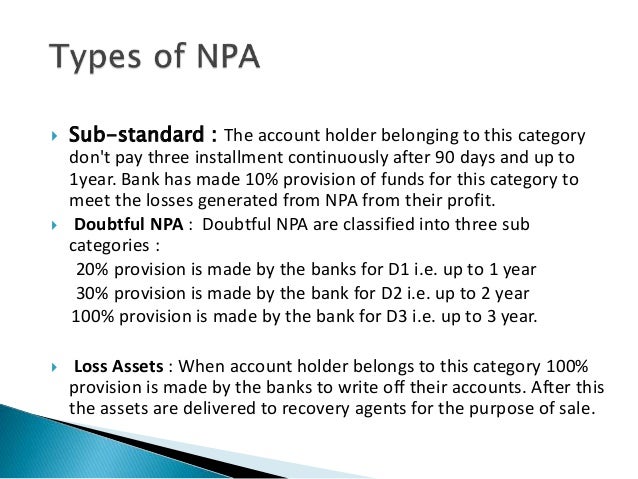
    • The assets of the banks which don’t perform (that is – don’t bring any return) are called Non Performing Assets (NPA) or bad loans. Bank’s assets are the loans and advances given to customers. If customers don’t pay either interest or part of principal or both, the loan turns into bad loan.
    • According to RBI, terms loans on which interest or instalment of principal remain overdue for a period of more than 90 days from the end of a particular quarter is called a Non-performing Asset.
    • However, in terms of Agriculture / Farm Loans; the NPA is defined as under: For short duration crop agriculture loans such as paddy, Jowar, Bajra etc. if the loan (installment / interest) is not paid for 2 crop seasons, it would be termed as a NPA. For Long Duration Crops, the above would be 1 Crop season from the due date.
    source

    Impact of NPA on Economy

    The problem of NPAs in the Indian banking system is one of the foremost and the most formidable problems that had impact the entire banking system. Higher NPA leads to following adverse impact on Economy:

    1. Depositors do not get rightful returns and many times may lose uninsured deposits. Banks may begin charging higher interest rates on some products to compensate Non-performing loan losses
    2. Bank shareholders are adversely affected
    3. Bad loans imply redirecting of funds from good projects to bad ones. Hence, the economy suffers due to loss of good projects and failure of bad investments
    4. When bank do not get loan repayment or interest payments, liquidity problems may ensue.

    Reasons for the rise in NPA in recent years

    • GDP slowdown: Between early 2000’s and 2008 Indian economy were in the boom phase. During this period Banks especially Public sector banks lent extensively to corporates. However, the profits of most of the corporate dwindled due to slowdown in the global and domestic economy, bans in mining projects, delays in environmental related permits ,Land acquisition hurdles and volatility in prices of raw material. This has adversely affected their ability to pay back loans and is the most important reason behind increase in NPA of public sector banks.
    • Relaxed lending Norms: One of the main reasons of rising NPA was the relaxed lending norms especially for corporate honchos when their financial status and credit rating was not analyzed properly. Also, to face competition banks were hugely selling unsecured loans .
    • Priority Sector Lending: There is a myth that main reason for rise in NPA in Public sector banks was Priority sector lending as according to the findings of Standing Committee on Finance , NPAs in the corporate sector are far higher than those in the priority or agriculture sector. However, even if PSL is not the main cause but it is still a cause for rising NPA which can be seen from the fact that As per the latest estimates by the SBI, education loans constitute 20% of its NPAs.
    • The Lack of Bankruptcy code in India and sluggish legal system makes it difficult for banks to recover these loans from both corporate and noncorporate.

    Other factors

    • Banks did not conducted adequate contingency planning, especially for mitigating project risk. They did not factor eventualities like failure of gas projects to ensure supply of gas or failure of land acquisition process for highways.
    • Restructuring of loan facility was extended to companies that were facing larger problems of over-leverage & inadequate profitability. This problem was more in the Public sector banks.
    • Companies with dwindling debt repayment capacity were raising more & more debt from the system.

    Why most NPA in Public sector?

    • Five sectors Textile, aviation, mining, Infrastructure contributes to most of the NPA, since most of the loan given in these sector are by PSB, they account for most of the NPA.
    • Public Sector banks provide around 80% of the credit to industries and it is this part of the credit distribution that forms a great chunk of NPA. Last year, when kingfisher was marred in financial crisis, SBI provided it huge amount of loan which it is not able to recover from it.
    • Less Professional management
    • Political Pressure and interference forces PSB to lend to not so commercially sounds project.

    Steps taken by RBI and Government in last few years to curb NPA

    • Government has launched Mission Indradhanush to make the working of public sector bank more transparent and professional in order to curb the menace of NPA in future.
    • Government has also proposed to introduce Bankruptcy code which will make it easier for banks to Recover the loans from the debtors.
    • RBI introduced number of measures in last few years which include:
      • Tightening the Corporate Debt Restructuring (CDR) mechanism,
      • Setting up a Joint Lenders’ Forum, prodding banks to disclose the real picture of bad loans, asking them to increase provisioning for stressed assets,
      • Introducing a 5:25 scheme where loans are to be amortized over 25 years with refinancing option after every five years, and
      • Empowering them to take majority control in defaulting companies under the Strategic Debt Restructuring (SDR) scheme.

    How to curb the menace of NPA?

    #1. Short Term measures

    • Review of NPA’S/Restructured advances- We need to assess the viability case by case. Viable accounts need to be given more finance for turnaround and unviable accounts should either be given to Asset Reconstruction Company or Management/ownership restructuring or permitting banks to take over the units.
    • Bankruptcy code should be passed as soon as possible. Bankruptcy code will make it easier for banks to recover loans from unviable enterprises.
    • Government should establish ARC with equity contribution from the government and the Reserve Bank of India (RBI). The established ARC should take the tumor (of non-performing assets or NPAs) out” of the banking system. An ARC acquires bad loans from banks and financial institutions, usually at a discount, and works to recover them through a variety of measures, including sale of assets or a turnaround steered by professional management. Relieved of their NPA burden, the banks can focus on their core activity of lending.

    #2. Long term Measures

    • Improving credit risk management– This includes credit appraisal, credit monitoring, and efficient system of fixing accountability and analyzing trends in group leverage to which the borrowing firm belongs to
    • Sources/structure of equity capital– Banks need to see that promoter’s contribution is funded through equity and not debt.
    • Banks should conduct necessary sensitivity analysis and contingency planning while appraising the projects and it should built adequate safeguards against such external factors.
    • Strengthen credit monitoring– Develop an early warning mechanism and comprehensive MIS(Management information system) can play an important role in it.MIS must enable timely detection of problem accounts, flag early signs of delinquencies and facilitate timely information to management on these aspects.
    • Enforce accountability- Till now lower ring officials considered accountable even though loaning decisions are taken at higher level. Thus sanction official should also share the burden of responsibility.
    • Restructured accounts should treated as non performing and technical write offs where Banks remove NPA’S from their balance sheets Permanently should be dispensed with.
    • Address corporate governance issues in PSB- This includes explicit fit and proper criteria for appointment of top executives and instituting system of an open market wide search for Chairman.

    References:

  • Gold Monetisation Scheme

    PM Modi Launches 3 Gold Schemes

    In a bid to rein in the gold imports and attract investors away from physical assets, PM Modi launches 3 Gold Schemes: 

    1. Gold Coin and Bullion scheme
    2. Gold Monetisation Scheme
    3. Gold Sovereign Bond Scheme

    #1. India Gold Coin and Bullion scheme

    • The coin will be the first ever national gold coin minted in India and will have the National Emblem of Ashok Chakra engraved on one side and Mahatma Gandhi on the other side.
    • Initially, the coins will be available in denominations of 5 and 10 grams.
    • The Indian Gold coin is unique in many aspects and will carry advanced anti-counterfeit features and tamper proof packaging that will aid easy recycling.

    #2. Gold Monetisation Scheme (GMS), 2015

    • Scheme allows you to earn some regular interest on your gold and save you carrying costs as well.
    • It replaced the existing Gold Deposit Scheme, 1999.
    • It offers option to resident Indians to deposit their precious metal and earn an interest of up to 2.5 per cent.

    Who can make deposits?

    • Resident Indians (individuals, HUF, trusts, including mutual funds/exchange traded funds registered under Sebi norms) can make deposits under the scheme.
    • No maximum limit for deposit under the scheme and the metal will be accepted at the Collection and Purity Testing Centres (CPTC) certified by the Bureau of Indian Standards.

    #3. Sovereign Gold Bond Scheme

    • Investors can earn an interest rate of 2.75 per cent per annum by buying paper bonds.
    • Sovereign Gold Bonds will be issued in multiple tranches subject to the overall borrowing limits.
    • The bond would be restricted for sale to resident Indian entities and the maximum allowable limit is 500 grams per person per year.
    • They can be used as collateral for loans and can be sold or traded on stock exchanges


    Few more things to know

    1. Minimum investment in the bond shall be 2 grams.
    2. The bonds can be bought by Indian residents or entities and is capped at 500 grams.
    3. The RBI has fixed the public issue price of sovereign gold bonds at Rs 2,684 per gram.
    4. The borrowing through issuance of Bond will form part of market borrowing programme of Government.
    5. The Bonds will be eligible for Statutory Liquidity Ratio (SLR).

    Why was there a need for such schemes?

    1. To lure tonnes of gold from households into banking system.
    2. According to the World Gold Council, an estimated 22,000-23,000 tonnes of gold is lying idle with households and institutions in India.
    3. Huge gold imports pushed India’s current account deficit (CAD) to a record $190 billion in 2013, prompting the hike its duty on imports to a record 10 percent.
    4. The government wants to reduce the reliance on gold imports over time.

    But, will these schemes succeed in bringing down Gold imports?

    1. Experts who believe, investors will still find 8 percent offered for bank deposits as more attractive.
    2. The present scheme will not bring out even 20 tonnes of gold.
    3. Investors fear that the tax department will hound them questioning the source of gold.

    Okay! But tell me how good are they from investing point of view?

    1. A section of experts feels the interest rates being offered (on both deposits and bonds) are attractive.
    2. For people who have gold as an investment asset, it is a good opportunity to gain some interest out of it.
    3. Gold is always written off as a zero-yield instrument compared to equities, which give dividend and fixed income which gives fixed interest.

    From now on, gold will not only be an instrument of security but will also give earnings and will become part of nation building.


    Published with inputs from Arun