💥Join UPSC 2027,2028 Mentorship (July Batch) + XFactor Notes & Microthemes PDF

GS Paper: Indian Economy

  • New Umbrella Entity (NUE) for Retail Payment Systems

    The Reserve Bank of India (RBI) has proposed to set up a new pan-India new umbrella entity (NUE) or entities focussing on retail payment systems with a minimum paid-up capital of Rs 500 crore.

    New Umbrella Entity (NUE)

    • The proposed entity will set up, manage and operate new payment systems especially in the retail space.
    • It would comprise of but not limited to ATMs, white label PoS, Aadhaar-based payments and remittance services, develop payment methods, standards and technologies, monitor related issues and internationally.
    • It would take care of developmental objectives like enhancement of awareness about the payment systems.
    • The RBI retains the right to approve the appointment of directors as also to nominate a member on the board of the NUE.
    • The NUE should conform to the norms of corporate governance along with ‘fit and proper’ criteria for persons to be appointed on its board.

    Functions

    It will:

    • operate clearing and settlement systems
    • identify and manage relevant risks such as settlement, credit, liquidity and operational and preserve the integrity of the system
    • monitor retail payment system developments and related issues in the country and internationally to avoid shocks, frauds and contagions that may adversely affect the system and the economy in general

    Terms of reference

    • The entity eligible to apply as promoter or the promoter group for the NUE should be ‘owned and controlled by residents’ with 3 years’ experience in the payments ecosystem as Payment System Operator (PSO) or Payment Service Provider (PSP) or Technology Service Provider (TSP).
    • The shareholding pattern should be diversified.
    • Any entity holding more than 25 per cent of the paid-up capital of the NUE will be deemed to be a promoter.
  • A new approach on investment

    Context

    When Prime Minister Narendra Modi welcomes U.S. President Donald Trump to India this month the two leaders are expected to sign a first-ever trade agreement.

    What will be on the agenda of the trade deal?

    • GSP issues: The restoration of India’s Generalised System of Preferences benefits,
    • Pricing of medical devices.
    • And agriculture trade are all important.
    • Incremental outcomes: If the two sides continue efforts to achieve incremental outcomes, the start of negotiations on a comprehensive free trade agreement (FTA) could even be a credible scenario. Presently, this is not the case.

    What could be the incremental outcomes?

    • The most obvious candidates are-
      • Intellectual property rights (IPR).
      • IPR has historically been an area of contention between the two, but discussions on IPR have progressed well in recent years.
      • Digital trade.
      • Both are grappling with the appropriate scope and approach for regulating electronic commerce issues in this digital age.
      • Ideally, there should be room to seriously consider better ways to encourage skilled professionals to work in the other’s economy.
    • Progress on the investment

    There are already some shared interests in the area of investment.

    • For example, India invests in the U.S. and continues to seek U.S. investment in India.
    • FDI issue: Foreign direct investment (FDI), this is an important moment to do more to encourage it than simply welcoming it.
    • Need to negotiate o investment: Ideally, the two sides should move ahead to negotiate an agreement on investment matters that can provide greater transparency, predictability, and regulatory certainty to investors from the other country.
    • Negotiation on FDI off the table: It appears that the traditional approach through which countries pursue commitments on FDI, bilateral investment treaties, or ‘BITs’ (bilateral investment treaties) is off the table.
    • The Trump administration has put a hold on negotiating additional BITs and appears to be suspicious of how well they balance U.S. interests.
    • The Indian government is similarly sceptical of BITs, having cancelled all existing ones soon after it came into office.

    Need for the new approach on the investment issues

    • Until they resume their work on BITs, the two sides may find common ground in devising a new approach to investment issue.
    • What the new approach involve?
    • Taking cues from their respective FTAs: A starting point should be to review what they have done in their recent FTAs.
    • Abandonment of investor-state dispute settlement: The recently concluded U.S.-Mexico-Canada Agreement contains a novel approach on investment notably its abandonment of investor-state dispute settlement with respect to the U.S. and Canada.
      • Similarly, the Regional Comprehensive Economic Partnership, which India had been negotiating with ASEAN, Australia, China, Japan, Korea, and New Zealand, does not include investor-state dispute settlement.
      • While India chose not to join the Regional Comprehensive Economic Partnership when it was concluded at the end of last year, it appears to have been on board with the FTA’s investment provisions.
    • Where the agreement focus as of now? For now, however, both countries should focus on what is doable. A U.S.-India investment agreement could focus on-
      • Fair treatment for investors from the other country.
      • Regulatory transparency and predictability.
      • And approaches for resolving concerns short of investor-state dispute settlements.
    • At a later stage: At a later stage-
      • Most likely when the two are prepared to negotiate a more comprehensive bilateral FTA, they can go further on investment matters.

    Conclusion

    A new, hybrid approach on investment would be a substantial step in the right direction. It will be critical to sustaining momentum coming out of a first trade deal when the two leaders meet in Delhi. If India and the U.S. fail this test, the trade relationship is more likely to languish than blossom.


  • The high cost of raising trade walls

    Context

    India’s international trade posture appeared to turn protectionist in the past week, with two indicators the government sent out.

    What were the two indicators?

    • The first-Signal sent out in the Budget: The first indicator, which played out live on television was contained in the Union Budget.
      • Laying out the Budget for the year, the finance minister made several references to the problems with free trade and preferential trade agreements (FTAs and PTAs).
      • Raise in tariffs, changes in the act: The Budget raised tariffs on the import of more than 50 items and changed the Customs Act provisions substantially to penalise imports suspected to originate from third countries.
    • The second- India declined negotiations: The other indicator was that India declined to attend a meeting of trade negotiators in Bali that was discussing the next step in the Association of Southeast Asian Nations (ASEAN)-led Regional Comprehensive Economic Partnership (RCEP) trade agreement.

    Issues with the Free Trade Agreement

    • What the FM told Parliament: It has been observed that imports under Free Trade Agreements (FTAs) are on the rise.
      • Undue claims of FTA benefits have posed a threat to the domestic industry.
      • Such imports require stringent checks, adding that the government will ensure that all FTAs are aligned to the conscious direction of our policy.
    • What could be the consequences of the Govt. policy?
      • Discouragement to imports: While the Govt. motive may be to protect Indian markets from dumping-primarily by Chinese goods-
      • The consequence of the changes will be to put Indian importers on notice and discourage imports in general.
      • Even as the government reserves the right to modify or cancel preferential tariffs and ban the import or export of any goods that it deems fit.

    The rise in the trade deficit and decision to walk out of FTA

    • The trade deficit with FTA partners: The government’s problem with FTAs was a key theme in its decision to walk out of the RCEP negotiations (of 16 countries) the rise in trade deficits with FTA partners.
    • Review of all agreements: The government says it will now review all those agreements and wants to “correct asymmetry” in negotiations with new partners. The agreement that would be reviewed includes-
      • TAs signed with the 10-nation ASEAN grouping (FTA).
      • Japan (Comprehensive Economic Partnership Agreement, or CEPA).
      • And South Korea (CEPA).

    Why it would not be easy to negotiate bilateral treaties

    • The bilateral agreement would not be a priority for other countries: If India makes a complete break with RCEP, negotiating the bilateral trade agreements (TAs) will not be a priority for the other countries until RCEP is done.
      • The process of legal scrubbing is likely to take most of the year, and any talks with India will probably only follow that.
      • Difficulty in getting better deal: It is also hard to see any of them being able to offer India a better deal bilaterally once they are bound into the multilateral RCEP agreement.

    India’s pending talks on bilateral treaties

    • Negotiations of CECA with Australia: The case of the Comprehensive Economic Cooperation Agreement (CECA) being negotiated with Australia, will be a difficult task, not the least due to its history.
      • India and Australia began CECA talks in 2011.
      • However, talks hit a dead-end in September 2015. With the focus on RCEP, no progress has been made since then.
    • Negotiations of FTA with the UK: A similar scenario awaits the announcement of the India-United Kingdom FTA talks.
      • It is unlikely that the U.K. will actually be able to talk until next year after terms for the K.’s full withdrawal from the European Union (EU) are completed.
    • Negotiation of BTIA with the EU: Bilateral Trade and Investment Agreement (BTIA) negotiation are also unlikely to make headway until the UK’s complete withdrawal from the EU.
      • Both sides will have to decide how to revive from where they left off in 2013.
      • Why the negotiations are pending? Making the negotiations harder is the government’s decision to scrap all bilateral investment treaties with 57 countries including EU nations, and bringing in a new Bilateral Investment treaty (BIT) model in 2015.
      • Only Kyrgyzstan, Belarus and most recently Brazil have agreed to sign a new investment treaty based on that model.
    • The US-India trade issue: Finally, there is the much-anticipated resolution of U.S.-India trade issues ahead of the visit of U.S. President.
      • The talks in that visit could also include talks on an FTA.
      • At present, there have only been some non-paper talks on the issue.
      • And given that the U.S. has expressed deep misgivings about India’s BIT model, these talks will also take several years to come to fruition.

    Why India should rethink its stand on FTA

    • First-Prospect of no dispute settlement mechanism: The decline of multilateralism, accelerated by the retrenchment of the U.S. and China’s intransigence have all meant the World Trade Organization (WTO) has lost steam as a world arbiter.
      • This leaves states that are not part of arrangements without a safety net on dispute settlement mechanisms.
    • The second-trade deficit of other countries with India: The government has invoked the massive $57-billion trade deficit with China to explain protectionist measures, but it forgets its own trade surpluses with smaller economies.
      • Particularly in the neighbourhood, where Indian exports form more than 80% of total trade with Nepal, Bangladesh, Bhutan and Sri Lanka, respectively.
    • Third- The rise of regional agreements: It is clear that most of the world is now divided into regional FTAs, for example-
      • The North American Free Trade Agreement (NAFTA) for North America.
      • The Southern Common Market (MERCOSUR for its Spanish initials) for South America.
      • The EU, the Eurasian Economic Union (Russia and neighbours).
      • The African Continental Free Trade Agreement (AfCFTA).
      • The Gulf Cooperation Council (GCC) FTA in West Asia.
      • And now the biggest of them all, RCEP, which minus India, represents a third of the world’s population and just under a third of its GDP.
    • Fourth- Finally, the trend across the world does not favour trade in services the way it does in goods.
      • India’s strength in the services sector and its demand for more mobility for Indian employees, is thus becoming another sticky point in FTA negotiations.

    Conclusion

    India’s demographic might is certainly attractive for international investors, but only if that vast market has purchasing power and is not riven by social unrest and instability. India’s demographic might is certainly attractive for international investors, but only if that vast market has purchasing power and is not riven by social unrest and instability.


  • RBI’s growth push

    Context

    February signalled a new dynamic-Monetary policy is no longer driven by MPC.

    What changed after December MPC review

    • Pause in the rate cut by MPC: In its December policy, the Reserve Bank of India suddenly paused on cutting rates, putting the ball in the government’s court to support growth.
    • Conservative union budget: With last week’s Union Budget belying expectations of short-term growth boosters, the ball was back in the RBI’s court.
      • The Budget opted for fiscal conservativism over activism, consolidating the fiscal deficit to 3.5 per cent of GDP in 2020-21 from 3.8 per cent in 2019-20– bypassing any ambitious expenditure boost or significant tax cuts.
    • Rise in the inflation in Dec-Feb interval: Meanwhile, the policy arithmetic turned more complicated for the MPC.
      • At the time of the December policy meeting, CPI inflation was trending close to 5 per cent (the October reading was 4.6 per cent).
      • Since then a combination of supply-side shocks, which led for example to unseasonally high vegetable and protein prices, buoyed inflation to over 7 per cent, nearly 140 basis points above the RBI’s upper bound comfort zone of 6 per cent.
      • As a primarily inflation-targeting central bank, this effectively stopped the MPC from easing further

    Key takeaways from February MPC meeting

    • The February policy meeting removed two key uncertainties in the current policy scenario.
    • First, the RBI is still very concerned about growth and the burgeoning negative gap between the current growth trajectory and potential growth.
    • Second, monetary policy is no longer strictly limited to the MPC’s decision-making.
      • Because of the risk of supply-side shocks hitting inflation, it is understandable that the RBI has summarised its outlook on inflation as “highly uncertain”.
      • Hence, of the policy measures that the RBI has at its disposal, the MPC’s “conventional” arrow of rate cuts was left unused.
      • Instead, the RBI has opted for macroprudential intervention, unveiling two other “unconventional” policy arrows.

    RBI opting for macroprudential intervention in two ways

    • Policy transmission via LTRO-the first arrow: The primary macro challenge has been transmission via the credit channel — banks are not lowering their deposit rates.
      • Why? This is due to competition from the small savings rate and to protect saver, and in turn are keeping lending rates high.
      • How it impacts economy: Sectors considered higher risk (real estate, MSMEs) find themselves credit-starved.
      • In a move that seems inspired by the European Central Bank’s quantitative easing in 2011, the RBI’s announcement on long term repo operations (LTROs) has been aimed at promising banks longer-duration liquidity at the repo rate, which is cheaper relative to their current deposit rates.
      • The aim is to nudge them to kick-start the credit cycle.
      • The exemption of cash reserve ratio for incremental loans to MSMEs and the retail sector is also aimed at lowering costs for banks, which ideally should be passed onto these sectors.
    • Managing the stress in financial system-the second arrow: It is aimed at managing the looming stress in the financial system from bad loans, especially as deleveraging becomes more difficult during an economic slowdown.
      • Extension to restructuring durations: The extension of the restructuring scheme on MSME loans and projects in the commercial real estate sector is aimed at releasing capital for banks in the short term.
      • Though banks will ultimately need to recognise loans that are non-performing.
      • Easing guidelines on the classification of loans: Similarly, easing guidelines on the classification of loans for projects in the commercial real estate sector that have been delayed is essentially designed to provide some breathing space to banks.

    What does this mean for the macro outlook?

    • Recovery in demand is a must: The RBI’s new macroprudential measures, its “unconventional” policy arrows, while well-meaning, are ultimately supply-side measures.
      • For the RBI to attain its goals, be it on asset quality or transmission, there eventually needs to be a recovery in demand conditions.
      • ECB’s LTRO experience: To be fair, even the ECB’s LTRO programme has had mixed success — a central bank can flood the market with liquidity, but the ultimate onus on releasing it to the real economy rests with banks.
      • So far, excess liquidity has not benefitted segments considered high risk (real estate developers, MSMEs).

    Conclusion

    The ECB introduced the LTRO programme when growth was weak and the euro area was struggling with a severe sovereign debt crisis. With the RBI embarking on something similar, albeit on a smaller scale, the niggling concern is if there is more financial instability lurking around the corner but not yet evident in the current data.


  • Listening to the call of the informal

    Context

    Attempt to formalise the informal sector would not necessarily benefit it as two recent papers reveal.

    What do the research papers reveal?

    • The first paper-No strong evidence that formalisation improves business outcomes.
      • Published by the National Bureau of Economic Research, economist Seema Jayachandran argues that there is no strong evidence from studies conducted in many developing countries that formalisation improves business outcomes.
    • The second article-Formalisation an evolutionary process:
      • In the second article, a background paper for the International Labour Organisation (ILO), economist Santosh Mehrotra calls formalisation an evolutionary process.
      • During this evolutionary process small, informal enterprises learn the capabilities required to operate in a more formal, global economy.
      • He says they cannot be forced to formalise.

    The formalisation trap

    • Why does the state want to formalise?
      • Easy monitoring and taxation: The state finds it easier to monitor and to tax the firms that adopt its version of formality.
      • Reduced last-mile cost for banks: Formality can reduce the last-mile costs for banks also.
    • Problem with the imposed formalisation
      • The added cost outweighs benefits: Ms Jayachandran’s study reveals that most of the formalities imposed from above, add to the costs of the firms that outweigh the benefits of inappropriate formalisation.

    How informal sector improves themselves?

    • Association with their peers: Small entrepreneurs gain from forming effective associations with their peers.
    • Mentoring: They also benefit greatly from ‘mentoring’.
    • On job skill development: Skills of small entrepreneurs and their employees are best developed on-the-job.
      • This is because they cannot afford the loss of income by taking time off for training.
    • Soft skills to form associations and manage enterprises, matter as much for the success of the enterprises as ‘hard’ resources of finance and facilities.

    Problems with connecting to global supply chains-

    • There is a desire to connect small firms in India more firmly with global supply chains.
      • Search for lover cost source supply: Mehrotra points out that the primary motivation of multinational companies for expanding their global supply chains is to tap into lower-cost sources of supply.
      • Supply chains compete with each other.
      • When wages and costs increase in their source countries, they look for other lower-cost sources.
      • Informal-the lowest labour cost firms: The lowest labour cost firms at the end of supply chains are generally informal.
      • Thus, the push by the state to formalise firms is countered by the supply chain’s drive to lower its costs.

    Way forward

    • India’s jobs, incomes, and growth challenges necessitate a reorientation of policies towards the informal sector.
    • First-The government and its policy advisers must stop trying to reduce its size.
      • The development of an economy, from agriculture to the production of more complex products in the industry, is a process of learning.
      • Informal enterprises provide the transition space for people who have insufficient skills and assets to join the formal sector.
    • Second-Policymakers must learn to support informal enterprises on their own terms.
      • Merely making it easy for MNCs and large companies to invest will not increase the growth of the economy.
    • Third-Find ways to speed up the process of learning.
      • Policymakers must learn how to speed up the process of learning within informal enterprises by developing their ‘soft’ skills.
      • Large schemes to provide enterprises with hard resources such as money and buildings, which the government finds easier to organise, are necessary but inadequate for the growth of small enterprises.
    • Fourth-Networks and clusters of small enterprises must be strengthened.
      • They improve the efficiency of small firms by enabling sharing of resources.
      • More clout to negotiate: They give them more clout to improve the terms of trade in their favour within supply chains.
      • Reduced last-mile cost: They reduce the ‘last mile costs’ for agencies and providers of finance and other inputs to reach scattered and tiny enterprises.
    • Fifth-The drumbeat for labour reforms must be changed.
      • The laws should be simplified, and their administration improved. And, their thrust should be to improve the conditions of workers.
    • Finally- The social security framework for all citizens must be strengthened.
      • Health insurance and the availability of health services must be improved.
      • And disability benefits and old-age pensions must be enhanced.
      • The purpose of ‘labour reforms’ must be changed to provide safety nets, rather than make the workers’ lives even more precarious with misdirected attempts to increase flexibility.


  • The billion standard

    Context

    India has crossed the target of a billion monthly digital payments. Now, to a billion transactions a day.

    The story of payment revolution and financial inclusion in India

    • Progress on the financial inclusion: India was long a financially excluded nation –only 17 per cent of Indians had a bank account in 2011.
      • 50 more years estimate: The World Bank suggests it would have taken 50 more years for 80 per cent of Indians to get a bank account at the pre-2011 speed.
      • Yet, we reached that milestone in 2018.
      • How? A magical combination of
      • Political will (Jan Dhana Yojana and Aadhaar embedding).
      • A proactive central bank (creating a non-profit market participant entity and levelling the playing field between non-banks and banks).
      • And a technology stack with three layers (identity, payments, and data).
    • The rise of UPI
      • The swift rise in use: The digital payment transactions on the Universal Payment Interface (UPI) platform rising from 0.1 million in October 2016 to 1.3 billion in January 2020.
      • Result of working together: This represents the magic of entrepreneurs, nonprofits and policymakers working together.
      • And gives us a new target — a billion transactions a day.
    • India’s Payment revolution
      • What are the components of the payment revolution: India’s payment revolution comes from-
      • A clear vision: Shifting the system from low volume, high value, and high cost to high volume, low value, low cost.
      • A clear strategy: Regulated and unregulated private players innovating on top of public infrastructure.
      • And trade-offs balanced by design: Regulation vs innovation, privacy vs personalisation, and ease-of-use vs fraud prevention.
    • What consumers wanted?
      • Consumers wanted a payment experience that was mobile-first, low-cost, 24/7, instant, convenient, interoperable, fintech friendly, inside banking, and safe.
    • Answers lies in UPI.
      • What did UPI achieve?
      • Interoperability: UPI created interoperability between all sources and recipients of funds -consumers, businesses, fintechs, wallets, 140 member banks.
      • Instant settlement: UPI settles instantly inside the central bank in fiat money -state-issued money declared by the sovereign to be legal tender.
      • Blunted data monopolies: Big tech firms have strong autonomy but weak fiduciary responsibilities over customer data, it was taken care of by UPI.

    5 Policy lessons from the success of UPI

    • First- how the India stack: Interconnected yet independent platforms or open APIs — are a public good that-
      • Lowers costs, spur innovation and blunts the natural digital winner-takes-all.
      • Replication in other areas: Replicating this in education, healthcare, and government services are likely to be a harbinger of large scale multi-domain collaborative innovation.
    • Second-collaboration: Collaboration can create ecosystems that overcome the birth defects of its constituents
      • The execution deficit of government, the trust deficit of private companies, and the scale deficit of nonprofits.
    • Third-policy intervention: Complementary policy interventions are important.
      • Demonetisation and GST are changing the stories that firms and individuals tell themselves around cash and informality.
    • Fourth-human capital and diversity matter: This revolution needed career bureaucrats to partner with academics, tech entrepreneurs, venture capitalists, global giants and private firms.
    • The final lesson-Western model is not needed always: India doesn’t need to be Western or Chinese to be modern. If our policymakers had copied Alipay or US banks, we wouldn’t have leapfrogged their birth defects.

    Way forward

    • Fix the deadline: The central government must deadline digitising all its payments.
    • RBI implement 100+ action items: The RBI must implement the 100-plus action items arising from its own Vision 2021 document and the Nandan Nilekani Committee for Deepening Digital Payments.
    • UPI for inward remittances: RBI must also make UPI and RuPay fit for use in our $70 billion inward remittances that currently come through exploitative financial institutions which don’t have clients but hostages.
    • Replication of UPI in bank credit: The RBI must replicate the core design of UPI — fierce but sustainable private and public competition in bank credit-
      • Our 50 per cent credit-to -GDP ratio is one of the reasons India is poor.
      • China’s 300 per cent is the wrong number, but reaching the OECD average of 100 per cent needs the RBI to do many things-
      • Raising its human capital and technology game in regulation and supervision.
      • Catalysing an ecosystem for lending against the rapidly expanding digital exhaust of small firms and individuals.
      • Issuing more private bank licences, facilitating management changes in old private banks with market caps that signal questions about book value, and shepherding governance and human capital revolution at PSU banks.

    Conclusion

    Converting the collective independence our citizens got in 1947 to individual freedom surely involved universal financial inclusion. The gap between this aspiration and reality was not a lie but a disappointment because our capital got handicapped without labour and our labour got handicapped without capital. Change has begun -the RBI, the finance ministry, and many individuals deserve our gratitude and dues for a billion digital payments a month. We now ask you for a billion digital payments a day.

  • [op-ed snap] Fashioning the framework of a New India

    Context

    As the Indian economy is going through a severe crisis, a major solution to the present economic crisis is to go in for inclusive growth; it also means shared prosperity.

    Where India stands on poverty and how the slowdown is impacting the poor.

    • Bottom 30-40% adversely impacted: The slowing economy has had an adverse impact on the bottom 30%-40% of the population.
      • Absolute poverty on the rise: The incidence of absolute poverty, which has been falling since 1972-73, has increased to 30% (4% jump).
    • 44% population below the multi-dimensional Poverty line: The Human Development Report (2019) has shown, more than 44% of the Indian population is under the multi-dimensional poverty line.
    • Rising inequality: The poorest 50% population at present owns only 4.1% of the national wealth.
      • While the richest 10% of people own 73% of the total wealth in India (Suisse Credit 2019).
    • Rampant malnourishment: India has 15.2% population malnourished (women 15%) as against 9.3% in China.
      • And 50% of the malnourished children in the world are in India.
    • At 112th position on global hunger: India’s global hunger rank has gone up to 112 while Brazil is 18, China is 25 and South Africa, 59.
    • Dismal performance on education: In the field of education as per a UN report (2015), overall literacy in India is 74.04% (more than the 25% are totally illiterate) against 94.3% in South Africa, 96.6% in China and 92.6% in Brazil.
      • Almost 40-45% population is either illiterate or has studied up to standard 4.
    • Poor quality of education: Given the quality of education in India, the overall population is very poorly educated, with the share of ‘educated unemployment’ rising by leaps and bounds.

    What needs to be realised?

    • Focus on domestic demand: It needs to be realised that when exports are declining, the economy will have to depend on domestic demand for growth.
      • It is no more feasible for the top 20-25% population to continue growing without depending on the demand from the bottom 40-45% population.
    • Demand by the bottom 40% a must: There is thus a strong reason now for the economy to increase effective demand of this bottom 40-45% population at least to continue growing-to reach a $5-trillion economy by 2024.

    What is wrong with the growth process?

    • Bottom 40% not getting the fair share of growth: A major reason for the crisis is that the growth process has marginalised the bottom 40-plus% of the population.
      • It is in the sense that they do not get a fair share of the economic growth, and are more or less deprived of productive employment with a decent income.
      • They have not been used as active participants in the growth process. Their potential has not been promoted.
    • Less spending for the poor and its consequences: Though the bottom population depends on the government for basic health and elementary education (and also for access to higher educational opportunities)-
      • The government spends just 4% of GDP on health (against the norm of 4-6% of GDP) and 3% of GDP on education (against the norm of 6-8% of GDP).
      • How this dismal spending affects the poor: As a result of this below norm spending, these people are left hardly literate and sick, with poor nutrition and high morbidity.
      • They are incapable of acquiring any meaningful skills or participating actively when new technology is spreading in the rest of the economy.
    • The sub-optimal use of labour force: This sub-optimal use of the labour force in the economy is not likely to enable India to achieve optimal growth with proper use of the national resources -the labour force.

    Inclusive growth- a solution to the present economic crisis

    • Inclusive growth also includes shared prosperity: Here, inclusive growth does not mean only including all sections of the population in the growth process as producers and beneficiaries; it also means “shared prosperity”.
      • Since India has already committed to sustainable and inclusive growth at the UN General Assembly, India is definitely obliged to implement inclusive growth.
      • This should be our “New India”.
    • What “New India” would involve?
      • Improve the capability and opportunities: To start with, to improve the capabilities of the masses as well as their well-being by expanding productive employment opportunities for them.
      • What expanding productive employment mean? The main steps to expand productive employment for all in the economy should be made up of-
      • A process of inclusion.
      • Expanding the quality of basic health for all.
      • And ensuring quality education to all.
    • How will “New India” help?
      • Which will by itself generate large-scale employment in the government.
      • Having a well-educated and healthy labour force will ensure high employability.
      • Such people will be able to participate actively in the development process.
      • The cycle of more productive employment: Having a well-educated labour force will help start-ups and MSMEs, in turn triggering a cycle of more productive employment in the economy.
      • Global competitiveness increase: This will also improve the global competitiveness of our production units.
      • Labour absorption potential of MGNREGA: Employment guarantee schemes such as the Mahatma Gandhi National Rural Employment Guarantee Act (MGNREGA) will also increase employment.
        • Assets generated under MGNREGA will expand capital formation in the economy, thereby raising the labour-absorbing capacity of the mainstream economy.
      • Why this strategy is advantageous?
        • Such a strategy has multiple advantages:
        • First– it will raise incomes and the well-being of those who need it most urgently.
        • Second– it will raise effective demand rapidly, which is so badly needed in the economy today to raise economic growth.
        • Third– growth will be equitable and sustainable.

    Way forward

    • Finally, how does one raise resources to increase new public investments in the selected sectors?
    • Raise direct taxes: One major strategy is to raise direct taxes, both capital tax and wealth tax.
      • Past growth has failed to reach the poor: Growth led by providing tax cut and extra incentives, but this growth does not much percolate to the poor.
      • Consequently, taxing the rich has to be a major strategy to raise government revenue.
    • Treat public expenditure as an investment: The public expenditure on raising capabilities should be treated as social investment rather than social welfare, policymakers will be willing to spend on this capital formation.
    • Let the fiscal deficit slip: Finally, there was no sound economic reason to control fiscal deficit ratio. Sound macroeconomics never supports this.


  • Key Highlights of Economic Survey 2019-20


    The Union Minister for Finance & Corporate Affairs, Smt. Nirmala Sitharaman presented the Economic Survey 2019-20 in the Parliament today. The Key Highlights of the Survey are as follows:

    Wealth Creation: The Invisible Hand Supported by the Hand of Trust

    [Covered in a separate newscard]

    Survey posits that India’s aspiration to become a $5 trillion economy depends critically on:

    1. Strengthening the invisible hand of the market.
    2. Supporting it with the hand of trust.

    Pro-business versus Pro-markets Strategy

    • Survey says that India’s aspiration of becoming a $5 trillion economy depends critically on:
    1. Promoting ‘pro-business’ policy that unleashes the power of competitive markets to generate wealth.
    2. Weaning away from ‘pro-crony’ policy that may favour specific private interests, especially powerful incumbents.
    • Pro-crony policies such as discretionary allocation of natural resources till 2011 led to rent-seeking by beneficiaries while competitive allocation of the same post 2014 ended such rent extraction.

    Strengthening the invisible hand by promoting pro-business policies to:

    1. Provide equal opportunities for new entrants.
    2. Enable fair competition and ease doing business.
    3. Eliminate policies unnecessarily undermining markets through government intervention.
    4. Enable trade for job creation.
    5. Efficiently scale up the banking sector.
    • Introducing the idea of trust as a public good, which gets enhanced with greater use.
    • Survey suggests that policies must empower transparency and effective enforcement using data and technology.

    Entrepreneurship at the Grassroots

    • Entrepreneurship as a strategy to fuel productivity growth and wealth creation.
    • India ranks third in number of new firms created, as per the World Bank.
    • New firm creation in India increased dramatically since 2014:
    1. 2 % cumulative annual growth rate of new firms in the formal sector during 2014-18, compared to 3.8 % during 2006-2014.
    2. About 1.24 lakh new firms created in 2018, an increase of about 80 % from about 70,000 in 2014.
    • Survey examines the content and drivers of entrepreneurial activity at the bottom of the administrative pyramid – over 500 districts in India.
    • New firm creation in services is significantly higher than that in manufacturing, infrastructure or agriculture.
    • Survey notes that grassroots entrepreneurship is not just driven by necessity.
    • A 10 percent increase in registration of new firms in a district yields a 1.8 % increase in Gross Domestic District Product (GDDP).

    Impact of education on entrepreneurship

    • Literacy and education in a district foster local entrepreneurship significantly:
    1. Impact is most pronounced when literacy is above 70 per cent.
    2. New firm formation is the lowest in eastern India with lowest literacy rate (59.6 % as per 2011 Census).
    • Physical infrastructure quality in the district influences new firm creation significantly.
    • Ease of Doing Business and flexible labour regulation enable new firm creation, especially in the manufacturing sector.
    • Survey suggests enhancing ease of doing business and implementing flexible labour laws can create maximum jobs in districts and thereby in the states.

    Divestment in public sector undertakings
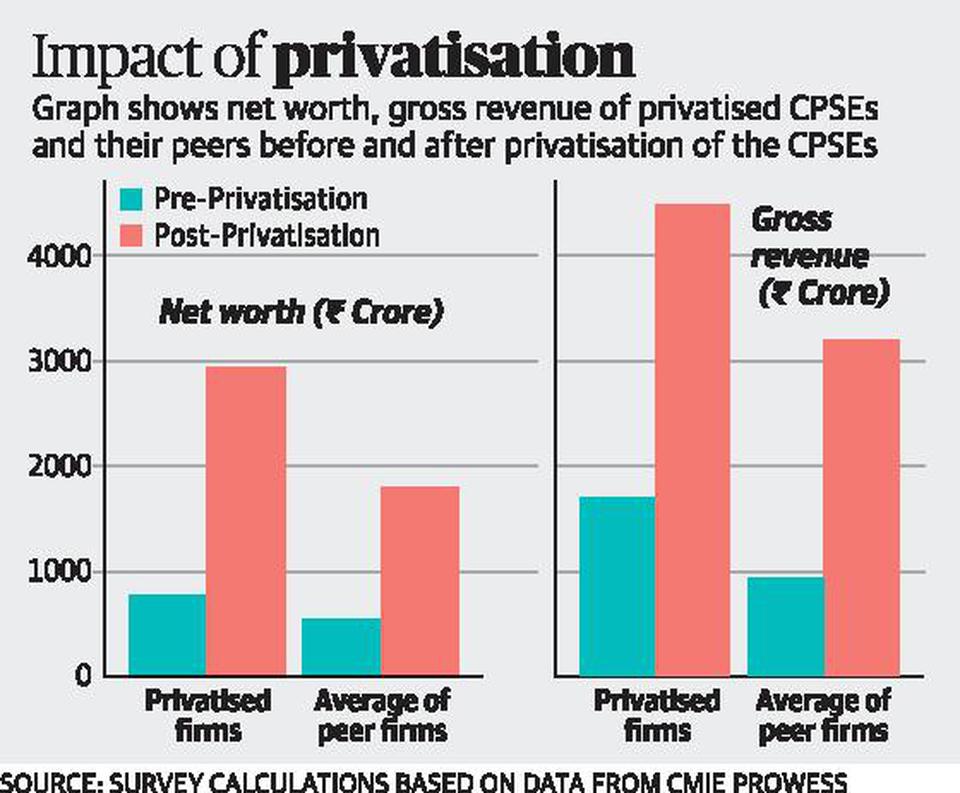
    • The Survey has aggressively pitched for divestment in PSUs by proposing a separate corporate entity wherein the government’s stake can be transferred and divested over a period of time.
    • The survey analysed the data of 11 PSUs that had been divested from 1999-2000 and 2003-04 and compared the data with their peers in the same industry.
    • Further, the survey has said privatized entities have performed better than their peers in terms of net worth, profit, return on equity and sales, among others.
    • The government can transfer its stake in listed CPSEs to a separate corporate entity.
    • This entity would be managed by an independent board and would be mandated to divest the government stake in these CPSEs over a period of time.
    • This will lend professionalism and autonomy to the disinvestment programme which, in turn, would improve the economic performance of the CPSEs.

    Golden jubilee of bank nationalization: Taking stock

    • The survey observes 2019 as the golden jubilee year of bank nationalization
    • Accomplishments of lakhs of Public Sector Banks (PSBs) employees cherished and an objective assessment of PSBs suggested by the Survey.
    • Since 1969, India’s Banking sector has not developed proportionately to the growth in the size of the economy.
    • India has only one bank in the global top 100 – same as countries that are a fraction of its size: Finland (about 1/11th), Denmark (1/8th), etc.
    • A large economy needs an efficient banking sector to support its growth.

    The onus of supporting the economy falls on the PSBs accounting for 70 % of the market share in Indian banking:

    1. PSBs are inefficient compared to their peer groups on every performance parameter.
    2. In 2019, investment for every rupee in PSBs, on average, led to the loss of 23 paise, while in NPBs it led to the gain of 9.6 paise.
    3. Credit growth in PSBs has been much lower than NPBs for the last several years.

    Solutions to make PSBs more efficient:

    • Employee Stock Ownership Plan (ESOP) for PSBs’ employees
    • Representation on boards proportionate to the blocks held by employees to incentivize employees and align their interests with that of all shareholders of banks.
    • Creation of a GSTN type entity that will aggregate data from all PSBs and use technologies like big data, artificial intelligence and machine learning in credit decisions for ensuring better screening and monitoring of borrowers, especially the large ones.

    Doubts regarding GDP Growth
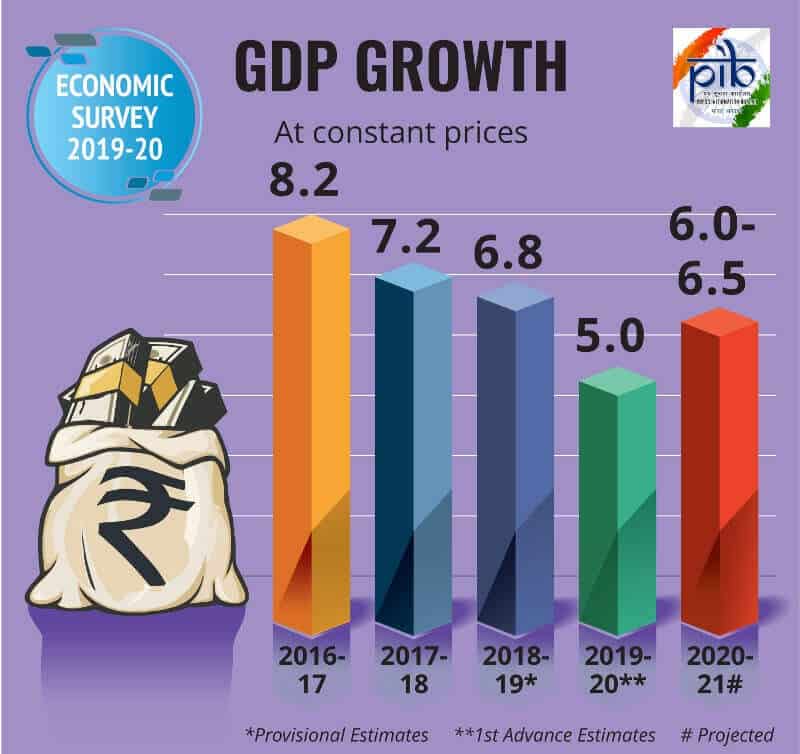
    • GDP growth is a critical variable for decision-making by investors and policymakers. Therefore, the recent debate about accuracy of India’s GDP estimation following the revised estimation methodology in 2011 is extremely significant.
    • As countries differ in several observed and unobserved ways, cross-country comparisons have to be undertaken by separating the effect of other confounding factors and isolating effect of methodology revision alone on GDP growth estimates.
    • Models that incorrectly over-estimate GDP growth by 2.7 % for India post-2011 also misestimate GDP growth over the same period for 51 out of 95 countries in the sample.

    Fiscal Developments

    • Revenue Receipts registered a higher growth during the first eight months of 2019-20, compared to the same period last year, led by considerable growth in Non-Tax revenue.
    • Gross GST monthly collections have crossed the mark of Rs. 1 lakh crore for a total of five times during 2019-20 (up to December 2019).
    • Structural reforms undertaken in taxation during the current financial year:
    • Change in corporate tax rate.
    • Measures to ease the implementation of GST.
    • Fiscal deficit of states within the targets set out by the FRBM Act.
    • Survey notes that the General Government (Centre plus States) has been on the path of fiscal consolidation.

    External Sector

    Balance of Payments (BoP):

    • India’s BoP position improved from US$ 412.9 bn of forex reserves in end March, 2019 to US$ 433.7 bn in end September, 2019.
    • Current account deficit (CAD) narrowed from 2.1% in 2018-19 to 1.5% of GDP in H1 of 2019-20.
    • Foreign reserves stood at US$ 461.2 bn as on 10th January, 2020.

    Global trade:

    • India’s merchandise trade balance improved from 2009-14 to 2014-19, although most of the improvement in the latter period was due to more than 50% decline in crude prices in 2016-17.
    • India’s top five trading partners continue to be USA, China, UAE, Saudi Arabia and Hong Kong.

    Exports:

    • Top export items: Petroleum products, precious stones, drug formulations & biologicals, gold and other precious metals.
    • Largest export destinations in 2019-20 (April-November): United States of America (USA), followed by United Arab Emirates (UAE), China and Hong Kong.
    • The merchandise exports to GDP ratio declined, entailing a negative impact on BoP position.
    • Slowdown of world output had an impact on reducing the export to GDP ratio, particularly from 2018-19 to H1 of 2019-20.
    • Growth in Non-POL exports dropped significantly from 2009-14 to 2014-19.

    Imports:

    •  Top import items: Crude petroleum, gold, petroleum products, coal, coke & briquittes.
    •  India’s imports continue to be largest from China, followed by USA, UAE and Saudi Arabia.
    •  Merchandise imports to GDP ratio declined for India, entailing a net positive impact on BoP.
    • Large Crude oil imports in the import basket correlates India’s total imports with crude prices. As crude price raises so does the share of crude in total imports, increasing imports to GDP ratio.

    Logistics industry of India:

    • Currently estimated to be around US$ 160 billion.
    • Expected to touch US$ 215 billion by 2020.
    • According to World Bank’s Logistics Performance Index, India ranks 44th in 2018 globally, up from 54th rank in 2014.

    Direct investments and remittances:

    • Net FDI inflows continued to be buoyant in 2019-20 attracting US$ 24.4 bn in the first eight months, higher than the corresponding period of 2018-19.
    • Net FPI in the first eight months of 2019-20 stood at US$ 12.6 bn.
    • Net remittances from Indians employed overseas continued to increase, receiving US$ 38.4 billion in H1 of 2019-20 which is more than 50% of the previous year level.

    External debt:

    • Remains low at 20.1% of GDP as at end September, 2019.
    • After significant decline since 2014-15, India’s external liabilities (debt and equity) to GDP increased at the end of June, 2019 primarily by increase in FDI, portfolio flows and external commercial borrowings (ECBs).

    Monetary Management and Financial Intermediation

    Monetary policy:

    • Remained accommodative in 2019-20.
    • Repo rate was cut by 110 basis points in four consecutive MPC meetings in the financial year due to slower growth and lower inflation.
    • However, it was kept unchanged in the fifth meeting held in December 2019.
    • In 2019-20, liquidity conditions were tight for initial two months; but subsequently it remained comfortable.

    Prices and Inflation

    Inflation Trends:

    • Inflation witnessing moderation since 2014
    • Consumer Price Index (CPI) inflation increased from 3.7 per cent in 2018-19 (April to December, 2018) to 4.1 per cent in 2019-20 (April to December, 2019).
    • WPI inflation fell from 4.7 per cent in 2018-19 (April to December, 2018) to 1.5 per cent during 2019-20 (April to December, 2019).

    Drivers of CPI – Combined (C) inflation:

    • During 2018-19, the major driver was the miscellaneous group
    • During 2019-20 (April-December), food and beverages was the main contributor.
    • Among food and beverages, inflation in vegetables and pulses was particularly high due to low base effect and production side disruptions like untimely rain.

    Cob-web Phenomenon (Cyclical fluctuations in inflation) for Pulses:

    • Farmers base their sowing decisions on prices witnessed in the previous marketing period.
    • Measures to safeguard farmers like procurement under Price Stabilization Fund (PSF), Minimum Support Price (MSP) need to be made more effective.

    Volatility of Prices:

    • Volatility of prices for most of the essential food commodities with the exception of some of the pulses has actually come down in the period 2014-19 as compared to the period 2009-14.
    • Lower volatility might indicate the presence of better marketing channels, storage facilities and effective MSP system.

    Essential Commodities Act is outdated

    • The Centre’s imposition of stock limits in a bid to control the soaring prices of onions over the last few months actually increased price volatility, according to the ES.
    • The finding came in a hard-hitting attack in the report against the Essential Commodities Act (ECA) and other “anachronistic legislations” and interventionist government policies, including drug price control, grain procurement and farm loan waivers.
    • The Centre invoked the Act’s provisions to impose stock limits on onions after heavy rains wiped out a quarter of the kharif crop and led to a sustained spike in prices.
    • However the Survey showed that there was actually an increase in price volatility and a widening wedge between wholesale and retail prices.
    • The lower stock limits must have led the traders and wholesalers to offload most of the kharif crop in October itself which led to a sharp increase in the price volatility.

    Agriculture

    • Agricultural productivity is also constrained by lower level of mechanization in agriculture which is about 40 % in India, much lower than China (59.5 %) and Brazil (75 %).
    • With regard to the agri sector, the Survey argued that the beneficiaries of farm loan waivers consume less, save less, invest less and are less productive.
    • It added that the government procurement of foodgrains led to a burgeoning food subsidy burden and inefficiencies in the markets, arguing for a shift to cash transfers instead.

    Food Management

    • The share of agriculture and allied sectors in the total Gross Value Added (GVA) of the country has been continuously declining on account of relatively higher growth performance of non-agricultural sectors.
    • GVA at Basic Prices for 2019-20 from ‘Agriculture, Forestry and Fishing’ sector is estimated to grow by 2.8 %.

    Services Sector

    Increasing significance of services sector in the Indian economy:

    1. About 55 % of the total size of the economy and GVA growth.
    2.  Two-thirds of total FDI inflows into India.
    3. About 38 per cent of total exports.
    4. More than 50 % of GVA in 15 out of the 33 states and UTs.

    Social Infrastructure, Employment and Human Development

    • The expenditure on social services (health, education and others) by the Centre and States as a proportion of GDP increased from 6.2 % in 2014-15 to 7.7 % in 2019-20 (BE).
    • India’s ranking in Human Development Index improved to 129 in 2018 from 130 in 2017:
    • With 1.34 % average annual HDI growth, India is among the fastest improving countries
    • Gross Enrolment Ratio at secondary, higher secondary and higher education level needs to be improved.
    • Gender disparity in India’s labour market widened due to decline in female labour force participation especially in rural areas:
    • Around 60 % of productive age (15-59) group engaged in full time domestic duties.

    Sustainable Development and Climate Change

    • India moving forward on the path of SDG implementation through well-designed initiatives
    • SDG India Index:
    1. Himachal Pradesh, Kerala, Tamil Nadu, Chandigarh are front runners.
    2. Assam, Bihar and Uttar Pradesh come under the category of Aspirants.
    • India hosted COP-14 to UNCCD which adopted the Delhi Declaration: Investing in Land and Unlocking Opportunities.
    • COP-25 of UNFCCC at Mandrid:
    1. India reiterated its commitment to implement Paris Agreement.
    2. COP-25 decisions include efforts for climate change mitigation, adaptation and means of implementation from developed country parties to developing country parties.
    • Forest and tree cover:
    1. Increasing and has reached 80.73 million hectare.
    2. 56 % of the geographical area of the country.
    • The numbers of stubble-burning incidents in 2019 were the least in four years, the Economic Survey says.
  • Strategy for boosting Wealth Creation

    • The big idea from the Economic Survey 2019-20 is the need to push towards increasing the number of wealth creators in the Indian economy.
    • The Survey states that to achieve the goal of becoming a $5-trillion economy, the invisible hand of markets will need the support of “the hand of trust”.

    Wealth Creation

    • Essentially, this means that regulation and rules in the economy should be such that they make it easy to do business but not turn into crony capitalism.
    • The Survey states: “The invisible hand needs to be strengthened by promoting pro-business policies to:
    1. Provide equal opportunities for new entrants, enable fair competition and ease doing business,
    2. Eliminate policies that unnecessarily undermine markets through government intervention,
    3. Enable trade for job creation, and
    4. Efficiently scale up the banking sector to be proportionate to the size of the Indian economy.”

    How can this be done?

    • The Survey introduces the idea of “trust as a public good that gets enhanced with greater use”.
    • In other words, it states that policies must empower transparency and effective enforcement using data and technology to enhance this public good.
    • A key element here is the need to increase the opportunities for new entrants.
    • “Equal opportunity for new entrants is important because… a 10 per cent increase in new firms in a district yields a 1.8 per cent increase in Gross Domestic District Product (GDDP)”.
    • According to the Survey, the right policy mix can boost job creation.

    Levers for furthering Wealth Creation

    The Survey identifies several levers for furthering Wealth Creation, which are:

    • entrepreneurship at the grassroots as reflected in new firm creation in India’s districts;
    • promote ‘pro-business’ policies that unleash the power of competitive markets to generate wealth as against ‘pro-crony’ policies that may favour incumbent private interests;
    • eliminate policies that undermine markets through government intervention, even where it is not necessary;
    • integrate ‘Assemble in India’ into ‘Make in India’ to focus on labour intensive exports and thereby create jobs at a large scale;
    • efficiently scale up the banking sector to be proportionate to the size of the Indian economy and track the health of the shadow banking sector;
    • use privatization to foster efficiency. The Survey provides careful evidence that India’s GDP growth estimates can be trusted.

    Is this push for wealth creators new?

    • This is an extension of what PM said during his Independence Day speech in August last year, where he stressed on the need for the country to view “wealth creators” differently.
    • Those who create wealth for the country, those who contribute in the country’s wealth creation — they all are serving the nation as well.
    • We should not look at wealth creators with apprehension and doubt their intentions; we should not look down upon them.
    • The PM had also said there was a need in the country to give such wealth creators due respect and credit.
    • He had said that this change is required because “If no wealth is created, no wealth can be distributed”.

    Focus on Ethical Wealth Creation

    • The Survey emphasised on the importance of ‘Ethical Wealth Creation’, as the key to making India $5 trillion economy by 2025.
    • Krishnamurthy V. Subramanian, the Chief Economic Adviser of Ministry of Finance has done a commendable job in producing a thought-provoking masterpiece on ‘ethical wealth creation.
  • Economic Survey & its significance

    With the Indian economy in the doldrums, this year’s Economic Survey will be keenly watched. The Economic Survey for 2019-2020 will be tabled in Parliament today.

    What is the Economic Survey?

    • The Economic Survey is a report the government presents on the state of the economy in the past one year, the key challenges it anticipates, and their possible solutions.
    • One day before the Union budget, the Chief Economic Adviser (CEA) of the country releases the Economic Survey.
    • The document is prepared by the Economic Division of the Department of Economic Affairs (DEA) under the guidance of the CEA.
    • Once prepared, the Survey is approved by the Finance Minister.
    • The first Economic Survey was presented in 1950-51. Until 1964, the document would be presented along with the Budget.
    • For the past few years, the Economic Survey has been presented in two volumes.
    • For example, in 2018-19, while Volume 1 focussed on research and analysis of the challenges facing the Indian economy, Volume 2 gave a more detailed review of the financial year, covering all the major sectors of the economy.

    Why is the Economic Survey significant?

    • The Economic Survey is a crucial document as it provides a detailed, official version of the government’s take on the country’s economic condition.
    • It can also be used to highlight some key concerns or areas of focus — for example, in 2018, the survey presented by the then CEA Arvind Subramanian was pink in colour, to stress on gender equality.

    Is it binding on the government?

    • The government is not constitutionally bound to present the Economic Survey or to follow the recommendations that are made in it.
    • If the government so chooses, it can reject all suggestions laid out in the document.
    • But while the Centre is not obliged to present the Survey at all, it is tabled because of the significance it holds.

    What are the expectations from Economic Survey 2020?

    • At a time when India’s growth has plummeted to a six-year low, the Economic Survey ahead of the Union Budget is expected to offer key insights into the path ahead for the government to revive growth.
    • The conundrum of remaining fixated on deficit targets or making a concerted push towards more expenditure to kickstart growth is one of the key challenges the government is facing.
    • The Survey is expected to shed light on the crucial gaps that the Budget will aim to fill in terms of unemployment, private investment, and a slump in consumption.