💥Join UPSC 2027,2028 Mentorship (July Batch) + XFactor Notes & Microthemes PDF

GS Paper: Indian Economy

  • Masala Bonds

    What’s New In The Masala Bonds?


    During his visit to the UK last week, Prime Minister Narendra Modi spoke about the Indian Railways issuing bonds and listing them on the London Stock Exchange.



    Let’s explore the Bonds as a financial instrument and then dive deep into Masala Bonds.

    What are Bonds?

    Bonds are debt instruments which allow the companies or govt. to raise funds only by incurring debt and lender is guaranteed of a fixed repayment (Principle and Interest).

    What are instrument available with Company to raise funds?

    1. Issue Bonds – Companies will have to pay the fixed amount when the bond matures.

    2. Issue Shares – Companies would like to raise money, but don’t want is as a debt, so company will issue shares.

    Can you imagine who (Company/Investor) will prefer what (Debt/Shares)?

    Companies will prefer to raise money through equities i.e. issuing shares because they will part a share of the company to the investors, while the investors will prefer to purchase bonds because bonds are more secured.

    Shares may give higher returns in the long run. So, it is risk-return trade-off.

    How the bonds are more secure than shares?

    In case of liquidation of the company, the bond holders are the one who get their claim before the share holders.

    Now, let’s get into main discussion on Masala Bonds


    What’s new in the Masala Bonds?

    Basically, overseas rupee bonds are known as Masala bonds.

    • Indian firms have earlier raised money abroad through bonds and other forms of borrowings, but always in foreign currency.
    • However, the first overseas rupee bonds were issued in 2013 by the International Finance Corporation, the World Bank’s private sector investment arm.
    • To raise funds for capital expenditure, the Indian Railway Finance Corporation will be issuing bonds denominated in rupees.

    What are the risk associated Indian companies with foreign currency overseas bond? 

    • An Indian company issuing a overseas bond(i.e. in other currencies specially dollar) runs into a risk on account of currency fluctuation.
    • If rupee weakens during the period of bond, then it add significantly to costs at the time of repayment, normally at the end of 5 years.

    How Masala Bonds will benefit Indian companies?

    • If the issuer, issues bonds in rupees, then he gets rid of this risk (currency fluctuation) which passes on to the investor.
    • This bond brings a new and diversified set of investors for Indian companies, and more liquidity in foreign exchanges, apart from bank funding and the corporate bond market in India.

    Does Masala bond offer something for foreign investors?

    The investor who purchases a bond issued by an Indian entity is betting on India, in a hope that currency and inflation would be stable enough to ensure good returns after hedging for foreign exchange risks.

    With India’s GDP or national income rising, and projected to grow at a reasonably fast clip over the next few years, many overseas investors would like to buy into such bonds to join the party and to earn higher returns compared to the US and Europe where interest rates are still low.

    How does Govt. and RBI view Masala Bonds?

    The local currency bond markets can contribute to financial stability by reducing currency mismatches and extending the duration of debt.

    It will also be a sign of early acceptance of the Indian currency in trading and settlement overseas, showing the confidence of investors and can lead to  internationalization of the currency over the medium- and long term.

    Foreign investors prefer to hedge their risks overseas because there are limited products in the Indian market, especially for longer periods.

    The other worry, if the overseas rupee bond market takes off, will be about the growth of the Indian corporate bond market and Indian banks as top companies shift to another market, impacting growth here.

    Was such an approach adopted by any emerging economies in past?

    China’s People’s Bank of China has previously issued yuan denominated bonds to raise funds at a little over 3%.

    China had issued bonds in its own currency in Hong Kong dubbed dimsum bonds and plans to issue more as part of its plan to push its currency for global trade.

    1. Unlike China, the Indian govt. has never borrowed abroad on its own, preferring to push its state owned firms, instead.
    2. RBI, unlike the Chinese central bank, cannot issue debt with no legal sanction for it.

    But these have been borrowings in dollar or other currencies. The Railways bond, on the other hand, will be denominated in rupees.


    Published with inputs from Pushpendra
  • Insolvency and Bankruptcy Code

    How is ease of doing business linked with the Insolvency and Bankruptcy Code?

    In India, lack of resolution of insolvency is one of the significant factors for the failure of credit market in the country. The present legislations governing insolvency are fragmented, multi-layered and the adjudication of insolvency matters take place in multiple forum, resulting in an unpredictable regime.

    The Insolvency and Bankruptcy Code has been hailed as an excellent reform for India that will pay a critical role in improving the ease of doing business.

    Why does India need a Bankruptcy law?

    Currently it takes, on an average, more than 4 years to resolve insolvency in India. The proposed Bankruptcy Code will replace over a century-old archaic insolvency act – The Presidency Towns Insolvency Act, 1909.

    • Delays in making decisions on the viability of business.
    • Sometimes, company promoters try to delay reorganisation or attempts to sell-off assets or change of management.
    • Delays in disposing off cases by Debt Recovery Tribunal.
    • Continued litigation at various levels and delays in appellate level.
    • Currently, there are 4 different agencies viz. the HC, the Company Law Board, the BIFR and the DRTs that handle insolvency-related cases.

    How can a modern law help?

    • Speedy closure will help firms on the verge of brink in two ways, i.e. either restructure the firm or sell-off the assets to recover the money.
    • It will promote efficient allocation and greater availability of credits for businesses, as it frees up capital.
    • Development of financial markets such as bond market, due to clarity on repayment for debtors.

    What is the international experience in this regard?

    • US Bankruptcy Code provides for fairly quick liquidation or reorganisation of the company.
    • In UK, once the cases are filed, then after 12 months, either the part of assets are discharged to pay-off debt or court-appointed administrators handle the case, if company can be turned around.

    Was any committee formed to suggest Insolvency reforms?

    • The Bankruptcy Law Reform Committee (BLRC) was set up in August, 2014 under the chairmanship of Mr. T.K. Vishwanathan.
    • It was the first committee with the mandate of suggesting comprehensive and not incremental reforms.
    • The BLRC extensively studied the insolvency regime within India as well as various international jurisdictions.

    What was the recommendation of the Committee?

    • The committee proposed an all-encompassing law for corporate and individual insolvency, reflecting the best practices from across the globe.
    • The corporates should assess the viability of an enterprise in the early stages of insolvency, such that the creditor and the debtors can negotiate a financial arrangement while preserving the economic value of the enterprise.
    • However, if the negotiations fail, then the enterprise is liquidated. The insolvency resolution is required to be done within a period of 180 days.
    • It also suggested fast track insolvency resolution for certain entities which is required to be completed within 90 days.

    What are the provisions of draft Insolvency and Bankruptcy Code?

    The code aims to bring modern framework to deal with bankruptcy and insolvency of variety of economic players, including individuals, but excluding financial firms.

    • It will restore some power to creditors, both financial and operational.
    • It will fast-track mechanism of insolvency resolution process may be applicable to certain categories of entities.
    • The corporate insolvency would have to be resolved within a period 180 days, extendable by 90 days.
    • It also provides for fast-track resolution of corporate insolvency within 90 days.
    • Debt Recovery Tribunals will be adjudicating authority over both individual & unlimited liability partnership firms.
    • National Company Law Tribunal will be adjudicating authority with jurisdiction over companies with limited liability.
    • It has a clause to provide for insolvency professionals who will specialize in helping sick companies. <These professionals will help revive control the management of distressed firm to revive it>
    • It also provides for information utilities that will collate all information about debtors to prevent serial defaulters from misusing the system
    • To setup Insolvency and Bankruptcy Board of India to act as a regulator for these utilities and professionals.
    • The bill also seeks to establish Insolvency and Bankruptcy Fund of India.

    What about Financial Sector Insolvencies?

    • FSLRC recommended creation of a resolution corporation to monitor financial firms and intervene before they go bust.
    • The aim is to close-down the firms which can’t be revived or change their management to protect investors or depositors.

    The reform is dubbed as 2nd most important reform after GST, as it will also improve the ease of doing business in India.


    Published with inputs from Pushpendra
  • Tourism Sector

    It’s no secret that our Tourism Industry remains heavily underemployed, highly unregulated and its true potential to both Economy and workforce is still unharnessed. 

    With 32 UNESCO recognized natural and cultural heritage sites, India ranks second in Asia and fifth in the world. Still, India’s share in ITAs (International tourist arrivals) is a paltry 0.6%. 

    source

    Why are International / Foreign Tourists important?

    • For one, they bring in much valued Foreign Currency which contributes to our Foreign Exchange Reserves and keeps our Balance of Payment robust. <Note that Tourist expenditure in India counts as “Exports” under BoP accounting>
    • India’s receipts from tourism during 2012 ranked 16th in the world, and 7th among Asian and Pacific countries (World Tourism Organization Report)
    • It helps stabilize our currency in International Market
    • Builds Brand India (Incredible !ndia campaign has proven to boost foreign tourism more than domestic tourism)
    • Although it is notable that domestic tourists contribute to more than 75% of the revenue from Tourism Sector, but its denominated in INR
      • Note:  Under 7th Schedule division of Powers, Pilgrimages outside India comes under Union’s List while those Inside India is covered by State List.

    India’s Comparative performance in International tourist arrivals (ITAs)

    • ITA simply means the percentage of outbound tourists travelling to another country in proportion to all outbound tourists of the world combined.
    • France has the highest share of ITAs, despite being much smaller than a continent size country like India. (India’s share in ITA is 0.6% compared to 7.8 per cent in France)
      • Foreign tourist arrivals by source country: Largest foreign tourists are from USA, 2nd largest from Bangladesh and third largest from UK.
      • Tamil Nadu witnesses most foreign tourist visits.
    •  Although ITAs in India registered a growth of 10.6%, countries like Vietnam and Indonesia continue to have higher shares of FTAs than India
      • Internationally ranking pitiably 41st in terms of Foreign Footfalls- India gets only 77 lakh foreign tourists every year.
      • Travel & Tourism Competitiveness Report 2015 (World Economic Forum) ranks India 52nd out of 141 countries overall in areas other than Foreign Footfall.
        • India has quite good air transport (ranked 35th)
        • Reasonable ground transport infrastructure (ranked 50th).
    • Target: In next 3-5 years, we want to receive >1 crore tourists (and 1% of the ITAs should be in India)

    Who qualifies as a foreign tourist?

    • Staying at least twenty four hours in the country
    • Purpose of whose journey can be classified as either
      • Leisure (recreation, holiday, health, study, religion and sport)
      • Business, family, mission, meeting
    • Following are excluded from category of Foreign Tourists:
      • Persons arriving to take up an occupation or engage in activities remunerated from within the country are not treated as foreign tourists
      • Nationals of Nepal and Bhutan entering India through land routes, are also not included in the data series on foreign tourism

    Burning issue of Foreign Tourists and Sexual Assaults

    • Its noteworthy that 40% of the foreign tourists who came to India in 2013 were women
    • Delhi has repeatedly topped the survey for being the most unsafe and hostile city for Foreign Tourists.
    • How can this be prevented?
      • Foreign tourists in India are advised to take the same precautions like domestic tourists take
      • Code of conduct for tourist destinations and the stake holders there has also been fixed.
      • Accused should be apprehended by the police authorities within a few days and action be initiated to bring the culprits to justice
      • E.g. In the Madhya Pradesh incident in March, 2013, the accused were tried in a Fast Track Court and sentenced to life imprisonment within four months.

    What are other benefits of Tourism Sector to India?

    Economy: 

    • Contributes to 9% of global GDP, In India’s case it contributed 6.8% of the GDP

    Employment and demographics:

    • It is a labour intensive industry (Employs 8.7% of India’s workforce) and provides livelihood to non-farm sector
    • Although Tourism in India being largely an unorganized sector activity, potential for employment is still untapped
    • Women comprise 70% of the workforce and 50% of the workforce is below 25 years

    Other benefits apart from Employment:

    • Helps preserve heritage and culture (Fundamental Duty and DPSP)
    • Niches such as Rural tourism, and Ecotourism can help reverse migration to urban areas
    • Tourism sector can be a powerful antidote to poverty, it eliminates the disadvantage of market inacessibility suffered by poor in respect of their goods and services by bringing consumers to their doorstep

    Tourism reforms by integration with ongoing schemes

    It is said that Tourism as a sector doesn’t need huge budgetary expenditure for its rise as a “sunrise industry”. Here, we look at some of the ways we can make it so by integrating with ongoing schemes of Government of India.

    1. Infrastructure Reforms and Tourism

    • Sagarmala project beginning with Char Dham Yatra linking Puri Jagannatha Temple to Dwaraka by sea via various places off religious interest enroute
    • MNREGA labour for creating permanent assets like tourism infrastructure and facilities


    2. Taxation Reforms, Startup India and Tourism

    • Solve the Multiple Taxation Issues (give tax concessions to Tourism Sector)
    • Tour Operators don’t need to pay service tax, if serving foreign tourist for foreign trips. (e.g. Yatra.com etc)
    • Special Tourism Zones shall be notified and developed to encourage investment in identified areas along with PPP
    • Incentivize Startups which promote Tourism in Niche areas such as Adventure Tourism, Ecotourism, Rural Tourism
    • Devise a National Tourist Maps promoting Unique / Mystery Spots, and Less Known Destinations


    3. Tourist Training Schools, Skill India and Tourism

    • Skill and Etiquettes training to tour operators
    • Certification programmes like Hunar se Rozgar tak (HSRT) and earn while you learn programs
      • Vocational training for tourist guides hospitality business
      • Aims to train 8th class passouts (upto age of 28 years) in Food Production and Beverages services
      • Conducted through Institute of Hotel Management and Food Craft Institutes
      • Diploma in Tourism Management through ITIs


    4. Swachh Bharat and Tourism:

    • Litter/Recycling Bins at accessible places
    • Special focus on cleanliness and women safety of tourist sites
    • Partnering with Shulabh International (NGO) for scaling up pay-and-use toilets rather than depending on free public utilities (as it has been observed that former type remain more user friendly due to regular maintenance than government ones)


    5. Green Urban Policies and Tourism

    • Attempts should be made to design climatically responsive and location sensitive tourism architecture
    • Use energy efficient materials for pavements leading to a tourist landmark (minimal use of hardscape materials)
    • Solar lighting and use of renewable energy must be encouraged


    6. Conservation and Tourism

    • Adopt the principle of “First Conservation Later Tourism” for Cultural Heritage
    • Discourage fountains and water based elements in areas facing water paucity
    • Discourage large scale illumination in areas with electricity shortage (Without compromising on security, of course)


    7. Sugamya Bharat (Accessible India) and Tourism

    • Promote Universally accessible infrastructure for ease of access by differently abled and elderly
    • Use signages that conform to World Tourism Organization, and UNESCO charters for World Heritage Sites

    Annex: Eased norms for Tourit Visa

    • E-visa
      • Will increase foreign tourists by 25%.
      • Foreigner applies online (as opposed to Consulate/Embassy) he’ll get Visa in five days
    • Visa on arrival
      • Foreigner applies online three days before his arrival in India
      • Gets visa on airport, 30 days validity
      • As of 2015, this facility has been enlarged to cover 180 countries
  • Pay Commission Updates

    The 7th Central Pay Commission Report

    The Seventh Pay Commission, headed by Justice A K Mathur, submitted its report to the Centre in November, recommending 23.55% overall hike in pay, allowances and pensions of government employees from January 1, 2016. This means the Centre’s salary bill will go up by Rs 1,02,100 crore in 2016-17.

    The terms of reference of 7th CPC

    1. To review the principles that should govern the emoluments structure including pay, allowances and other benefits, in respect of the following categories of employees:-
      • Central Govt employees (industrial and non-industrial)
      • Personnel of the All India Services
      • Personnel of the UTs
      • Officers and employees of the Indian Audit and Accounts Dept
      • Members of regulatory bodies (excluding the RBI) set up under Acts of Parliament
      • Officers and employees of the Supreme Court
    2. To review the principles that should govern emoluments, concessions and benefits, as well as retirement benefits of Defence Forces
    3. To work out a framework for an emoluments structure to attract the most suitable talent to Govt service, promote efficiency, accountability and responsibility in the work culture
    4. To examine the existing schemes of payment of bonus and recommend general principles for an appropriate incentive scheme to reward excellence in productivity, performance and integrity
    5. To review the existing allowances available to employees and suggest their rationalization and simplification
    6. To examine the principles that govern the structure of pension and other retirement benefits
    7. To recommend the date of effect of its recommendations on all the above

    The recommendations should consider the following criteria:

    • Economic conditions in India and the need for fiscal prudence
    • Need to ensure that adequate resources are available for developmental expenditures and welfare measures
    • Likely impact of the recommendations on the finances of the States, which usually adopt the recommendations with modifications
    • Prevailing emolument structure and retirement benefits available to employees of Central PSUs
    • Best global practices and their adaptability and relevance in Indian conditions

    The above information may be helpful during prelims, though it has little relevance for mains

    Now, let’s take a look at the key recommendations

    It has recommended overall hike of 23.55% in pay, allowances and pensions of central govt. employees with effect from January 1, 2016

    • The minimum pay in govt to be set at ₹18,000 per month
    • The  system of pay bands and grade pay has been dispensed with and a new pay matrix has been designed
    • The Military Service Pay will be admissible only to the Defence forces personnel. <It is a compensation for the various aspects of military service>
    • Introduce a health insurance scheme for central govt employees and pensioners
    • The force personnel of CAPFs should be accorded martyr status in case of death in the line of duty. <Currently, it is accorded only to defence forces personnel>
    • Fair and equitable treatment must be given to all services; or it will widen the gap between the IAS and other services
    • A screening committee should be set up to decide on the allocation of officers on deputation to the centre on the basis of domain knowledge
    • Introduce Performance Related Pay for all categories of central govt employees
    • Take steps to improve the functioning of NPS and establishment of a strong grievance redressal mechanism

    Now, let’s analyse various issues pertaining to personnel in govt. sector.

    It is a long-pending debate that there are huge disparities between private sector and govt. employees in terms of salaries.

    Let’s analyse the difference in salaries of private and govt. employees

    • Compensation to Group C and D employees in govt. is greater than the private sector.< More than 90% of the workforce employed by govt. lies here>
    • For Group B employees, it is similar to private sector <Govt. workforce includes approx 5% group B employees>
    • However, for Group A employees, it is lower than private sector <Govt. workforce includes less than 5% group B employees>

    Govt. job offers added benefits, which are not available in private sector

    Pay Commission on Performance Related pay (PRP)

    What is it : Paying salaries or wages based on performance

    Rationale: Human beings respond to incentives. Recognition for good effort and achievement through an incentive is expected to energize and motivate officers to perform even better

    What’s the problem in implementing such a scheme?

    1. How to measure performance of an organization when targets are more in the nature of social and public goods which may not even be tangible?
    2. How to distribute credit among various departments for such larger public good?
    3. How to separate individuals from collective?
    4. How to prevent PRP degenerating into routine entitlements?

    The Commission notes it may be easier to implement such schemes in profit-driven private organizations where targets based on quantitative criteria make performance appraisal easier.

    Pay flexibility reforms are not a silver bullet, and involve trade-offs and risks. A study of the literature on the subject reveals that employee motivation and performance are not exclusively linked to Performance Related Pay (PRP) which may only enforce temporary compliance.

    Yet evidence from many countries indicates that pay flexibility contributes to management improvements, promotes an atmosphere of dialogue, rewards teamwork and is helpful in efficient task allocation.

    Two important aspects to be kept in mind before evolving such a scheme:

    1. Evolve proper criteria to measure performance along with setting a context where individual and organizational goals are clearly aligned
    2. Devise a performance appraisal system in which the objectives of the appraisal system match with that of the reward system

    Recommendation

    1. Results Framework Document (RFD) can be used as the primary assessment tool for linking the targets of the organization with that of the individuals
    2. Suitable changes in the Annual Performance Appraisal Report (APAR) can provide the necessary link between targets of the appraisal system with those of the RFD document

    Let’s see some of the critical observations of 7th CPC

    • The core of govt. employees (excluding security and commercial department) is very small
    • Pay, allowances and pension as a proportion of govt. expenditure has been declining sharply. <In 1998-99, it was 38% of revenue expenditure, which has reduced to 18% in 2015-16>
    • Pay and allowances in the central govt. have remained stable since 2010-11 at around 1.8%-2% of GDP
    • Impact of the pay hike will be .65% of the GDP. However, some increase in the salary comes back to govt. as taxes, reducing the net impact

    Often, it is argued that Indian govt. employs less people in proportion to its population. Let’s take a look at it.

    Why govt. should hire more?

    • Indian govt. employs less than 1.5% of its population with respect to China which employs 3% of its population
    • The number of personnel per lakh population is 139 for India, against  668 for the US
    • 7th CPC notes there is overall vacancy of around 18% of sanctioned strength
    • It has also observed that sanctioned strength is not adequate to deliver adequate governance

    Recent Developments

    • The Union finance ministry has set up an implementation cell for processing and implementing accepted recommendations of the 7th Pay Commission
    • Recently, several States have approached the Union govt. seeking more time in implementation of the Commission’s report.

    India should implement the recommendations of 7th CPC and II ARC together, reflecting the new mindset. Govt. should be ready to pay its public officials well, increase their strength and invest in building competence.

    It’s time for some questions:

    1. Pay commissions are relics of an age when India was a closed economy and govt. was the major employer. This archaic model has no role in today’s economy and it’s high time India scrapped the system of setting up pay commissions. Comment.
    2. Private organizations are generally thought to be more efficient than government organizations. What could be the possible reasons for this? How can we make our government system more efficient?
    3. Salary hikes are generally linked to performance. This truism of management is totally lost in the public sector, where duration of employment is linked to salary hikes. Keeping in view of the recommendations of 7th Pay commission, discuss the pros and cons of performance related pay.
    Published with inputs from Pushpendra 
  • Differentiated Banks – Payment Banks, Small Finance Banks, etc.

    Payment Banks are the new stripped-down type of banks, which are expected to reach customers mainly through their mobile phones rather than traditional bank branches. They are expected to increase the financial inclusion in the country by providing banking services to the people who are currently out of the reach of banking services.

    source

    • Features of Payment Banks
    • Why these Banks were set up?
    • Requirements for payment banks
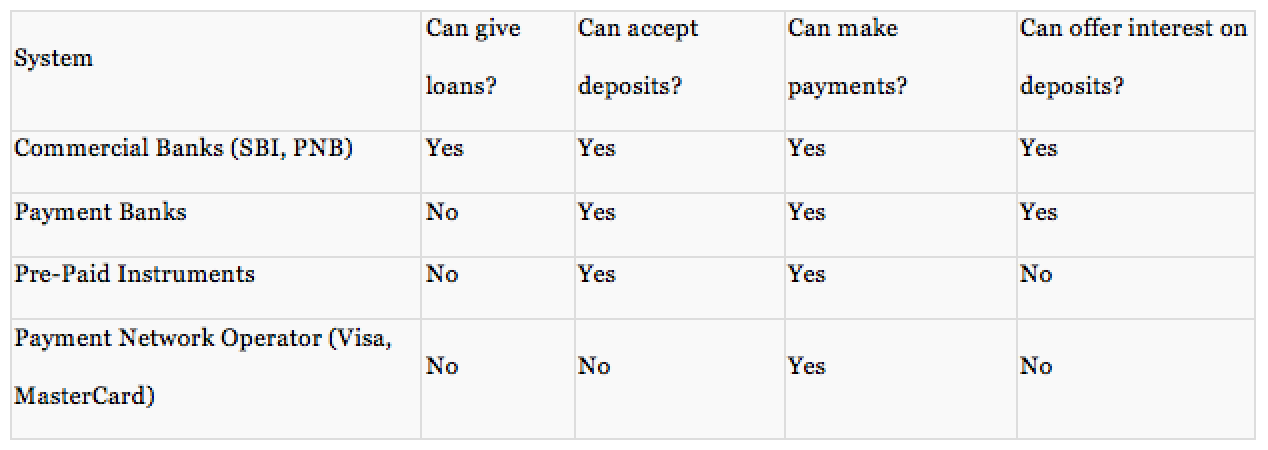
    • Major difference between the payment banks, PPI and Commercial banks
    • Approved payment banks in India
    • Why does India need payment banks when we already have so many PSB?
    • How these Payment Banks Will Survive, when they cannot lend?
    • How can we make Payment Banks Viable?
    • Way ahead

    Features of Payment Banks

    • Payments Banks can accept demand deposits (only current account and savings accounts) with a ceiling limit of Rs.1 lakh per customer.
    • Payment Banks will pay interest at the rate notified by the RBI.
    • Payment Banks can issue Debit Cards but not credit cards.
    • Payment Banks cannot engage in lending services i.e. they cannot give loans, thus phasing out the fear of NPA.
    • The Deposit up to Rs.1 lakh is insured by the DICGC (Deposit Insurance and Credit Guarantee Corporation), same as in bank accounts.
    • Payment banks cannot involve in any credit risk and can only invest in less than one year G-Secs or treasury bills.
    • Payment Banks will charge a fee as commission. This will be the sole earning for the banks.
    • Payment bank will also have to maintain CRR (Cash reserve ratio) just like other Scheduled commercial banks (SBI, PNB, BoB, Dena, ICICI etc)

    source

    What’s the need for Payment banking in India?

    • The goal behind creating these payment banks is to bring about financial inclusion, by making it easier for anyone to get a bank account. That’s also why the cash limit in the accounts is set to just Rs. 1 lakh.
    • The Reserve Bank expects payment banks to target India’s migrant labourers, low-income households and small businesses, offering savings accounts and remittance services with a low transaction cost.
    • These banks will enable poorer citizens who transact only in cash to take their first step into formal banking. The innovation is also expected to accelerate India’s journey into a cashless economy.

    Approved payment banks in India

    source

    How will these banks will survive, when they cannot lend?

    The questions are being raised as to how these new banks will be able to survive in absence of income from lending.

    • The payments banks are expected to bring in to their fold millions of customers who are currently not within the fold of the formal financial system.  This would lead to large volumes of transactions fetching the payments banks fees – a charge of even 1 or 2 per cent on a large volume can be lucrative on normal cash transfers, which will include government’s direct benefits transfer programmes.
    • Moreover, new payments banks can also earn 7.0% or so on their investments in government securities.
    • With no need for any provisions or losses on NPAs for these payment banks, they may become fitter banks than existing banks.

    How can we make Payment Banks viable?

    • Payment Banks will need to be more like these innovative consumer products businesses (particularly digital businesses).
    • Digital technology, coupled with a rigorous approach to user interface/user experience and an asset-light strategy, making good use of cloud-based services, will play an important role in enabling Payment Banks to develop simple solutions and acquire customers at low marginal cost.
    • The success of payment banks will depend on low-cost technology and high volume of transactions so that charges are reasonable and yet, profits are made.
    • If the model is to be a success, a payment bank should neither offer fixed-deposit products nor savings bank accounts.
    • Payment banks should offer small-ticket loan products because these products are required in rural areas, as these will discourage borrowers from approaching local moneylenders.
    • If payments banks aren’t mandated to have a capital adequacy ratio, it will provide them relief.
    • RBI should also reconsider an entry capital of Rs 100 crore for smaller banks, since such low entry-capital requirement may let non-serious players to throw their hat in the ring. This will also help weed out non-serious players from the bank licence fray.

    Way ahead

    The concept of new payments bank is compelling as it opens another route for inclusive banking. While time will tell how successful this model will be in incremental terms, the RBI on its part has given permission to probably the best players who are capable of making this a reality.


    References: