💥Join UPSC 2027,2028 Mentorship (July Batch) + XFactor Notes & Microthemes PDF

GS Paper: Indian Economy

  • Regulator SEBI expands promoter definition for IPO-bound companies    

    Why in the news?

    • SEBI expands promoter definition for IPO-bound companies, including founders holding 10% or more, and their immediate relatives.
      • According to current SEBI regulations, a promoter is someone who controls the affairs of the company or can appoint the majority of directors or is named as such in an offer document.

    What is an IPO?

    • An IPO is an initial public offering, in which shares of a private company are made available to the public for the first time.
    • An IPO allows a company to raise equity capital from public investors.
    • The Dutch are credited with conducting the first modern IPO by offering shares of the Dutch East India Company to the general public.

    What Norms Say

    • Expanded Definition of Promoter: The definition of a promoter has been expanded for companies preparing for an IPO. A promoter is someone who controls the company’s affairs, can appoint the majority of directors, or is named as such in an offer document.
    • Previous Criteria: Founders holding 25% were previously deemed promoters due to their negative control and power to block special resolutions.
    • New Criteria: Founders holding 10% or more must classify themselves as promoters if they are key managerial personnel (KMP) or directors in the company. Immediate relatives on the company board or KMP will also be classified as promoters, even if they hold just 1%.

    About Declassification and 31A of LODR (Listing Obligations and Disclosure Requirements) Regulations

    • Declassification Difficulty: The current regulations do not provide an easy path for declassifying a promoter as a public shareholder.
    • Rule 31A of LODR Regulations: To be declassified, a person must not hold more than 10% in the listed company along with their relatives.
    • Restrictive Nature: This restrictive rule makes declassification almost impossible for immediate relatives who are classified as promoters by virtue of their relationship, especially problematic for married daughters with no active role in the company.

    Issue Over Subjective Definition

    • Subjective Nature of Promoter Definition: The definition of a promoter has been historically subjective, leading to varying interpretations and legal disputes.
    • Court Rulings: There have been several court rulings addressing the subjective nature of who qualifies as a promoter, highlighting inconsistencies and complexities.
    • Complex Criteria: Accounting standards and regulatory criteria for determining control and influence in a company are often complicated and can be interpreted in multiple ways.
    • Need for Objectivity: Experts argue for a more objective test to ascertain control and promoter status, which would provide clearer guidelines and reduce disputes.
    • Example: Vinod Kothari, Director at Vinod Kothari Consultants, points out that moving towards an objective test is a positive step, given the current complexities in determining control.

    Way forward: 

    • Standardised Guidelines: Develop clear and standardised guidelines for identifying promoters, reducing subjectivity and ensuring consistency.
    • Detailed Disclosures: Mandate detailed disclosures from companies about their promoters, including shareholding patterns, roles, and influence in decision-making.

    Mains PYQ:

    Q In the light of Satyam Scandal (2009), discuss the changes brought in corporate governance to ensure transparency and accountability. (UPSC IAS/2015)

  • What is Greedflation?

    Why in the News?

    Political campaigns highlight inequality in India. Accusations suggest billionaires amass wealth through monopolistic control, dictating prices and suppressing real wages.

    Monopoly Power and Economic Dynamics

    • Monopoly Influence: Billionaires often amass wealth through monopolistic control, enabling them to dictate prices and suppress real wages.
    • Consumption Conundrum: Higher mark-ups under monopolies lead to reduced real wages and diminished consumption power, hindering economic growth and investment.
    • Greedflation Impact: The phenomenon of “Greedflation,” where companies raise prices to bolster profit margins amidst multiple demand-and-supply shocks, exacerbates inflationary pressures, particularly observed in developed economies.

    So what is Greedflation?

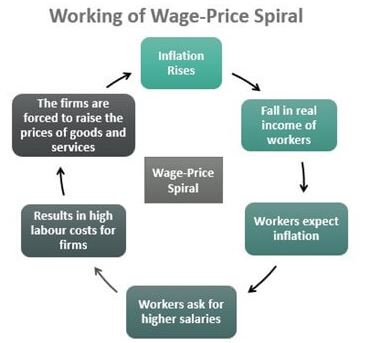
    • Definition: Greedflation, in essence, signifies that corporate greed is driving inflation, rather than the traditional wage-price spiral, leading to a profit-price spiral.
    • Corporate Exploitation: Companies exploit inflation by significantly raising prices, surpassing the need to cover increased costs, thereby maximizing profit margins and perpetuating inflation.
    • Profit-Price Spiral: Unlike the wage-price spiral, it involves companies exploiting inflation by excessively raising prices to maximize profit margins, triggering a cycle of inflation.

    Illustrative Scenario

    • Crisis Dynamics: During crises such as natural disasters or pandemics, businesses often raise prices due to increased input costs.
    • Exploitative Practices: However, some businesses exploit the situation by engaging in excessive profit-making through significantly inflated price mark-ups.

    Impact of Greedflation

    • Disproportionate Impact: Greedflation disproportionately affects low-income and middle-class individuals, diminishing their consumption and lowering living standards.
    • Wealth Disparities: While benefiting the wealthy by inflating asset values, it widens the wealth gap and exacerbates income inequality.
    • Market Instability: Sharp price increases and speculative activities driven by greed can create bubbles and unsustainable market conditions, heightening the risk of financial market crashes and crises.

    Global Implications

    • Divergent Policies: Inflationary pressures from greedflation may lead to divergent policy responses among nations.
    • Trade and Geopolitical Risks: Conflicting strategies to combat inflation can exacerbate global imbalances, trade tensions, and geopolitical conflicts as countries prioritize their interests and competitiveness.

    PYQ:

    [2015] Which reference to inflation in India, which of the following statements is correct?

    (a) Controlling the inflation in India is the responsibility of the Government of India only.

    (b) The Reserve Bank of India has no role in controlling the inflation.

    (c) Decreased money circulation helps in controlling the inflation.

    (d) Increased money circulation helps in controlling the inflation.

  • India’s GDP growth is impressive, but can it be sustained?

    Why in the news?

    The release of India’s GDP data was eagerly anticipated, especially following the recent upgrade in the “sovereign rating outlook” by S&P. It comes just days before the announcement of the union election results.

    Back2Basics: Rating Agency

    • A rating agency is a company that assesses the financial strength of companies and government entities, especially their ability to meet principal and interest payments on their debts.
    • Fitch Ratings, Moody’s Investors Service and Standard & Poor’s (S&P) are the big three international credit rating agencies controlling approximately 95% of the global rating business.
    • In India, six credit rating agencies are registered under the Securities and Exchange Board of India (SEBI): CRISIL, ICRA, CARE, SMERA, Fitch India and Brickwork Ratings.

    What does the data say?

    • India’s GDP growth for 2023-24 is 8.2%, exceeding market expectations and surpassing the previous year’s growth of 7%.
    • Fourth-quarter growth is particularly robust at 7.8%, with upward revisions in previous quarters contributing to overall growth.
    • Notable divergence of 1 percentage point between GDP and GVA growth in 2023-24, mainly due to increased net taxes.
    • Sectoral analysis reveals mixed performance, with manufacturing and construction showing strong growth, while agriculture remains subdued.
    • Expenditure-side breakdown highlights a slower growth rate in private consumption but healthy growth in investment, led mainly by government spending.

    Pillars need to be sustained:

    • Private Consumption: Ensuring sustained consumer spending, particularly by addressing high inflation and low wage growth, to maintain economic momentum.
    • Investment: Continuously stimulating both government and private sector investment to drive economic expansion and foster innovation and productivity.
    • Exports: Maintaining competitiveness in global markets and promoting export-oriented growth to leverage external demand and diversify revenue sources.

    How to ensure the benefits of high growth trickle down to the lower-income categories?

    • Improving Private Consumption: Focus on reviving private consumption, especially among lower-income groups. Address concerns of high inflation and low wage growth affecting consumer confidence.
    • Enhancing Employment Opportunities: Prioritize improving the employment scenario, particularly in sectors generating significant employment like IT and the unorganized sector. Recognize the importance of employment in sustaining consumption growth and overall economic stability.
    • Investment in Rural Development: Ensure spatial and temporal distribution of rainfall for rural demand recovery. Moderating food inflation and improving employment conditions crucial for rural consumption revival.
    • Boosting Private Capex Cycle: Create an environment conducive to private investment, focusing on policy certainty and confidence in economic stability. Encourage private sector investment through favourable policies and supportive regulatory frameworks.
    • Policy Focus on Inclusive Growth: Direct policy attention towards ensuring that the benefits of high growth extend to lower-income categories. Implement targeted social welfare programs and initiatives to support vulnerable groups and reduce income inequality.
    • Monitoring Global Developments: Stay vigilant of global economic trends and developments that could impact the Indian economy, such as geopolitical tensions and supply shocks. Adapt policies accordingly to mitigate risks and capitalize on opportunities for sustained economic growth.

    Conclusion: The Indian government aims to bolster equitable growth through measures such as stimulating private consumption, enhancing employment prospects, and fostering a conducive investment environment, supported by targeted policies and proactive global monitoring.

    Mains PYQ:

    Q Explain the difference between the computing methodology of India’s Gross Domestic Product (GDP) before the year 2015 and after the year 2015. (UPSC IAS/2021)

  • RBI brings back 100 tonnes Gold from UK to its Vaults 

    Why in the News?

    The RBI has repatriated over 100 tonnes of gold from the UK to its domestic vaults, the largest transfer since at least 1991.

    What are Gold Reserves?

      • A gold reserve is the gold held by a country’s central bank, acting as a backup for financial promises and a store of value.
      • India, like other nations, stores some of its gold reserves in foreign vaults to spread out risk and facilitate international trading.
    • India’s Gold Reserves:
      • As of the end of March 2024, the RBI held 822.10 tonnes of gold, with 408.31 tonnes stored domestically.
      • The share of gold in the total forex of India is around 7-8% as of 2023.

    Where does the RBI store its gold?

    • India’s gold reserves are primarily stored in the Bank of England, which is known for its stringent security protocols.
    • The RBI also stores a portion of its gold reserves at the:
    1. Bank for International Settlements (BIS) in Basel, Switzerland, and the
    2. Federal Reserve Bank of New York in the United States.
    • During India’s foreign exchange crisis in 1990-91, the country pledged some of its gold reserves to the Bank of England to secure a $405 million loan, according to reports.
    • Even though the loan was paid back by November 1991, India decided to keep the gold in the UK for convenience.

    Why does the RBI store its gold in foreign banks?

    • Convenience: Storing gold overseas makes it easier for India to trade, engage in swaps and earn returns.
    • Averting Risks: There are risks involved, especially during times of geopolitical tensions and war.
      • The recent freezing of Russian assets by Western nations has raised worries about the safety of assets kept abroad and the RBI decision to shift a portion of the gold reserve to India could be prompted by these concerns.
    • Stable Prices: Unlike fiat currencies, which can be subject to inflation or devaluation due to various economic factors, the value of gold tends to be relatively stable over time, which makes it an attractive asset for central banks to hold as a reserve.

    Benefits Offered by Gold Reserves

    • Control domestic gold prices: With its big stash of gold, the RBI can help control local gold prices by using some of it in India. Last financial year, the RBI added about 27.47 tonnes of gold to the total reserve, bringing it to 794.63 tonnes.
    • Security buffer: The increased gold reserve works as a hedge against any financial crisis and to take measures to control inflation as well as currency devaluation.

    Why is the recent move significant?

    • Efficiency and Confidence: Bringing gold back to India reduces storage fees and signals confidence in the stability of the Indian economy.
    • Logistical Efficiency: Moving gold to India saves on storage fees paid to foreign custodians, such as the Bank of England.
    • Diversified Storage: Repatriation ensures diversified storage, enhancing security and reducing dependency on foreign storage.

    Has the RBI made similar purchases or transfers of gold in the past?

    • RBI started buying gold in 2018 and had previously bought 200 tonnes during the global financial crisis in 2009.
    • In the first quarter of 2024, the RBI bought 19 tonnes of gold, surpassing the 16 tonnes purchased throughout 2023.

    PYQ:

    [2015] The problem of international liquidity is related to the non-availability of:

    (a) Goods and services

    (b) Gold and silver

    (c) Dollars and other hard currencies

    (d) Exportable surplus

  • Can domestic MFs invest in their overseas counterparts?

    Why in the news?

    SEBI issued a consultation paper, proposing a framework to enable domestic Mutual Funds (MFs) to invest in their overseas counterparts or Unit Trusts (UTs) that allocate a portion of their assets to Indian securities.

    About the Framework for Facilitating Investments by Domestic Mutual Funds (MFs)

    • Aim: To clarify the process and regulations surrounding such investments to encourage domestic MFs to diversify globally while maintaining limited exposure to Indian securities.

    About the Proposals:

    • On Investment Cap: SEBI proposes that overseas instruments being considered for investment by domestic MFs must not have more than 20% exposure to Indian securities.
      • This cap is intended to balance facilitating global investments while preventing excessive exposure to Indian markets.
    • On Pooling of Contributions: Indian MFs must ensure that all investors of the overseas MF/UT pool their contributions into a single investment vehicle. This ensures fair distribution of gains among investors, proportional to their contributions, without any preferential treatment.
    • On Autonomous Management: Investments must be made autonomously by the manager of the overseas instrument, without influence from investors or undisclosed parties, to avoid conflicts of interest.
    • About Transparency and Disclosure: SEBI requires periodic public disclosures of the portfolios of such overseas MF/UTs for transparency.
    • No Advisory Agreements: SEBI warns against any advisory agreement between the Indian MF and the overseas MF/UT to prevent conflicts of interest and avoid undue advantage.
    • On Observance Period: If an overseas instrument breaches the 20% limit, the Indian MF scheme will enter a six-month observance period for rebalancing the portfolio.
      • Further investments will only be allowed when the exposure is below the limit. If not rebalanced within six months, the MF must liquidate its investment in the overseas instrument.

    Impacts of the Regulation

    • Diversification of Opportunities: The framework provides a structured path for Indian MFs to invest in overseas instruments, enhancing diversification opportunities for Indian investors.
    • Market Transparency: The requirement for periodic public disclosures of portfolios will increase transparency and investor confidence in overseas investments.
    • Risk Management: The 20% exposure cap and autonomous management of investments help mitigate risks associated with excessive exposure to Indian securities and conflicts of interest.
    • Compliance Burden: The need to adhere to strict regulations and rebalance portfolios within specified periods may increase the compliance burden on domestic MFs.
    • Potential for Growth: By facilitating global investments, the framework can potentially attract more investors to Indian mutual funds, contributing to the growth of the mutual fund industry in India.

    What are the concerns associated with this framework?

    • RBI’s Upper Limit: The Reserve Bank of India’s (RBI) upper limit for overseas investment by mutual funds poses a concern. RBI Governor Shaktikanta Das indicated there are no plans to increase this limit, which means the overall industry limit for overseas investments is already exhausted.
    • Practical Impact: As the industry limit for overseas investments is effectively exhausted, the changes to regulations may not have an immediate practical impact, limiting the diversification opportunities for Indian investors.
    • Implementation and Compliance: Ensuring compliance with the 20% exposure cap and other regulations may pose challenges for domestic MFs, requiring careful monitoring and management of their overseas investments.

    Conclusion: Need to establish collaborations with global investment firms to gain insights and best practices in managing overseas investments. Learning from established global players can help Indian mutual funds navigate the complexities of international markets more effectively.

    Mains PYQ:

    Q The product diversification of financial institutions and insurance companies, resulting in overlapping of products and services strengthens the case for the merger of the two regulatory agencies, namely SEBI and IRDA. Justify. (UPSC IAS/2013)

  • Surge in Indian Companies’ External Commercial Borrowings (ECBs)

    Why in the News?

    Indian companies “external commercial borrowings” nearly doubled in FY24, reaching $49.2 billion, according to RBI data.

    Key Statistics:

    • Disbursements: ECB disbursements stood at $38.4 billion in FY24, a significant increase from $23.8 billion in FY23, underscoring the growing reliance on overseas markets for funding.
    • Domestic Pressure: High interest rates in the domestic system have led to increased pressure, prompting companies to explore ECBs as a viable funding alternative.

    External Commercial Borrowing (ECBs) in India:

    Details
    Definition Loans provided by non-resident lenders in foreign currency to Indian borrowers.
    Usage Widely used by Indian corporations and PSUs to access foreign funds.
    Instruments Covered Commercial bank loans, buyers’ credit, suppliers’ credit, securitised instruments (floating rate notes, fixed-rate bonds), credit from official export credit agencies, and commercial borrowings from multilateral financial institutions.
    Regulation Monitored and regulated by the Department of Economic Affairs (DEA) under the Ministry of Finance, Government of India, along with the Reserve Bank of India.
    Contribution Contributed between 20 and 35% of total capital flows into India in 2012.
    Recent Changes RBI raised ECB limit for infrastructure finance companies from 50% to 75% of owned funds.
    Guideline Changes RBI allowed all eligible borrowers to raise ECB up to USD 750 million per financial year under the automatic route (2019).
    Utilisation of Funds 25% of ECB can be used to repay rupee debt; 75% should be allocated for new projects.
    Regulatory Framework Governed by the Foreign Exchange Management Act, 1999.
    Routes for Raising ECBs Automatic Route and Approval Route.

    1. Automatic Route: Cases examined by AD (Authorized Dealer) Category-I Banks.
    2. Approval Route: Borrowers submit requests to RBI through their AD banks for examination.
    Maturity Period ECBs can only be raised for a specific period known as the Minimum Average Maturity Period (MAMP).
    Advantages Offered
    • ECBs offer the opportunity to secure substantial funding.
    • These funds typically come with longer-term repayment options.
    • Interest rates on ECBs are generally lower compared to domestic borrowing rates.
    • ECBs are denominated in foreign currencies, providing corporations with access to foreign currency to fulfil import needs such as machinery procurement.


    PYQ:

    [2019] Consider the following statements :

    1. Most of India’s external debt is owed by governmental entities.
    2. All of India’s external debt is denominated in US dollars.

    Which of the statements given above is/are correct?

    (a) 1 only

    (b) 2 only

    (c) Both 1 and 2

    (d) Neither 1 nor 2

  • RBI launches PRAVAAH, Retail Direct mobile app and FinTech Repository

    Why in the News?

    • The Reserve Bank of India (RBI) recently introduced three significant initiatives: the PRAVAAH portal, the RBI Retail Direct mobile application, and the FinTech Repository.
      • These initiatives aim to streamline regulatory processes, empower retail investors, and provide insights into the fintech sector.

    1. PRAVAAH Portal:

    • The PRAVAAH portal (Platform for Regulatory Application, VAlidation, and AutHorisation) serves as a centralised web-based platform for individuals and entities to seek regulatory approvals from the RBI.
    • Offering features like online application submission and status tracking, the portal covers 60 different application forms across various regulatory departments, ensuring efficiency and transparency in the authorisation process.

    2. RBI Retail Direct Mobile App:

    • The RBI Retail Direct Mobile App provides retail investors with convenient access to government securities (G-Secs) trading directly from their smartphones.
    • Accessible on both Android and iOS platforms, the app simplifies transactions in both primary and secondary markets, empowering retail investors to participate more actively in the securities market.

    3. FinTech Repository:

    The FinTech Repository aims to provide comprehensive data on Indian fintech firms, facilitating better regulatory understanding and policy formulation in the rapidly evolving fintech landscape.

    Other initiatives launched:

    • EmTech Repository: It focuses on RBI-regulated entities’ adoption of emerging technologies like AI, ML, Cloud Computing, and Quantum, providing valuable insights for policymakers and industry stakeholders.
    • Reserve Bank Innovation Hub (RBIH): Both repositories are managed by the RBIH, underscoring the central bank’s commitment to fostering innovation and collaboration in the financial sector.


    PYQ:

    [2013] In the context of the Indian economy, ‘Open Market Operations’ refers to:

    (a) borrowing by scheduled banks from the RBI

    (b) lending by commercial banks to industry and trade

    (c) purchase and sale of government securities by the RBI

    (d) None of the above

  • Cost Inflation Index (CII) for FY25 to compute Capital Gains

    Why in the News?

    • The Income Tax Department has notified the cost inflation index (CII) for the current fiscal to calculate long-term capital gains arising from the sale of immovable property, securities and jewellery.
      • The CII is used by a taxpayer to compute gains arising out of the sale of capital assets after adjusting for inflation.

    CII Values:

    • For FY 2024-25, the CII is set at 363.
    • Previous years’ CII values were 348 for FY 2023-24 and 331 for FY 2022-23.

    What is Cost Inflation Index (CII)?

    • CII is a measure used by the Income Tax Department of India to account for inflation when calculating the capital gains on the sale of long-term capital assets.
    • It helps to adjust the purchase price of assets to reflect the effect of inflation.
      • CII adjusts the cost of acquisition of assets to the price level inflation at the time of sale.
      • This ensures that taxpayers pay taxes on the real gains rather than on the inflationary component of the price rise.
    • It is defined under Section 48 of the Income-tax Act, 1961.
    • The index is revised annually to keep up with inflation, with the base year being periodically reset (currently the base year is 2001-02 in India).

    Application of CII

    • CII is used to compute the indexed cost of acquisition of a capital asset that has been held for more than 36 months (considered as long-term capital assets).
    • Different holding periods apply for certain types of assets like immovable property and listed securities.

    Tax Calculation:

    • The formula used is:

    • This formula helps determine the adjusted cost basis from which any sale proceeds are subtracted to calculate capital gains.

    Back2Basics: Long Term Capital Gains

    • In India, long-term capital gains (LTCG) refer to the profit earned from the sale of a capital asset held for a specific period, qualifying it as “long-term” based on the duration of holding.
    • The tax implications and treatment of these gains are distinct from those of short-term capital gains.

    Definition of Long-Term Capital Assets

    • Equity or Preference Shares, Listed Securities, Units of UTI, etc.: These are considered long-term if held for more than 12 months before sale.
    • Immovable Property (e.g., Land, Building): Considered long-term if held for more than 24 months.
    • Other Assets (e.g., Jewellery, Debt-oriented Mutual Funds, etc.): These need to be held for more than 36 months to be considered long-term.

    Taxation of Long-Term Capital Gains

    • Equity Investments:
      • LTCG from the sale of listed shares or equity-oriented mutual funds over ₹1 lakh is taxed at 10% without the benefit of indexation, provided the securities transaction tax (STT) was paid at the time of sale.
    • Non-Equity Investments:
      • LTCG from assets like debt mutual funds, real estate, gold, etc., is taxed at 20% with the benefit of indexation.
    • Indexation Benefit:
      • For non-equity assets, the Cost Inflation Index (CII) is used to adjust the purchase price of the asset to reflect inflation. This reduces the taxable gain by increasing the acquisition cost.

    Calculation of Long-Term Capital Gains

    The general formula for calculating LTCG is:


    Where:

    Full Value of Consideration is the sale price of the asset.

    Indexed Cost of Acquisition is the purchase price adjusted by the CII.

    Indexed Cost of Improvement refers to the cost of any improvements made to the asset, adjusted by the CII.

    Cost of Transfer includes expenses directly related to the sale or transfer of the asset.

    Exemptions and Deductions

    • Section 54: Exemption on LTCG from the sale of a residential property if the proceeds are reinvested in another residential property in India.
    • Section 54EC: Exemption by investing LTCG in bonds issued by NHAI or REC within 6 months of the asset sale, subject to a cap of ₹50 lakhs.


    PYQ:

    [2015]  Which reference to inflation in India, which of the following statements is correct?

    (a) Controlling the inflation in India is the responsibility of the Government of India only

    (b) The Reserve Bank of India has no role in controlling the inflation

    (c) Decreased money circulation helps in controlling the inflation

    (d) Increased money circulation helps in controlling the inflation

  • India fighting pressure at WTO to allow ‘plurilateral pact’ on investment facilitation

    Why in the News?

    An official stated on Tuesday that India opposes a China-led proposal on investment facilitation at the WTO, arguing that it is a ‘non-trade’ issue beyond the global trade body’s mandate.

    About Plurilateral Agreement/Pact:

    • A plurilateral agreement is a trade agreement between more than two countries, but not necessarily encompass all members of a larger organization such as the World Trade Organization (WTO).
    • These agreements are binding only on the signatories and not on the entire membership of the organization under annexure-4 of the WTO.
    • They allow for deeper integration among interested parties without requiring full consensus, which can be difficult to achieve in larger multilateral frameworks.

    What is the China-led Investment Facilitation for Development Agreement (IFD)?

    • The IIFD Agreement is a proposed pact by China, with support from other countries, to streamline and facilitate foreign investment.
    • The main objectives of the IFD Agreement include:
      • Enhancing transparency of investment measures.
      • Streamlining and speeding up investment-related authorization procedures.
      • Promoting international cooperation, information sharing, and exchange of best practices.
      • Encouraging sustainable investment practices.
    • The proponents of the IFD argue that it would bring benefits to all WTO members, especially developing and least-developed countries, by creating a more predictable and transparent investment climate.

    India’s Strong Stand against the IFD at WTO MC13

    India has taken a firm stance against the inclusion of the IFD Agreement in the WTO framework for several reasons:

    • Investment is Not a Trade Issue: India argues that investment does not fall within the traditional purview of the WTO, which primarily focuses on trade issues. It points out that past Ministerial decisions have explicitly kept investment outside the WTO’s scope.
    • Sovereignty Concerns: A significant concern for India is the potential impact on its policy space. The IFD Agreement includes provisions that would require the government to consult with investors on policy matters, which India fears could undermine its ability to make sovereign decisions.
    • Lack of Consensus: India, along with South Africa, has highlighted the absence of a unanimous consensus among WTO members regarding the inclusion of the IFD as a plurilateral agreement. They argue that without exclusive consensus, it should not be brought onto the formal agenda.
    • Policy Autonomy: India is wary that the IFD Agreement’s requirements could constrain its autonomy in regulating investments to align with national development priorities and strategies.
    • Procedural Concerns: India contends that the issue should not have been part of the MC13 agenda and instead, should be discussed at the General Council, given the divisive nature of the proposal among WTO members.

    Conclusion: India’s opposition to the IFD Agreement at the WTO stems from a combination of concerns about preserving national sovereignty, adhering to established WTO boundaries regarding trade versus investment issues, and ensuring that any significant changes in the WTO framework are backed by broad-based consensus.

    Mains PYQ:

    Q The broader aims and objectives of WTO are to manage and promote international trade in the era of globalisation. But the Doha round of negotiations seems doomed due to differences between the developed and the developing countries.” Discuss in the Indian perspective. (UPSC IAS/2016)

  • India rises to 39th position in WEF Index for travel, tourism development

    Why in the News? 

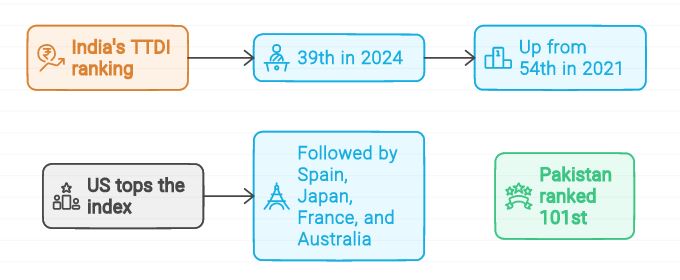
    • India has moved up to the 39th position in the World Economic Forum’s latest “Travel & Tourism Development Index (TTDI) 2024, a significant climb from 54th in 2021.
      • The United States tops the index, followed by Spain, Japan, France, and Australia.
      • Pakistan is ranked 101st.

    India’s Performance and Ranking

    • Price Competitiveness: India is ranked 18th in terms of price competitiveness.
    • Transport Infrastructure: It stands at 26th for air transport and 25th for ground and port infrastructure.
    • Resource Ranking: India is 6th in natural resources, 9th in cultural resources, and 9th in non-leisure resources.
    • TTDI Score Change: India’s overall TTDI score decreased by 2.1% compared to its 2019 level.
    • Decline in Sustainability Performance: India has seen a decline in sustainability performance relative to 2019 but still performs well due to the prevalence of sustainable long stays among inbound visitors.

    About Travel & Tourism Development Index (TTDI)

    • The TTDI was compiled in collaboration with the World Economic Forum (WEF) and the University of Surrey in the United Kingdom (UK).
    • TTDI 2024 is the second edition, evolved from the Travel & Tourism Competitiveness Index (TTCI) series, a flagship index of WEF that has been in production since 2007.
    • TTDI 2024 covered 119 countries’ travel and tourism sectors across various factors and policies.

    Back2Basics: World Economic Forum (WEF)

    Description
    Establishment Founded in 1971 by Swiss-German economist Klaus Schwab in Geneva, Switzerland.
    Purpose To bring together public and private sector leaders to address global political, social, and economic issues.
    Membership Introduced in 1975, membership includes the world’s top 1,000 companies.
    Scope Expansion Initially focused on European firms catching up with US management practices, expanded to encompass broader economic and social issues.
    Birth of the G20 The concept of the G20, focusing on global finance and comprising 20 countries, emerged from discussions at the WEF in 1998.
    Key Reports Published
    • Global Competitiveness Report
    • Global Risks Report
    • Global Gender Gap Report
    • Global Human Capital Report
    • Global Information Technology Report
    • Future of Jobs Report
    • Global Enabling Trade Report

    Trick: Reports beginning with the name ‘Global’.

    World level recovery in travel and tourism:

    • Sector Recovery: International tourist arrivals and the sector’s contribution to global GDP are expected to return to pre-pandemic levels in 2024.
    • Regional Recovery: West Asia exceeded its 2019 tourist arrival levels by 20%, while Europe, Africa, and the Americas are recovering robustly, each reaching about 90% of their 2019 levels.

    PYQ:

    [2019] The Global Competitiveness Report is published by the:

    (a) International Monetary Fund

    (b) United Nations Conference on Trade and Development

    (c) World Economic Forum

    (d) World Bank

    Practice MCQ:

    The Travel & Tourism Development Index (TTDI) is released by:

    1. International Air Transport Association (IATA)
    2. World Tourism Foundation (WTF)
    3. World Economic Forum
    4. World Bank