💥Join UPSC 2027,2028 Mentorship (July Batch) + XFactor Notes & Microthemes PDF

GS Paper: Indian Economy

  • GST Rates Rationalisation back on table

    Central Idea

    • The government has revived its focus on Goods and Services Tax (GST) rate rationalization by reconstituting the ministerial group of the GST Council.

    About Goods and Services Tax (GST)

    • Launch and Purpose: GST, implemented on 1 July 2017, is a comprehensive indirect tax across India, replacing multiple cascading taxes levied by the central and state governments.
    • Consumption-Based Tax: It is charged at the point of supply and is based on the destination of consumption, benefiting the state where the goods or services are consumed.

    GST Slabs and Their Distribution

    • Tax Slabs: GST in India is categorized into five main slabs: 0%, 5%, 12%, 18%, and 28%, with an additional cess on certain luxury and ‘sin’ goods.
    • Product and Service Coverage: The GST system covers over 1300 products and 500+ services, categorized under these slabs.
    • Periodic Revision: The GST Council revises the slab rates periodically, ensuring essential items are taxed lower, while luxury items attract higher rates.
    • 28% Slab and Cess: The highest slab of 28% is reserved for demerit goods like tobacco and luxury automobiles, with an additional cess for revenue generation.

    Issues with the Current GST Structure

    • Complexity: The multi-slab structure and varying rates lead to confusion and increased compliance costs for businesses.
    • Rate Heterogeneity: Diverse rates across different goods and services complicate the tax system.
    • Dual GST System: The coexistence of CGST and SGST adds to the complexity and compliance burden.
    • Cascading Effect: Despite being a value-added tax, GST sometimes leads to cascading taxation, increasing the cost of goods and services.
    • Lack of Transparency: Invoicing under GST often lacks clarity on tax breakdown, affecting consumer awareness.
    • Collection Infrastructure: Inadequate infrastructure for GST collection leads to administrative challenges and delays.

    Rationale behind GST Rationalization

    • Simplifying Tax Structure: Reducing the number of slabs can simplify the tax system, making it easier for businesses to comply.
    • Addressing Aberrations: Rationalization can correct anomalies where inputs are taxed higher than final products.
    • Revenue Concerns: Merging slabs like 12% and 18% could lead to revenue loss, necessitating careful consideration.

    Benefits of GST Rationalization

    • Easier Compliance: A simplified GST structure would ease the compliance burden on businesses.
    • Equitable Tax Distribution: Rationalization ensures a fair distribution of tax burden and efficient use of revenue.
    • Improved Tax Collection: Streamlining GST slabs can lead to more efficient tax collection and reduced compliance costs.

    Conclusion

    • Need for Reform: Rationalizing GST rates is crucial for enhancing the efficiency of the tax regime.
    • Expected Outcomes: A reformed GST system is anticipated to be simpler, leading to easier compliance, better revenue collection, and overall efficiency in the taxation system.
  • Controversy over Germany’s Debt Brake Rule

    Central Idea

    • On November 15, Germany’s constitutional court declared the government’s reallocation of €60 billion to a “climate and transformation fund” (KTF) as unlawful.

    Understanding the Debt Brake Rule

    • Definition and Purpose: The debt brake rule caps government borrowing and restricts the federal government’s fiscal deficit to 0.35% of GDP, while prohibiting deficit spending by Germany’s 16 regions.
    • Enactment: This rule was incorporated into German law in 2009 by a coalition, mirroring the EU’s Stability and Growth Pact and the 2012 Fiscal Compact Treaty.

    Legal Challenge and Its Implications

    • Opposition’s Argument: It argued that climate change and energy transition investments, being long-term, shouldn’t be funded by the debt brake’s emergency exemption, which was specific to COVID-19 relief.
    • Government’s Defense: The government contended that the reallocated funds addressed economic consequences of the pandemic by linking investment shortfalls to COVID-19’s economic impact.

    Germany’s Post-2009 Economic Performance

    • Mixed Outcomes: Germany experienced growth and budget surpluses in the last decade, benefiting from low-interest policies of the ECB.
    • Zero-Deficit Budget: The government achieved a zero-deficit budget, promoting it as an ideal approach for the EU during a sovereign debt crisis.
    • Challenges and Criticisms: A cooling economy highlighted under-investment in infrastructure. Critics urged for expansionary fiscal measures, while others favored higher taxation. Chancellor Angela Merkel emphasized the need to avoid burdening the younger generation with debt.
    • Pandemic Response: In 2020, the debt brake rule was suspended for pandemic-related borrowing, with plans for reinstatement.
  • 3 reasons why the RBI has held interest rates steady

    RBI MPC may maintain the status quo on August 10; comment on inflation,  growth trajectory to be in focus | Mint

    Central idea 

    The RBI’s recent monetary policy decision maintains a cautious stance, driven by concerns over persistent food inflation and global central banks signaling higher interest rates. Despite a positive economic outlook, challenges include incomplete transmission of past rate hikes and potential risks from interconnectedness between banks and non-banks.

    Key Highlights:

    • The Reserve Bank of India (RBI) maintained its pause on monetary policy and retained the withdrawal-of-accommodation stance.
    • Reasons for the decision include ongoing concerns about inflation, particularly in critical food items, despite a recent decrease.
    • Influences from systemically important central banks, such as the US Federal Reserve and the European Central Bank, impact India’s monetary policy.

    Key Challenges:

    • Persistent risks from food inflation, driven by factors like an uneven monsoon and global food supply uncertainties.
    • Impact of higher interest rates signaled by central banks like the US Federal Reserve and the European Central Bank on India’s economy.
    • Incomplete transmission of past rate hikes into lending rates poses challenges for the RBI.

    Key Terms:

    • Monetary Policy Committee (MPC): A committee responsible for framing India’s monetary policy.
    • Core CPI Inflation: Consumer Price Index inflation excluding volatile food and fuel components.
    • Macroprudential Tools: Measures used by central banks to ensure the stability of the financial system.

    Key Phrases:

    • “The battle against inflation is far from over.”
    • “Systemically important central banks signal higher-for-longer interest rates.”
    • “Transmission of past rate hikes into lending rates remains incomplete.”

    Key Quotes:

    • “The RBI expects consumer inflation at 5.4 per cent this fiscal, while our forecast is slightly higher at 5.5 per cent.” (Authors)
    • “The RBI Governor flagged increasing interconnectedness between banks and non-banks, raising the possibility of stress contagion.” (RBI Governor)

    Key Statements:

    • “Despite rate increases, bank credit growth has sustained over 15 per cent this fiscal, unchanged from last year.”
    • “India will continue to be a growth outperformer among large economies this fiscal.”

    Key Examples and References:

    • Influence of US Federal Reserve and European Central Bank’s higher interest rates on global monetary policies.
    • RBI’s use of measures like an incremental cash reserve ratio and open market sales to manage liquidity.

    Key Facts and Data:

    • RBI’s forecast for consumer inflation: 5.4 per cent.
    • GDP growth forecast lifted to 7 per cent for the fiscal year.

    Critical Analysis:

    • Emphasizes ongoing concerns about inflation, particularly in critical food items.
    • Highlights the impact of global central banks’ policies on India’s monetary decisions.
    • Raises the challenge of incomplete transmission of rate hikes into lending rates.

    Way Forward:

    • Monitor and address risks related to food inflation and global interest rate dynamics.
    • Continue using measures like liquidity management and macroprudential tools for financial stability.
    • Assess and manage potential challenges arising from the interconnectedness of banks and non-banks.
    • Anticipate and address the impact of rising interest rates on India’s economy.
  • Off-Budget Borrowing in India and its Fiscal Implications

    Central Idea

    • In recent years, India’s fiscal management has faced the significant challenge of off-budget borrowings by various states.
    • These borrowings, while providing short-term financial relief, have raised concerns regarding the overall fiscal health and transparency of the country’s finances.

    Understanding Off-Budget Borrowings

    • Definition: Off-budget borrowings are debts incurred not directly by the government but by public sector units or special purpose vehicles, with principal and interest serviced from the budget.
    • Legislative Oversight: These borrowings are not subject to legislative scrutiny and are outside the budget.
    • FRBM Act Bypass: They allow governments to circumvent borrowing limits set under the Fiscal Responsibility and Budget Management (FRBM) Act, 2003.

    How are off-budget borrowings raised?

    • Issuance of Bonds: The government can ask an implementing agency to raise the required funds from the market through loans or by issuing bonds.
    • Utilizing savings: For example, the food subsidy is one of the major expenditures of the Centre. In the Budget presentation for 2020-21, the government paid only half the amount budgeted for the food subsidy bill to the Food Corporation of India. The shortfall was met through a loan from the National Small Savings Fund.
    • Borrowing: Other PSUs have also borrowed for the government. For instance, public sector oil marketing companies were asked to pay for subsidized gas cylinders for PM Ujjwala Yojana beneficiaries in the past.
    • Bank sources: Public sector banks are also used to fund off-budget expenses. For example, loans from PSU banks were used to make up for the shortfall in the release of fertilizer subsidy.

    Prevalence of Off-Budget Borrowings

    • Recent Trends: Off-budget borrowings were rampant until recently, with significant amounts in states like Andhra Pradesh, Telangana, Kerala, Chhattisgarh, and Sikkim.
    • Magnitude: Estimates show ₹2.79 trillion in 2020-21 and ₹1.71 trillion in 2021-22.
    • Fiscal Transparency Concerns: The 15th Finance Commission and the Comptroller and Auditor General of India (CAG) have flagged these borrowings for undermining fiscal transparency and sustainability.

    Centre’s Stance on Off-Budget Borrowings

    • Past Practices: The Centre had substantial off-budget borrowings, reaching ₹1.62 trillion in 2018-19.
    • Recent Changes: Finance Minister Nirmala Sitharaman announced the end of such borrowings in the Union Budget for 2020-21, reducing them significantly in subsequent years.

    Centre’s Measures against State Off-Budget Borrowings

    • New Policy: In March 2022, the Centre declared that state off-budget borrowings would count towards their regular borrowing ceiling.
    • Impact on States: This policy limited states’ borrowing capacity, leading to cash flow issues in some states and prompting protests and threats of legal action.

    Current State of India’s Balance Sheet

    • Reduction in Off-Budget Borrowings: States’ off-budget borrowings are expected to decrease to ₹18,499 crore in 2022-23.
    • Overall Fiscal Health: True fiscal sustainability requires both the Centre and states to align their deficits with FRBM Act targets.
    • Deficit Targets: The FRBM Act aims for the elimination of a revenue deficit and a fiscal deficit of 3% of GDP. However, in 2023-24, 11 states are projected to have a revenue deficit, and the aggregate fiscal deficit of all states is expected to be 3.1%. The Centre’s revenue and fiscal deficits are anticipated to be 2.9% and 5.9% of GDP, respectively.

    Conclusion

    • The clampdown on off-budget borrowings is a step towards greater fiscal discipline in India.
    • While it has led to immediate challenges for some states, the long-term goal is to enhance fiscal transparency and sustainability in line with the FRBM Act.
    • Achieving these targets will be crucial for the overall health of India’s economy.

    Try this PYQ:

    With reference to the Union Government, consider the following statements:

    1. The Department of Revenue is responsible for the preparation of Union Budget that is presented to the Parliament.
    2. No amount can be withdrawn from the Consolidated Fund of India without the authorization from the Parliament of India.
    3. All the disbursements made from Public Account also need authorization from the Parliament of India.

    Which of the statements given above is/are correct?

    (a) 1 and 2 only

    (b) 2 and 3 only

    (c) 2 only

    (d) 1, 2 and 3

  • The GDP surprise: India on the up and up

    US Economic Forecast Q3 2023 | Deloitte Insights

    Central idea

    The Indian growth story remains a beacon of hope. The economy is unlikely to slow down in line with other major economies of the world as the government continues to undertake reforms.

    Key Highlights:

    • Economic Growth: The Indian economy expands by 7.6% in Q2, challenging doubts on post-pandemic macroeconomic resilience.
    • Manufacturing Surge: The manufacturing sector grows robustly at 13.9%, indicating positive outcomes from policy initiatives and credit stabilization.
    • Corporate Health: Corporate books show impressive bottom-line growth, reflecting broad-based economic recovery.
    • Capex Intentions: Historic capex intentions with new investment announcements reaching Rs 37 lakh crore in 2022-23, signifying increased private sector participation.
    • Agricultural Transformation: Agriculture grows by 1.2%, with a shift towards allied activities reducing dependence on traditional farm income.
    • Banking Support: Banks increasingly finance the entire agri value chain, with agri loans growing by 15.4% in 2022-23.
    • Services Sector Moderation: Services sector growth moderates to 5.8%, influenced by low growth in trade, hotels, transport, and communication.
    • Consumption Patterns: Private consumption decelerates to 3.1%, possibly impacted by higher inflation, expected to pick up in the third quarter.
    • Government Investments: Government consumption and investments register healthy growth, with gross fixed capital formation increasing by 11%.

    Key Challenges:

    • Global Growth Risk: Risk of softer global growth, especially in the US and Euro region, may impact India’s exports and economic momentum.
    • Consumer Sentiment Woes: Consumer sentiments in major economies worsen amid growing uncertainty, potentially affecting global trade.

    Key Terms and Phrases:

    • Macro-economic Resilience: India’s ability to withstand and recover from economic shocks.
    • PLI Scheme: Production-Linked Incentive scheme aimed at boosting manufacturing in specific sectors.
    • Corporate Balance Sheets: Financial health and performance of businesses.
    • Capex Intentions: Plans and commitments for capital expenditures.
    • Allied Activities in Agriculture: Diversification into areas like dairy and fisheries within the agriculture sector.
    • Gross Fixed Capital Formation: Investment in fixed assets contributing to economic growth.
    • Consumer Sentiments: Public attitudes and feelings regarding economic conditions and spending.
    • Global Trade Headwinds: Challenges and obstacles affecting international trade.

    Key Quotes:

    • “The Indian growth story remains a beacon of hope.”
    • “The economy is unlikely to slow down in line with other major economies of the world.”

    Key Statements:

    • Manufacturing sector growth indicates an uptick triggered by government expenditure, policy initiatives, and credit stabilization.
    • Agriculture’s increased focus on allied activities reduces dependence on traditional farm income.
    • Historic capex intentions and private sector participation signal a strong economic recovery.

    Key Examples and References:

    • New investment announcements hitting a high of Rs 37 lakh crore in 2022-23, showcasing increased private sector participation.
    • Agriculture loans by banks increase by 15.4% in 2022-23, indicating growing support for the agri value chain.

    Key Facts and Data:

    • Indian economy grows by 7.6% in Q2, marking two consecutive quarters of 7% plus growth.
    • Manufacturing sector grows at a robust 13.9%, reaching a nine-quarter high.
    • New investment announcements hit Rs 37 lakh crore in 2022-23, compared to Rs 20 lakh crore in 2021-22.
    • Agriculture grows by 1.2% in Q2, with allied activities contributing significantly.

    Critical Analysis:

    • The robust economic growth raises questions about the accuracy of forecasts doubting India’s resilience.
    • The manufacturing sector’s strong performance indicates positive outcomes from government initiatives and policies.
    • Private sector participation in capex reflects confidence in the economic recovery.
    • Increased focus on allied activities in agriculture showcases a shift in the sector’s dynamics.
    • The potential risk of softer global growth highlights external factors influencing India’s economic trajectory.

    Way Forward:

    • Continued government reforms and support for economic growth.
    • Monitoring and addressing potential risks from softer global growth.
    • Sustaining the positive momentum in manufacturing and capex through policy measures.
    • Emphasizing the role of allied activities in agriculture for a diversified income base.
    • Nurturing consumer sentiments and encouraging private consumption for sustained economic recovery.
  • Cabinet clears terms of reference for 16th Finance Commission

    Central Idea

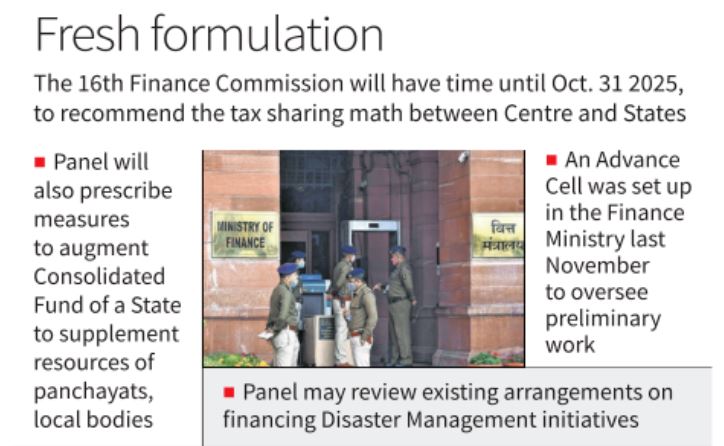
    • The Union Cabinet approved the terms of reference (ToR) for the Sixteenth Finance Commission.
    • The Commission will devise a formula for revenue sharing between the Centre and the States for the period starting April 1, 2026.

    About Finance Commission

    • Establishment: The Finance Commission (FC) of India was established by the President in 1951 under Article 280 of the Indian Constitution.
    • Purpose: Its primary role is to define and regulate the financial relations between the central government and the individual state governments.
    • Legislative Framework: The Finance Commission (Miscellaneous Provisions) Act, 1951, further outlines the qualifications, appointment, disqualification, term, eligibility, and powers of the Finance Commission.
    • Composition: Appointed every five years, the FC comprises a chairman and four other members.
    • Evolution: Since the First FC, changes in India’s macroeconomic landscape have significantly influenced the Commission’s recommendations.

    Constitutional Provisions

    • Article 268: Facilitates the levy of duties by the Centre, with collection and retention by the States.
    • Article 280: Outlines the FC’s composition, qualifications for members, and its terms of reference. It mandates the FC to recommend the distribution of net tax proceeds between the Union and States and the allocation among States. It also addresses the financial relations between the Union and States and the devolution of unplanned revenue resources.

    Key Functions of the Finance Commission

    • Tax Devolution: Recommends how net tax proceeds should be distributed between the Center and States.
    • Grants-in-Aid: Determines the principles governing these grants to States.
    • Augmenting State Funds: Advises on measures to enhance the States’ Consolidated Funds to support local bodies and panchayats, based on State Finance Commissions’ recommendations.
    • Other Financial Functions: Addresses any other financial matters referred by the President.

    Members of the Finance Commission

    • Structure and Standards: The Finance Commission (Miscellaneous Provisions) Act, 1951, provides a structured format and global standards for the FC.
    • Qualifications and Powers: Specifies rules for members’ qualifications, disqualification, appointment, term, eligibility, and powers.
    • Composition: The Chairman is chosen for their experience in public affairs. The other members are selected based on their judicial experience, knowledge of government finances, administrative and financial expertise, or special economic knowledge.

    Challenges for the 16th Finance Commission

    • Overlap with GST Council: The coexistence with the GST Council, a permanent constitutional body, presents a new challenge.
    • Conflict of Interest: Decisions by the GST Council on tax rates could impact the FC’s revenue-sharing calculations.
    • Feasibility of Recommendations: While the Centre often adopts the FC’s suggestions on tax devolution and fiscal targets, other recommendations may be overlooked.

    Major Outstanding Recommendations

    • Fiscal Council Creation: The 15th FC proposed a Fiscal Council for collective macro-fiscal management, but the government has shown reluctance.
    • Non-Lapsable Fund for Internal Security: Though the Centre agreed ‘in principle’ to establish this fund, its implementation details are pending.
  • In a world beset by economic uncertainty, India is a beacon of hope

    Central idea

    The article discusses positive economic indicators in India, including potential GDP growth, easing inflation, and successful festive season trading. It emphasizes the need for careful monitoring of oil prices, external demand, political developments, and continued policy coordination to sustain economic resilience and growth.

    Key Highlights:

    • Macroeconomic Positivity: November brings positive trends in India’s macroeconomic perspective, with optimism about second-quarter GDP growth.
    • Geopolitical Developments: Ceasefire agreement between Israel and Hamas and a summit between U.S. President Joe Biden and China’s President Xi Jinping signal positive global geopolitical shifts.
    • Inflation Trends: Global inflation rates, particularly in the U.S. and the European Union, ease, contributing to reduced bond yields and increased equity market performance.
    • Indian Economic Signals: India experiences a decline in retail inflation and wholesale price index, with encouraging signals from festive season trading.

    Key Challenges:

    • Continued Monitoring: Factors such as oil prices, external demand, and political developments require continued monitoring for potential impacts on India’s economic trajectory.
    • Global Trade Weakness: The global trade environment remains weak, with projections indicating a decline in world trade growth.
    • Political Influences: Focus on general elections after state election results may influence government and private sector activities.
    • Policy Coordination: Maintaining monetary and fiscal policy coordination is crucial, considering global risks and persistent inflation threats.

    Key Terms:

    • GDP (Gross Domestic Product)
    • Inflation
    • Bond Yields
    • Geopolitics
    • Macro and Financial Stability
    • GST (Goods and Services Tax)
    • Fiscal Deficit
    • OPEC+ (Organization of the Petroleum Exporting Countries and allies)

    Key Phrases:

    • “Economic Resilience and Stability.”
    • “Sequential Changes for Meaningful Analysis.”
    • “Crucial Policy Coordination in a Shock-Prone World.”

    Key Examples and References:

    • Geopolitical Shifts: Ceasefire agreement between Israel and Hamas, U.S.-China summit.
    • Global Inflation Trends: Positive trends in global inflation rates.
    • Indian Economic Signals: Decline in retail inflation, wholesale price index, and record festive season retail trading.

    Key Facts and Data:

    • U.S. Inflation: Consumer price index at 3.2% in October.
    • EU Inflation: Drops to 2.9% from 4.3%.
    • Indian Inflation: Retail inflation at a four-month low of 4.9%.
    • Expected GDP Growth: India’s GDP growth for Q2 expected to exceed 6.5%.

    Critical Analysis:

    • Emphasis on Fundamentals: Need for sound macroeconomic fundamentals and close monitoring of economic indicators.
    • Identification of Challenges: Recognition of potential challenges such as oil price fluctuations, weak external demand, and political uncertainties.
    • Policy Coordination: Importance of monetary and fiscal policy coordination in navigating a complex economic environment.

    Way Forward:

    • Economic Resilience: Continued focus on maintaining economic resilience and stability.
    • Monitoring and Response: Continuous monitoring and responsive measures for global and domestic economic challenges.
    • Policy Emphasis: Continued emphasis on policy coordination for sustained growth.
    • Preserving Global Standing: Importance of prudent economic management for preserving India’s relative global standing.
  • What RBI’s increase in Risk Weights mean to the borrower?

    Central Idea

    • The Reserve Bank of India (RBI) recently raised risk weights for unsecured loans, including credit cards, consumer durable loans, and personal loans.
    • Risk weights for bank lending to non-banking finance companies (NBFCs) serving this segment were increased to 125% from the existing 100%.

    What are Risk Weights?

    • Capital Implication: Every rupee lent by a bank has an impact on its capital position.
    • Attribution to Risk: Risk weights are assigned to loans and assets based on their nature and associated risk.
    • Capital Coverage: Banks must ensure that their capital is sufficient to cover these risk-weighted assets.
    • Varying Risk Weights: Different asset classes have varying risk weights. For example, home loans may have risk weights ranging from 50% to 75%, while corporate loans are assigned 100% risk weight.

    How does it impact Borrowers?

    • Interest Rates: Lower risk weights result in lower interest rates for borrowers. This principle guides the pricing of loans.
    • Examples: Home loans generally have lower interest rates due to their lower risk weights, while personal loans and credit cards carry higher interest rates due to their risk profile.

    RBI Decision: Concerns about Consumer Loans

    • Rising Share: Unsecured loans have seen rapid growth, constituting 10% of the banking system’s portfolio.
    • Fastest-Growing Segment: This segment has been the fastest-growing in recent years.
    • Unsecured Nature: Loans like consumer durable loans lack income-generating assets, making it challenging to ascertain borrowers’ true repayment capacity.
    • Granular Nature: While small-ticket in nature, the significant growth in this segment has raised regulatory concerns.

    https://www.thehindubusinessline.com/blexplainer/bl-explainer-what-rbis-increase-in-risk-weights-mean-to-the-borrower/article67554070.ece

  • State of the economy — temper the euphoria

    INDIA'S EXTERNAL TRADE RECOVERS STRONGLY IN 2021-22

    Central idea

    The article highlights India’s economic challenges, including concerns about post-COVID recovery sustainability, vulnerabilities to geopolitical shifts, a growing dependency on Chinese imports, and a decline in industrial growth rates. The central idea revolves around acknowledging these challenges and the imperative for strategic interventions to ensure long-term economic resilience and growth

    Key Highlights

    • GDP Growth and Recovery: India’s GDP projected to grow by 6.3% in 2023-24, showcasing post-COVID recovery. Positive signs of resilience, but concerns persist about employment quality and inflation.
    • Geopolitical Shifts and Vulnerabilities: Globalization ended in 2022-23, exposing India to geopolitical vulnerabilities. Calls for a reevaluation of economic strategies to navigate changing global dynamics.
    • Trade Deficit with China: India grapples with a soaring trade deficit with China. Strategic threat due to dependency on Chinese imports; calls for diversification.
    • Industrial Woes and Growth Rates: Industrial growth rates, especially in capital goods, have regressed. Decline in key sectors signals a threat to overall economic stability.
    • Public Sector Investment: Public sector investment appears stagnant despite reported growth. Doubts about credibility underscore the need for transparent reporting.
    • Social Development Challenges: India’s Human Development Index (HDI) ranking has slipped. Recognition of challenges in social development, prompting a need for improved strategies.

    Challenges

    • Sustainability Concerns Post-COVID Recovery: Quality and sustainability of post-COVID recovery raise concerns, necessitating comprehensive strategies.
    • Vulnerabilities to Geopolitical Shifts: Geopolitical vulnerabilities impact India’s economic stability, demanding adaptation of economic policies.
    • Dependency on Chinese Imports: Rising trade deficit with China poses economic frailty, urging the urgent need to diversify imports.
    • Decline in Industrial Growth: Regression in industrial growth rates, especially in capital goods, requiring targeted interventions for revitalization.

    Key Phrases and Terms for making mains answer value added

    • Post-COVID Resilience: Short-term economic success after the COVID-19 pandemic.
    • Geopolitical Realignment: Recognition of shifts in global dynamics impacting India’s economic strategies.
    • Trade Deficit Dynamics: China’s influence on India’s economic vulnerabilities due to a soaring trade deficit.
    • Industrial Regression: Decline in growth rates, especially in capital goods, signaling industrial challenges.
    • Credibility of Public Sector Investment: Doubts raised about the accuracy of reported public sector investment growth..

    Analysis of the article in balanced way for mains score improvement

    • Short-Term Success vs. Long-Term Resilience: Balancing short-term GDP growth with the need for sustainable and inclusive recovery.
    • Adapting to Geopolitical Realities: Necessity to adapt economic policies to navigate geopolitical shifts and ensure stability.
    • Diversification for Economic Stability: Addressing the trade deficit challenge by diversifying imports and promoting self-reliance.
    • Revitalizing Key Sectors for Growth: Targeted interventions required to revitalize industrial growth, especially in crucial sectors.

    Key Data and Facts

    • Projected GDP Growth (2023-24):3%
    • Trade Deficit with China: Strategic Threat
    • Industrial Growth Decline: Capital Goods
    • HDI Ranking (2021): Decline

    The Way Forward

    • Sustainable and Inclusive Growth: Develop comprehensive strategies for sustained and inclusive growth post-COVID.
    • Adaptive Economic Policies: Adapt economic policies to navigate evolving global dynamics and ensure stability.
    • Diversification and Self-Reliance: Diversify imports and boost domestic production for economic self-reliance.
    • Targeted Interventions for Industrial Revitalization: Implement targeted interventions to revitalize key industrial sectors and stimulate overall economic growth.
  • India’s Growing Influence on the MSCI Emerging Markets Index

    Emerging Markets

    Central Idea

    • India’s presence on the MSCI Emerging Markets (EM) Index is set to expand with the inclusion of nine new stocks, effective from 30th November.
    • This development will elevate India’s weightage on the index to 16.3%, reaching an all-time high representation of 131 Indian stocks.

    What is MSCI EM Index?

    • MSCI is a globally recognized index listed on the NYSE.
    • It is released and maintained by MSCI Inc., a leading provider of global equity indices, investment analytics, and other financial data and services.
    • Its stock indices are closely monitored by global asset managers, hedge funds, banks, corporations, and insurance companies.
    • They rely on these indices to allocate funds across global stock markets.
    • MSCI indices serve as a foundation for passive investments through exchange-traded funds (ETFs), index funds, and certain fund of funds.

    India’s Progress on the EM Index

    • Increasing Weight: India’s weightage on the MSCI EM Index has steadily grown, poised to double to 16.3% from four years ago with the upcoming rebalancing.
    • Second to China: India ranks second, trailing only China (29.89%), on the EM Index, outperforming countries like Taiwan (15.07%), South Korea (11.78%), and Brazil (5.42%).
    • Strong Performance: As an independent entity, India has excelled in generating net returns, boasting a 4.75% return in the year through October compared to MSCI EM’s -2.14%. Over the long term, India has achieved an annualized 8.33% return over ten years versus MSCI EM’s 1.19%.

    Inclusion Criteria for Stocks

    • Market Capitalization-Based Weightage: Stocks’ weights on the EM index are determined by free-float market capitalization, which represents shares available for foreign investors to trade. Higher market capitalization leads to greater weight and allocation by investors.
    • Top Indian Stocks: Prominent Indian stocks on MSCI EM include Reliance Industries (weight 1.34%), ICICI Bank (0.91%), and Infosys (0.87%).

    Impact of Increased Representation

    • Passive Inflows: Passive foreign trackers are expected to inject $1.5 billion into the nine newly included Indian stocks and other Indian counters with increased weights.
    • Stock Rebalancing: MSCI’s adjustments involve increasing the weights of stocks like Zomato, Hindustan Aeronautics, and Jio Financial Services, potentially attracting around $160 million in passive inflows. However, heavyweight stocks like Reliance may experience minor weight reductions.
    • Overall FPI Investment: The increase primarily benefits passive trackers, and it may not necessarily lead to a surge in overall foreign portfolio investment (FPI) flows. Nonetheless, it boosts investor sentiment, as passive investments tend to offer higher returns over extended periods due to lower expenses and reduced human error.
    • Positive Sentiment: MSCI EM’s positive review of India comes shortly after Morgan Stanley upgraded India to the status of the most preferred emerging market, further enhancing India’s appeal to global